Arriving at an Ancient Royal Temple
in the centre of Chonburi, surrounded by busy streets and modern buildings, Wat Yai Intharam preserves a very different sense of time. Its white walls, curved foundations, aged boundary stones, fading murals and richly decorated doors reveal layer after layer of Thai history.
This was not a visit to a silent monument. Monks were chanting inside the old hall, local people were sitting quietly in prayer, and even a temple dog had found a place beside them. Later, rain began to fall as a monk returned to the monastery. It was a fitting conclusion to a journey through a temple where royal history, local belief and daily Buddhist practice still exist together.
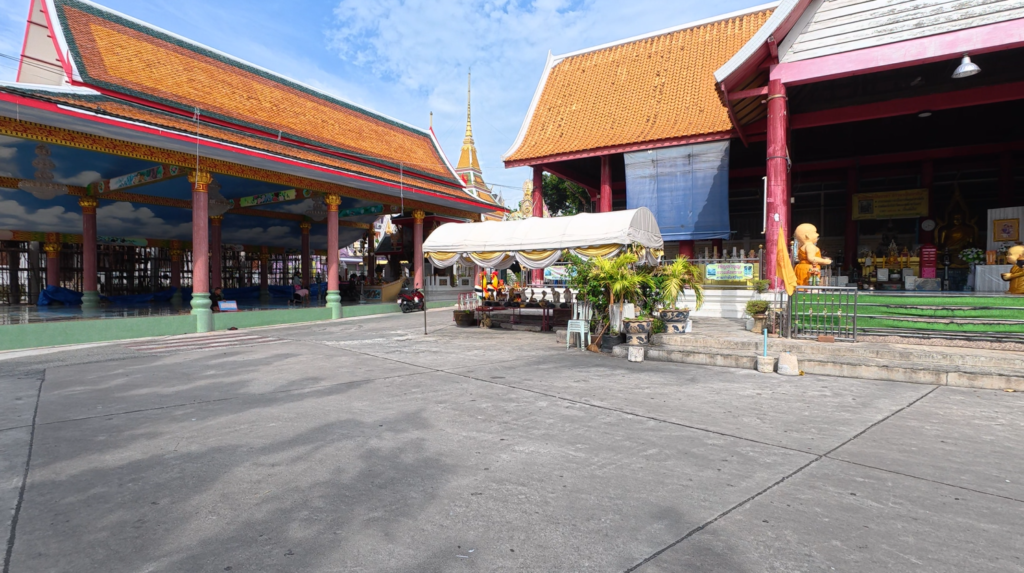
A Royal Temple with Ayutthaya Roots
According to the history preserved by the temple and the Chonburi Provincial Office of Buddhism, Wat Yai Intharam is believed to be nearly 600 years old. Its original name was Wat Intharam.
Temple tradition connects its foundation with King Intharacha, also known as Nakhon In, the sixth king of Ayutthaya. During a royal journey by water to Chonburi, the king is said to have admired the quiet coastal landscape and considered it suitable for monks seeking a contemplative life. The temple was consequently named Intharam, reflecting his former name.
Local people, however, gradually called it simply “Wat Yai,” meaning the great or large temple. The two names eventually became Wat Yai Intharam.
The monastery also has an association with King Taksin. Before recovering Siamese independence after the fall of Ayutthaya in 1767, Phraya Wachiraprakarn—the future King Taksin—is believed to have stopped here while gathering men and supplies in the eastern provinces. This makes the temple part of Chonburi’s memory of national recovery as well as a centre of Buddhist worship.
Wat Yai Intharam was later elevated to the status of a third-class royal monastery of the ordinary type, known in Thai as Phra Aram Luang Chan Tri, Chanid Saman. Royal-monastery status does not mean that members of the royal family visit every year, but it gives the temple an official ceremonial position within Thai Buddhism.
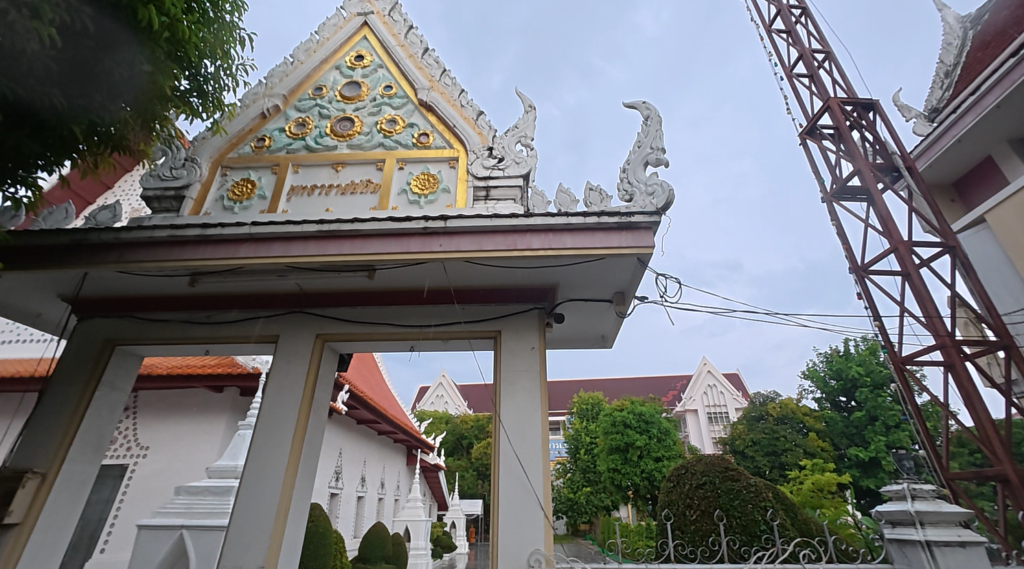
For the temple’s official historical account, see the Chonburi Provincial Office of Buddhism.
The Artistic Beauty of the Old Ubosot
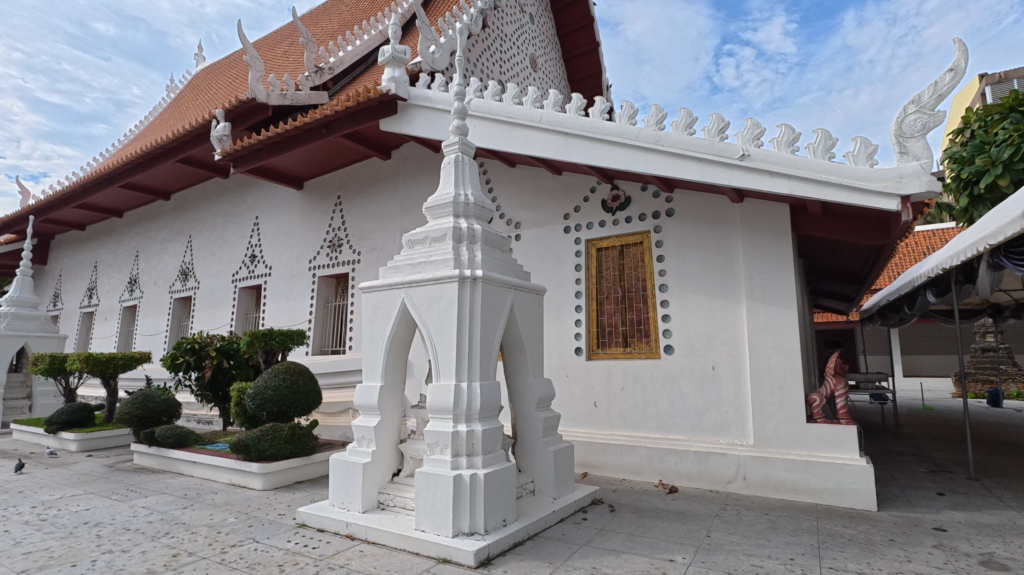
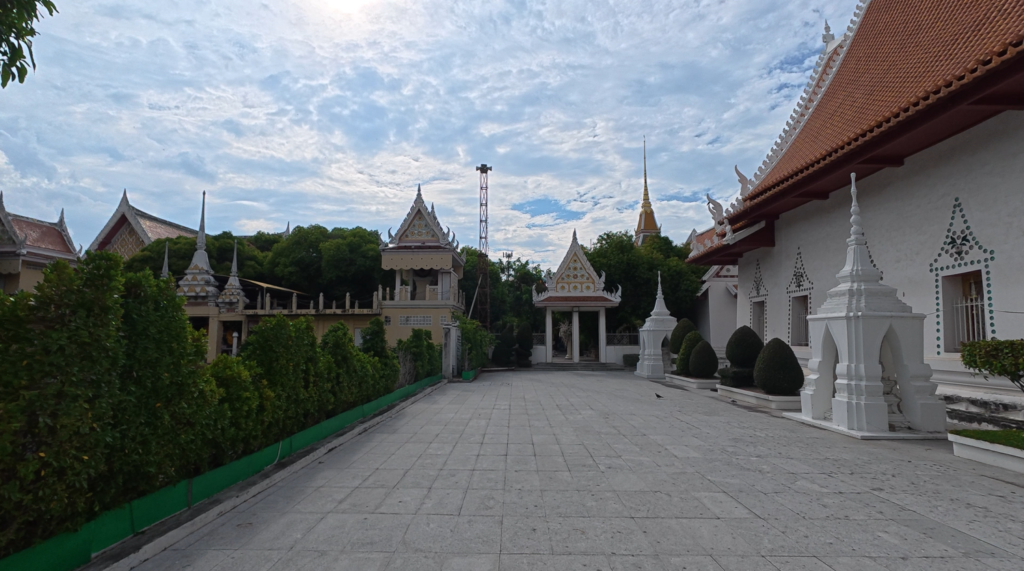
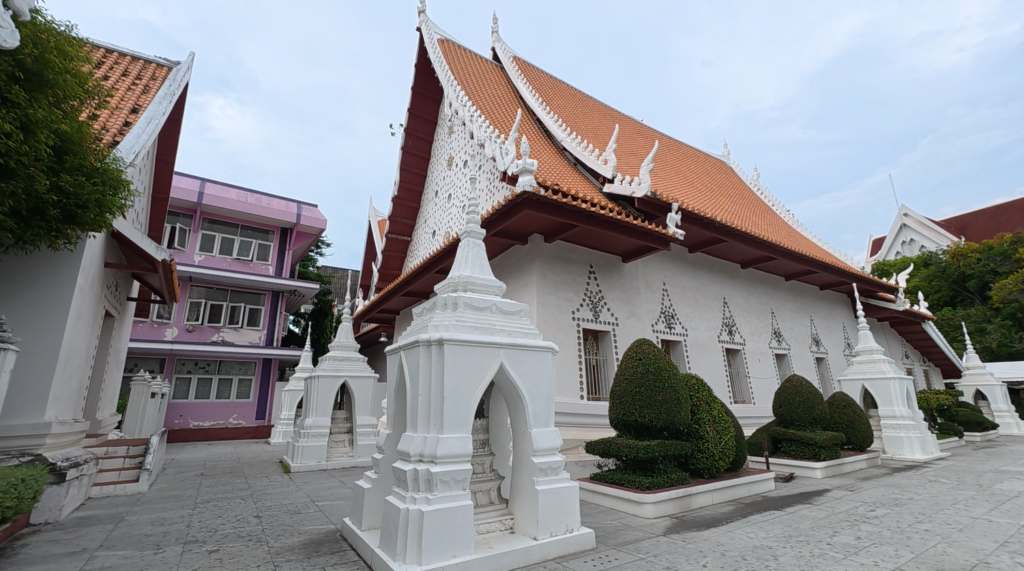
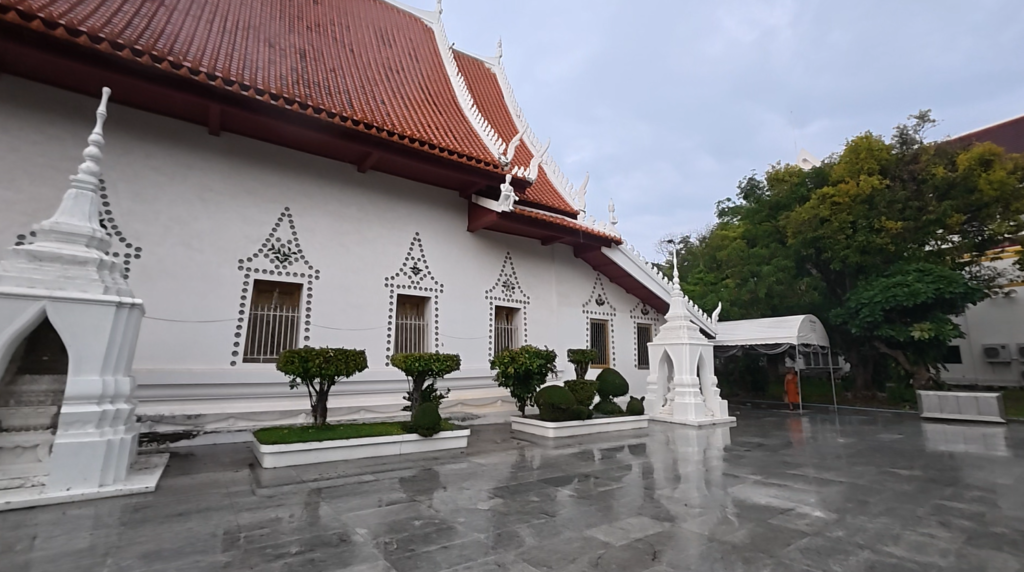
The old ubosot is the architectural heart of Wat Yai Intharam. Its base curves gently upward like the hull of a Chinese junk, a feature commonly associated with temples built or renovated from the late Ayutthaya period into the early Rattanakosin era.
The extended roof is supported by columns at the front, while the roof structure rises in two overlapping levels. Familiar Thai decorative elements such as chofa, bai raka and hang hong appear above, but the details also reveal several periods of restoration.
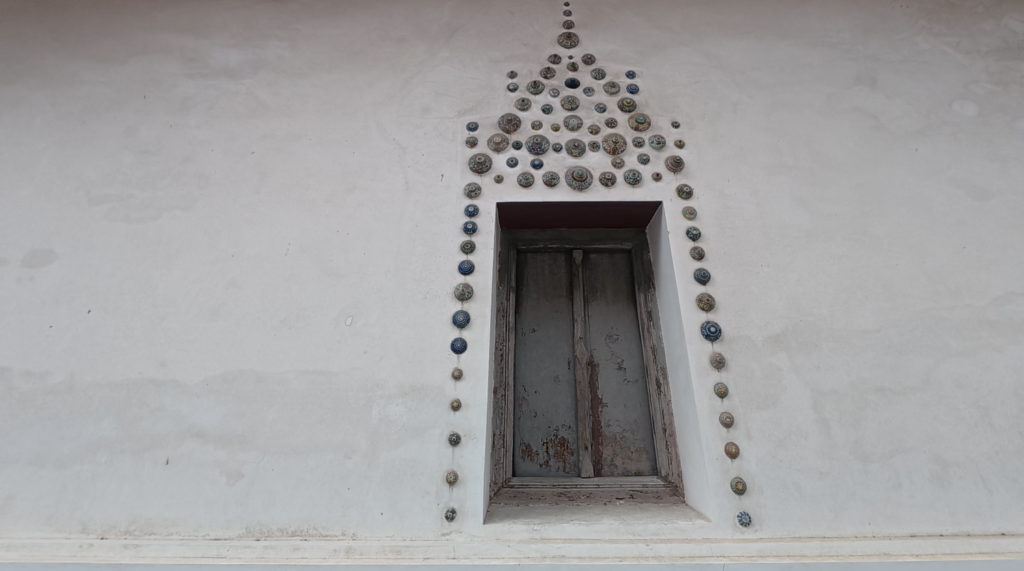
The pediments and the frames around doors and windows are decorated with floral stucco and pieces of Chinese glazed ceramics. This type of ornament became especially popular during the reign of King Rama III, when maritime trade with China strongly influenced Bangkok and central Thai temple art.
Once carried across the sea as pieces of pottery, these small ceramics became part of a temple wall—and remained here long after the traders and craftsmen had disappeared.
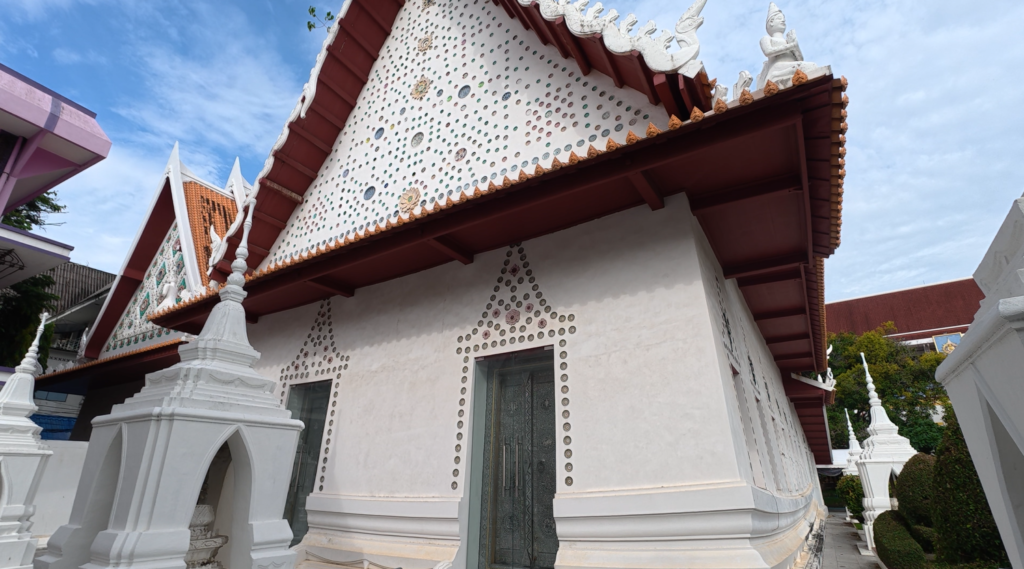
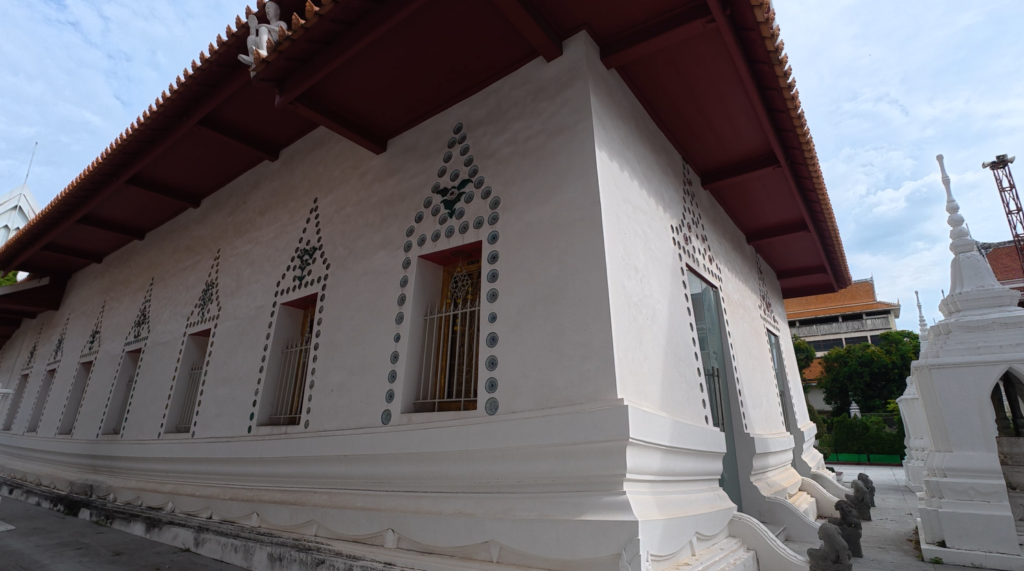
Small pieces of Chinese glazed ceramics form a floral and triangular frame around an old temple doorway.
The doorway is more than decoration. The ceramics, faded lacquer and worn wooden panels show how imported materials were gradually absorbed into Thai sacred architecture. Foreign objects were not simply copied; they were rearranged within a Buddhist visual language.
The Unusual Paired Bai Sema
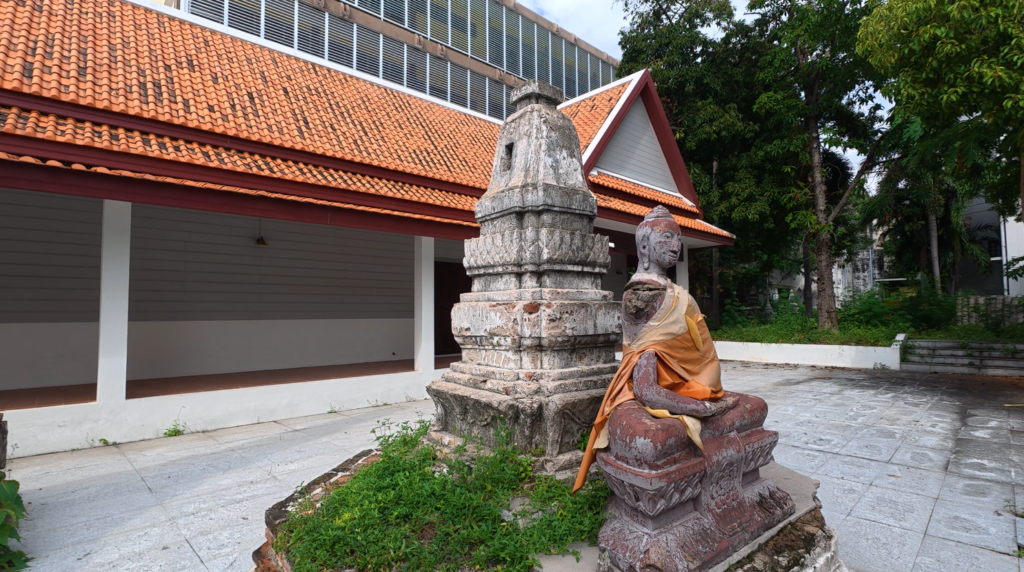
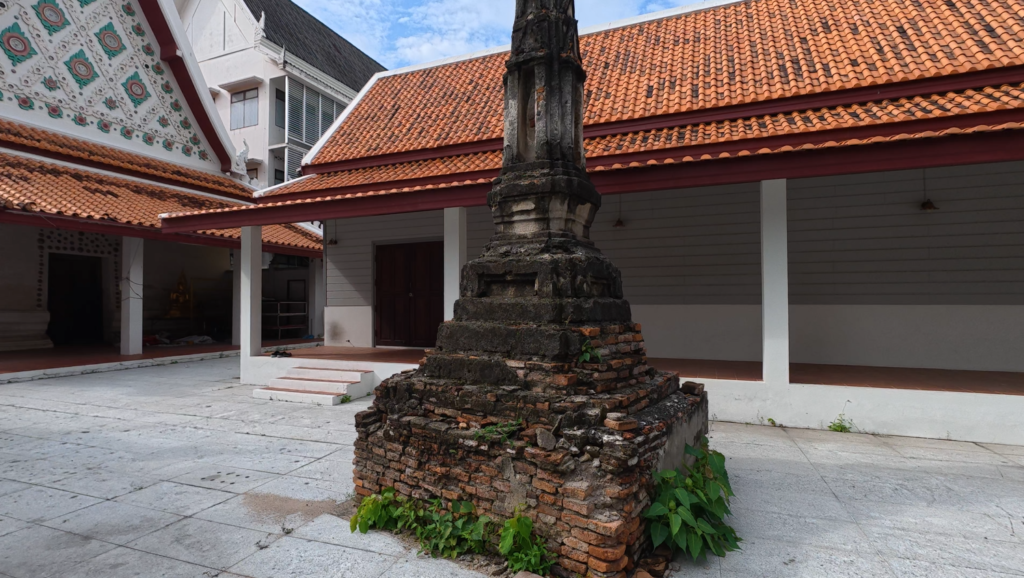
One of the most distinctive details at Wat Yai Intharam is the arrangement of its bai sema, the boundary stones marking the consecrated area of the ubosot.
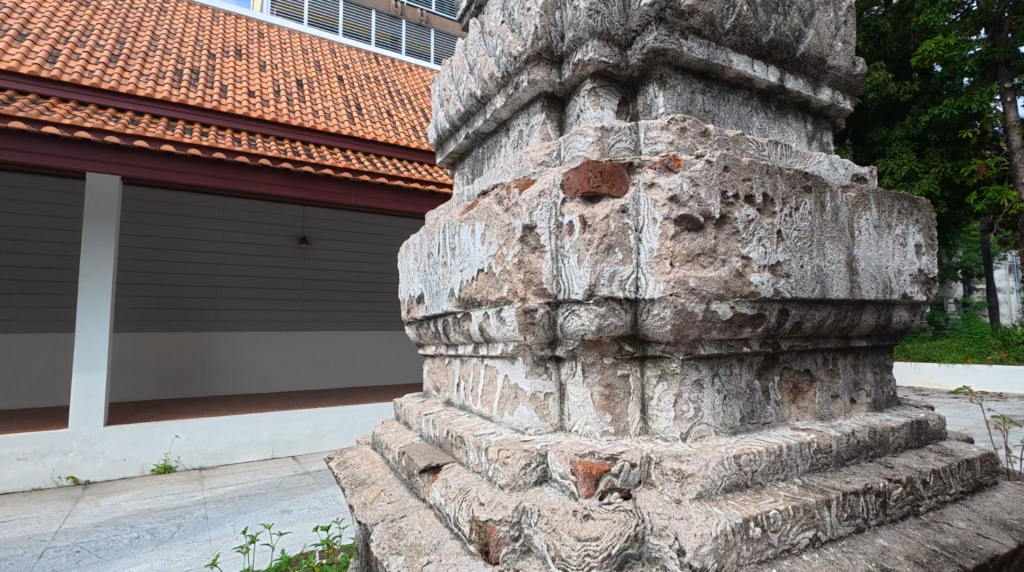
Here, two separate sema stones stand together as a pair. This form is called sema khu in Thai. Paired sema are traditionally associated with temples of elevated religious or royal importance, although their presence alone cannot determine the precise date or patron of a building.
The stones define the sacred boundary within which formal acts of the monastic community may be performed, including ordination. They therefore have a legal and ritual purpose within the Buddhist Sangha, not merely an ornamental one.
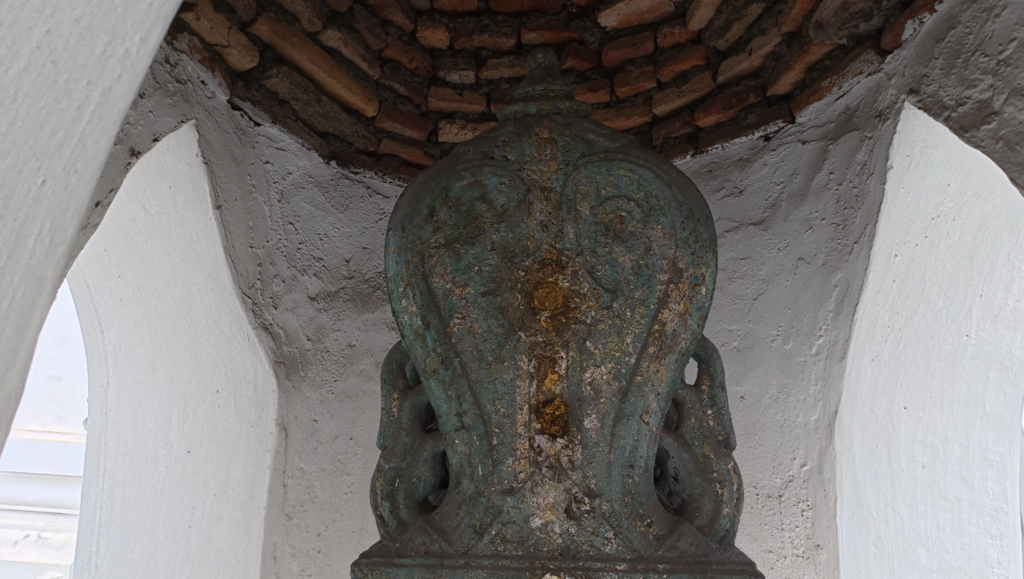
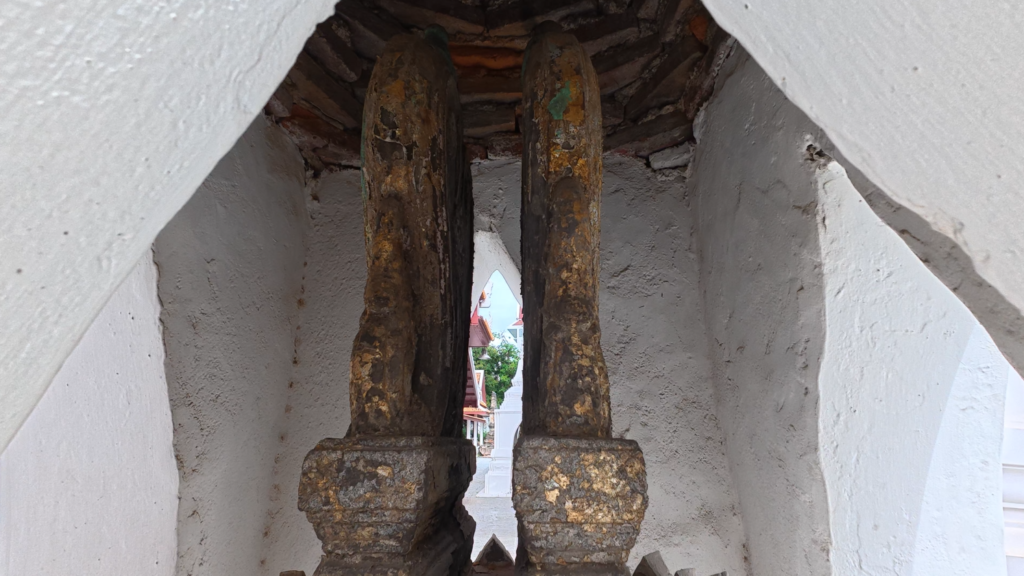
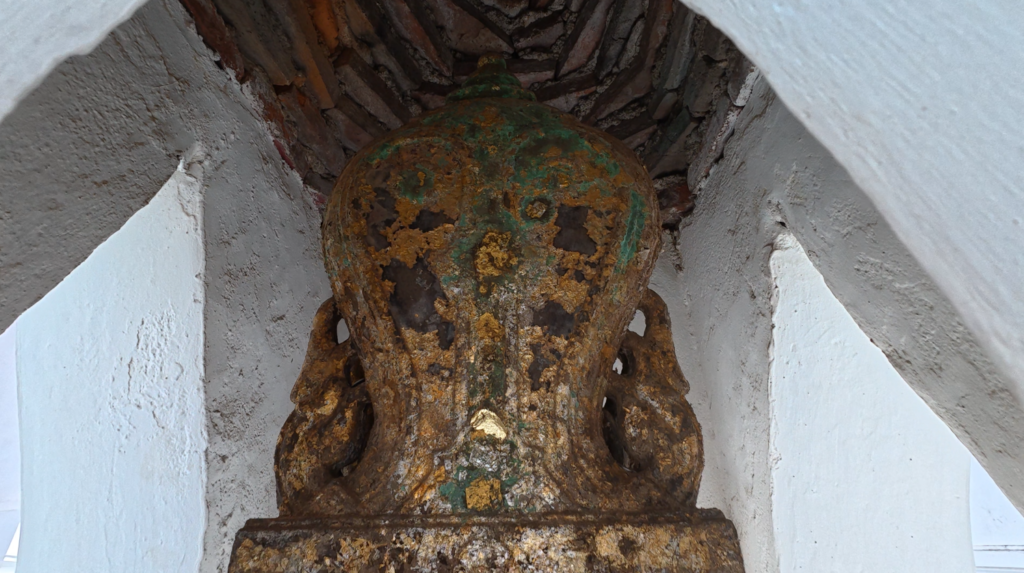
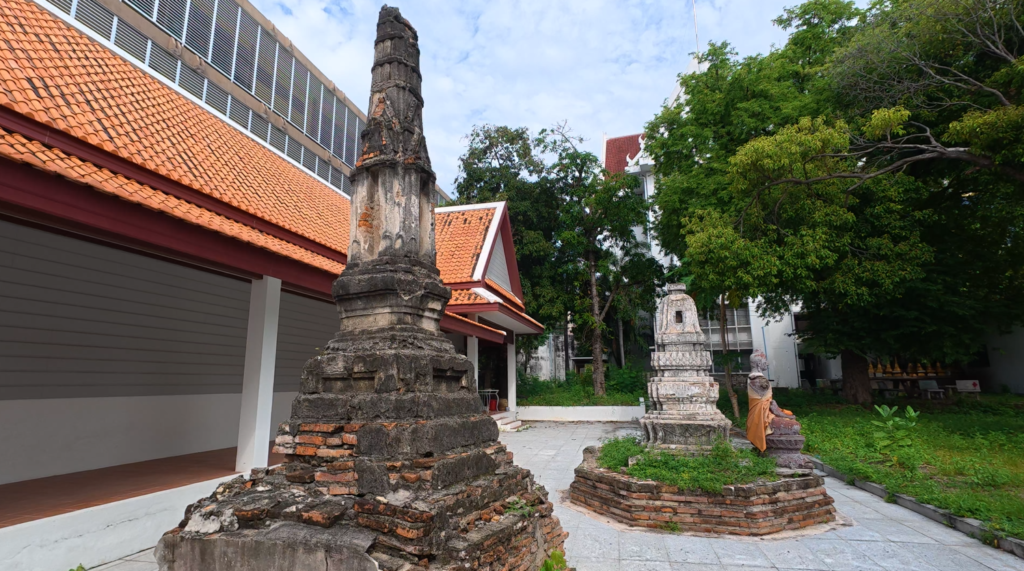
The paired bai sema of Wat Yai Intharam mark the consecrated boundary of the old ubosot. Their side view clearly reveals two independent stones standing closely together.
Centuries of weathering, gold leaf and repeated acts of devotion have softened their original details. Seen from the side, however, the unusual double construction becomes unmistakable.
A Standing Buddha of Protection
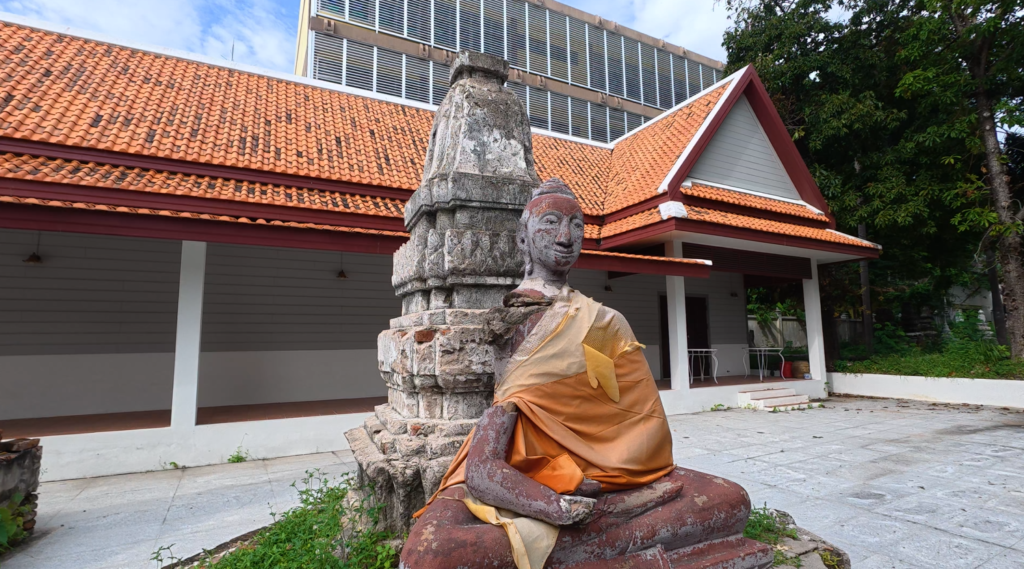
Near the old building stands a dark-coloured Buddha image with its right hand raised. The gesture appears to represent the abhaya mudra, a gesture of reassurance, protection and the removal of fear.
The Buddha does not hold a weapon or command through force. The raised hand communicates calmness: “Do not be afraid.”
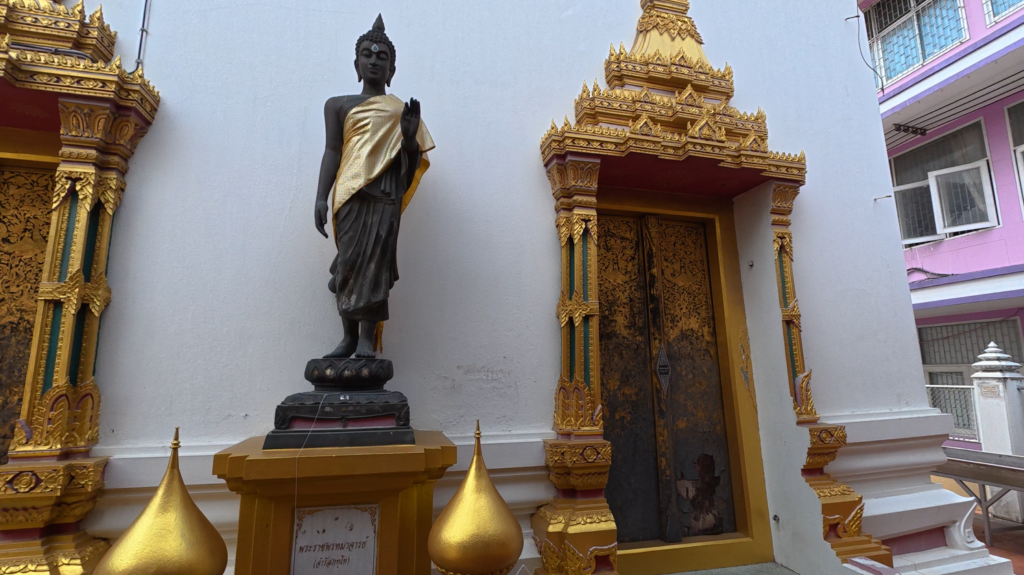
The contrast between the dark surface of the image and the golden robe gave the figure a quiet dignity against the white wall of the temple.
The Locked Viharn beside the Ubosot
Beside the old ubosot stands a smaller viharn built in a related architectural style. Its curved base resembles that of the main ordination hall, suggesting that the buildings belong to the same historical sacred zone.
Unfortunately, the viharn was locked during my visit. Official temple information describes old paintings inside, although many have faded until they are now difficult to distinguish. Its wooden doors are also associated with traditional gilded decorative work.
Standing outside a locked historic building always leaves a little regret. Yet the closed door also reminds visitors that an old temple is not a museum in which every space is permanently available. Buildings may remain closed for protection, ritual reasons or the practical needs of the monastery.
The Buddha Footprint and the Reclining Buddha
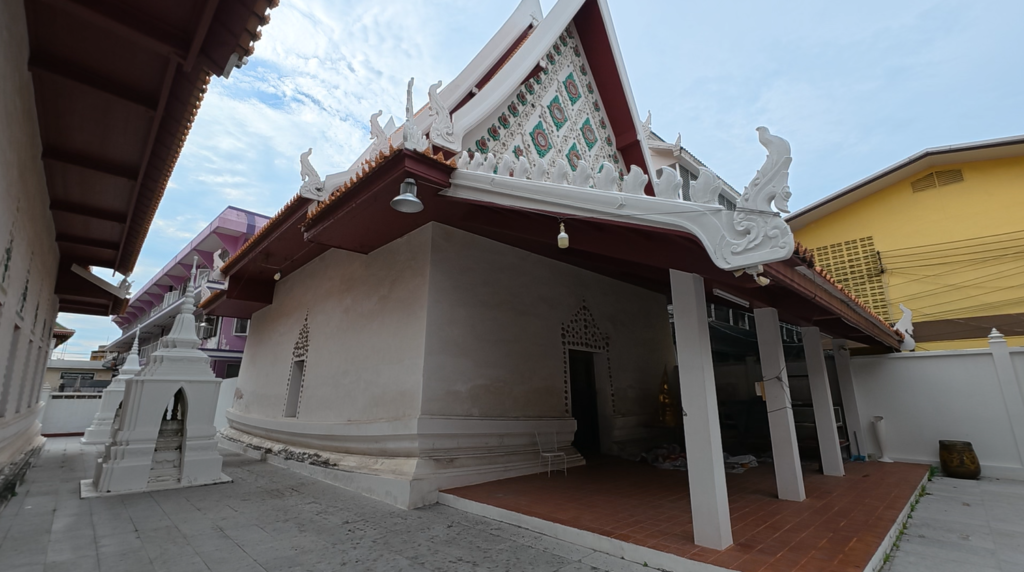
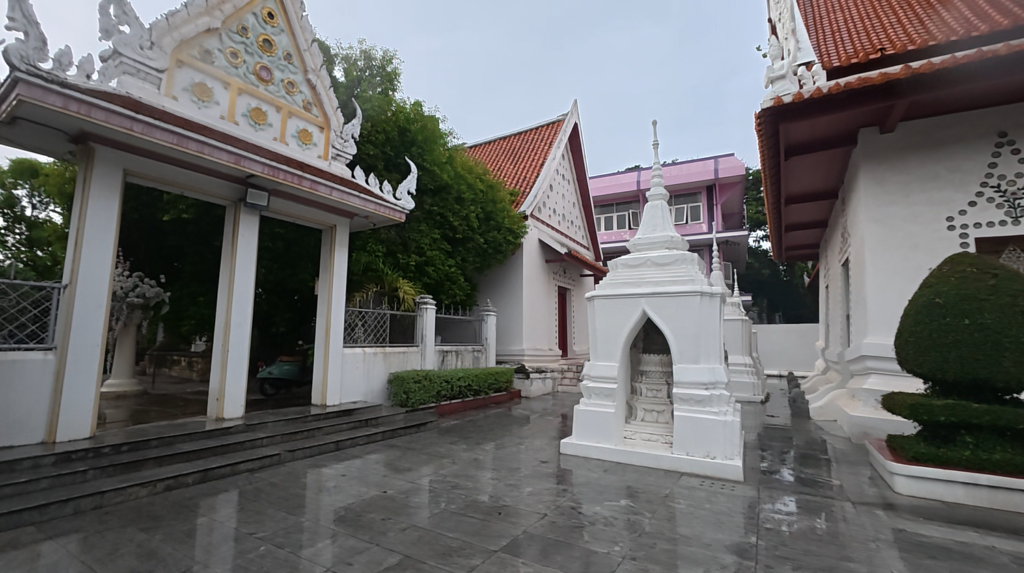
The Buddha-footprint pavilion stands beside the old ubosot and directly in front of the reclining Buddha. From the narrow passage, the buildings appear almost connected, creating a small but complex sacred landscape.
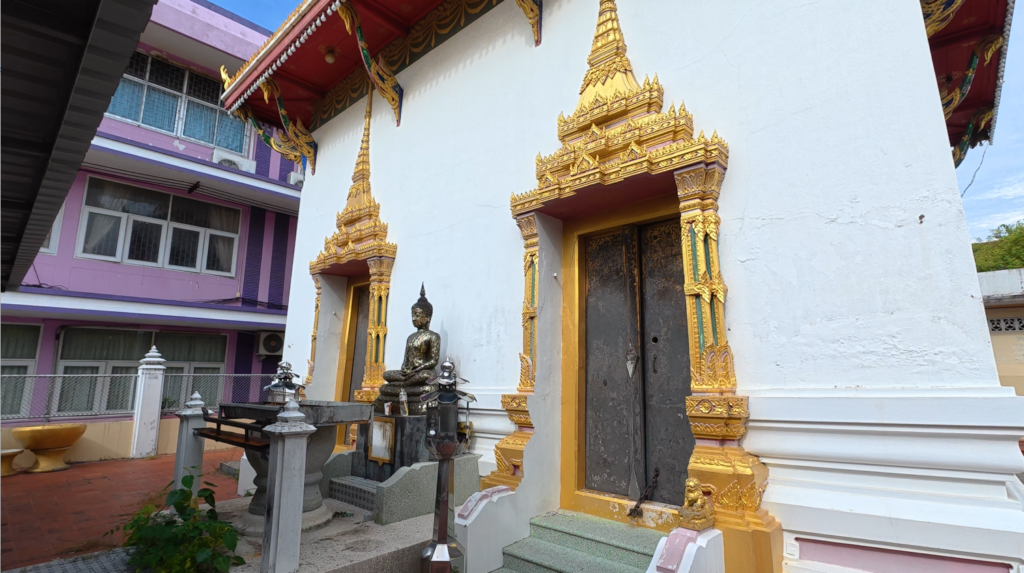
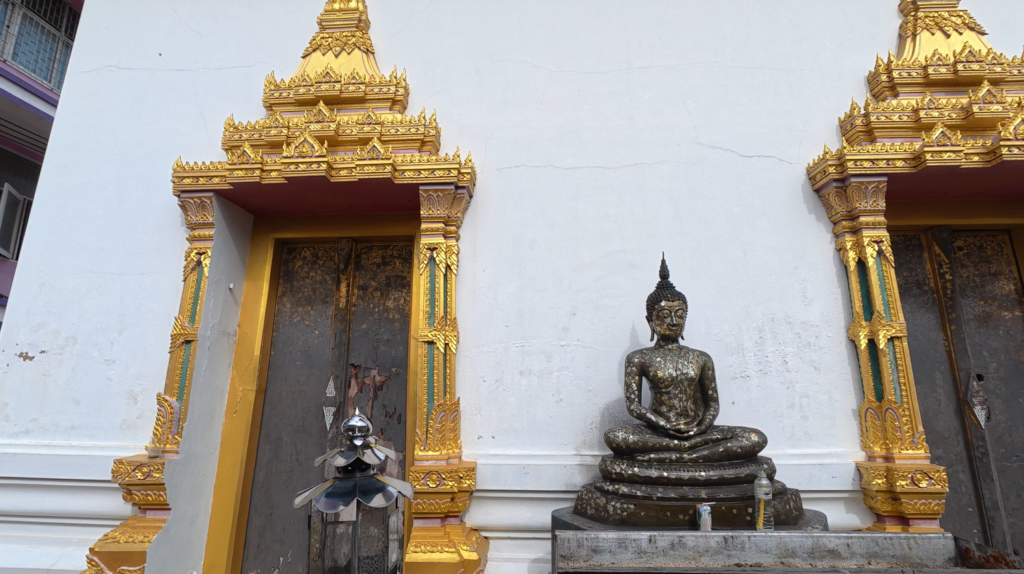
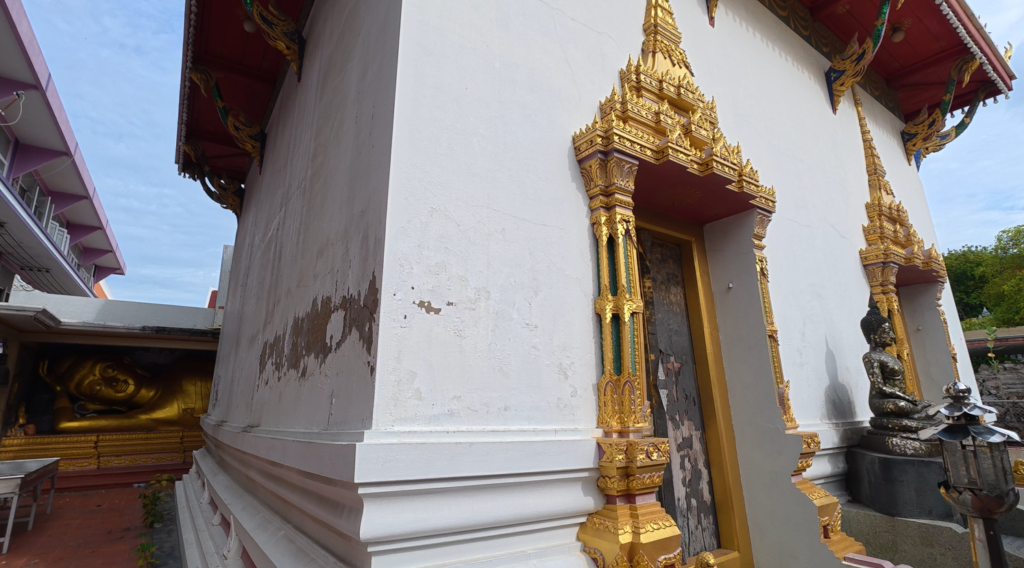
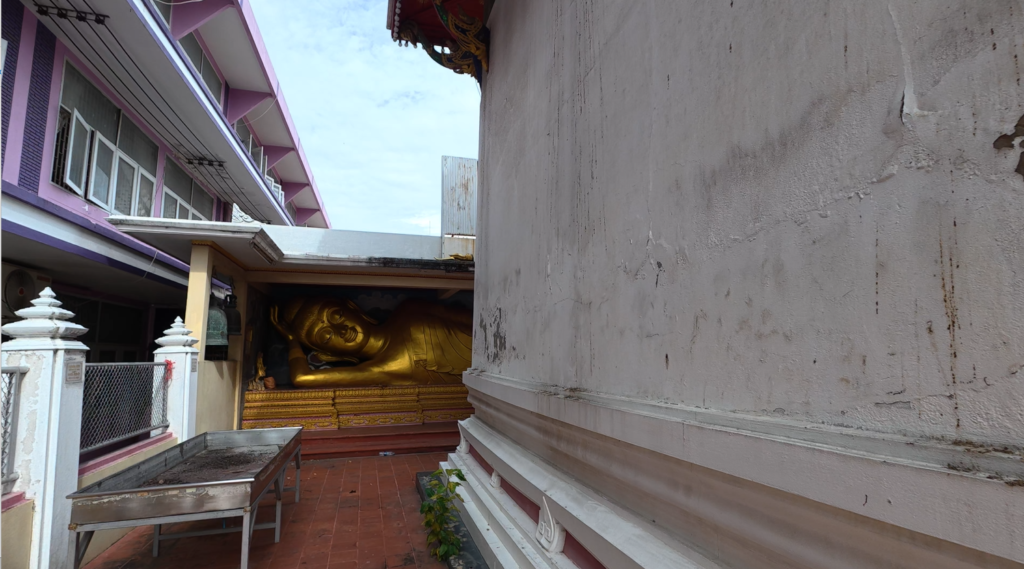
The locked Buddha-footprint pavilion stands beside the old ubosot, with the reclining Buddha visible through the narrow passage behind it.
Inside the pavilion is a representation of the Buddha’s left footprint measuring approximately 62 by 149 centimetres. The building was restored in 1949. Its later murals portray King Taksin’s struggle to restore Siamese independence, his connection with Wat Yai Intharam, Chonburi life and the province’s famous buffalo-racing tradition.
The pavilion was also locked during my visit. According to the provincial Buddhist office, it is normally opened to the public during the temple’s annual Chinese New Year celebration, usually around February.
The footprint does not claim to contain the Buddha’s physical body. Instead, it represents the continuing presence of his teaching—the trace left behind after the teacher has passed from the world.
This was another part of the temple I could not see that day. Perhaps it is also a reason to return.
Luang Pho Choei and Local Faith
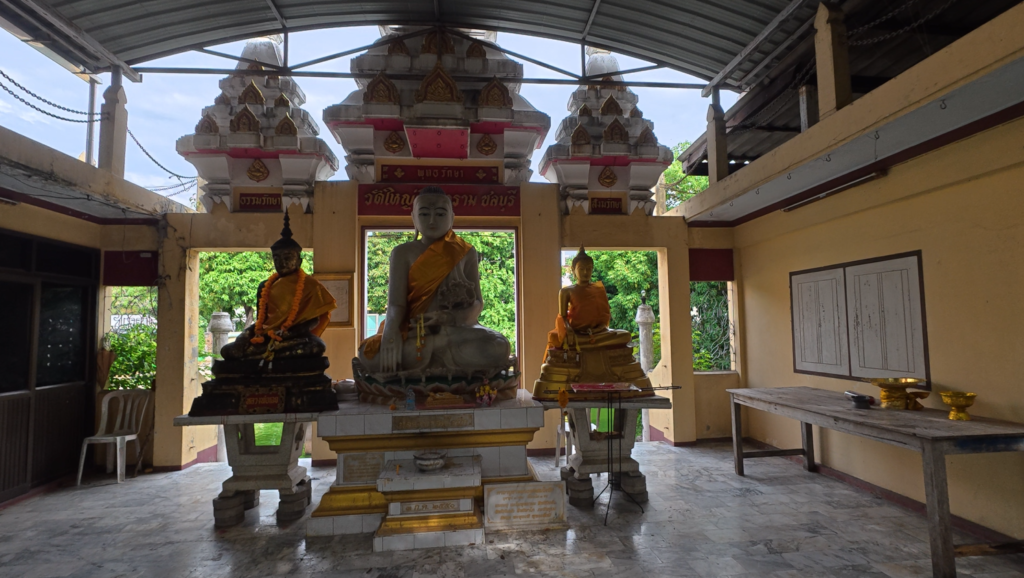
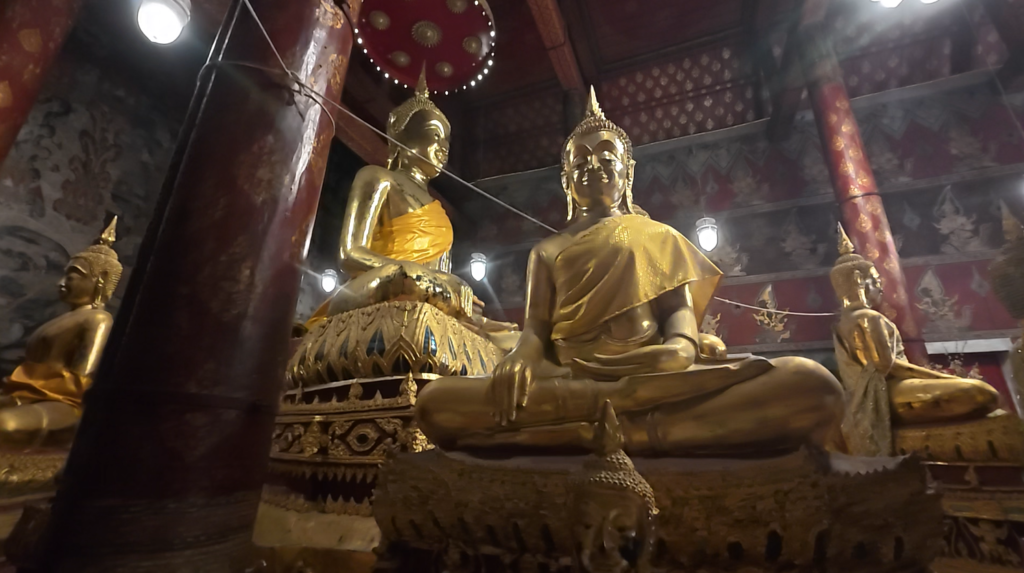
One of Wat Yai Intharam’s most revered images is Luang Pho Choei, a crowned bronze Buddha image in the Ayutthaya artistic tradition.
The image originally belonged to the abandoned Wat Samorakot. After its viharn deteriorated, the Buddha remained exposed to sun and rain for many years. Local people began calling it Luang Pho Choei—the venerable father who simply sat there without complaining.
It was eventually transferred to Wat Yai Intharam. Local belief holds that sickly children may receive protection by being symbolically entrusted to Luang Pho Choei. Families traditionally offered robes and sometimes tied a small piece of cloth from the robe around a child’s wrist.
Such practices belong to local devotional tradition rather than formal Buddhist doctrine, but they reveal how a temple becomes woven into the private fears and hopes of a community.
Pho Mo Suk Thewada—A Healer in the Temple
Another small shrine is dedicated to Pho Mo Suk Thewada, a local healer remembered for treating illness with traditional medicine. His image is covered with layers of gold leaf and surrounded by small figurines, garlands, incense and offerings.
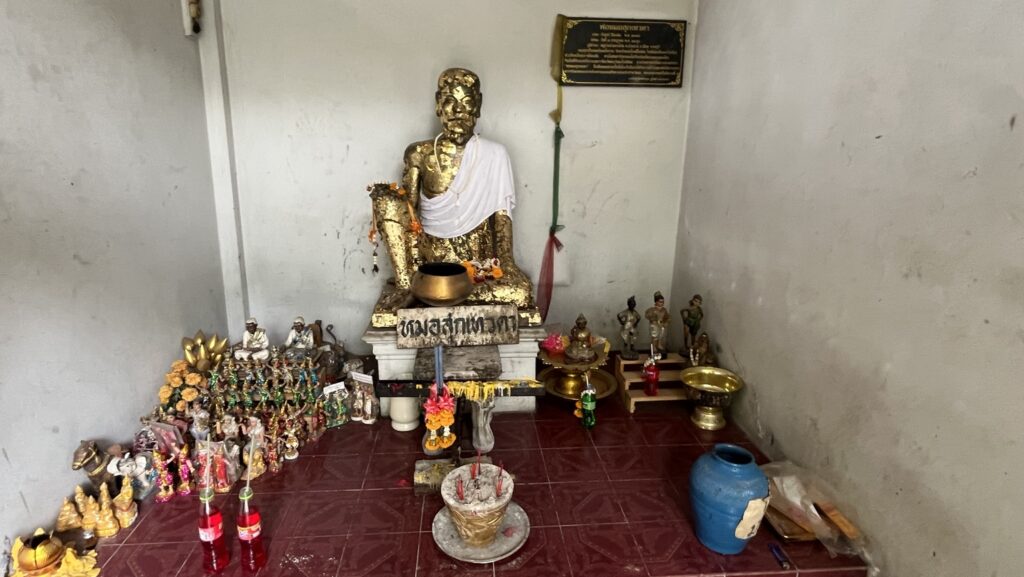
The shrine of Pho Mo Suk Thewada reflects the continuing local belief in healing, protection and gratitude toward a remembered traditional doctor.
This shrine illustrates the broad character of Thai temple life. Theravada Buddhist practice may occupy the centre, but local spirits, healers and guardian figures often remain around it. Visitors do not necessarily regard these traditions as competing religions. They approach different sacred figures according to different needs—merit, protection, health or gratitude.
Murals as a Painted Buddhist World
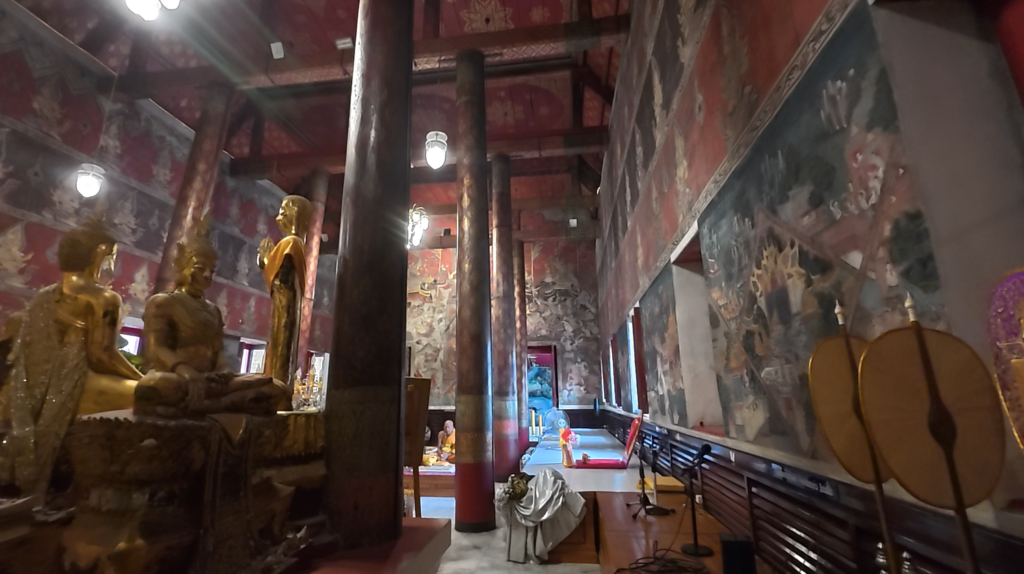
Inside the old ubosot, the atmosphere changes completely. The dark red walls, tall painted columns and subdued light create a visual world separate from the bright courtyard outside.
The murals were painted in the traditional tempera or dry-pigment technique. Between the windows are scenes from the Ten Great Birth Stories of the Buddha, known as the Dasajati Jataka. Above them, celestial beings gather in three ordered levels.
The wall facing the principal Buddha depicts the defeat of Mara. Its army includes foreign soldiers—European, Chinese and Cham figures carrying different weapons. These details reveal how Thai artists interpreted the Buddhist universe through the diverse people they knew from trade, warfare and travel.
Behind the principal Buddha is a representation of the Traiphum, the three-world Buddhist cosmos. It includes the Himavanta Forest, heavens, hell realms and episodes from the life of the Buddha. The legendary nariphon tree, whose fruit takes the form of young women, appears in the lower part of the composition.
The ceiling is painted red with star patterns, while the beams resemble ancient patterned textiles. Six pairs of columns carry delicate gilded designs. The result is not simply decoration; the entire hall becomes a painted map of karma, rebirth and enlightenment.
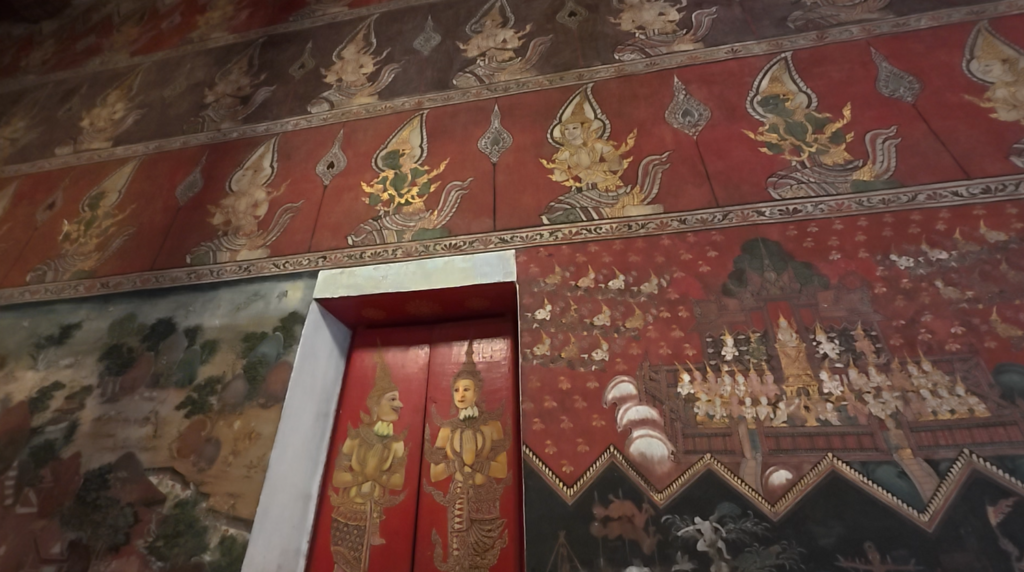
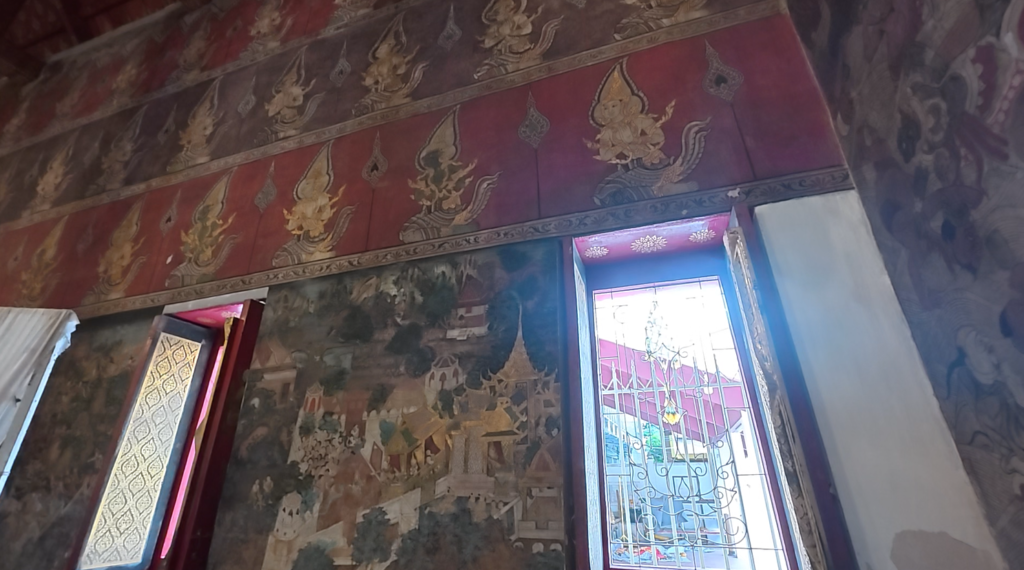
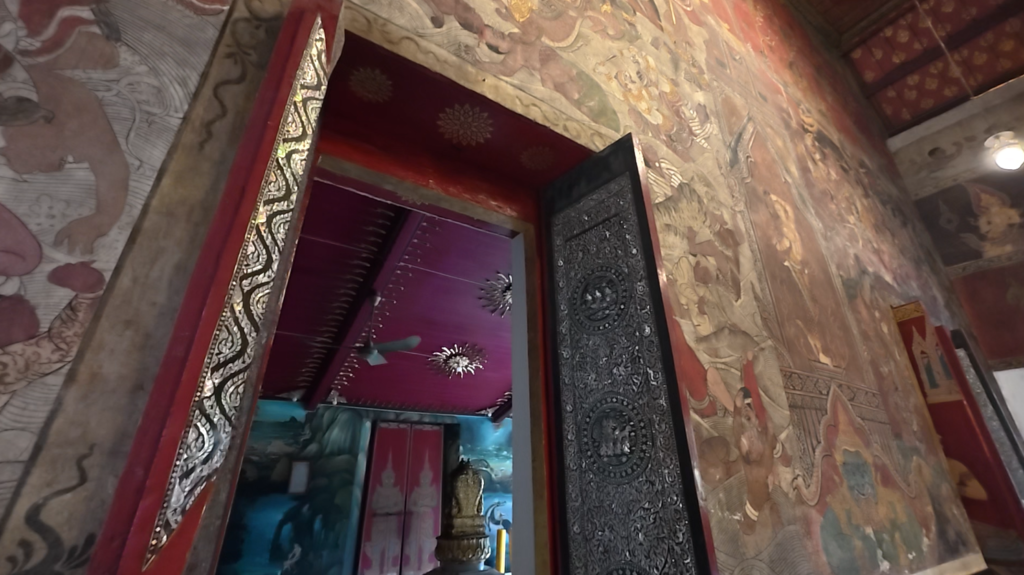
Celestial beings gather above the narrative murals, forming a sacred world around the worshippers below.
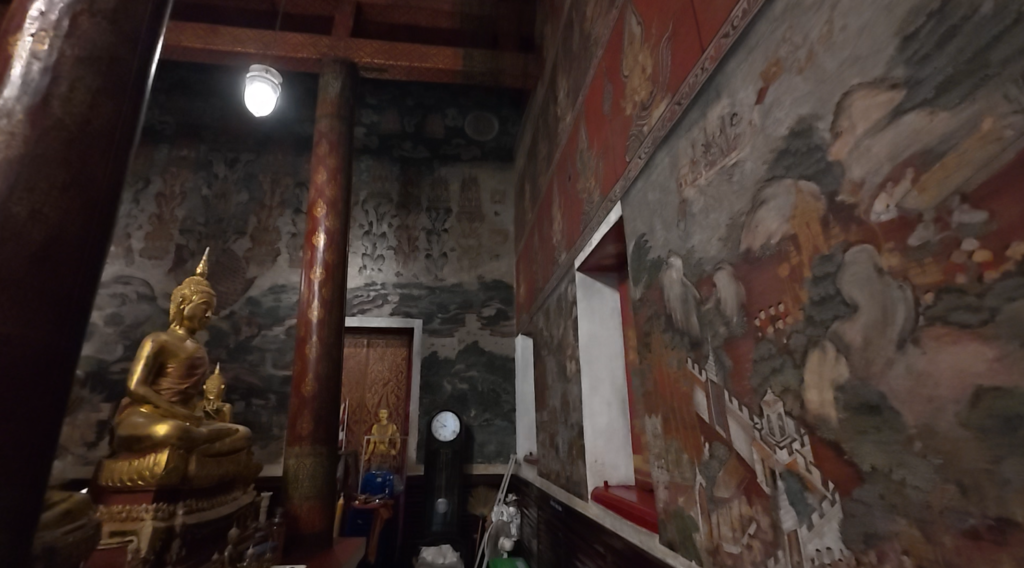
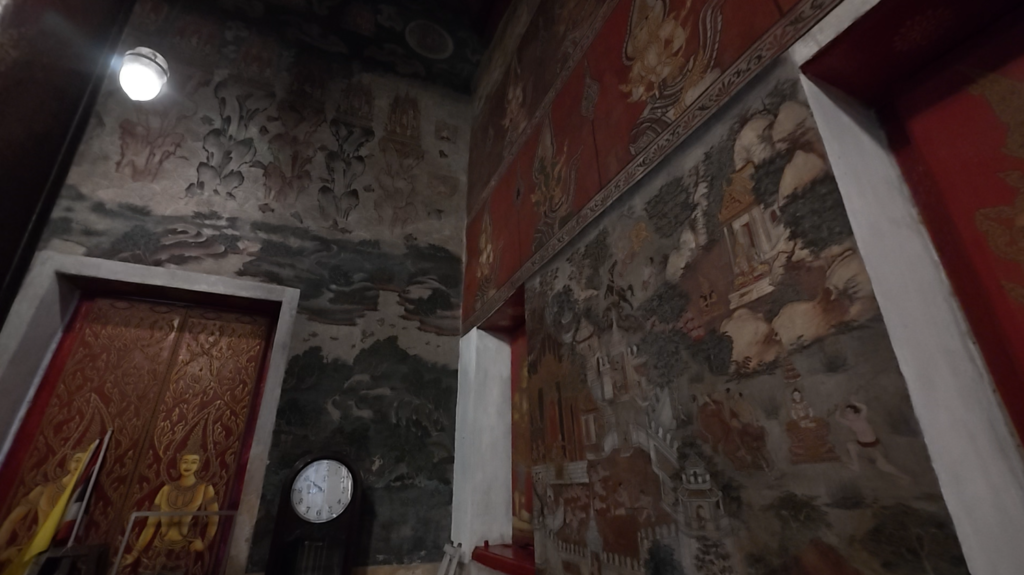
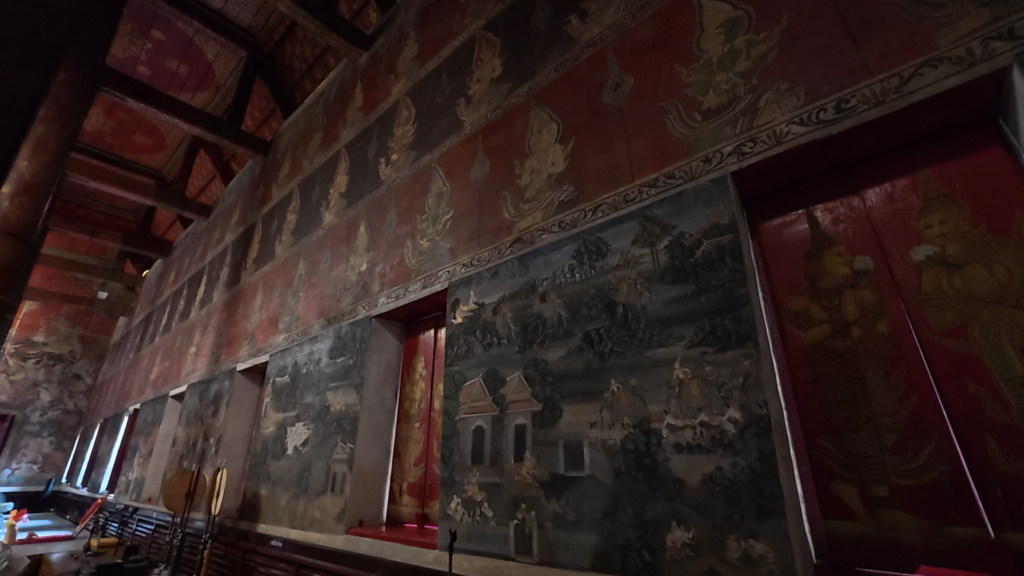
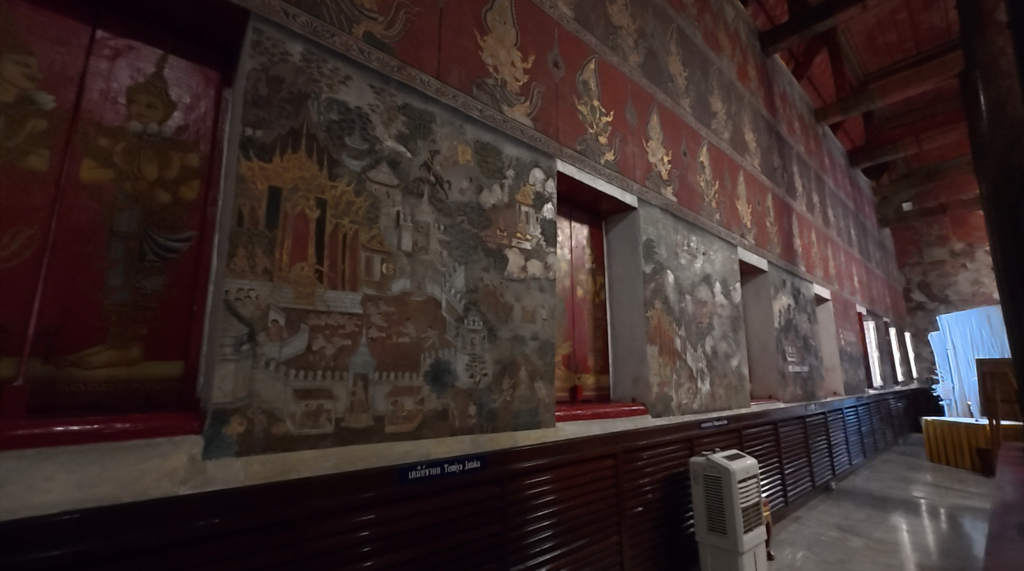
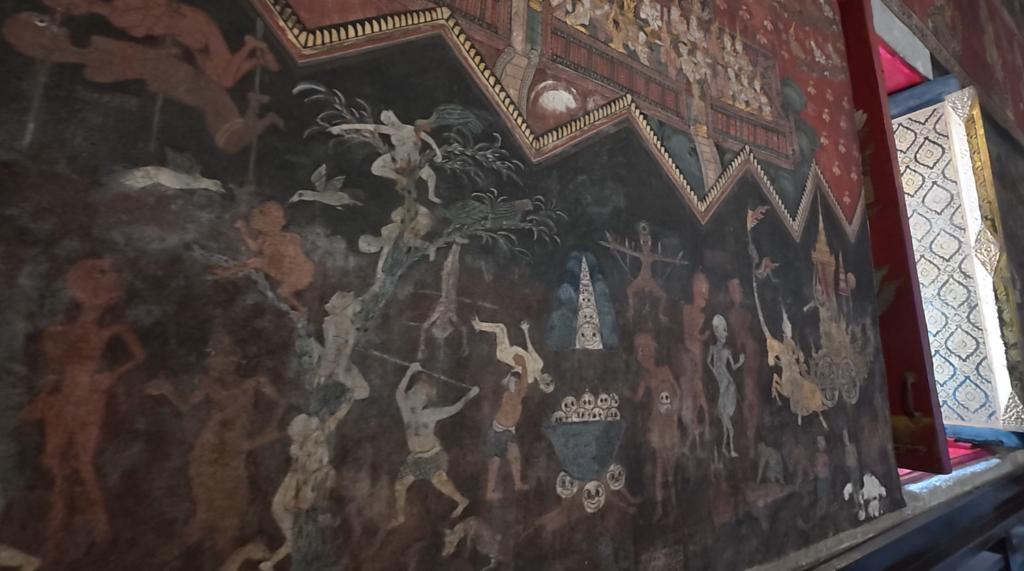
The old murals combine Buddhist cosmology, Jataka stories and glimpses of the diverse people known to earlier Thai artists.
A Door Shining in the Darkness
Among the hall’s most impressive artistic features is the tall black door decorated with intricate mother-of-pearl inlay. Floral vines fill the surface, while circular panels contain small narrative and symbolic scenes.
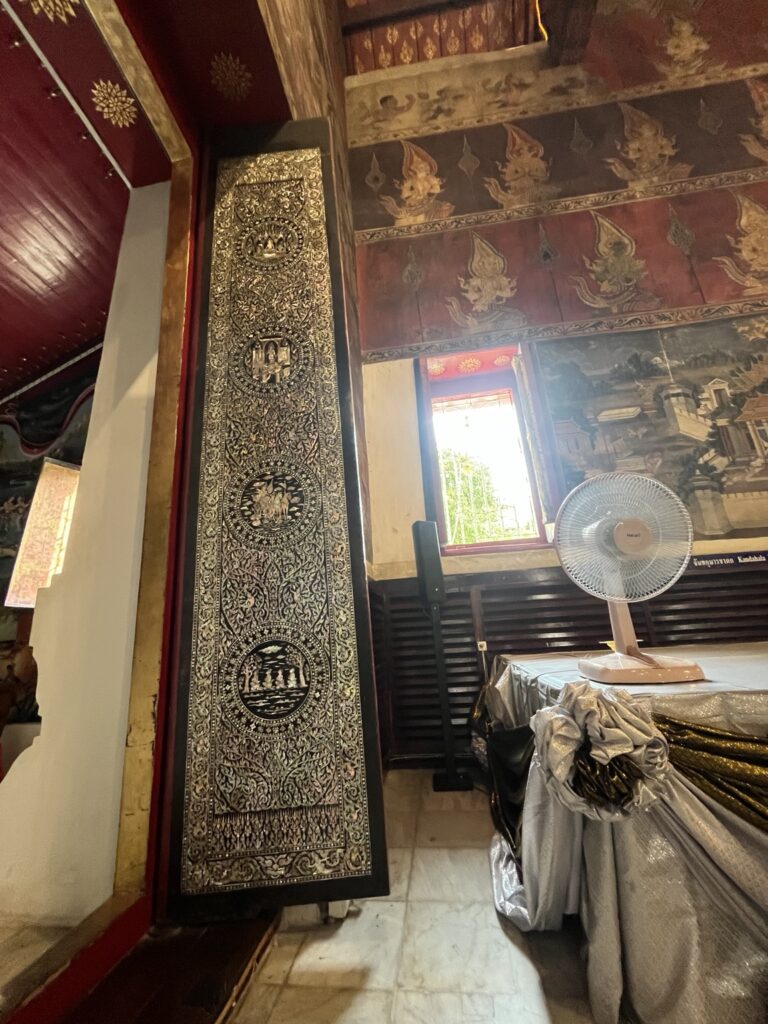
Delicate mother-of-pearl inlay transforms a dark wooden door into one of the ubosot’s most remarkable decorative features.
Mother-of-pearl changes according to the light. From one direction it appears pale and quiet; from another it flashes silver, green and blue. Within the dark interior, the door seems almost to hold its own light.
It is a refined contrast to the heavier architecture of the building: fragile shells arranged into patterns that have endured for generations.
The Seat of the Dharma
In front of the altar stood an elevated wooden monastic seat. It may resemble a throne, but its purpose is religious rather than royal. A senior monk sits here when preaching or presiding over a ceremony.
At the top of the backrest is the Dharmachakra, the Wheel of Dharma. The wheel represents the Buddha setting his teaching in motion with his first sermon at Sarnath. Its spokes are commonly understood as a reference to the Noble Eightfold Path.
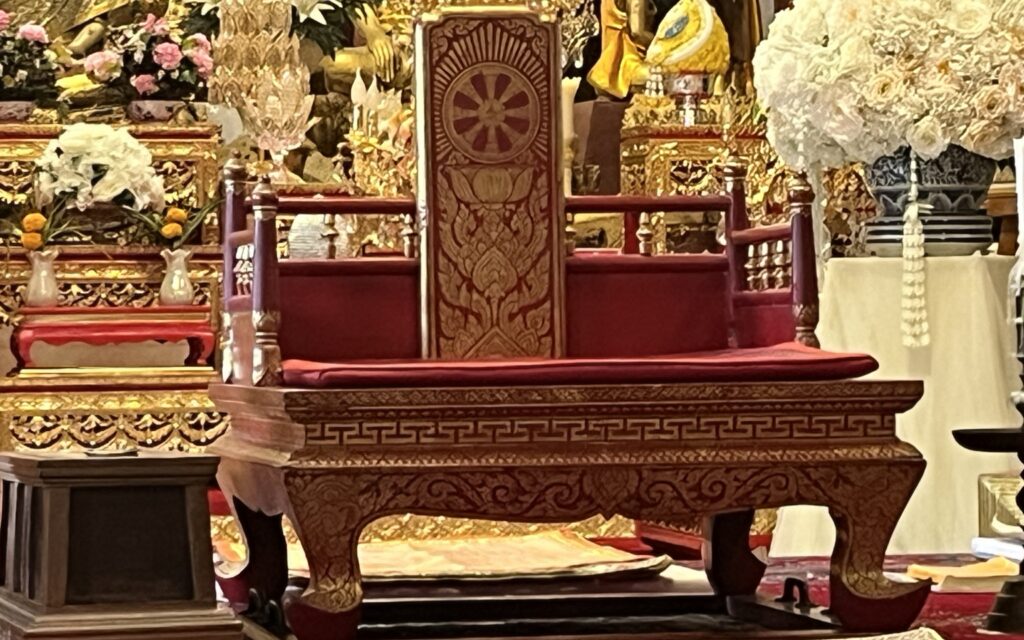
The elevated monastic seat bears the Wheel of Dharma, symbolising the continuing movement of the Buddha’s teaching.
The empty seat is therefore not a memorial to worldly authority. It waits for the spoken Dharma.
Annual Rituals of a Living Royal Monastery
Wat Yai Intharam continues to serve as a ceremonial centre. One of its most formal events is the presentation of royally bestowed Kathin robes after the end of the rains retreat. The robes may be presented by an authorised organisation or individual on behalf of the king; the ceremony does not necessarily involve a personal royal visit.
The temple also maintains its annual Mahachat preaching tradition, during which monks recite and explain the Vessantara Jataka. This final and most celebrated of the Ten Great Birth Stories teaches extraordinary generosity and the accumulation of merit before the Buddha’s last human birth.
During the Chinese New Year temple festival, the normally closed Buddha-footprint pavilion is opened for worship. These events show that the temple’s historic buildings are not preserved as empty architecture. They continue to support the same essential activities for which temples were built—ordination, teaching, chanting, merit-making and community gathering.
When the Chanting Began
The most memorable moment of my visit was not a carved ornament or an ancient wall. It was the moment the monks began to chant.
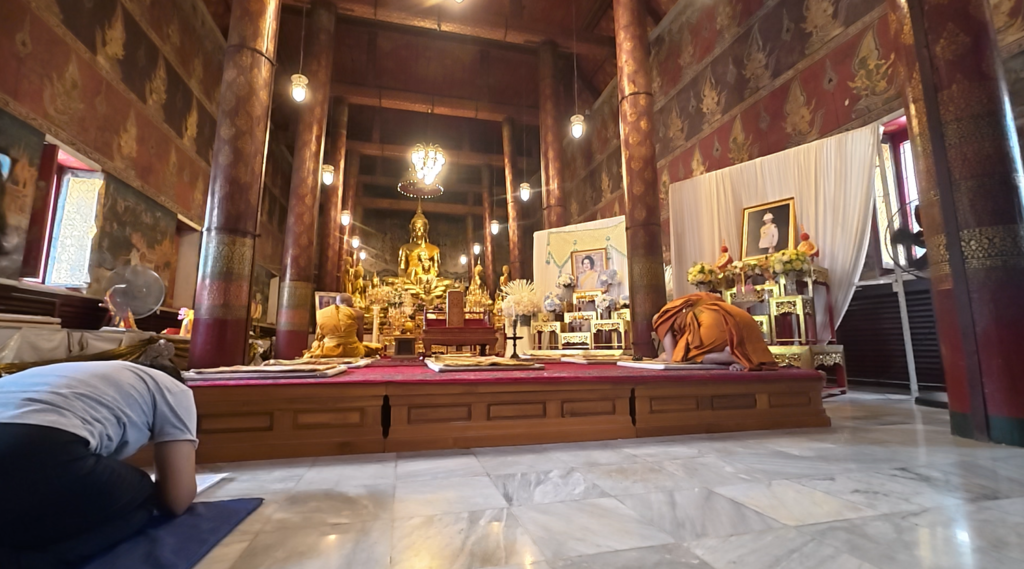
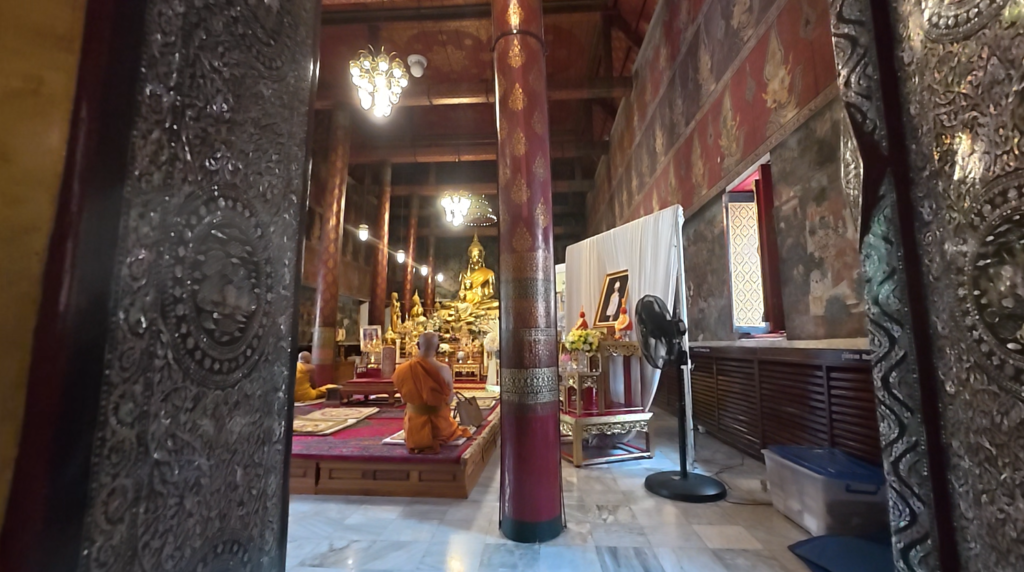
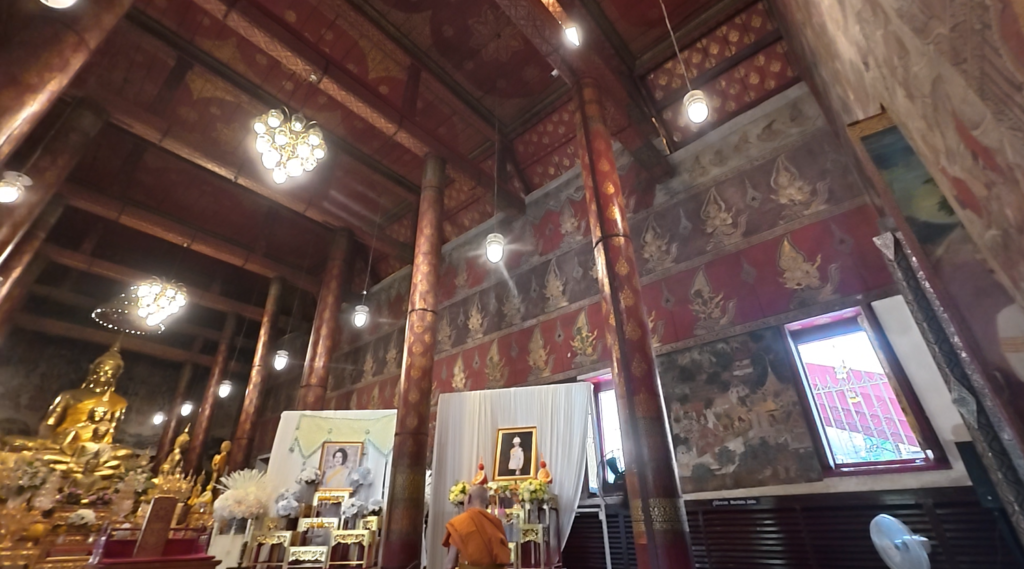
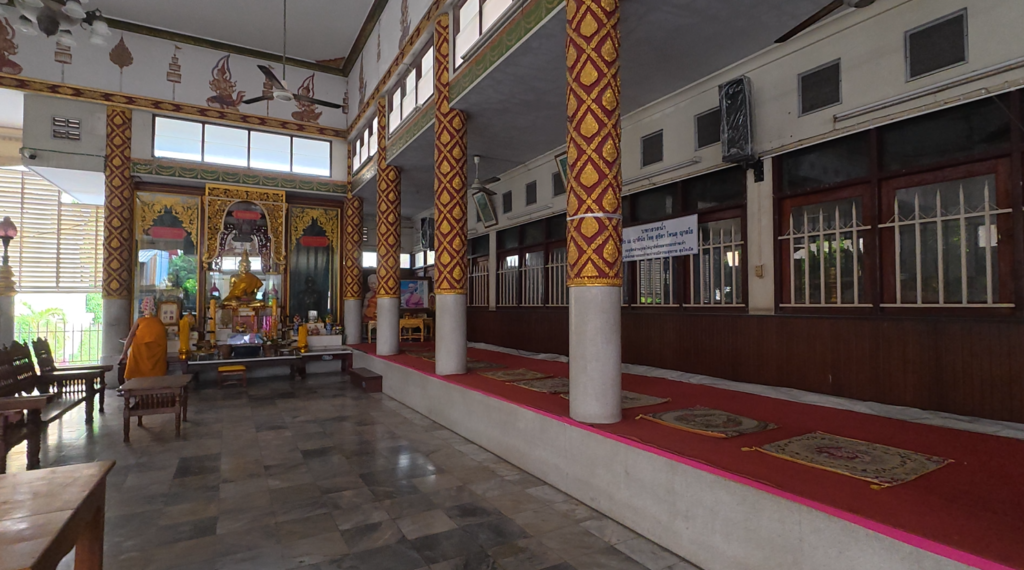
Monks and lay visitors gather inside the historic ubosot as evening chanting fills the painted hall.
The monks sat facing the principal Buddha while local worshippers settled onto cushions behind them. Royal portraits and ceremonial flower arrangements stood to one side, while the old murals watched silently from the walls.
The chanting rose between the tall columns and wooden beams. It was steady and unhurried, filling a hall built centuries earlier for this very purpose. For a moment, the distinction between architectural history and living religion disappeared.
The murals were no longer simply old paintings. The columns were not merely decorated timber. Everything became part of the ceremony.
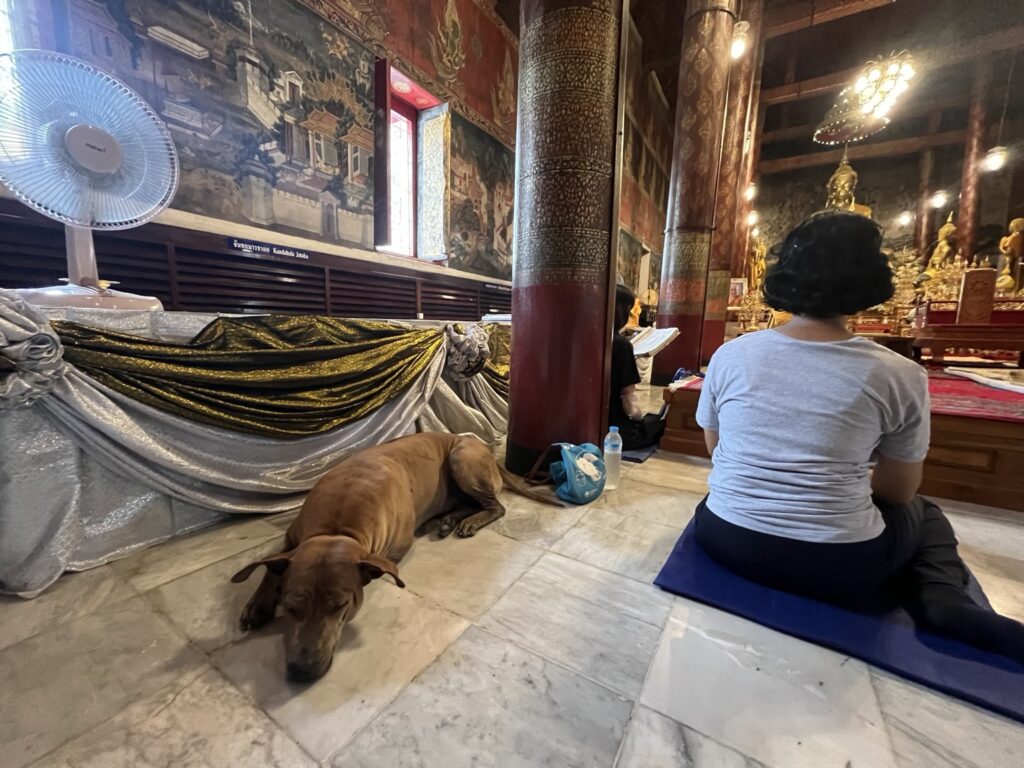
A temple dog rests quietly beside the worshippers, apparently undisturbed by the rhythm of the chanting.
Even the temple dog stretched out beside the worshippers as though the familiar sound of chanting had become part of its daily life.
YouTube Video
The video below follows my journey through the old royal monastery—from its architecture and sacred objects to the chanting that brought the historic ubosot back to life.
Exploring Wat Yai Intharam, its ancient art, paired bai sema and a quiet ceremony on a rainy day in Chonburi.
Rain over the Temple
By the time the ceremony was ending, rain had begun to fall across the temple grounds. The white walls darkened slightly, water gathered along the roofs, and the noisy city beyond the gate seemed to move farther away.
A monk appeared through the rain, returning to the monastery. While I was preparing to leave, he was coming home.
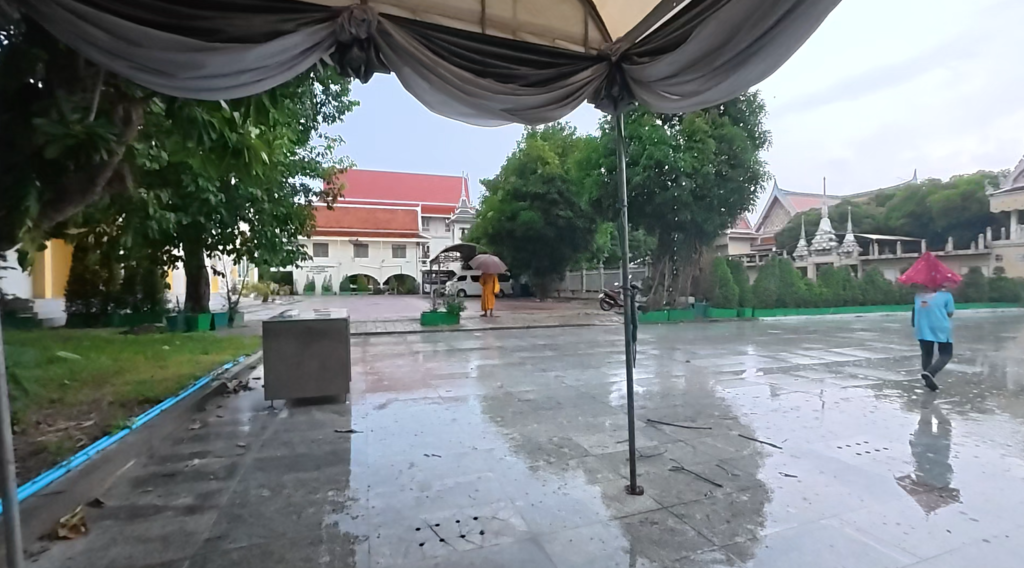
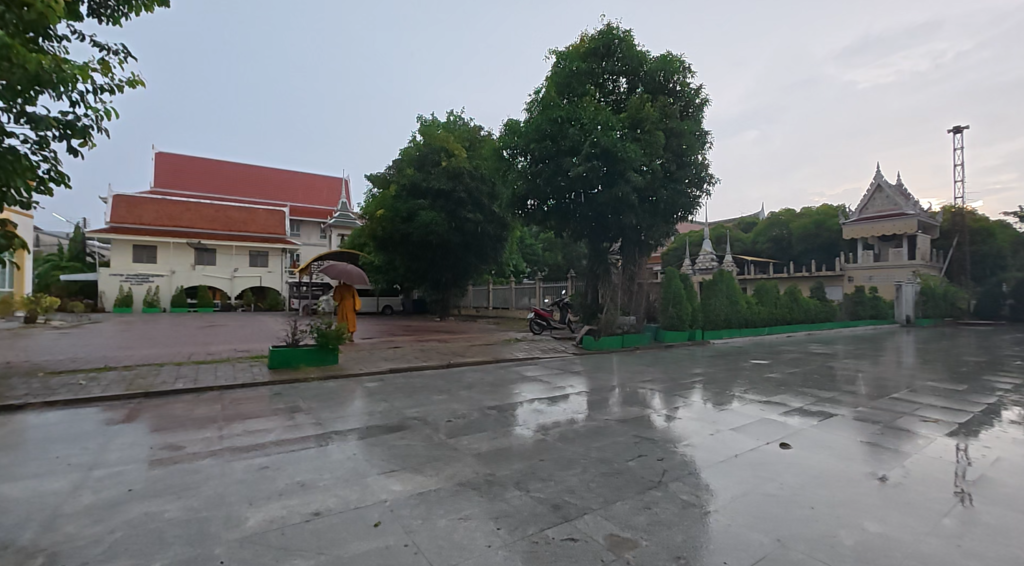
A monk appeared through the rain, returning to the monastery. While I was preparing to leave, he was coming home.
It was a simple crossing of two journeys. The monk walked back toward the temple, while I returned to my small motorcycle and the road. Behind me, the chanting continued beneath the old roof.
The rain did not feel like an interruption. It gave the visit its final rhythm—chanting inside, rain outside, one traveller arriving and another leaving.
I rode away slowly from Wat Yai Intharam, carrying no relic and making no claim to understand every image on its walls. What remained was something quieter: the memory of art still serving faith, old buildings still holding ceremony, and a royal monastery continuing its life in the centre of modern Chonburi.
The monk walked back toward the temple, while I returned to my small motorcycle and the road. Behind me, the chanting continued beneath the old roof.
Won Cub Life continues.
Location and Visitor Information
Location: Wat Yai Intharam Royal Monastery, 858 Chet Chamnong Road, Bang Pla Soi, Mueang Chonburi, Chonburi, Thailand
Admission: Free. Donations for temple maintenance are welcome.
Best time to visit: Early morning or late afternoon. Visit around Chinese New Year if you hope to see the normally closed Buddha-footprint pavilion, but confirm the opening schedule with the temple beforehand.
Dress: Wear clothing that covers the shoulders and knees. Remove hats when entering sacred halls.
Photography: Photography is generally possible, but avoid flash near old murals. Do not photograph monks or worshippers at close range without permission, especially during chanting.
Visit time: Allow approximately 60–90 minutes. More time may be needed if a ceremony is in progress.
Footwear: Shoes must be removed before entering the ubosot, viharn or other sacred interiors.
Google Maps: Wat Yai Intharam
Official Information: Chonburi Provincial Office of Buddhism – Wat Yai Intharam
Continue Exploring
Discover more historic temples, local beliefs and motorcycle journeys through Thailand in the Won Cub Life Temples Directory.