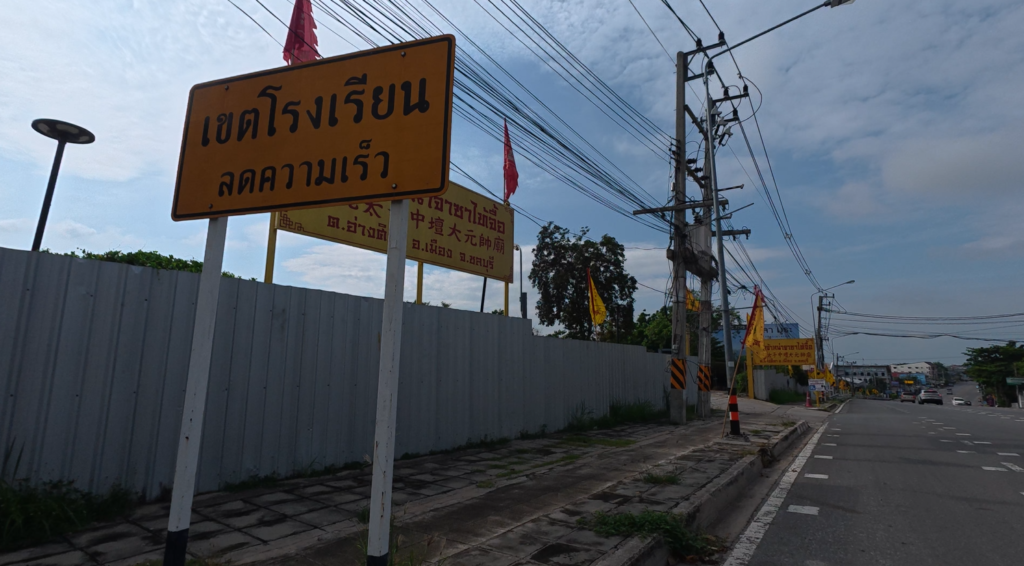
The narrow road through Ang Sila did not initially suggest that one of Thailand’s most elaborate Chinese shrines was waiting ahead. I rode past quiet houses, small workshops and roadside buildings until the layered roofs of Na Jasa Tai Chue Shrine began to appear above the neighborhood.
Beyond the red Chinese gateway stood something much larger than a local roadside shrine. Towers, dragons, painted columns and golden roofs rose one behind another, almost like a palace built for an entire celestial court.
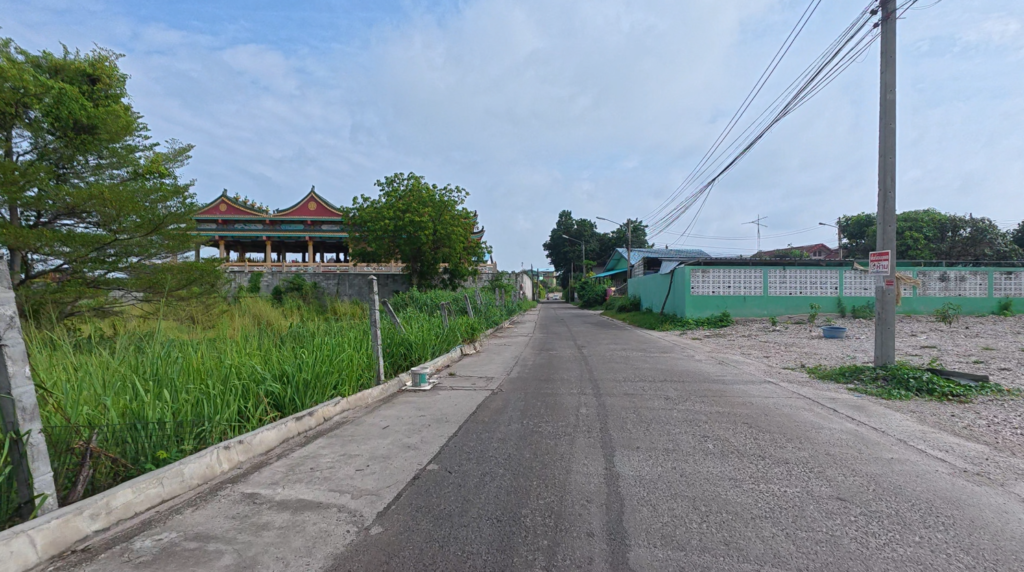
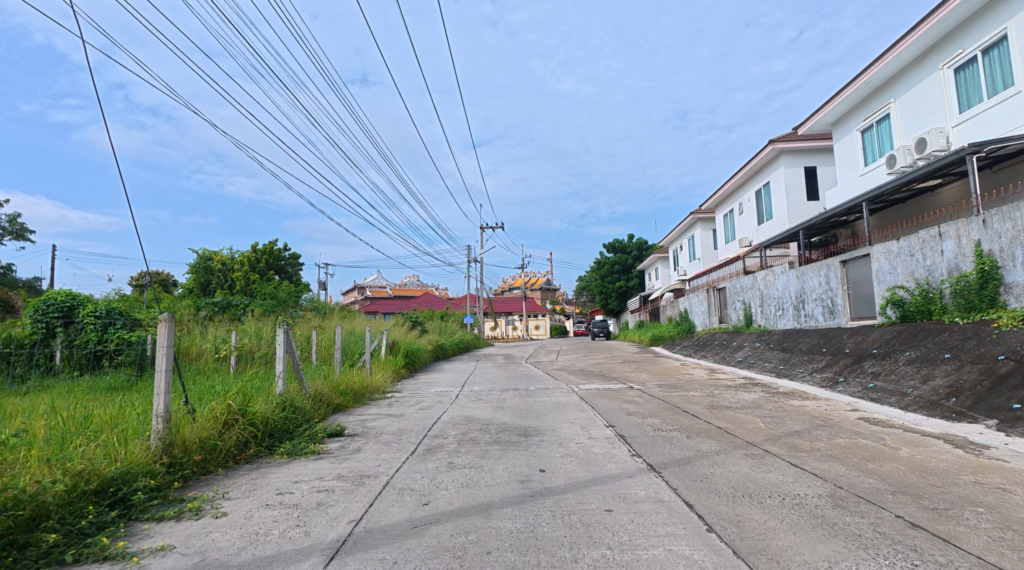
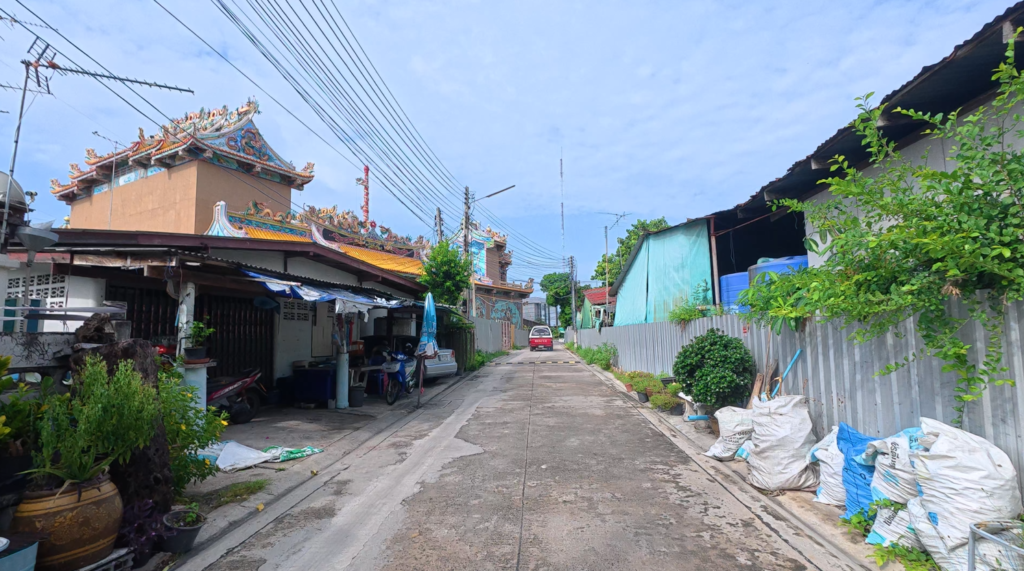
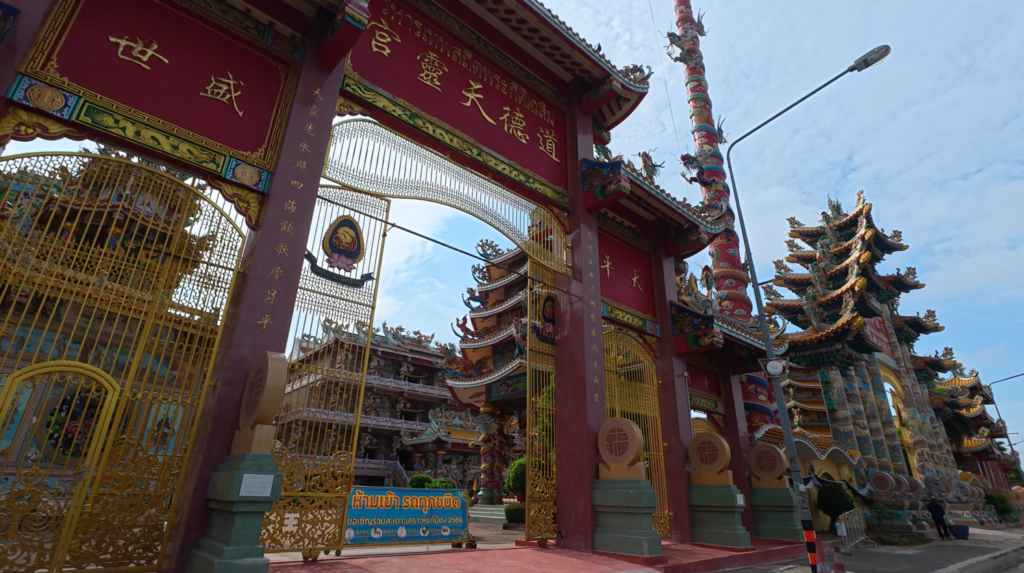
A quiet neighborhood road gradually reveals the red gateway and layered roofs of Na Jasa Tai Chue Shrine.
Arriving at Na Jasa Tai Chue Shrine Through the Back Roads of Ang Sila
The approach was modest and distinctly local. The road was narrow, the surroundings quiet, and there was little of the commercial atmosphere found around many famous tourist attractions. Only as I drew closer did the colorful gate and pagoda roofs reveal the scale of the complex.
After passing through the entrance, I followed the signs toward the parking area. My yellow Honda Cub rested beneath the covered structure while I continued on foot. From here, the journey changed from a ride through Ang Sila into a slow passage through Chinese religion, Buddhist devotion and Thai local history.
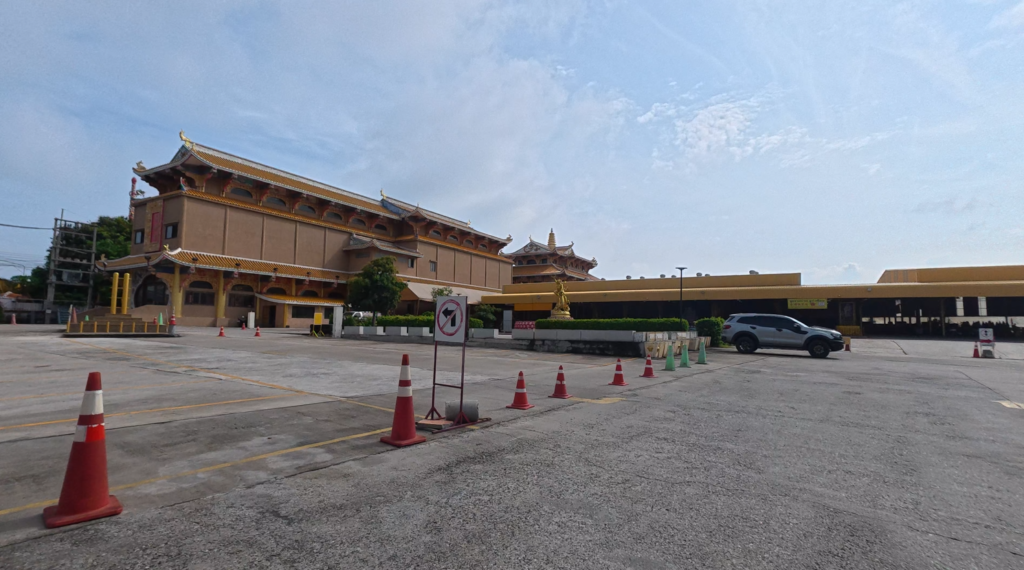
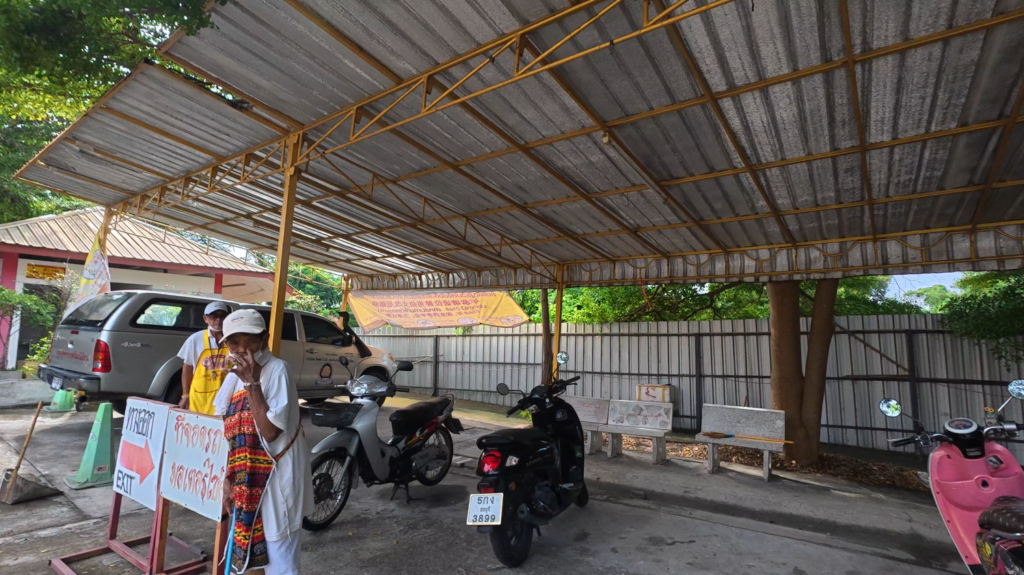
Signs lead toward the spacious parking area, where the yellow Honda Cub waits beneath the covered roof.
The First Hall — A Living Shrine, Not a Museum
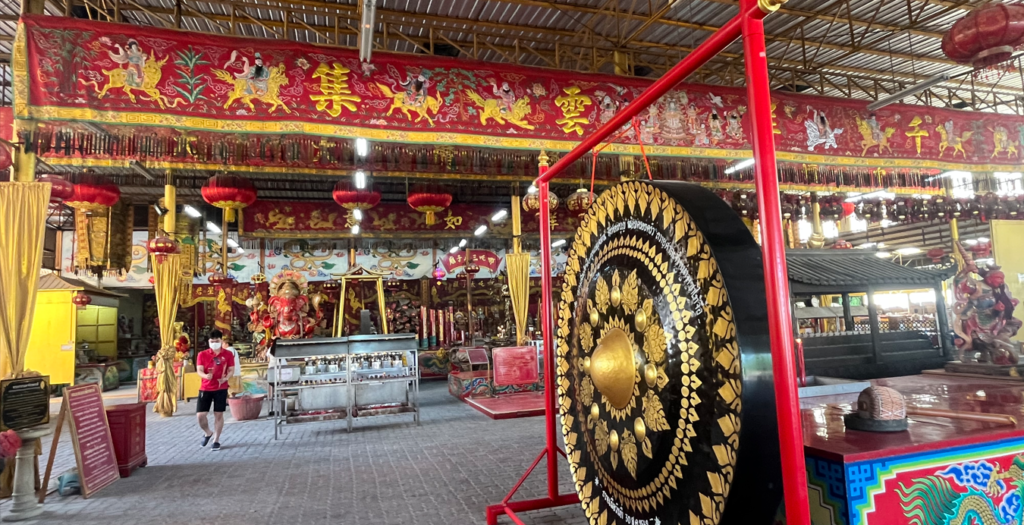
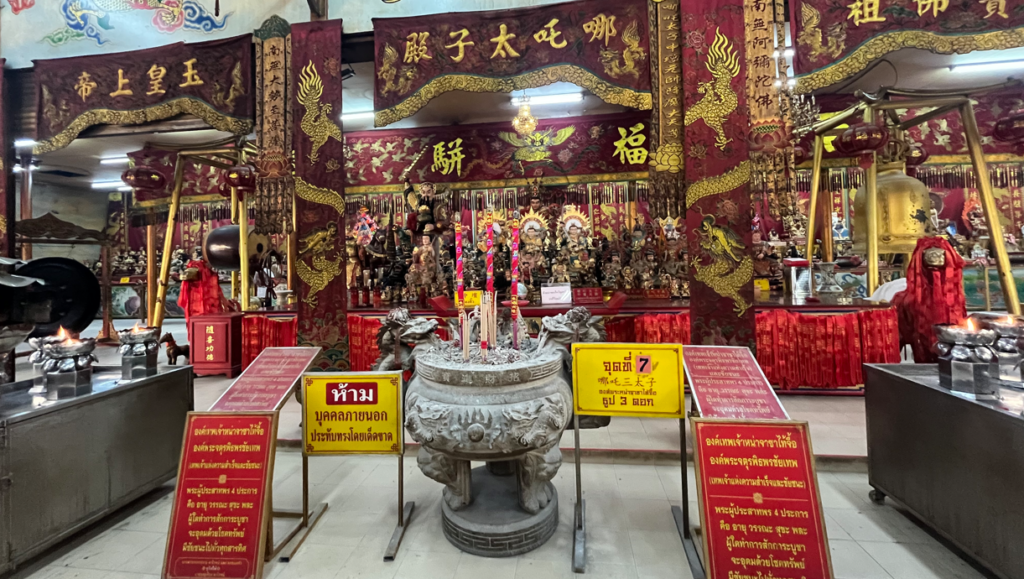
TThe first worship area of Na Jasa Tai Chue Shrine was open and practical. Incense burners stood before long rows of altars, while worshippers moved from one numbered station to another. Gongs, bells, candles and offering tables were not merely decorative objects; they formed part of an active sequence of prayer.
There were far more deities than I could confidently identify. Some appeared to be celestial officials, military guardians, local protective spirits or figures associated with health, prosperity and family welfare. Rather than presenting one simple religious doctrine, the hall resembled a celestial administration in which each deity held a different responsibility.
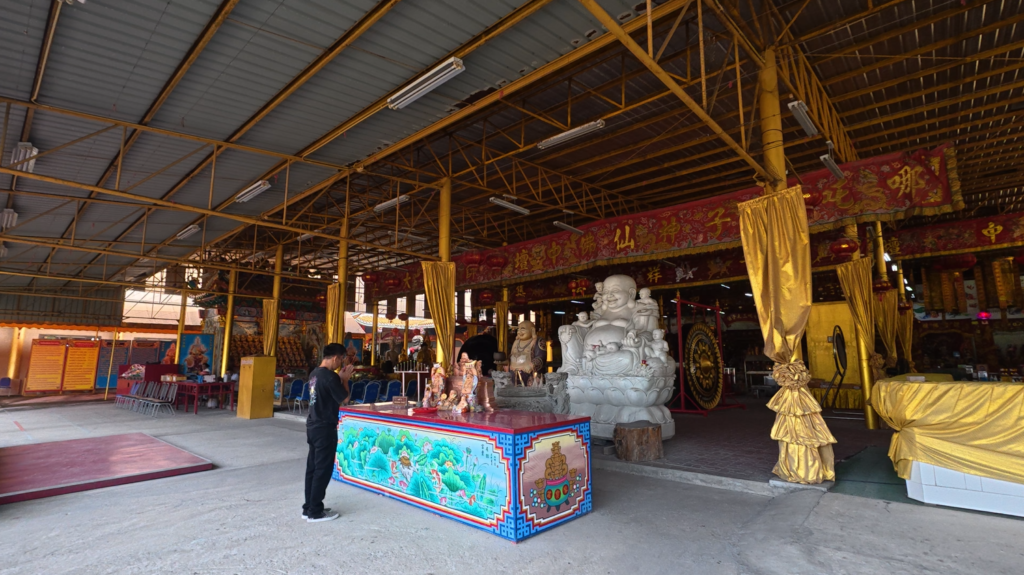
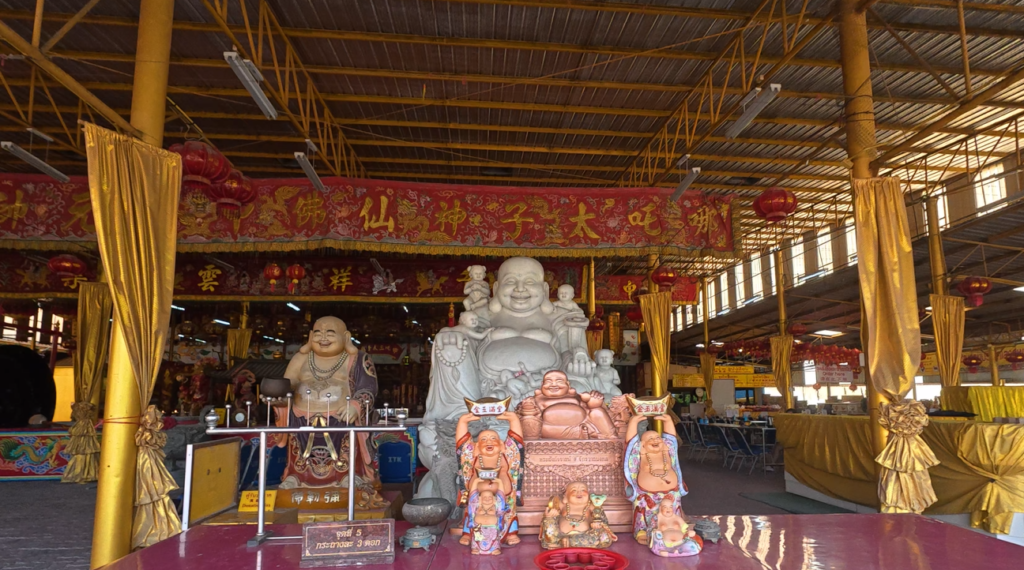
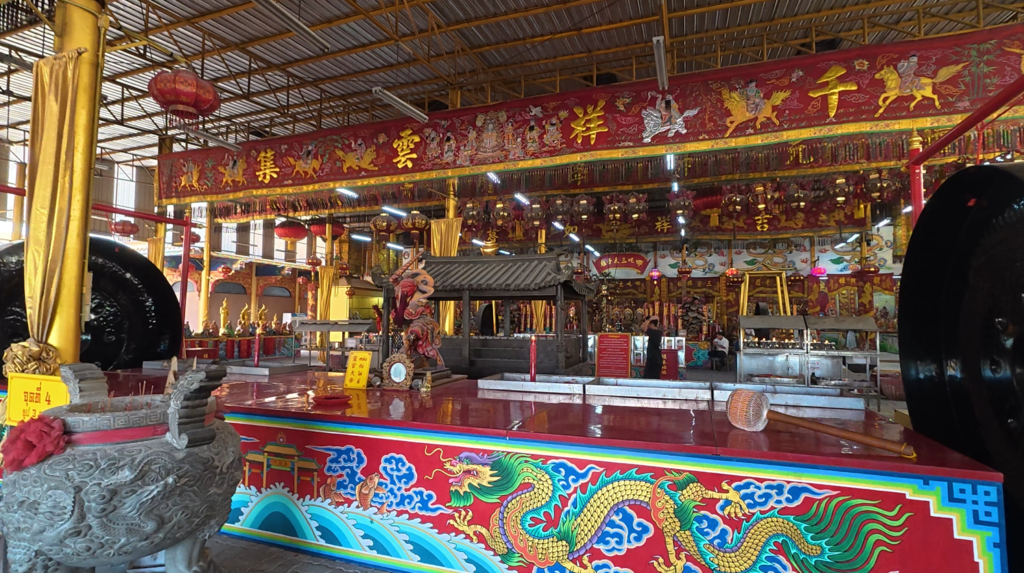
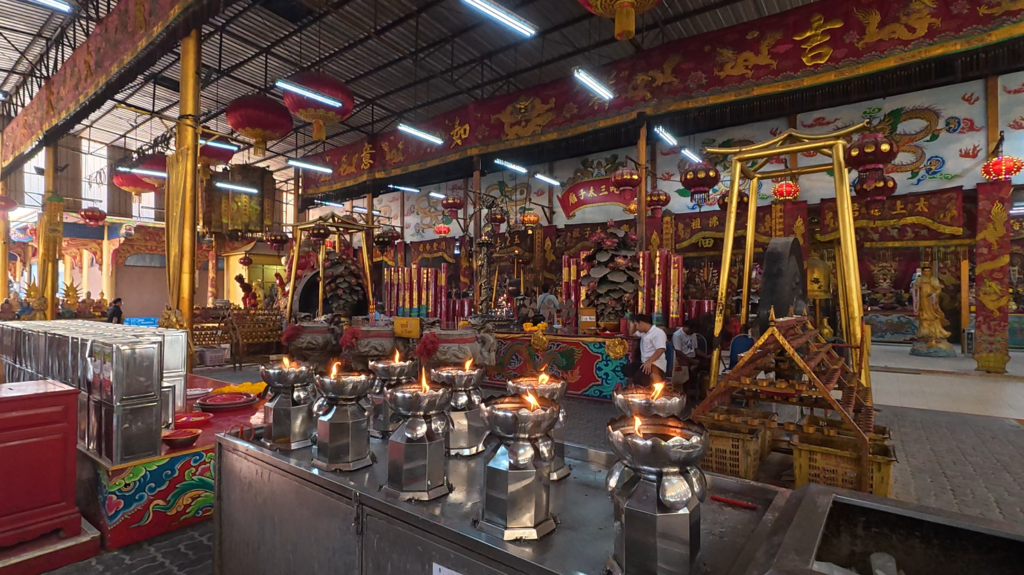
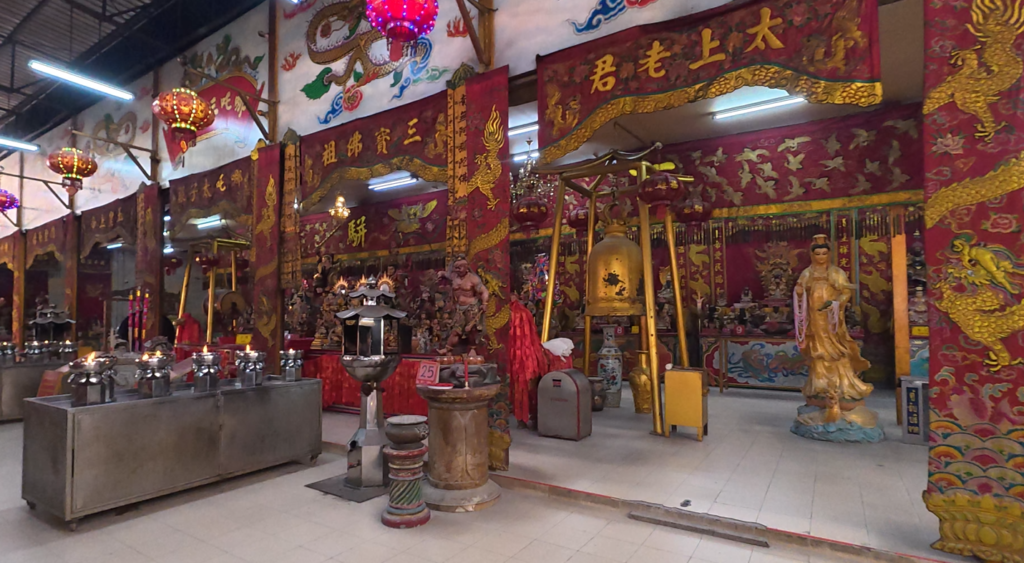
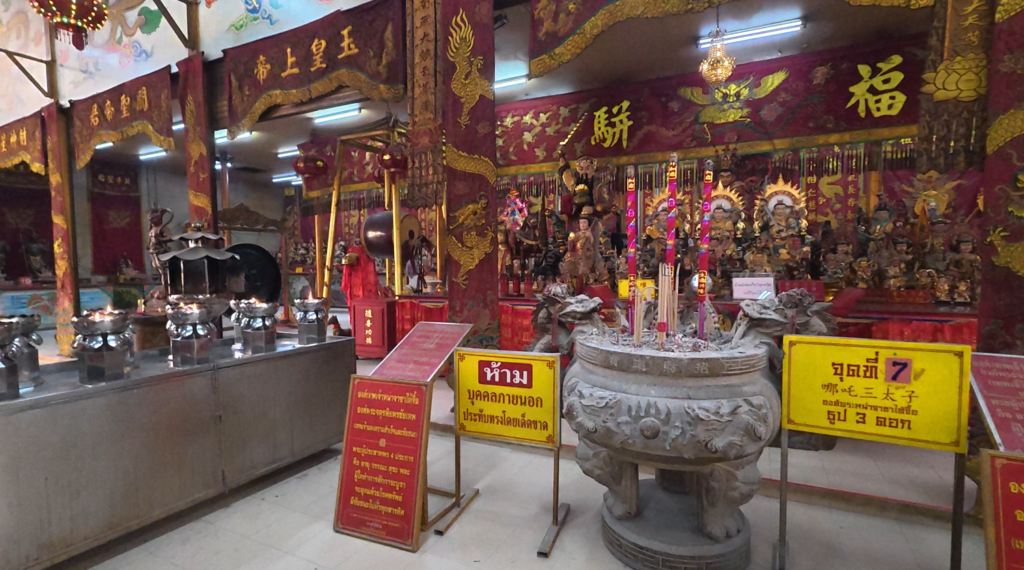
The first open worship hall introduces incense burners, prayer stations, gongs and rows of active altars.
This is an important characteristic of Chinese popular religion. A worshipper may pray to one deity for health, another for business, another for protection and another for relief from misfortune. Taoist cosmology, Buddhist figures and older folk traditions can share the same sacred space without being regarded as contradictory.
A Corridor of Gods and Human Concerns
One long section contained dozens of individual statues backed by red embroidered banners and Chinese inscriptions. The visual repetition was striking, yet every altar carried its own face, posture, weapon or symbolic object.
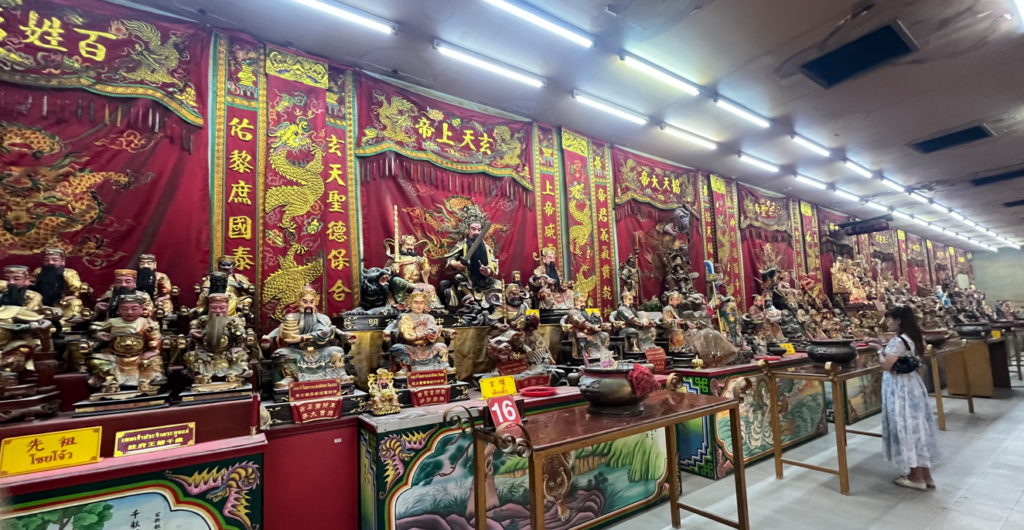
The numbered prayer stations helped visitors move through this complicated world. Even without understanding every Chinese title, I could sense how the structure guided ordinary people through their concerns—illness, work, family, fortune, safety and the uncertainties of the coming year.
Among these figures are the Tai Sui, celestial officers associated with the traditional sixty-year calendrical cycle. Visitors commonly seek their protection when their birth-year zodiac is believed to conflict with the ruling energy of a particular year. In Thailand, this practice is widely known as kae pi chong, or performing rites to ease the effects of an inauspicious year.
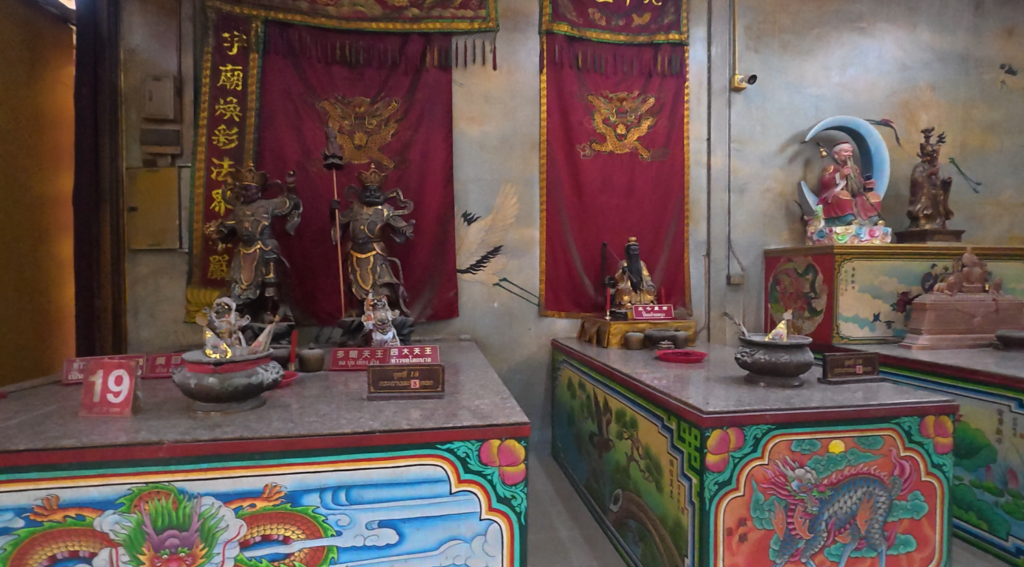
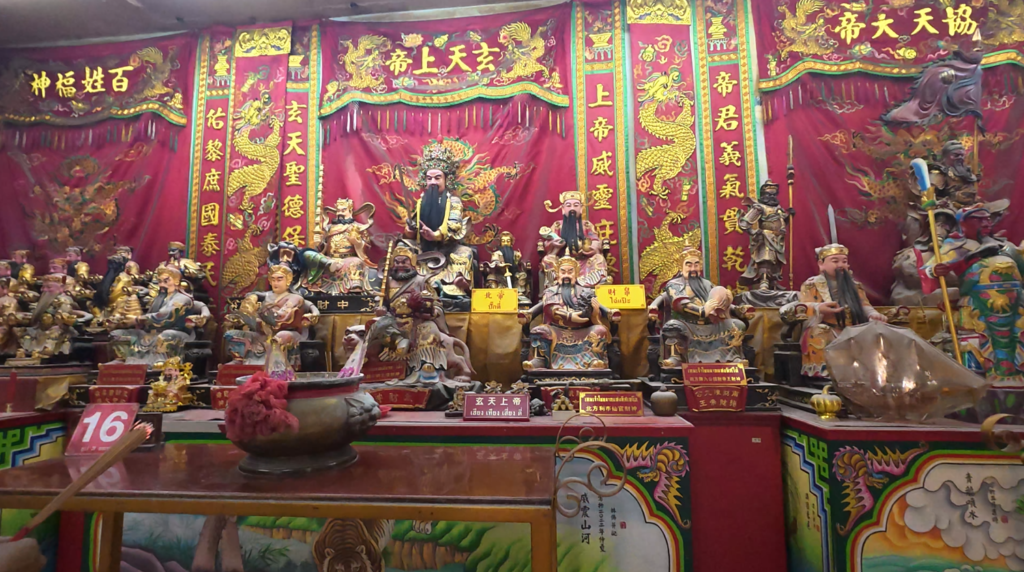
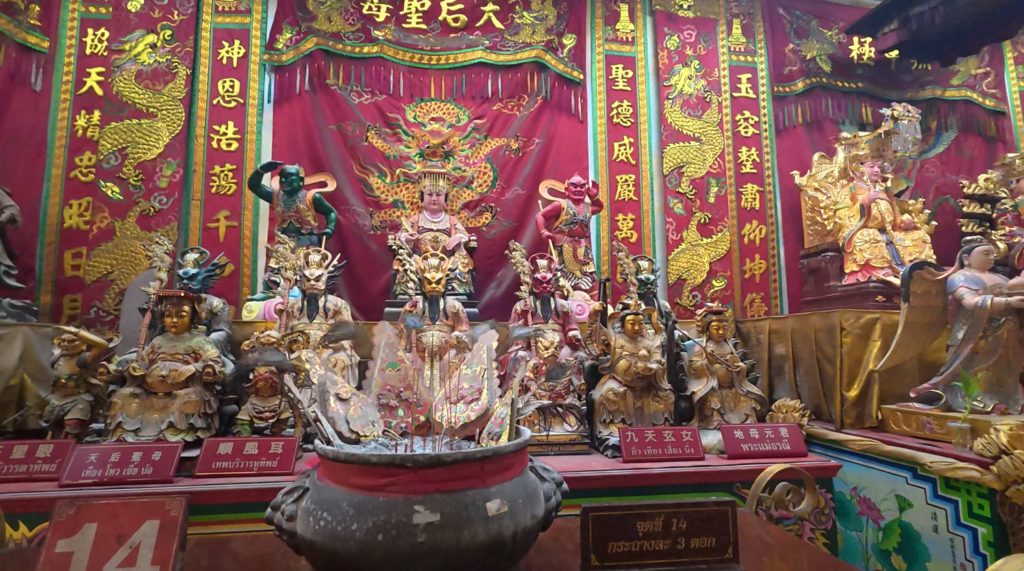
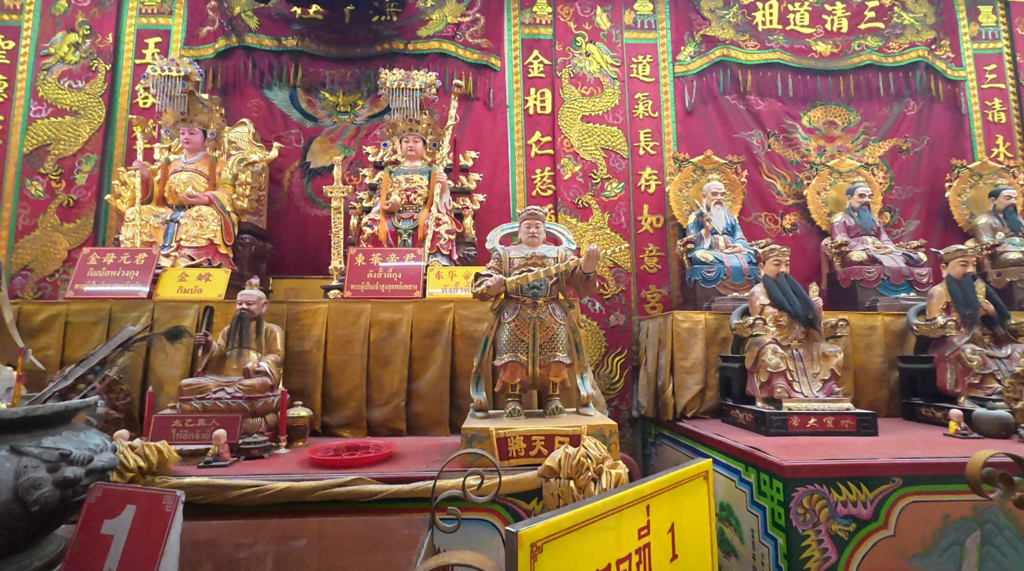
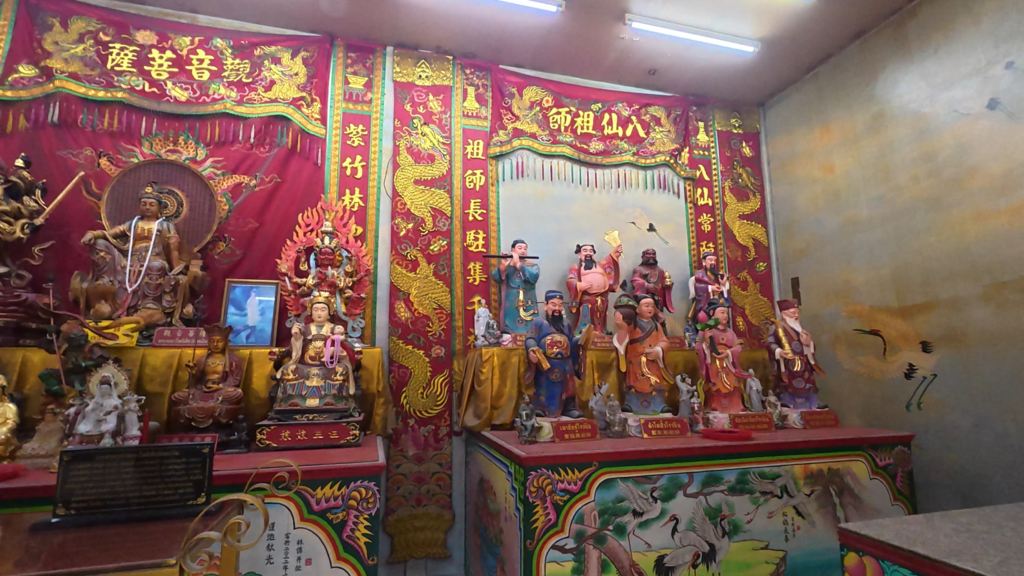
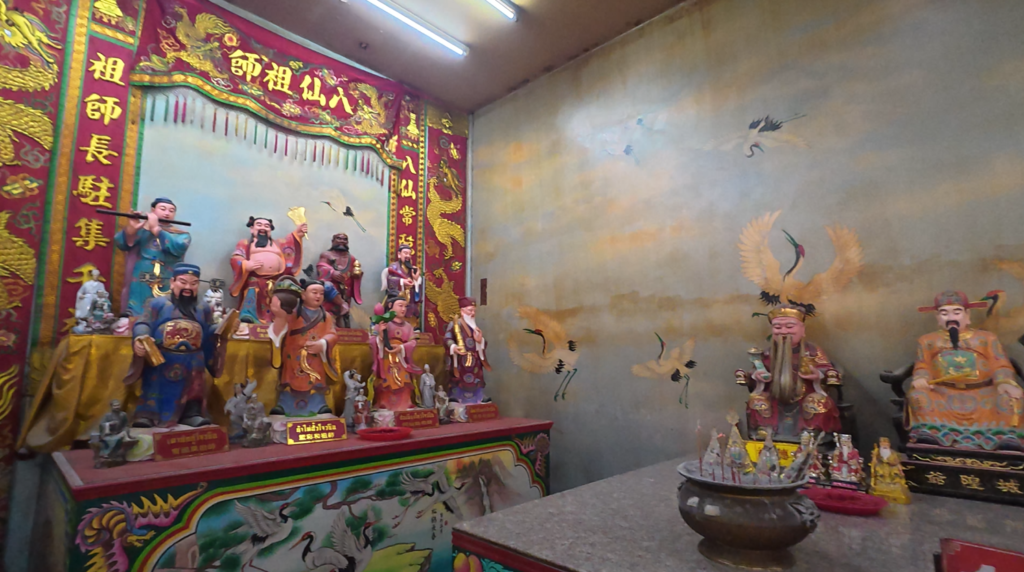
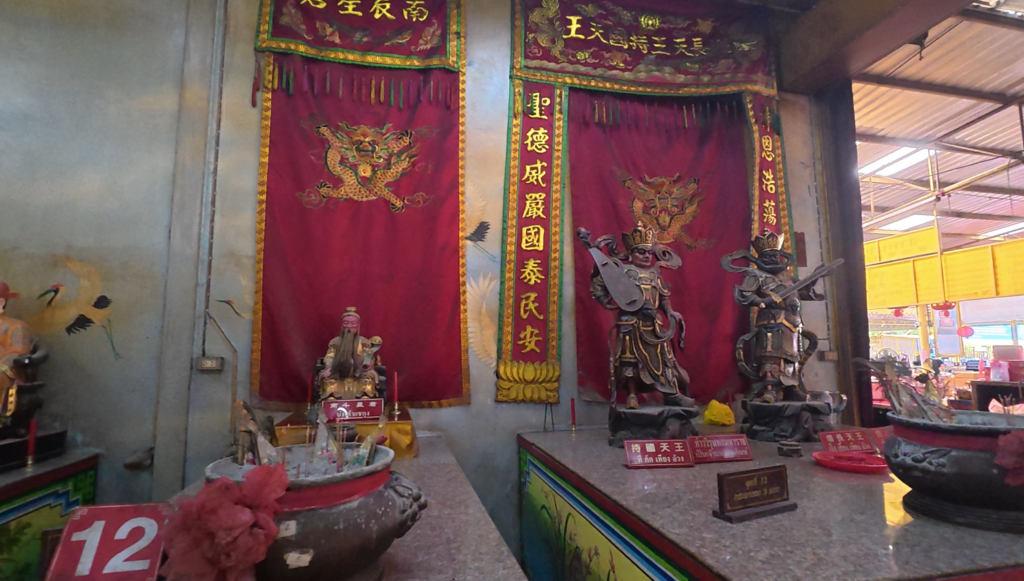
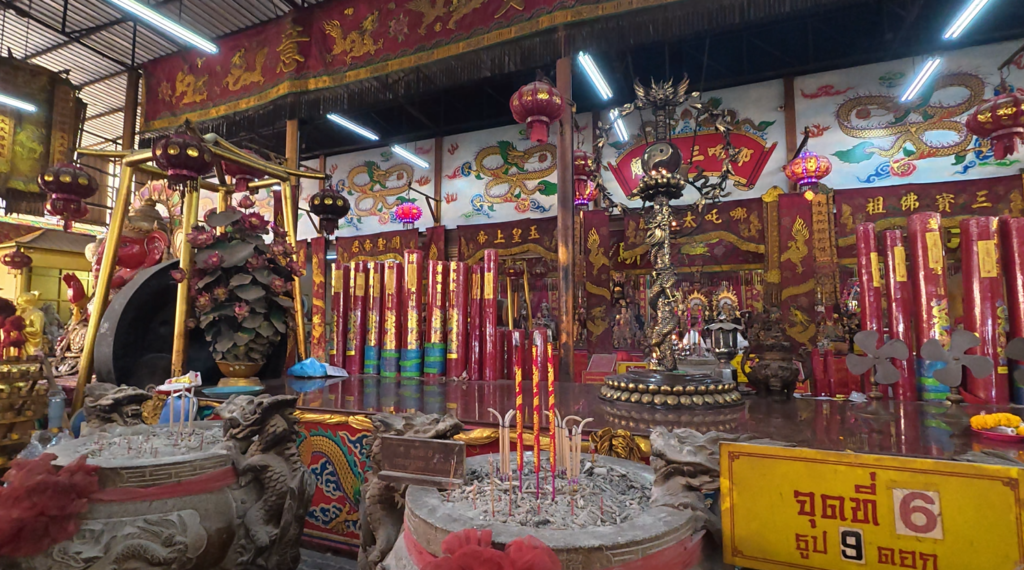
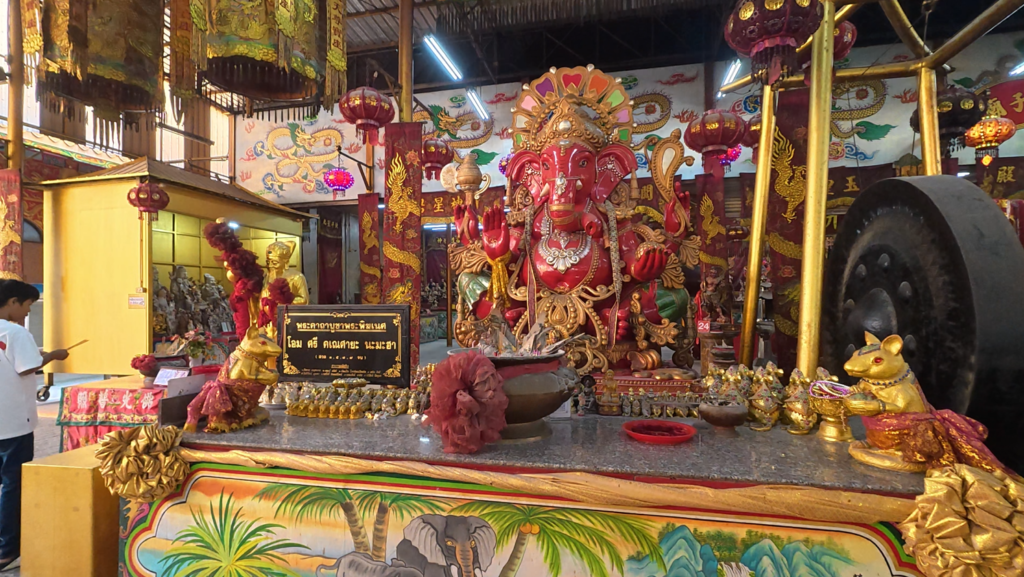
Numbered altars guide worshippers among guardians, celestial officials and deities associated with protection, health and fortune.
Where Taoism and Buddhism Meet
The deeper I walked, the less useful it became to classify the shrine as purely Taoist. Buddha images, bodhisattvas, arahant-like figures and Chinese celestial deities appeared in adjoining halls. Maitreya—the smiling, generous figure commonly called the Laughing Buddha—also had a place within the complex.
This mixture does not represent confusion. It reflects the history of Chinese religion itself. Buddhism entered China and interacted for centuries with Taoist ideas, ancestor veneration and regional folk traditions. Bodhisattvas such as Guanyin became deeply rooted in Chinese family and community worship, while Taoist and popular deities were sometimes interpreted through Buddhist language and imagery.
Na Jasa Tai Chue Shrine brings these layers together in a particularly visible way. A visitor may encounter a Buddha image, a Taoist celestial ruler and a folk protector within only a few steps.
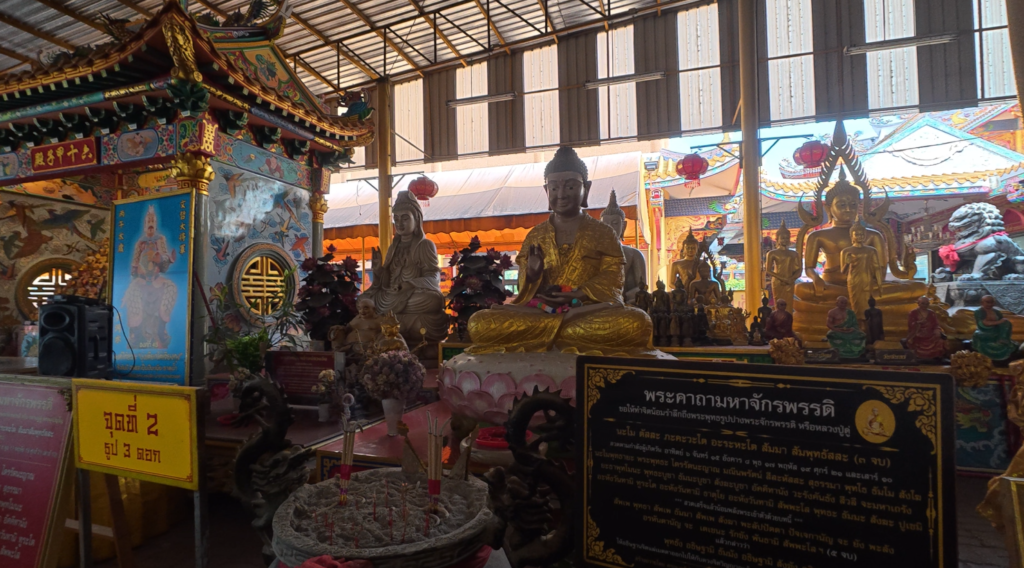
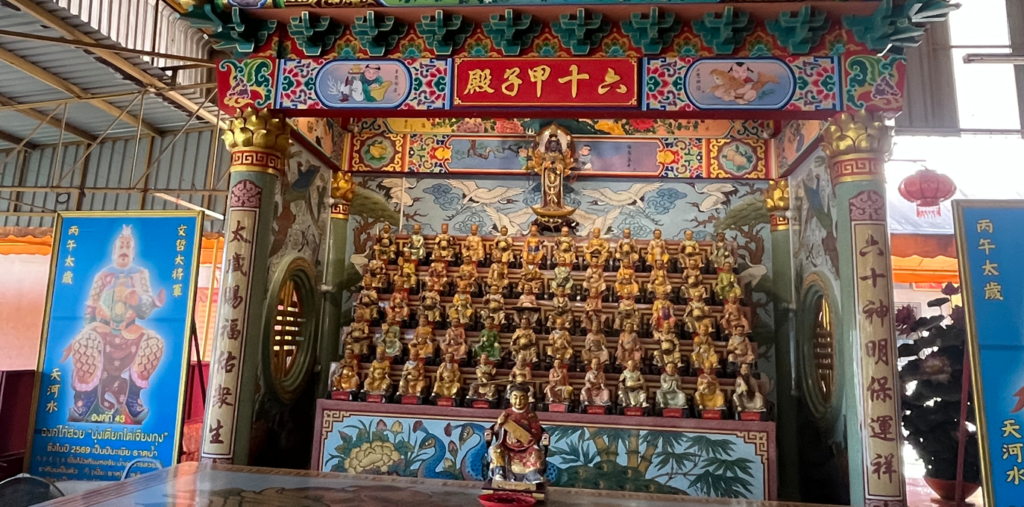
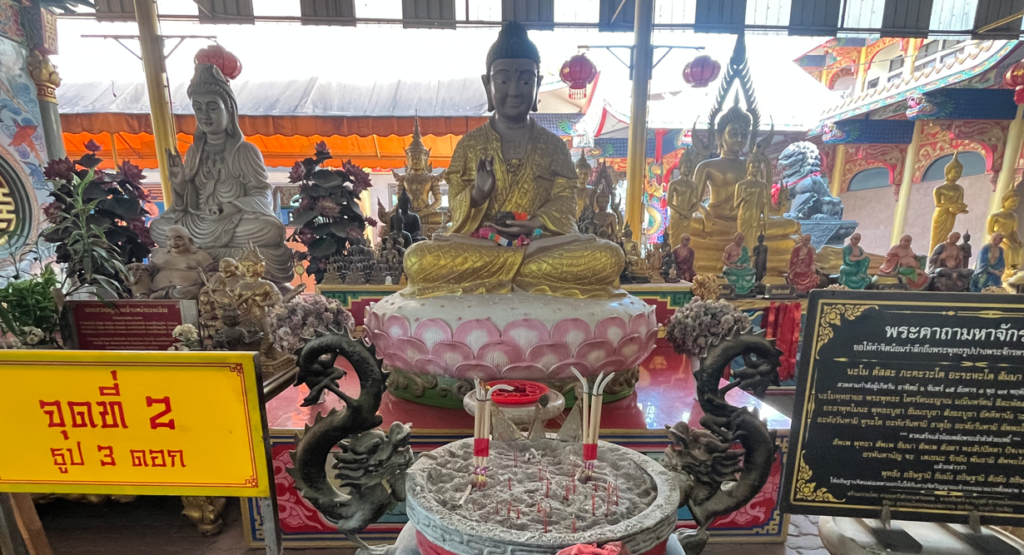
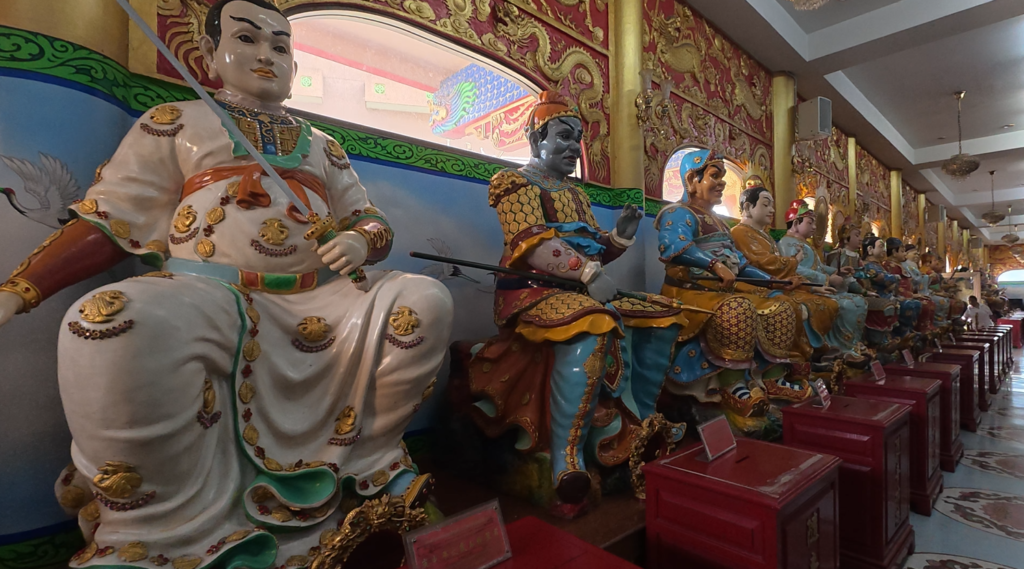
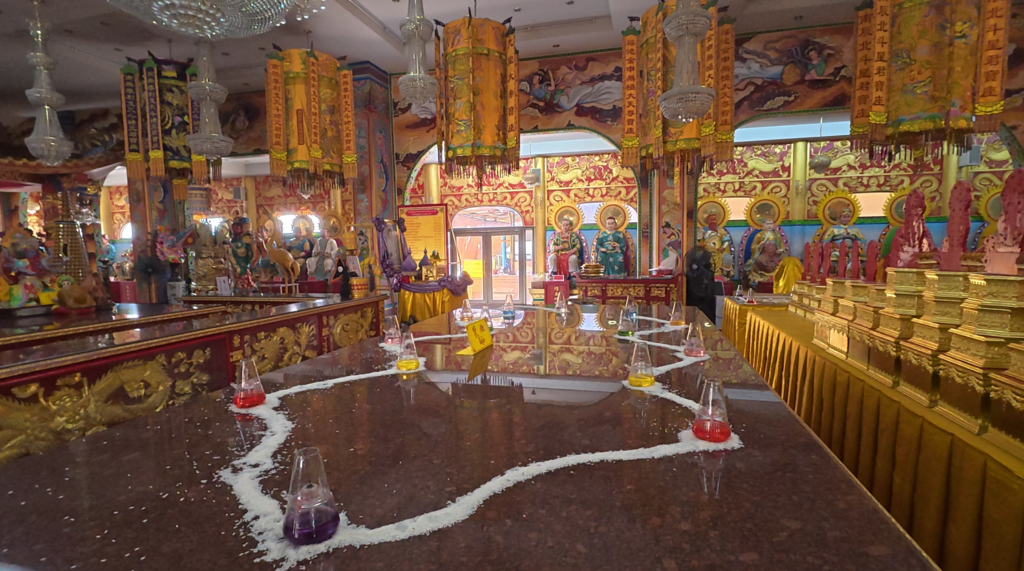
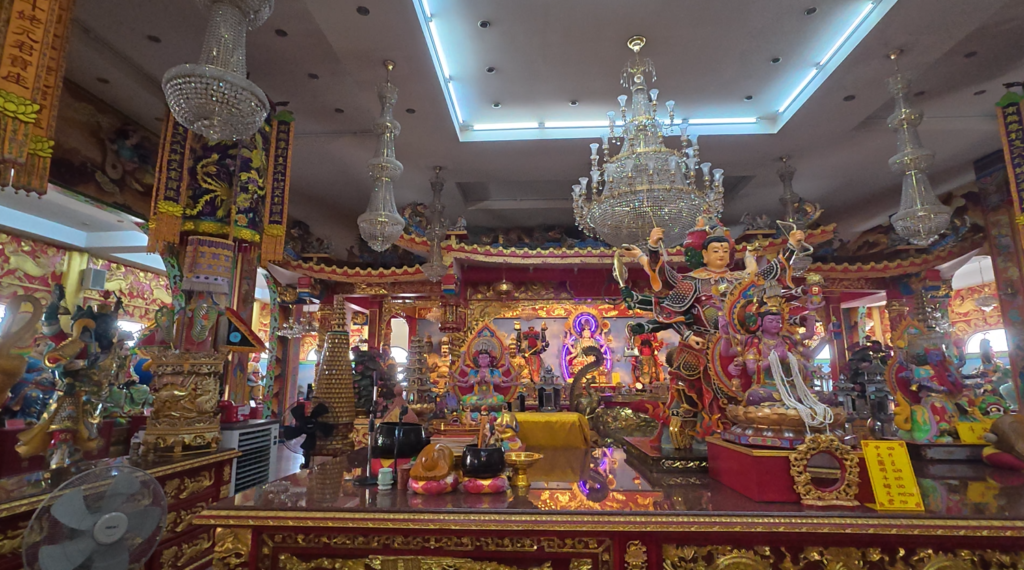
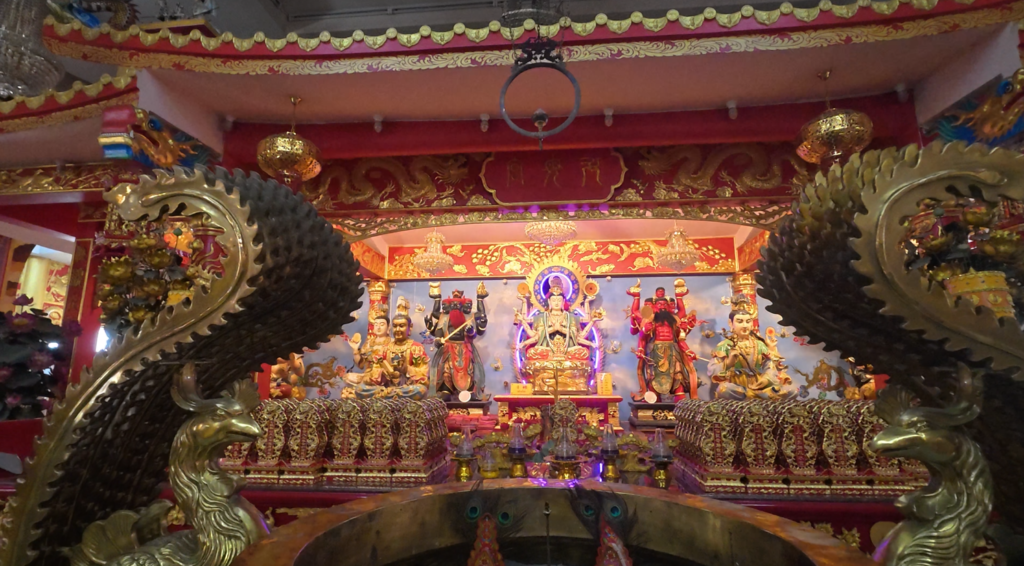
Buddha images, bodhisattvas, calendrical guardians and popular deities share the same religious complex.
Who Is Nezha, the Third Prince?
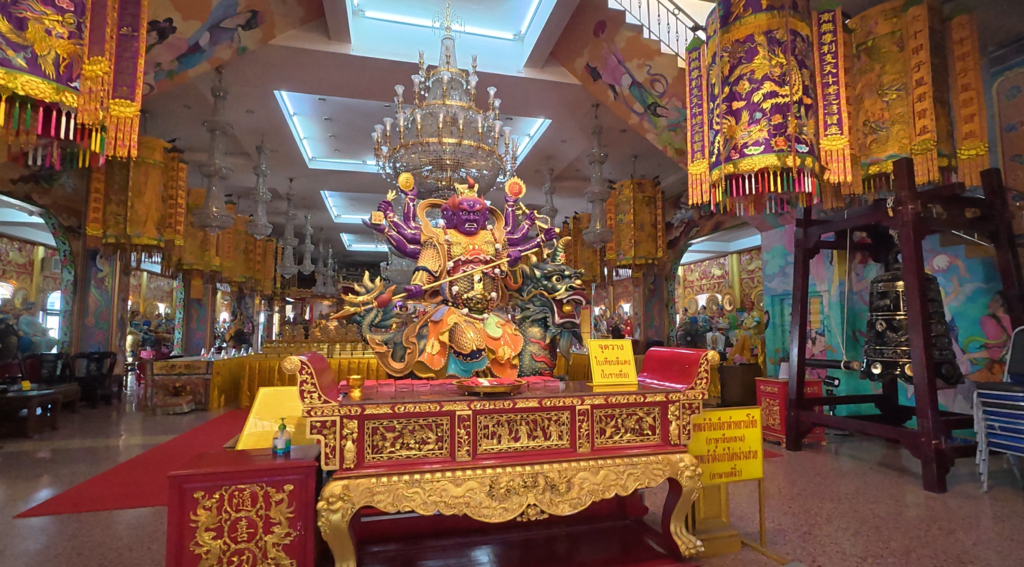
The principal deity of the shrine is Nezha, called Na Jasa Tai Chue in Thai-Chinese usage and often described as the Third Prince.
Nezha is not easily assigned to only one religion. His distant background may preserve elements connected with Buddhist figures transmitted from India, particularly the name Nalakuvara. In China, however, he developed into a distinctive youthful warrior deity through Taoist tradition, temple worship and popular literature.
His best-known stories were shaped by works such as the Ming-period novel Investiture of the Gods. Nezha is presented as the son of the military commander Li Jing. After conflict, sacrifice and rebirth, he receives a new body formed from lotus roots and returns as a powerful protector.
He is commonly shown with the Wind Fire Wheels beneath his feet, a fire-tipped spear and the Universe Ring. His youthful appearance represents fearless energy rather than immaturity. For worshippers, Nezha can protect travelers, children, families and businesses while overcoming dangerous or chaotic forces.
The history is therefore more complex than describing him simply as an ancient Chinese god who existed unchanged before Buddhism. The Nezha known today emerged through a long combination of transmitted Buddhist motifs, Chinese mythology, Taoist ritual and popular storytelling.
How Na Jasa Tai Chue Shrine Became a Monumental Complex
The shrine began around March 1991 under the initiative of Ajarn Somchai. The original structure occupied approximately 200 square wah and was far smaller than the complex seen today.
During the mid-1990s, plans were made to build a much larger sanctuary in honor of the 72nd birthday of King Rama IX. Donations reportedly reached about 300 million baht, and construction continued for more than four years.
On 11 January 1998, Thailand’s Supreme Patriarch, Somdet Phra Nyanasamvara, presided over the casting of seven Buddha images. Sacred relics were also presented for enshrinement. He bestowed the name Wihan Thep Sathit Phra Kitti Chaloem, generally interpreted as “the sanctuary where the deities dwell.”
By April 2000, Na Jasa Tai Chue Shrine had developed from a modest local sanctuary into a monumental multi-level religious complex.
Stepping Outside to Understand the Scale
After moving through the first series of halls, I stepped back into the courtyard. Only then could I properly understand the architecture.
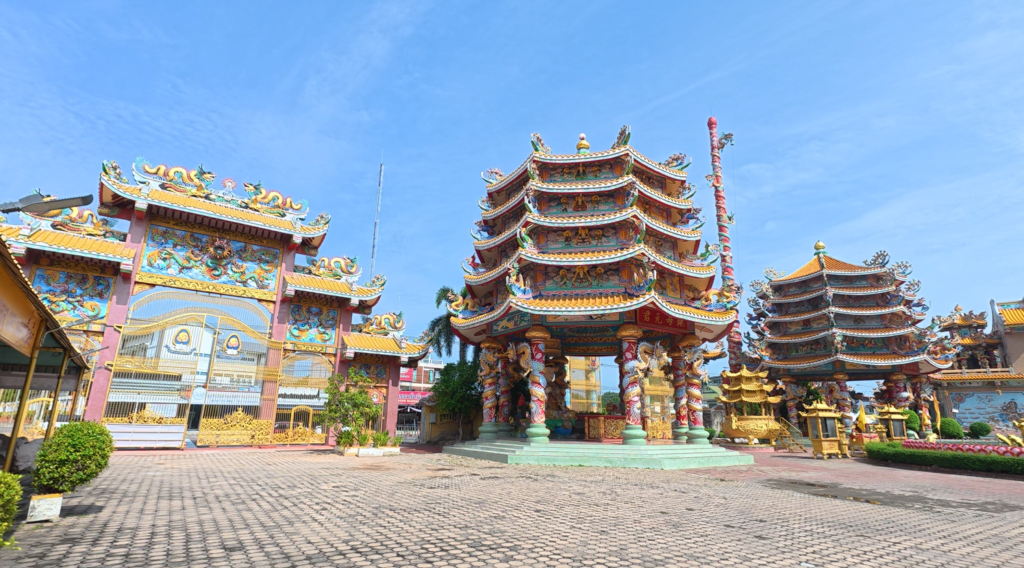
Multiple towers rose around an open central space. Roof corners curved upward beneath dragons and mythical animals, while decorated bridges and balconies linked the different levels. The complex seemed to unfold vertically as well as horizontally.
From the upper walkways I could look down over the courtyard and across the surrounding roofs. The sea was nearby, but within the walls the visual world belonged to Chinese cosmology—mountains, clouds, dragons, immortals and heavenly palaces.
The architecture was not restrained. Red, gold, green and blue competed for attention, yet the repeated rooflines and symmetrical courtyards held the whole composition together.
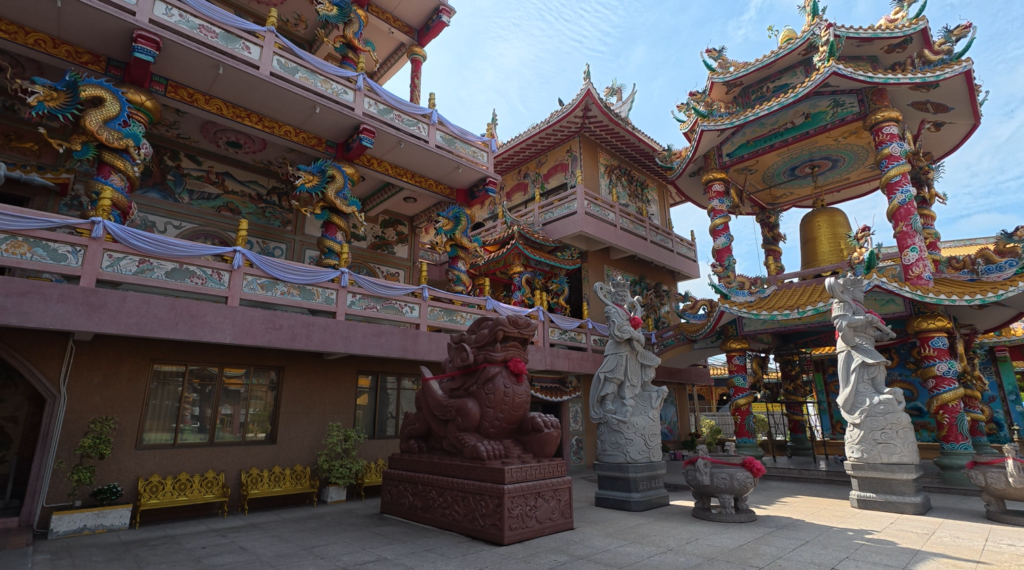
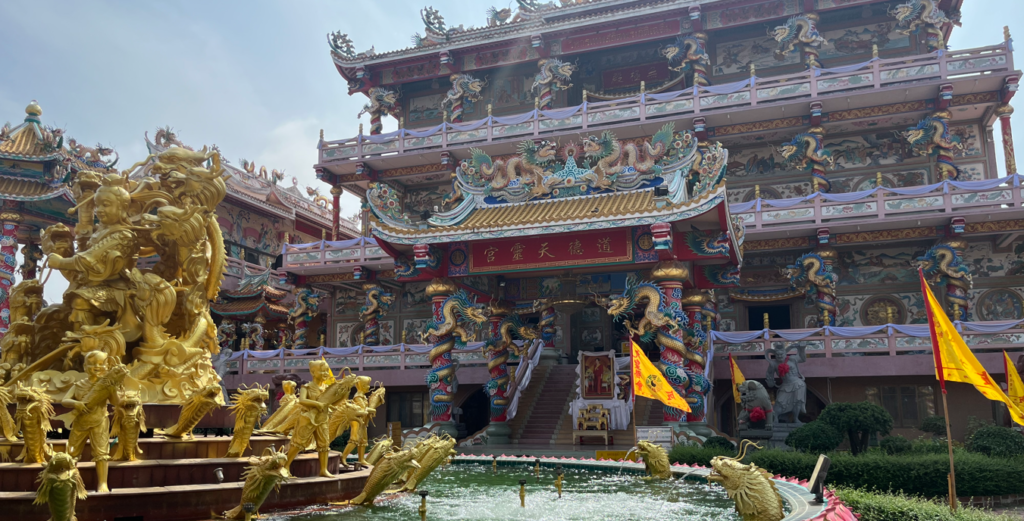
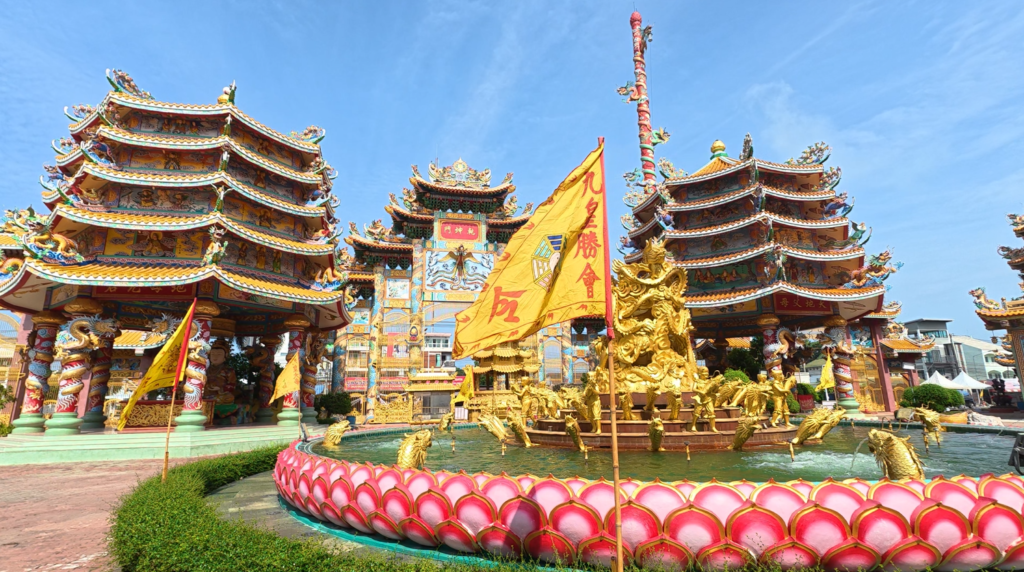
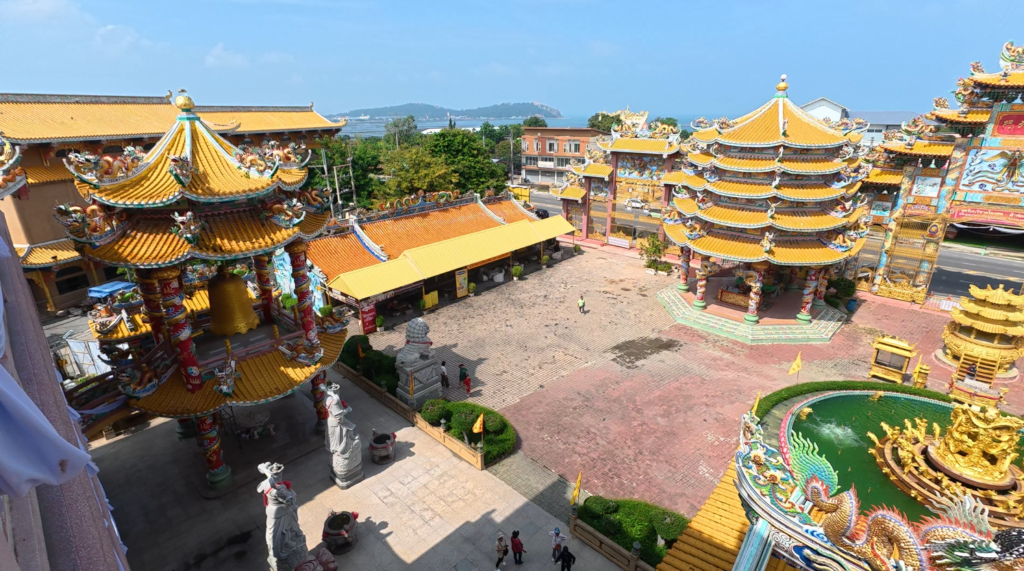
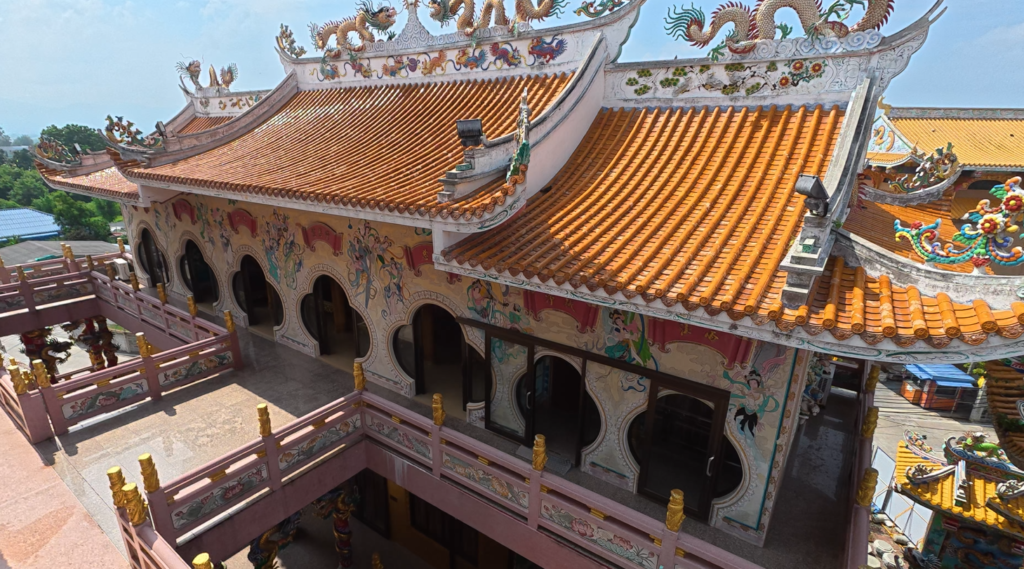
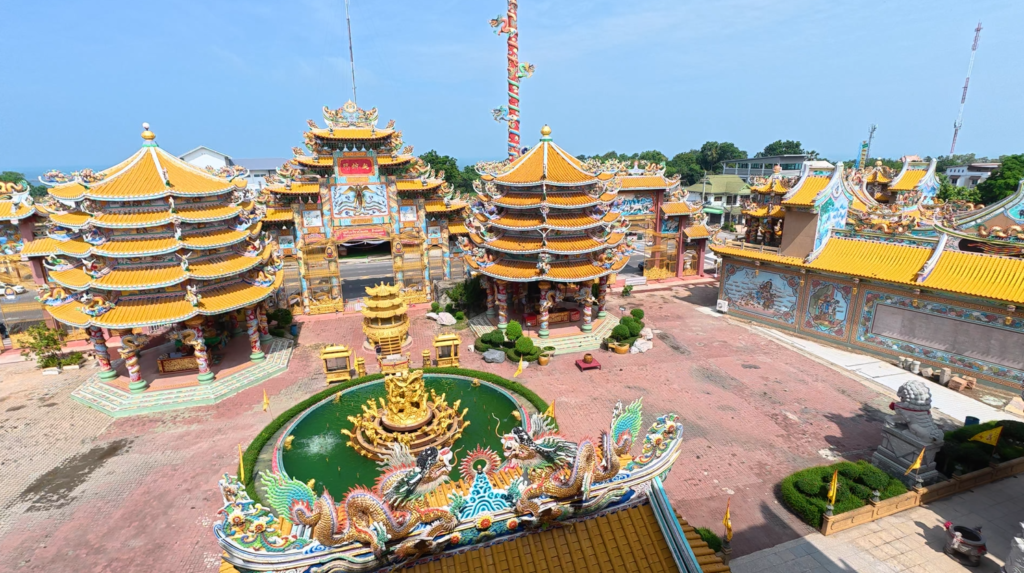
Upper walkways reveal the symmetry, rooflines and vertical scale that cannot be seen from the lower halls.
Entering the Palace of the Celestial Court
YouTube Video
The video follows the complete journey—from the narrow Ang Sila road and early prayer halls to the upper sanctuaries and monumental courtyards.
Riding to Na Jasa Tai Chue Shrine and walking through its layered world of Chinese gods, Buddhist images and Thai-Chinese history.
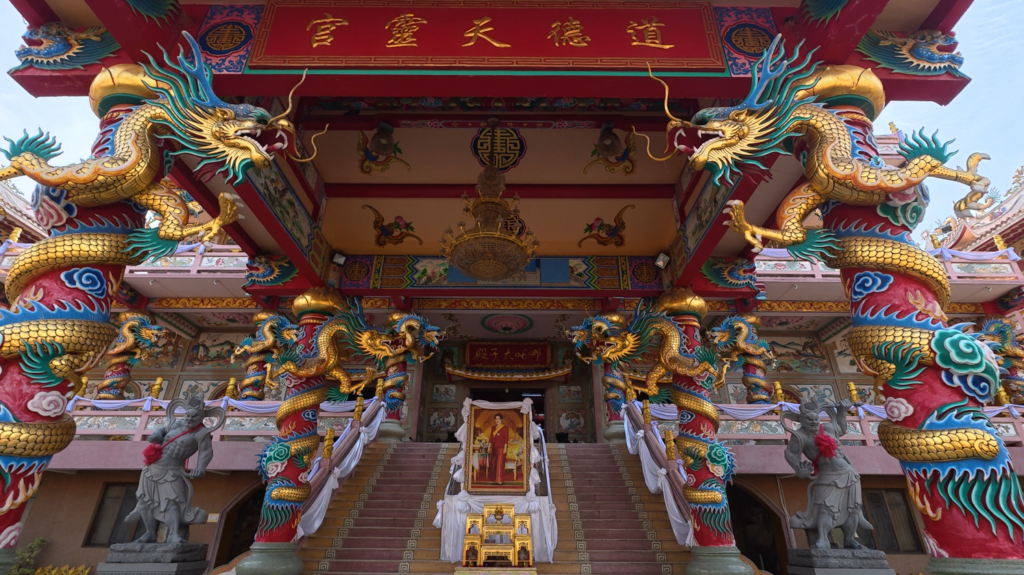
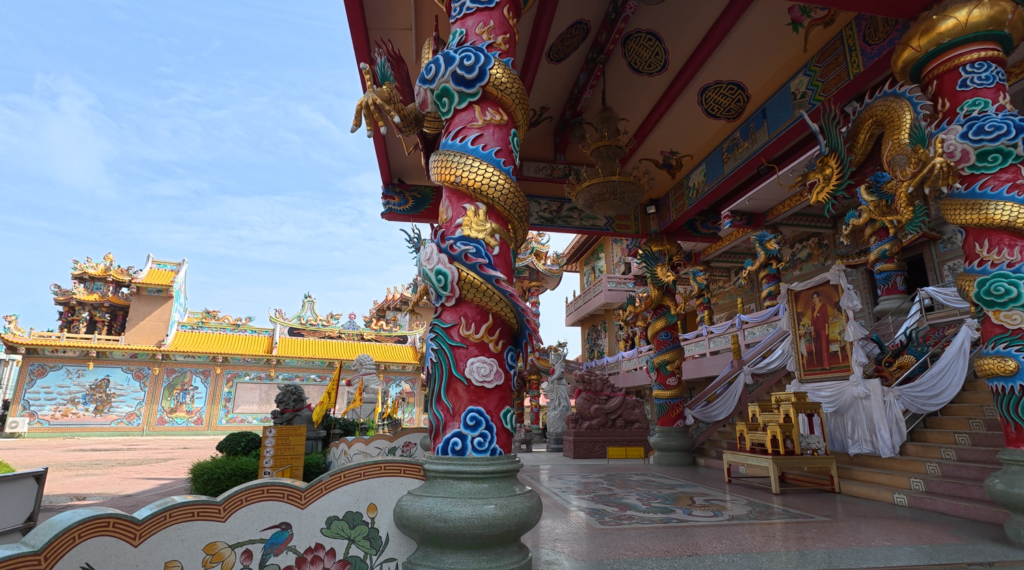
The monumental entrance, framed by dragon-wrapped columns, marked a transition into the most elaborate part of the shrine. The columns appeared to rise like living creatures supporting the heavenly palace above them.
Inside, chandeliers hung above gilded altars. Large dragons guarded the central axis, while flowers, incense vessels and embroidered banners surrounded the principal images. Every surface seemed to carry another symbol.
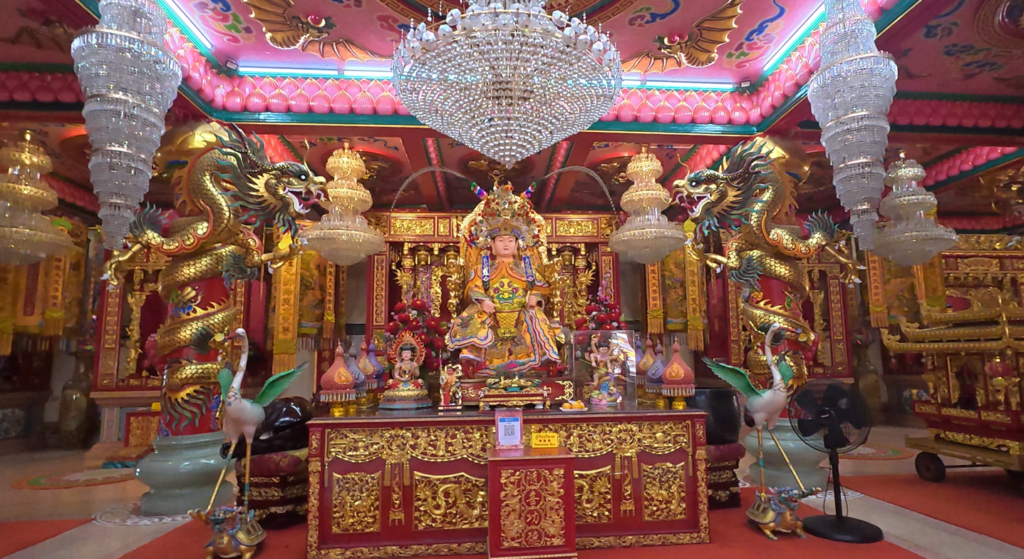
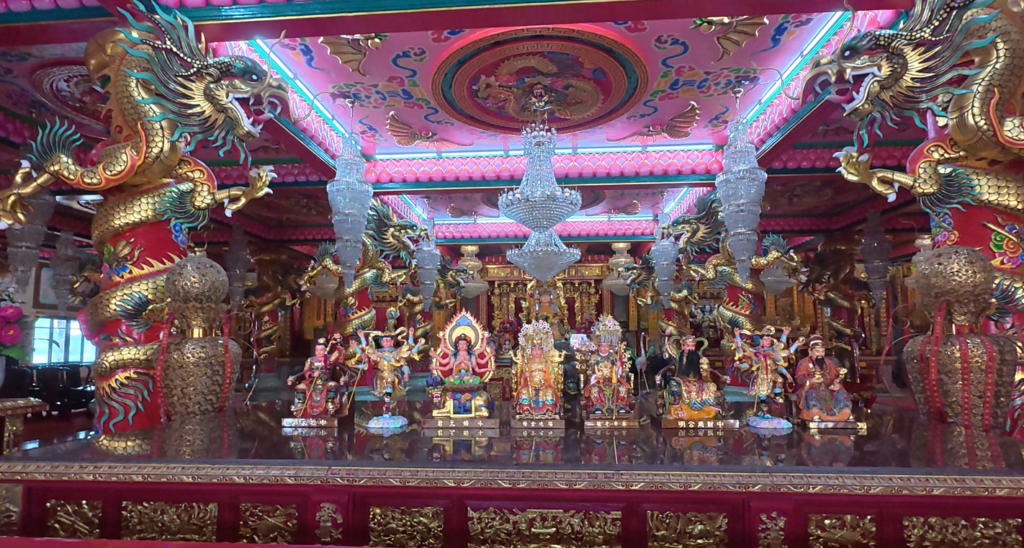
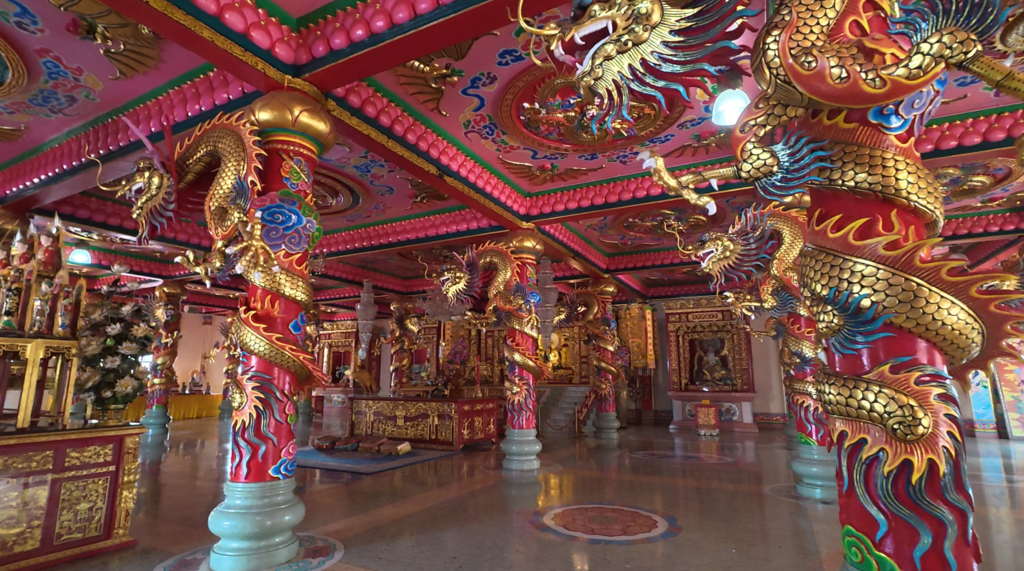
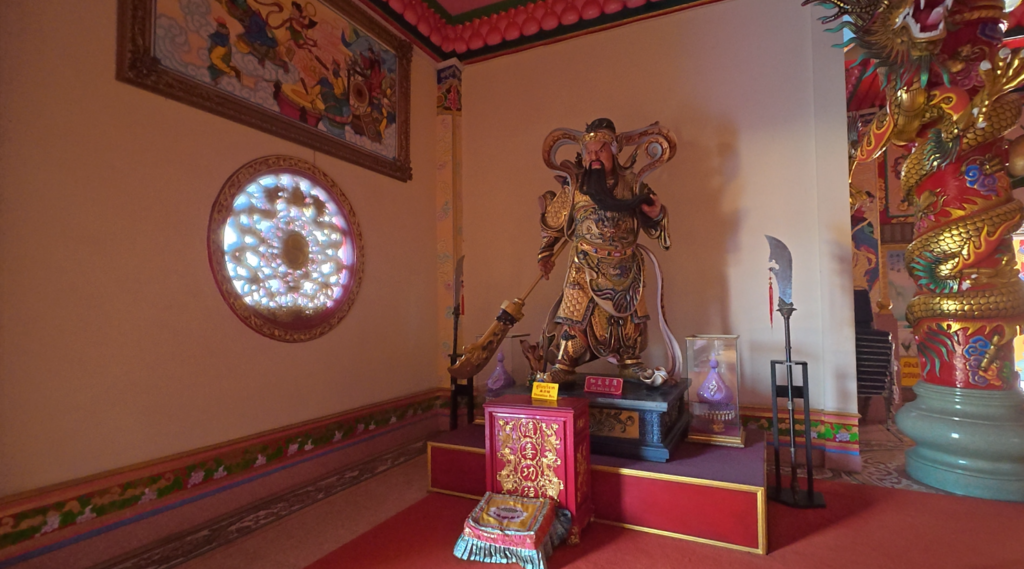
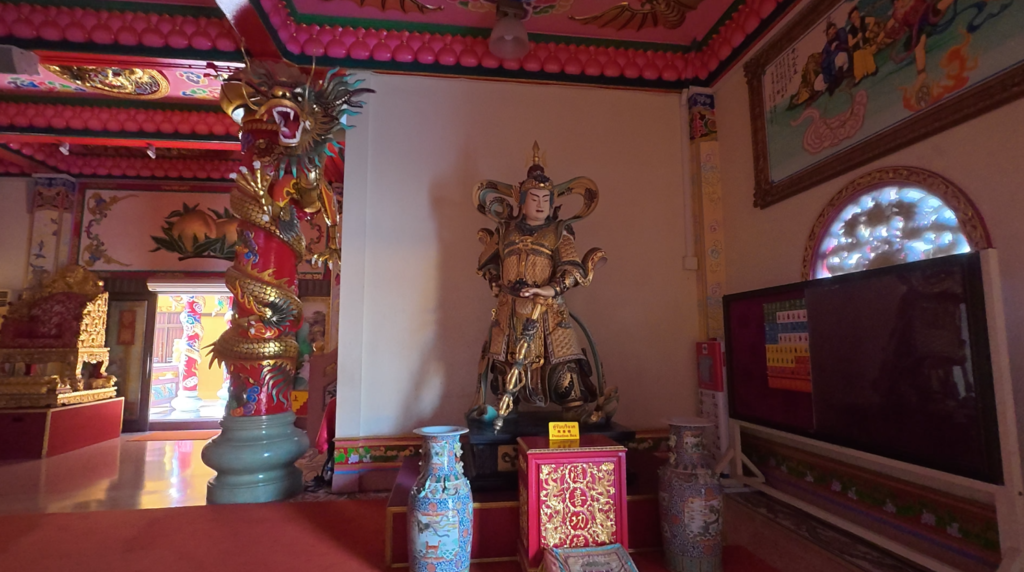
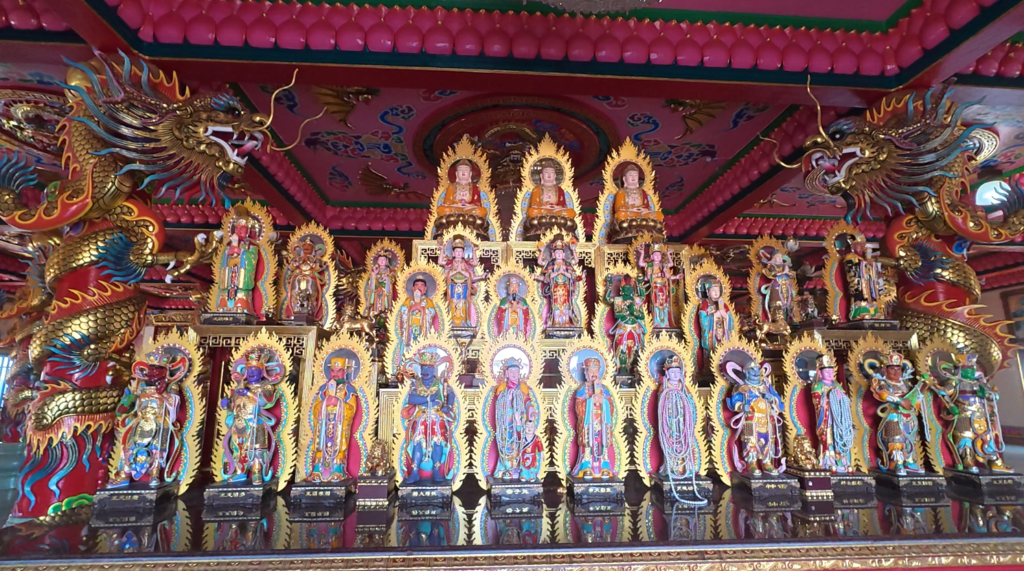
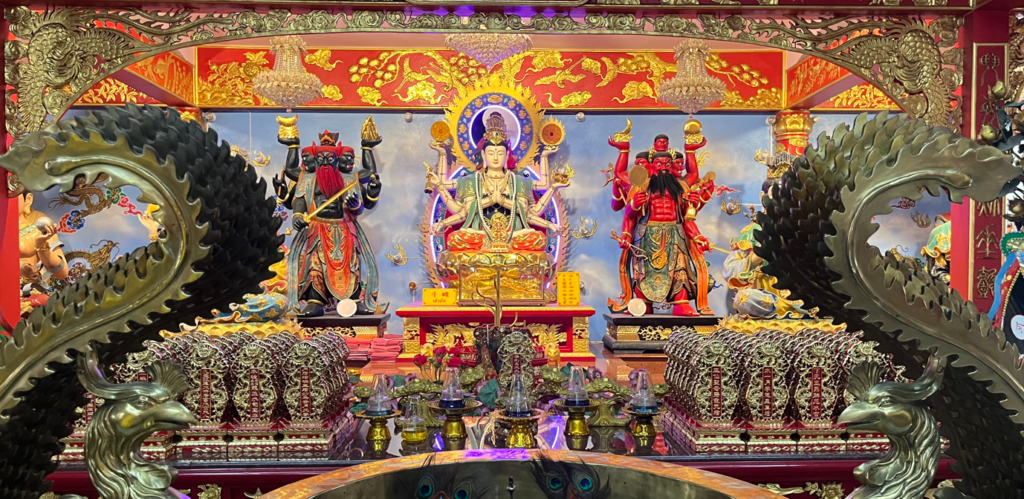
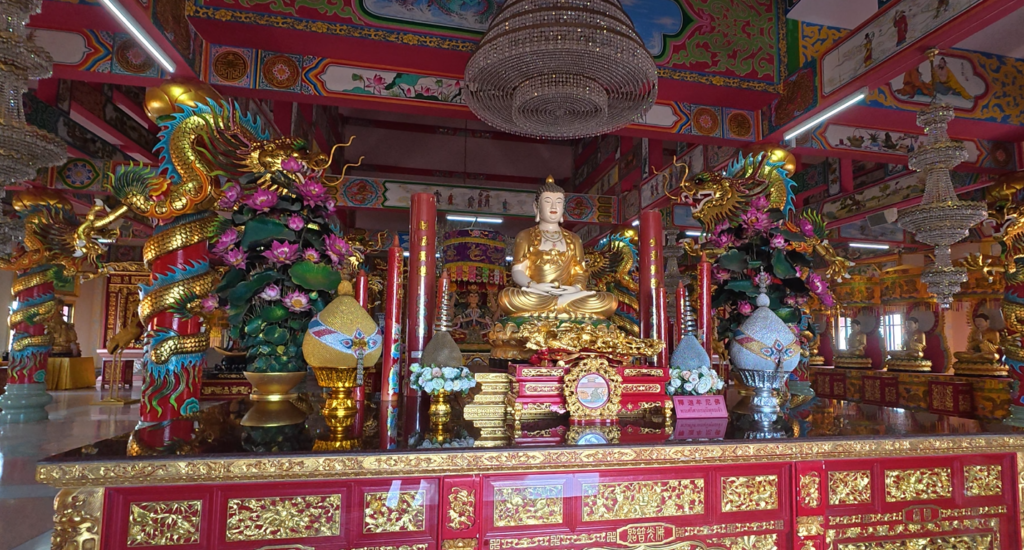
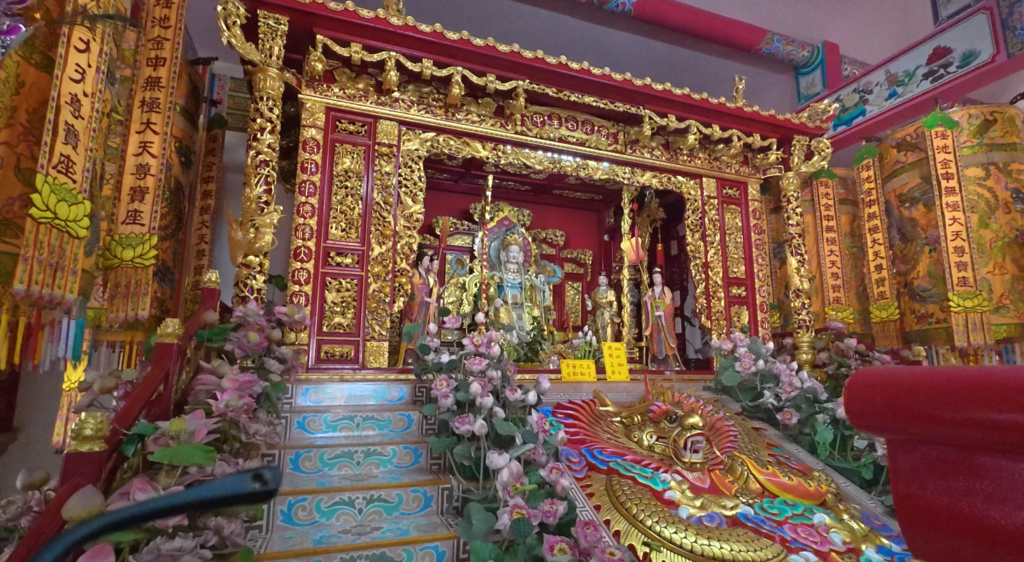
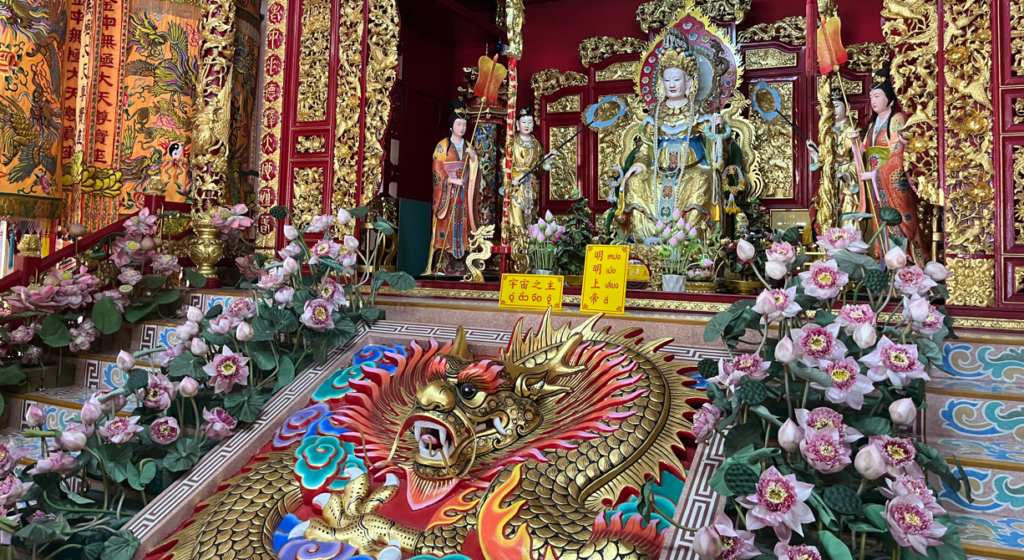
Gilded thrones, embroidered banners, chandeliers and celestial figures transform the inner sanctuary into an image of the heavenly court.
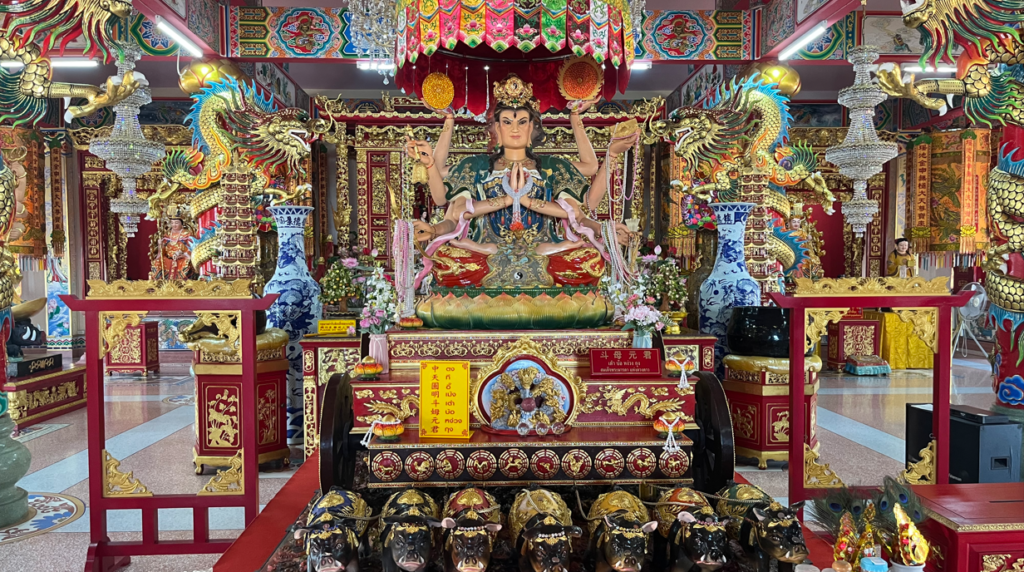
One of the most remarkable figures was Doumu Yuanjun, the Mother of the Dipper and a major Taoist celestial deity associated with the stars and cosmic order. Her multiple arms express extensive spiritual power rather than physical form. She is closely connected with the deities governing destiny and the movements of the heavens.
Other upper sanctuaries are dedicated to high celestial beings such as the Jade Emperor and the Queen Mother of the West. Their richly decorated thrones and dragon imagery evoke a heavenly bureaucracy modeled partly on the language of an imperial court.
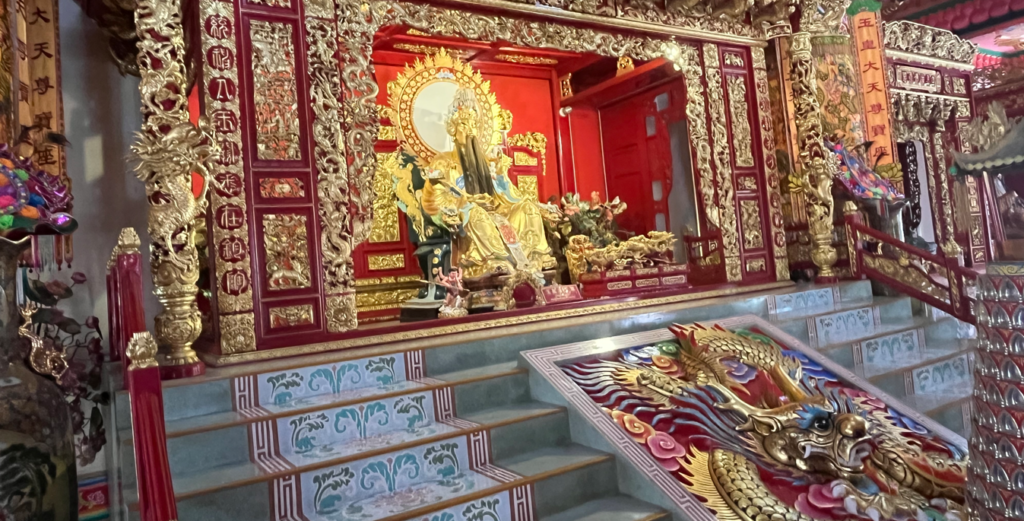
Because several adjacent figures share similar robes, crowns and attendants, identifications should follow the Chinese inscriptions at each altar rather than appearance alone.
Royal Visits to Na Jasa Tai Chue Shrine
The shrine’s significance extends beyond local Chinese worship. Its construction was associated with the celebration of King Rama IX’s 72nd birthday, and several members of the Thai royal family later attended important ceremonies.
| Date | Royal or religious figure | Ceremony |
|---|---|---|
| 11 January 1998 | Supreme Patriarch Somdet Phra Nyanasamvara | Presided over the casting of seven Buddha images, presented sacred relics and bestowed the sanctuary’s formal name |
| 23 October 2001 | Princess Chulabhorn Walailak | Laid the foundation stone for a royal-named lotus pond, consecrated a Heaven-and-Earth plaque, opened the eyes of a Guanyin image and planted a sal tree |
| 10 September 2002 | Princess Maha Chakri Sirindhorn | Performed eye-opening rites for Doumu Yuanjun and Nezha, consecrated an incense burner, planted a Bodhi tree and laid a foundation stone |
| 4 October 2002 | Princess Soamsawali | Opened a gate honoring King Rama IX, inaugurated the Vegetarian Festival, participated in casting three bodhisattva images and planted a sal tree |
| 10 October 2007 | Princess Soamsawali | Opened the Vegetarian Festival, laid the foundation stone for a rescue building and presented ambulances and a rescue vehicle |
| 23 September 2014 | Princess Soamsawali | Presided over the Vegetarian Festival honoring King Rama IX’s 87th birthday |
The shrine’s archive also records a visit by Princess Bajrakitiyabha, who presided over a ceremony of offering incense and candles to the Triple Gem. The precise date was not clearly established in the public records I could verify.
These visits should not automatically be interpreted as royal adoption of Taoism or personal devotion to Nezha. They more clearly demonstrate recognition of the shrine as a Thai-Chinese cultural institution, a royal commemorative project and a center for public charity.
Religion Connected to Public Service
The shrine is associated with the Thamma Ratsami Maneerat Foundation, whose activities include rescue and emergency assistance. This explains why ambulances, rescue vehicles and public-service buildings appear in the history of royal ceremonies here.
The annual Vegetarian Festival also brings religious observance into community life. Participants wear white, abstain from meat, attend rituals and receive vegetarian food. Processions, fire ceremonies and rites associated with the Nine Emperor Gods transform the complex into one of Chonburi’s major Chinese religious centers.
The combination of worship, food distribution, rescue work and community ceremonies helps explain why government bodies and members of the royal family have repeatedly taken part in events here.
Buddhist Rooms Above the Chinese Courtyards
The upper rooms returned the journey to a quieter Buddhist atmosphere. Buddha images and Maitreya stood beneath painted ceilings and crystal lights, surrounded by murals of mountains, trees, cranes and heavenly figures.
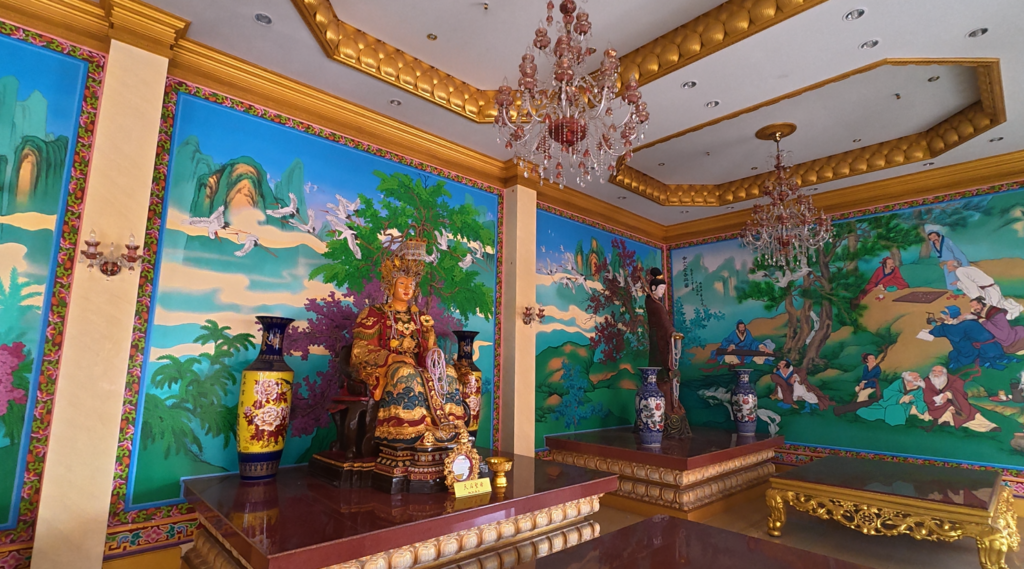
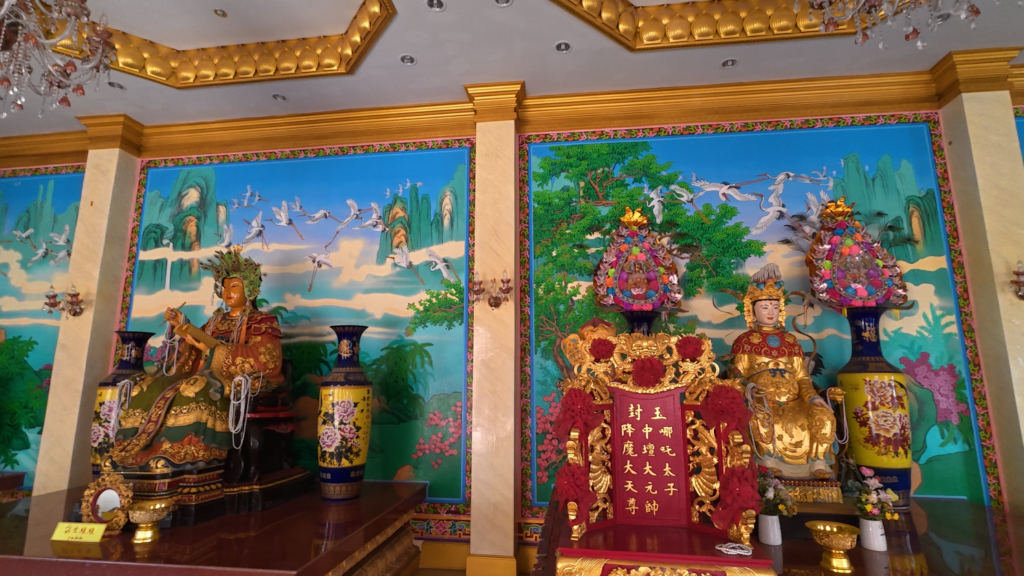
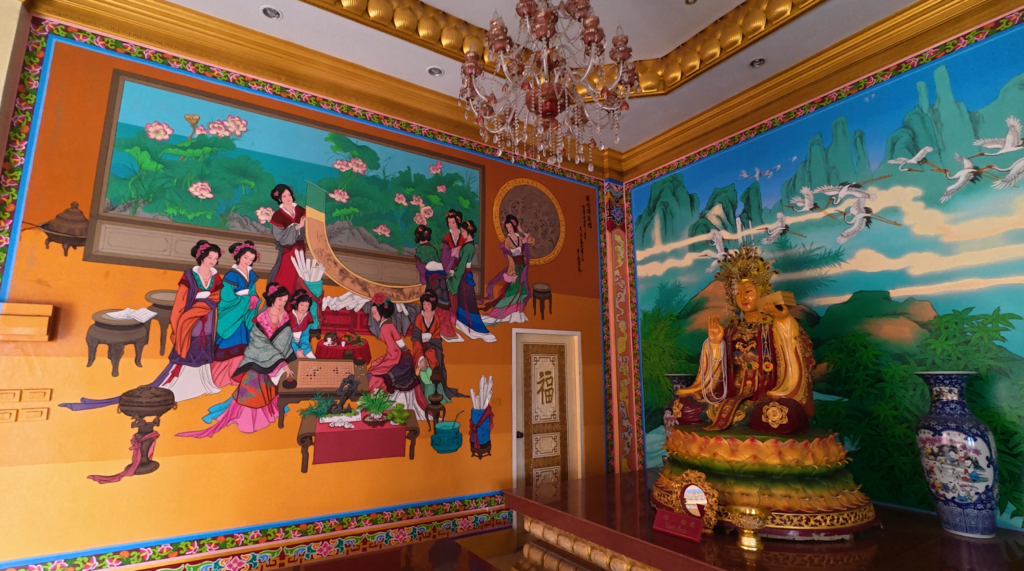
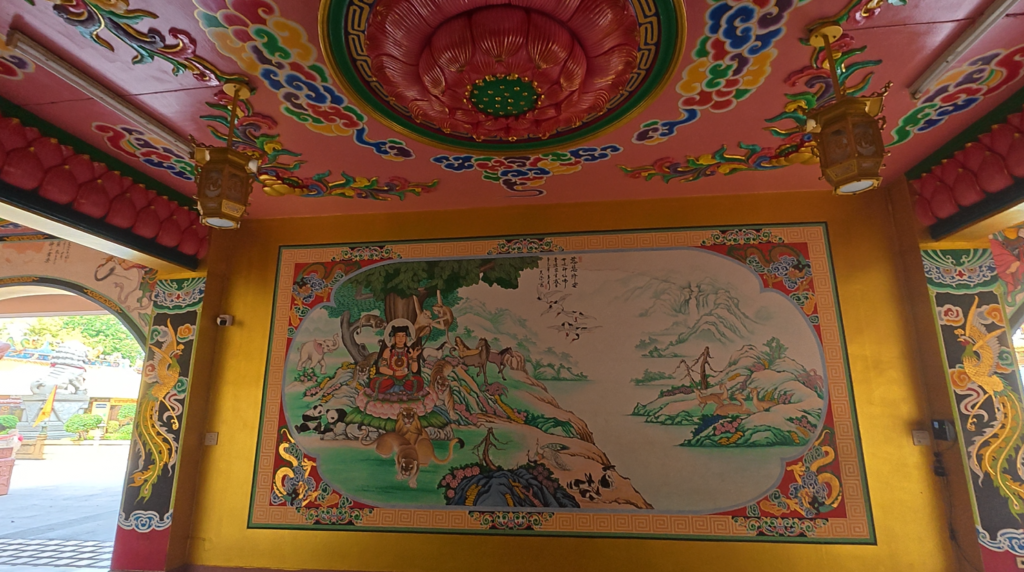
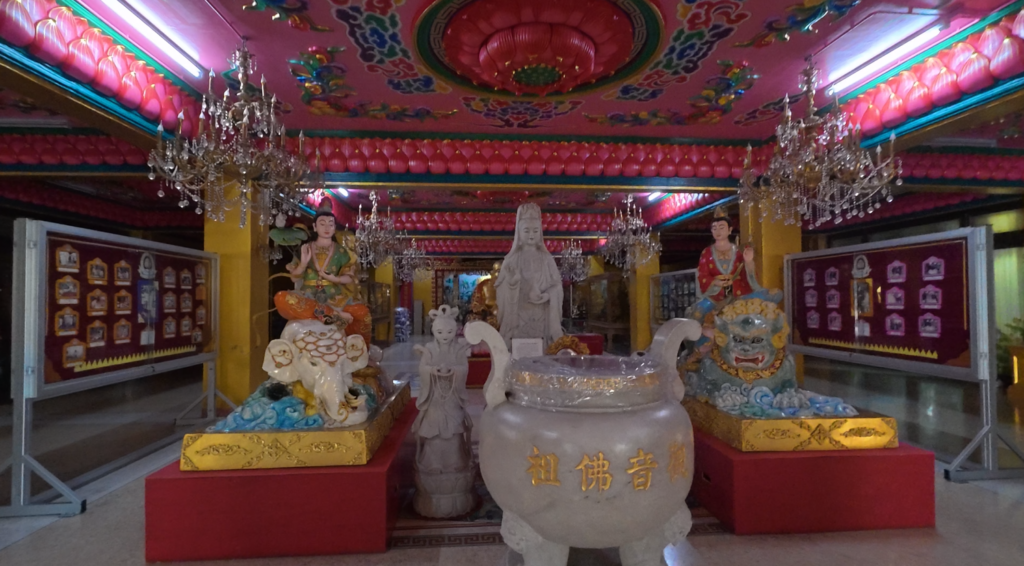
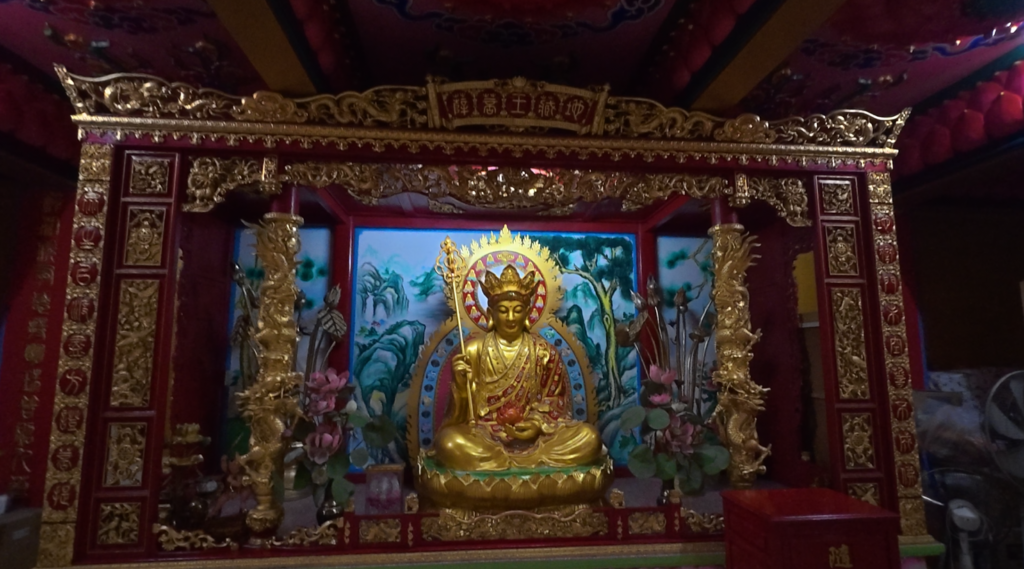
Upper rooms combine Buddhist images, royal commemorative elements and painted landscapes of mountains, cranes and sacred trees.
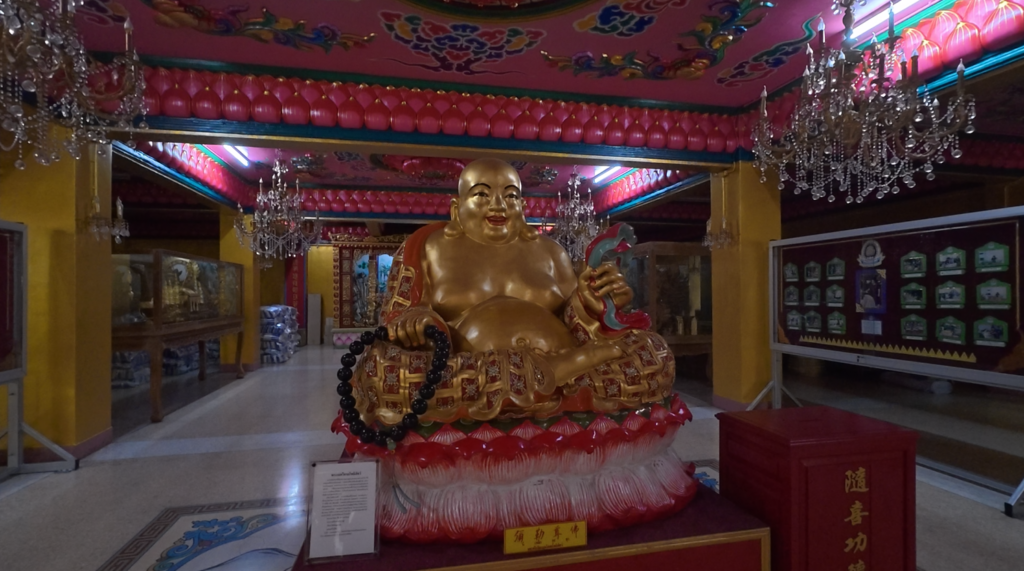
These rooms made the identity of the complex especially clear. It is not simply a Taoist temple containing a few Buddhist objects. Nor is it a Buddhist temple decorated in a Chinese style. It is a Thai-Chinese sacred environment in which traditions have been deliberately layered.
The paintings also seemed to soften the density of the lower halls. After rows of stern guardians and celestial officials, the landscapes of mountains, clouds and cranes suggested longevity, distance and spiritual release.
A Tourist Train and a Possible Future for Ang Sila
On 24 June 2023, a special KIHA 183 tourist train brought approximately 200 passengers to Chonburi Station. The program combined mangrove planting, an organized visit to Na Jasa Tai Chue Shrine, and a stop at Wat Samet.
The train did not run directly to the shrine. Visitors arrived at Chonburi Station and continued by road as part of an organized tour. Nevertheless, the event showed how railway tourism could support Ang Sila’s local economy.
A well-designed route could connect Chonburi or Saen Suk Station with Ang Sila Old Market, this shrine, Khao Sam Muk and Bang Saen. The existing railway already makes such packages possible; the essential missing element is a reliable station-to-attraction shuttle and regular scheduling.
As of 2026, there is no railway spur under construction to the shrine. The proposed three-airport high-speed railway remains delayed, while further eastern double-track expansion is still in planning and environmental-review stages. For the immediate future, organized tourist trains and road transfers remain the most realistic connection.
Leaving Through Dragons and Painted Clouds
My final walk passed beneath painted clouds, flying immortals and bright dragon reliefs. The visual intensity that had seemed overwhelming on arrival now began to make sense.
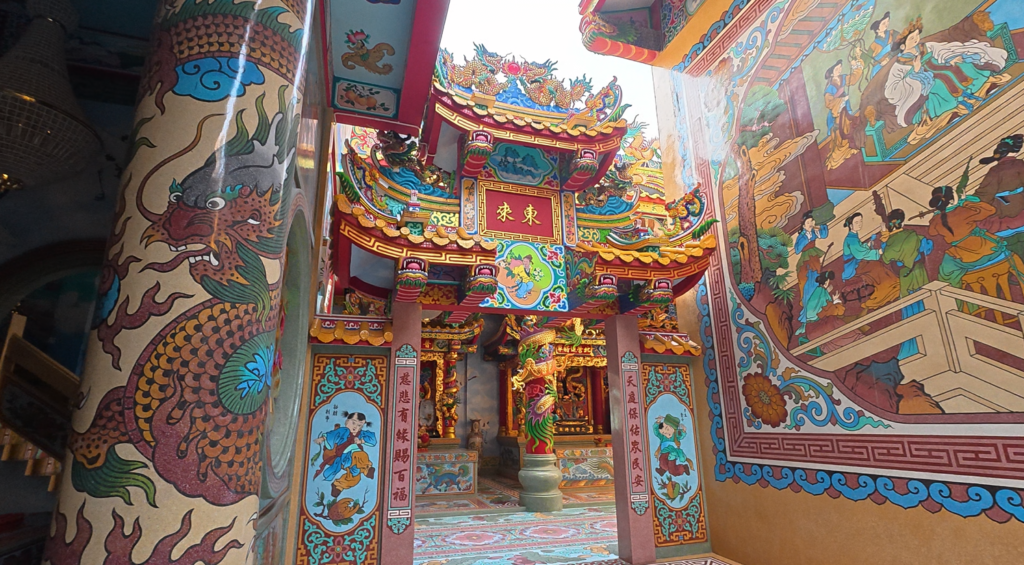
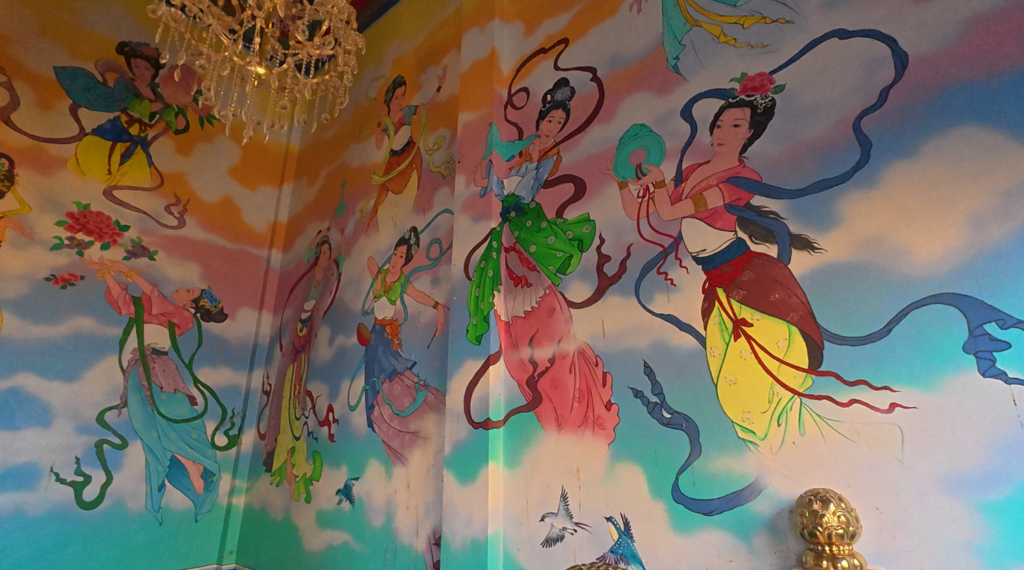
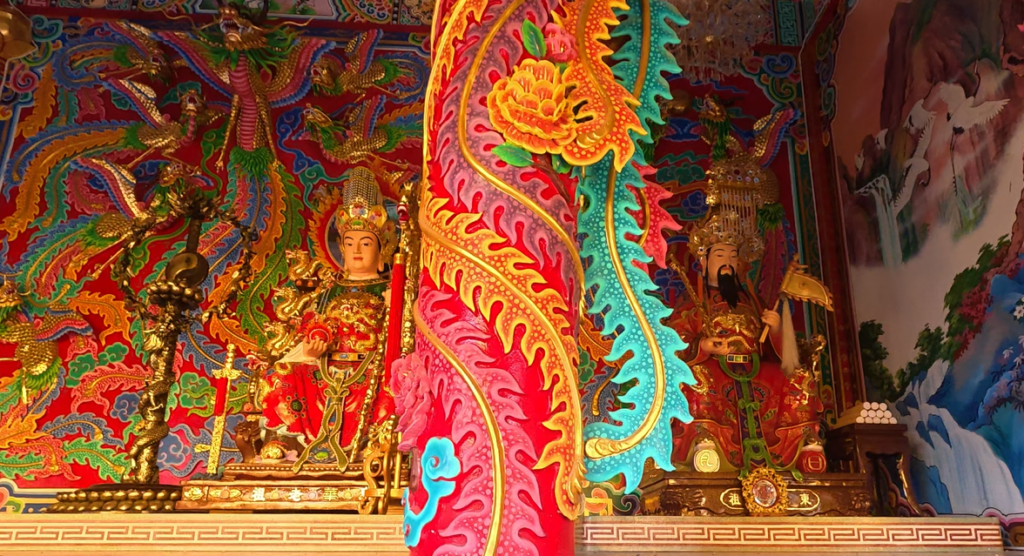
Painted immortals, clouds and brilliant dragon reliefs accompany the final passage through the shrine.
Every layer represented something different: Nezha’s protective energy, Taoist celestial order, Buddhist compassion, folk prayers for daily life, royal commemoration and the public-service role of the foundation.
I had entered expecting to see a large Chinese shrine. I left feeling that I had walked through a condensed history of how religions travel, adapt and learn to live together.
Na Jasa Tai Chue Shrine had revealed itself not as a single religious monument, but as a living meeting place of Chinese mythology, Buddhism, Thai royal history and community faith.
Outside, the yellow Cub was waiting beneath the ordinary roof of the parking area. Behind it stood the palace of gods, almost hidden from the narrow streets of Ang Sila.
The ride continued, but this was one of those places where the journey carried more history than the road first revealed.
Location and Visitor Information
Location: Na Jasa Tai Chue Shrine, Ang Sila, Mueang Chonburi District, Chonburi, Thailand
Thai name: วิหารเทพสถิตพระกิติเฉลิม – ศาลเจ้าหน่าจาซาไท้จื้อ
Admission: Free; donations are welcome
Opening hours: Approximately 8:00 a.m.–5:00 p.m. on weekdays and until around 6:00 p.m. on weekends and public holidays. Festival hours may differ.
Best time to visit: Morning or late afternoon. Chinese New Year and the Vegetarian Festival offer the most active atmosphere but also attract large crowds.
Dress: Modest clothing suitable for an active place of worship
Photography: Exterior photography is generally possible, but restrictions may apply inside particular sanctuaries. Check signs and ask staff before photographing principal statues or ceremonies.
Footwear: Follow posted instructions and remove shoes where requested
Recommended visit time: 1½–2 hours
Parking: Available within the complex
Google Maps: Na Jasa Tai Chue Shrine
For official cultural background, see the Ang Sila Municipality cultural information page. Current tourism information is also available from the Tourism Authority of Thailand.
Further historical details can be found in the Ang Sila Municipality’s cultural history
Visitor information is available through the official Tourism Authority of Thailand listing.
The journey was documented in the Thai Government PRD report on the 2023 KIHA 183
Continue exploring more temple journeys visited by Youtube Won Cub life
The Na Jasa Tai Chue Shrine in Chonburi offers a profound glimpse into the spiritual heritage of the region. Visitors are encouraged to respect the sanctity of the shrine by adhering to dress codes and photography guidelines. For a more comprehensive understanding of the shrine’s historical significance, one may refer to the Ang Sila Municipality’s cultural history resources. Additional temple journeys can be explored through the Youtube channel Won Cub Life, providing insight into various sacred sites.