A Quiet Road to an Old Village Temple
After riding for about ten minutes along a narrow country road in Pak Nam Prasae, the buildings of Wat Takhian Ngam slowly appeared through the trees.
There was no monumental entrance and no dazzling decoration waiting for me. Instead, I found a modest village temple surrounded by old trees, simple buildings, and the quiet rhythm of local life. As I parked my Honda Cub and began to walk around, the sound of a bell announced the approaching evening prayers.
At first, Wat Takhian Ngam seemed like a small temple that could easily be passed by. But the deeper I walked into its grounds, the more I realized that its story had begun long before many of the buildings standing here today.
Some of that story was still alive in the enormous trees growing beside the temple.
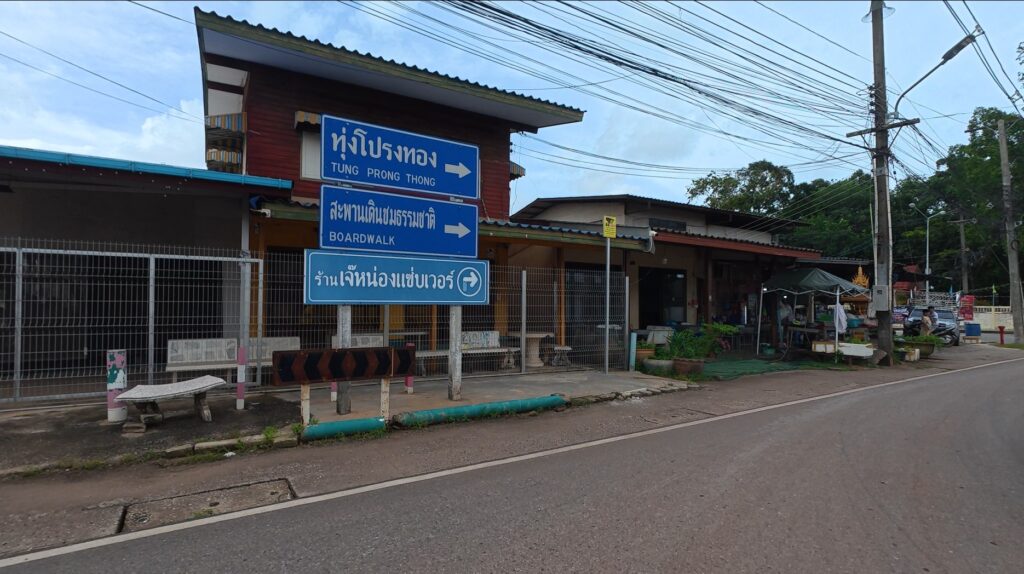
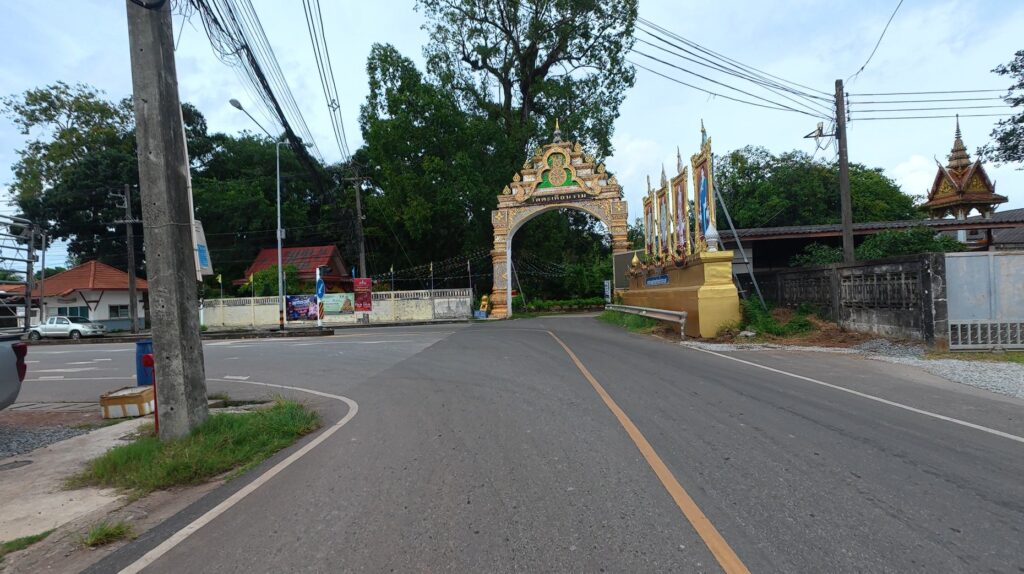
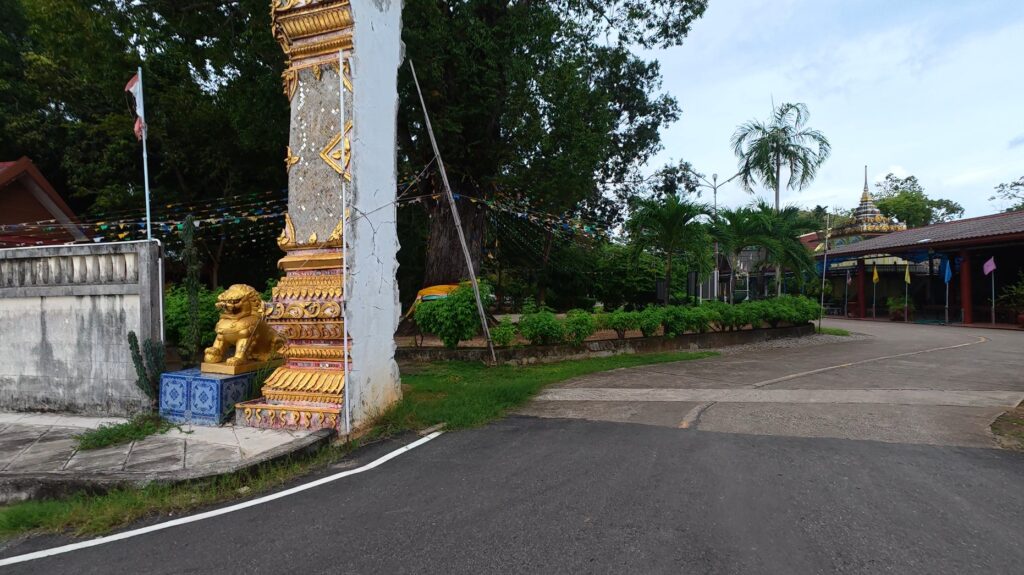
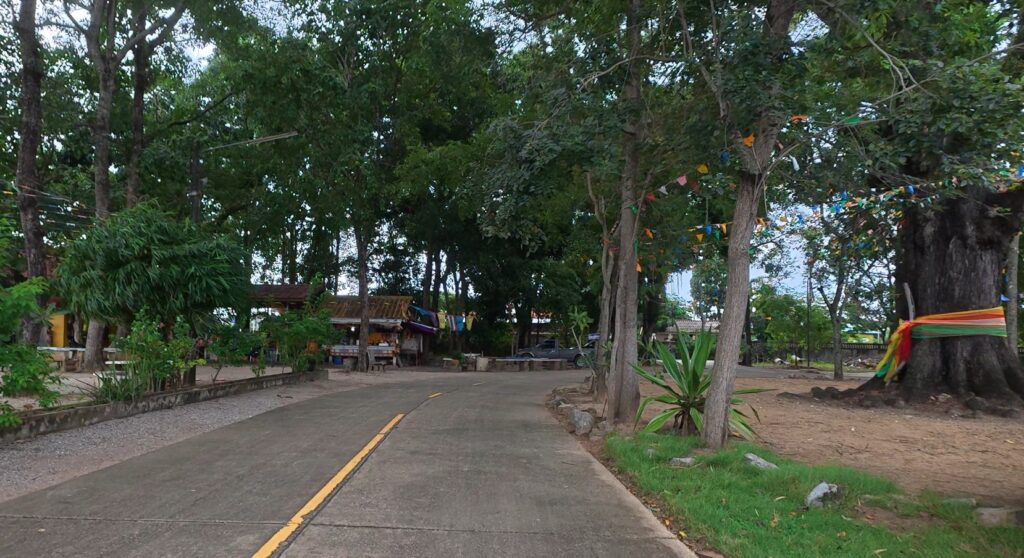
Following a quiet village road into Wat Takhian Ngam, a modest temple hidden among the trees of Pak Nam Prasae.
Beneath the Ancient Takhian Trees
Walking deeper into the temple grounds, I came to the feature that gives Wat Takhian Ngam its name — the great Takhian trees, known scientifically as Hopea odorata.
Local information preserved at the temple describes these trees as more than four centuries old. Long before modern roads, navigation apps, or coastal markers, their enormous crowns could be seen from a distance. For fishermen returning toward Pak Nam Prasae, the trees served as a familiar landmark pointing them back toward shore.
The Takhian was also valued for its exceptionally strong timber. Traditionally used for boats, houses, furniture, and tools, it was one of the important hardwoods of mainland Southeast Asia. Information displayed at the temple further connects Takhian timber from the Prasae area with royal boat building during the reign of King Mongkut, Rama IV.
But here, the importance of the trees is not only practical or historical. Over generations, the trees also became part of local spiritual life.
In Thai folk belief, very old Takhian trees are often associated with protective spirits. At Wat Takhian Ngam, sacred cloth wrapped around the trunks and traces of offerings show that these beliefs have not entirely disappeared. The trees are remembered not simply as old wood, but as living witnesses to the village and the generations that grew around them.
Standing beneath their enormous canopy, it was easy to understand why the temple itself eventually took their name.
For more about the temple and its ancient Takhian trees, the Pak Nam Prasae Subdistrict Municipality preserves a detailed local history of Wat Takhian Ngam and the surrounding community.
Pak Nam Prasae Subdistrict Municipality – Wat Takhian Ngam
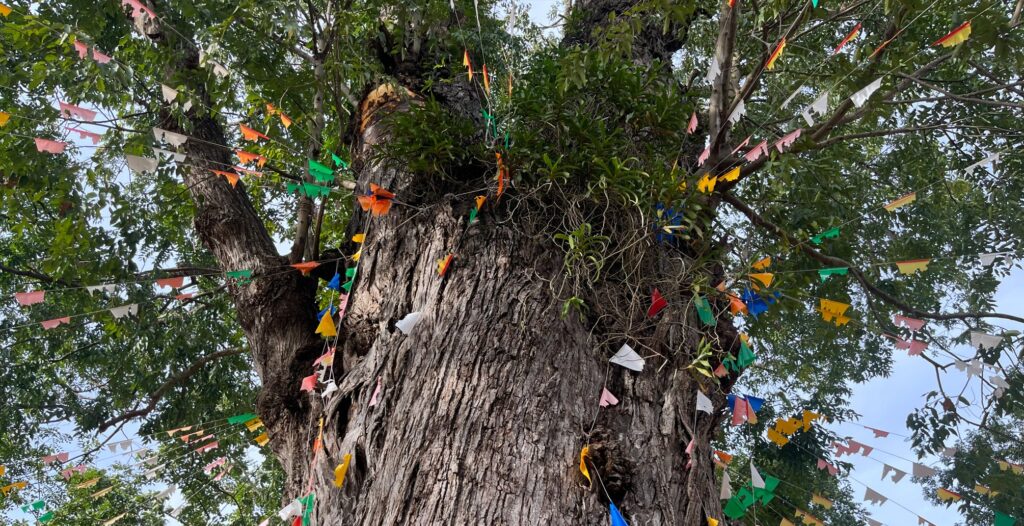
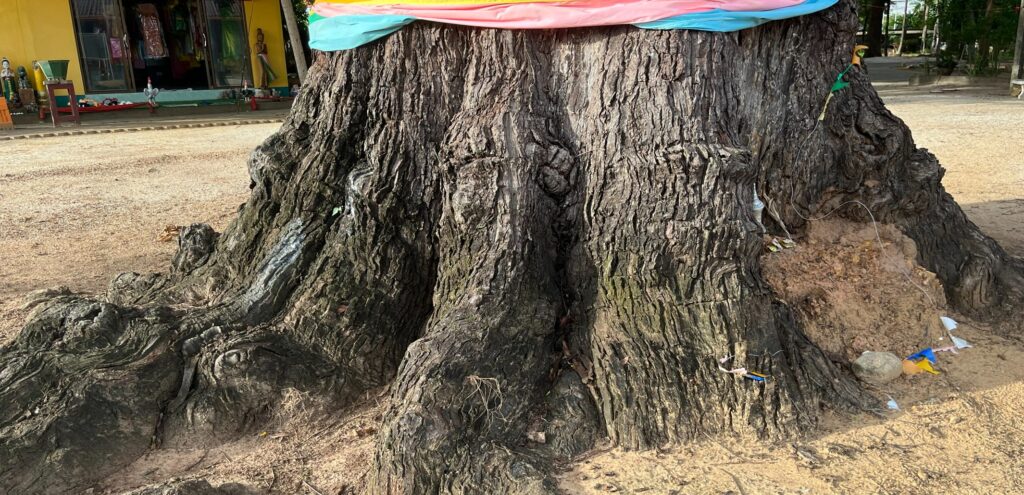
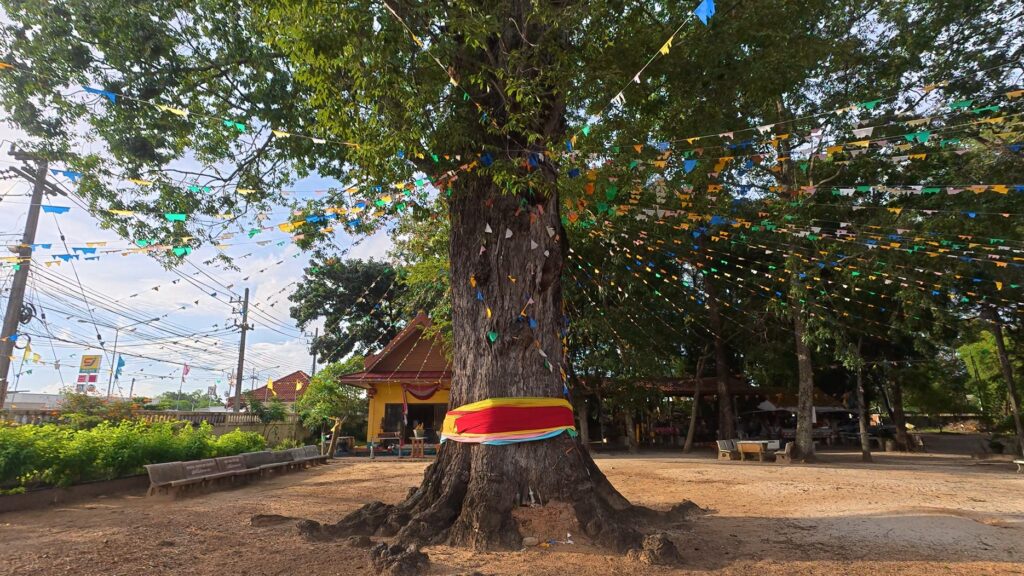
The ancient Takhian trees of Wat Takhian Ngam — living landmarks where local history, nature and traditional belief have grown together for centuries.
Ride with me through the quiet lanes of Pak Nam Prasae and experience Wat Takhian Ngam, from its ancient Takhian trees and village beliefs to the sound of evening chanting.
Wat Takhian Ngam — ancient trees, local beliefs and an evening ride through the quiet community of Pak Nam Prasae, Rayong.
Where Buddhism Meets Local Belief
Behind the great trees, a small shrine reveals another layer of the temple’s character.
Inside are small figures, colorful cloth, incense, and traces of offerings left by local people. The space is modest and easy to overlook, but it reflects something common in many Thai communities — Buddhism living side by side with older local beliefs.
Rather than existing in strict separation, temple Buddhism, spirit belief, and everyday village customs often overlap naturally. A person may come to make merit before a Buddha image, then leave an offering at a sacred tree or small shrine nearby. For local residents, these practices do not necessarily contradict one another. They are simply different ways of asking for protection, good fortune, or peace of mind.
Nearby, even part of a fallen old tree has been carefully preserved instead of discarded. A sign identifies the species and explains its traditional uses, reinforcing the sense that the trees here are regarded as part of the temple’s history rather than ordinary vegetation.
This was the moment when Wat Takhian Ngam began to feel less like a place I was merely visiting and more like a place shaped slowly by the memories and beliefs of the people who had lived around it.
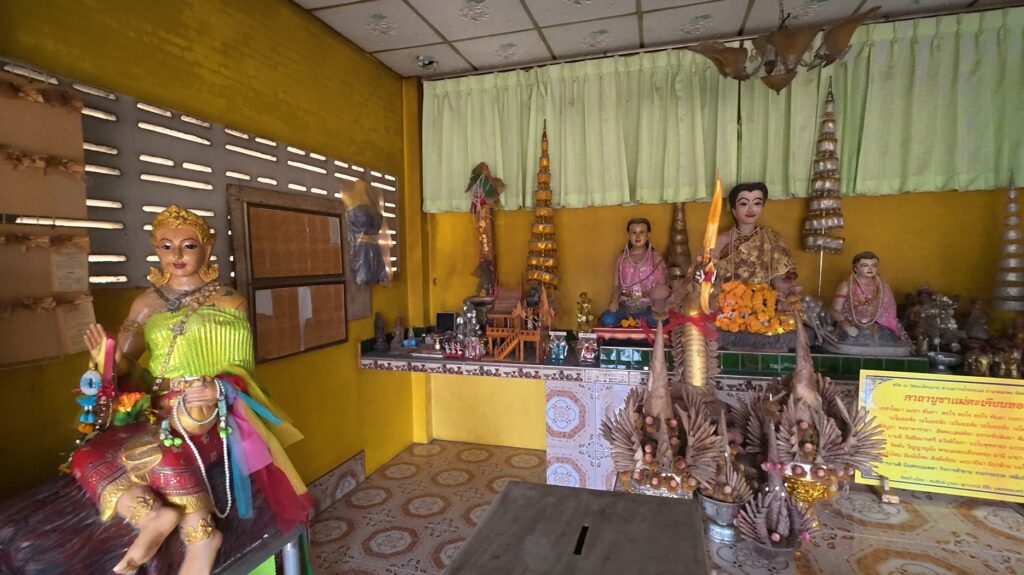
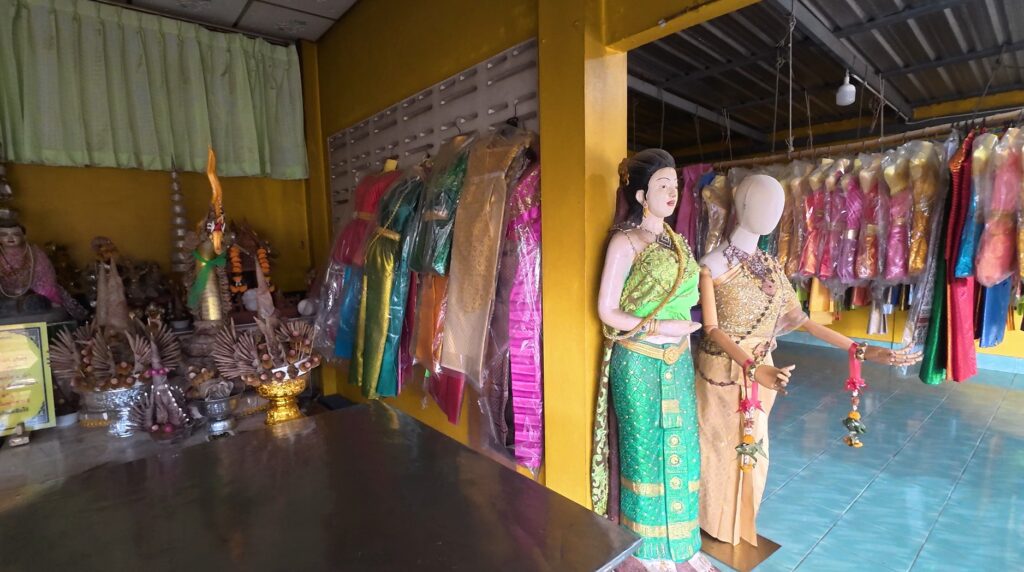
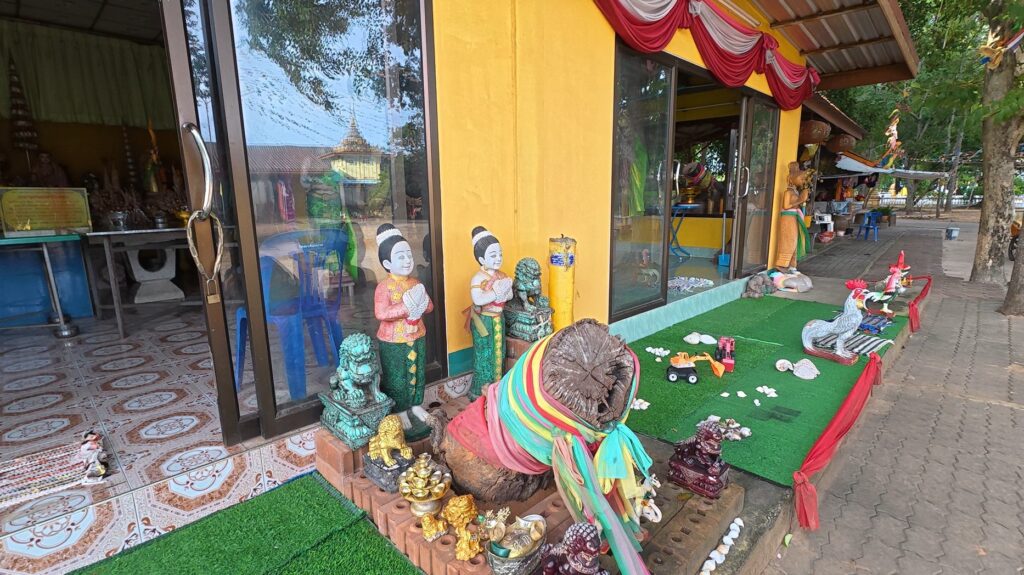
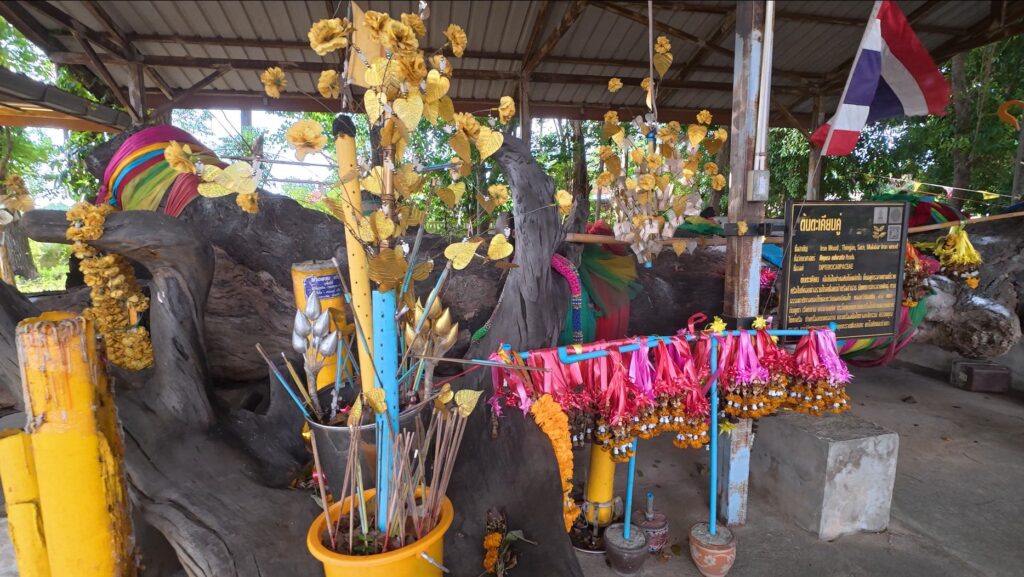
Behind the great Takhian trees, small shrines, figures and offerings reveal another layer of village belief, where Buddhism quietly coexists with older local traditions.
Stories Told Beside the Temple
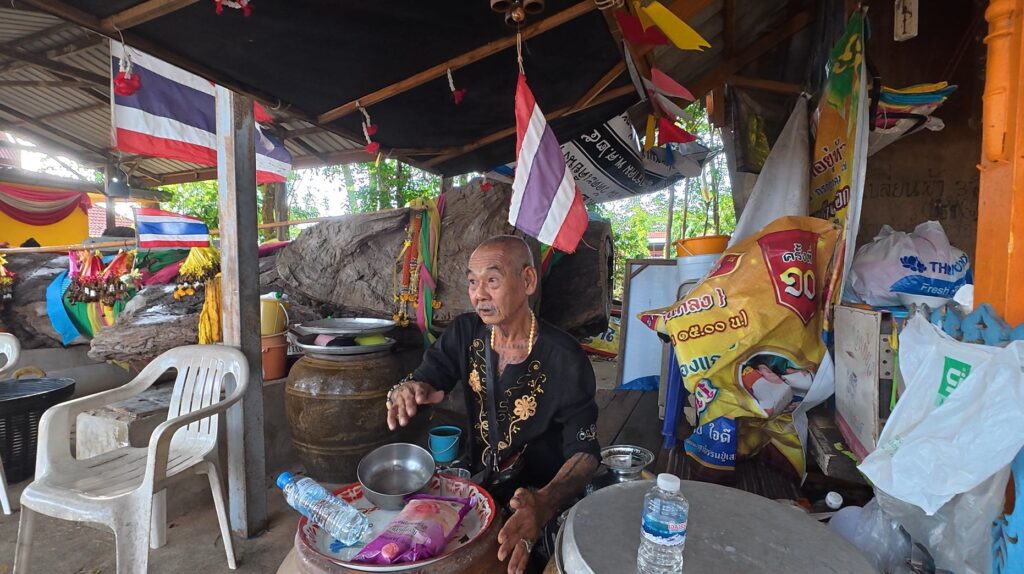
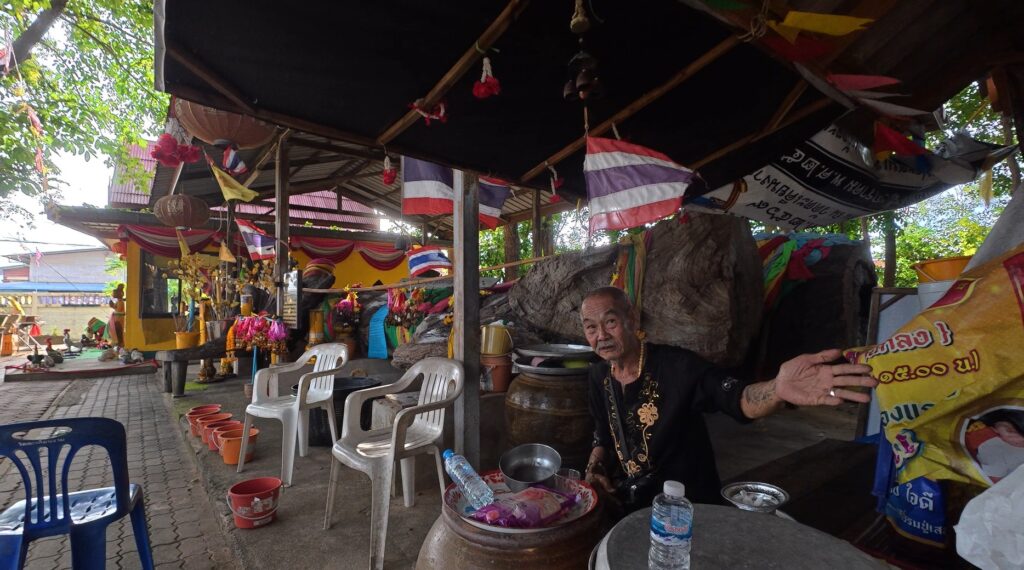
Beside the old trees was a small shop selling offerings for visitors to the temple. An elderly man was sitting there, and before long he began telling me stories about Wat Takhian Ngam.
My Thai was not good enough to understand every detail, but that did not seem to matter very much. He spoke enthusiastically and at length, pointing toward different parts of the temple as if he had many years of memories to share.
Sometimes the history of a village temple is not found only on plaques or in official records. It survives in conversations like this — in the memories of people who have watched the temple change while remaining part of everyday community life.
I thanked him and continued walking, passing another enormous tree on my way toward the ubosot.
The Sound of Evening Prayer
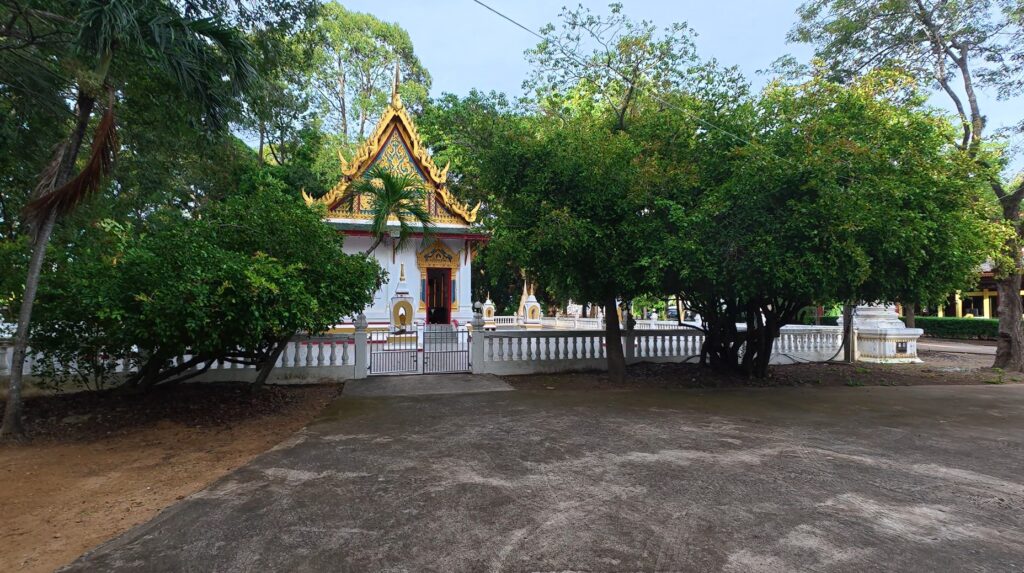
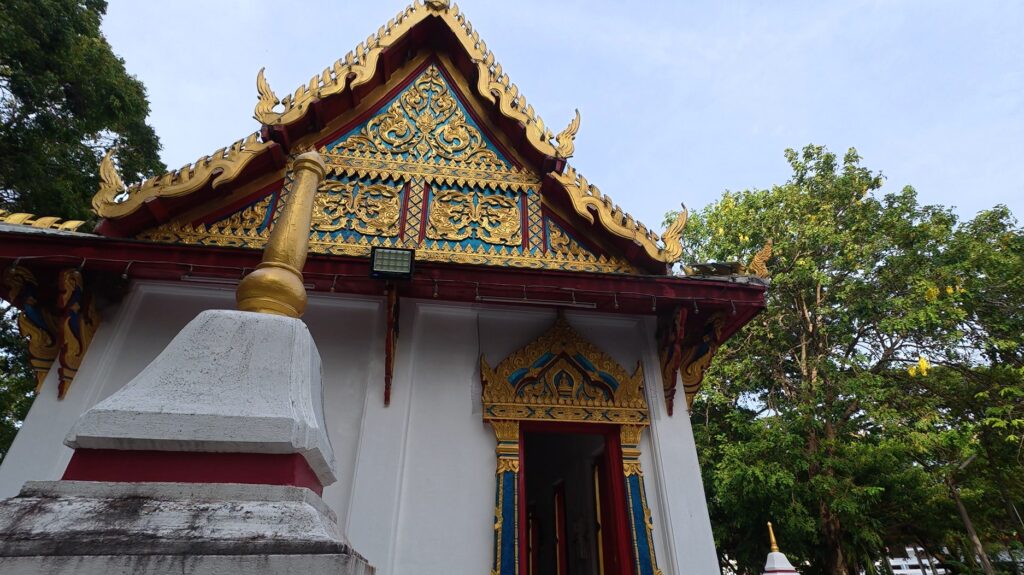
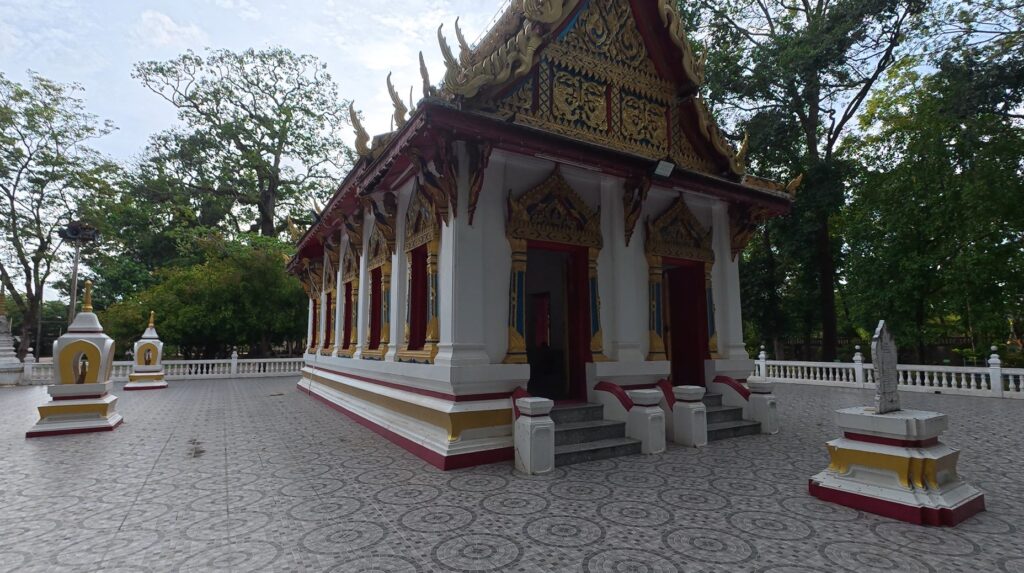
By now, the sound that had followed me since I entered the temple had changed. The bright rhythm of the bell had given way to the steady voices of monks chanting inside the ubosot, the temple’s ordination hall.
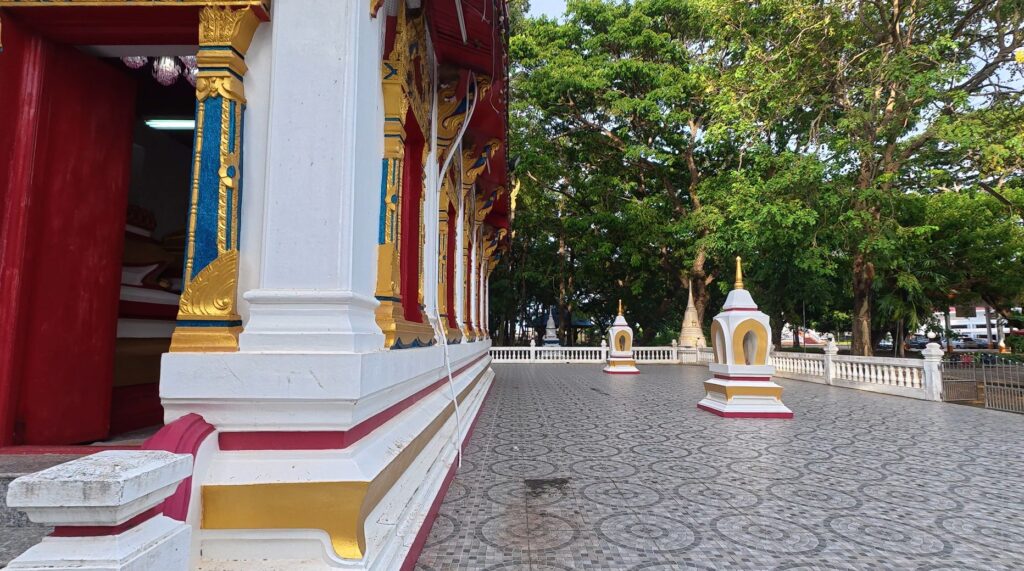
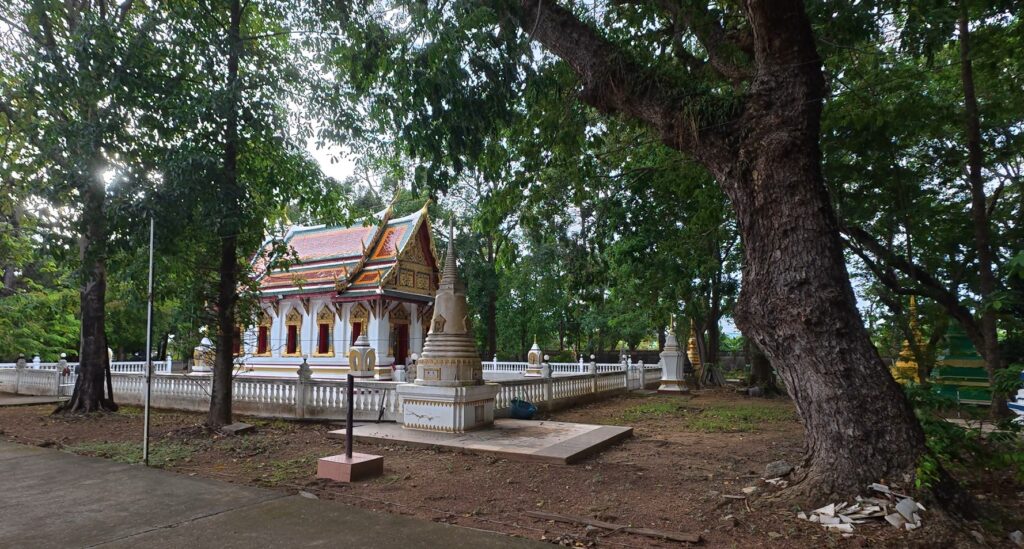
Boundary stones known as bai sema stood around the building, marking the sacred space traditionally reserved for important monastic ceremonies. Through the front entrance I could catch only a brief glimpse inside.
I walked quietly around the side of the hall and approached the rear entrance. Several monks were seated together, reciting Buddhist scriptures in the calm rhythm of evening prayer.
For a moment I simply listened.
There was no performance and no tourist ceremony. It was an ordinary evening at a village temple — monks chanting as they had done countless evenings before, their voices carrying beyond the walls and through the surrounding trees.
I worried that my camera might disturb them, so I did not stay.
Sometimes respecting a place means knowing when not to enter.
A Temple Rooted in the Old Community
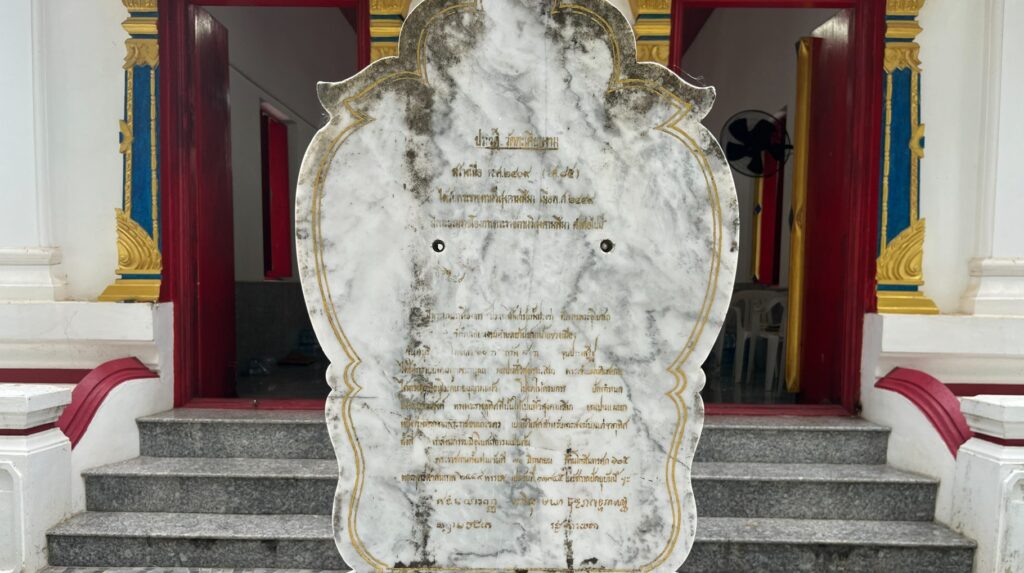
After stepping away from the chanting, I stopped in front of a stone inscription recording part of the temple’s history.
Wat Takhian Ngam did not begin as a grand religious complex. Its origins are tied to the old community of Pak Nam Prasae and to the enormous Takhian trees that had already stood here for generations. Local historical accounts trace the establishment of the temple to 1866, during the reign of King Mongkut, Rama IV.
The connection with Rama IV is particularly interesting because the reign marked a period when Siam was opening more actively to the outside world while coastal communities continued to depend heavily on fishing, boats and maritime trade. Here in Prasae, however, that larger national history feels very distant. What remains is a small temple that grew together with its village.
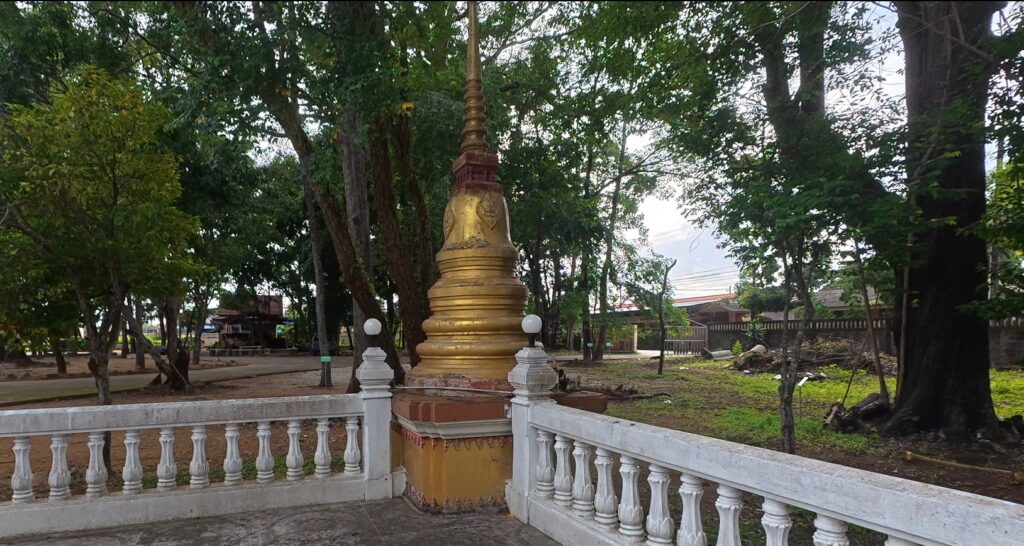
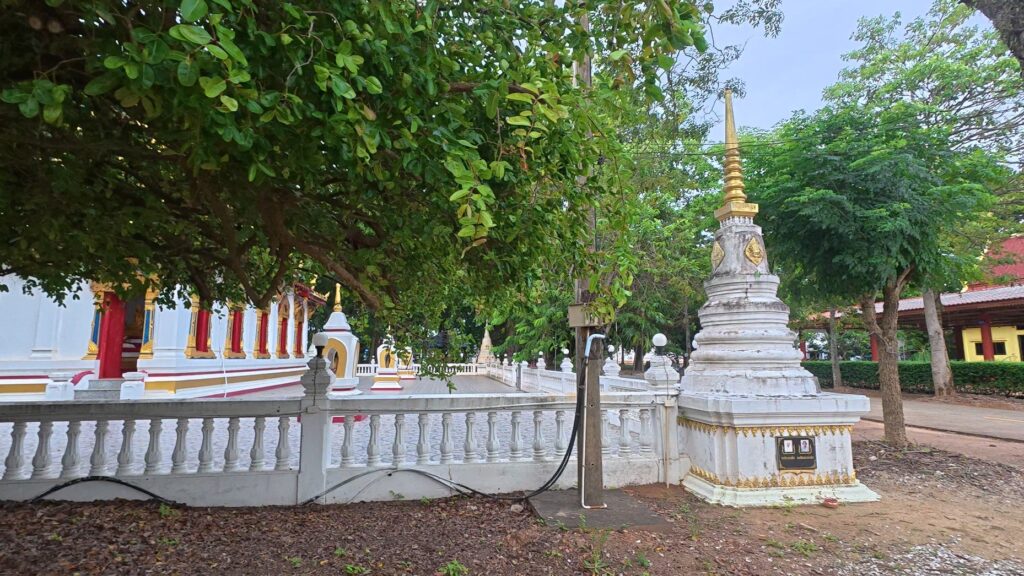
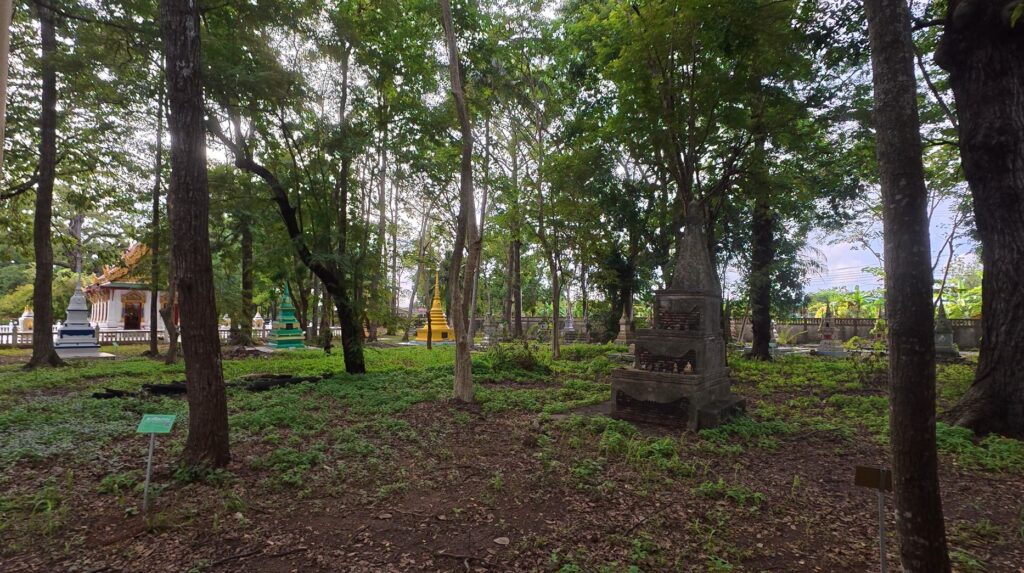
Nearby stands a chedi, while smaller stupas are scattered farther behind the main temple buildings. Some may preserve ashes or memorials connected with monks and local families, a practice commonly found in Thai temples. Rather than forming a monumental complex, they seem to have accumulated gradually as generations passed through this place.
That may be one of the most interesting things about Wat Takhian Ngam.
Its history is not expressed through grandeur.
It is written in an old tree, a weathered building, a small chedi, a stone inscription — and in the sound of monks chanting at the end of an ordinary day.
Small Shrines and Everyday Belief
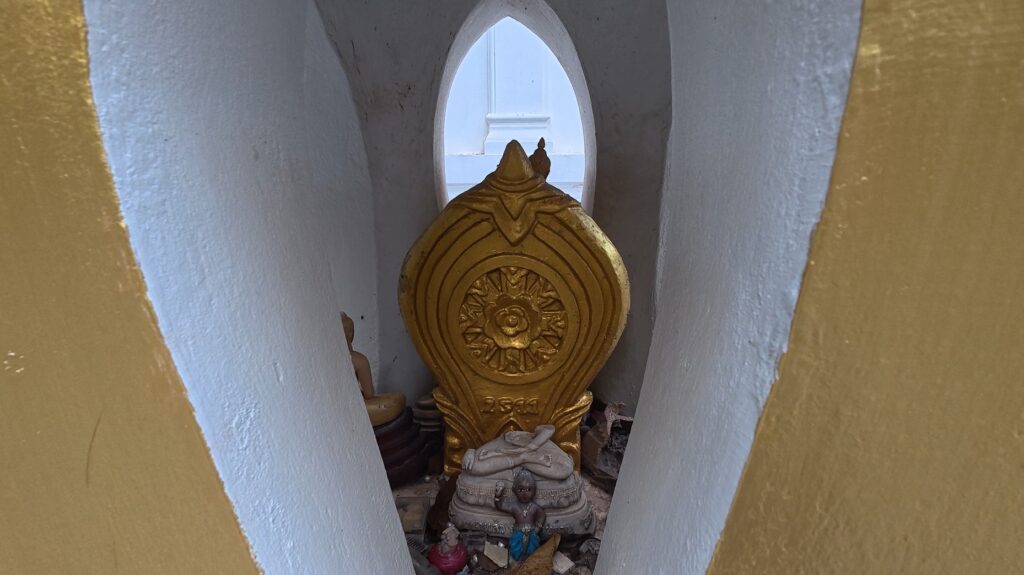
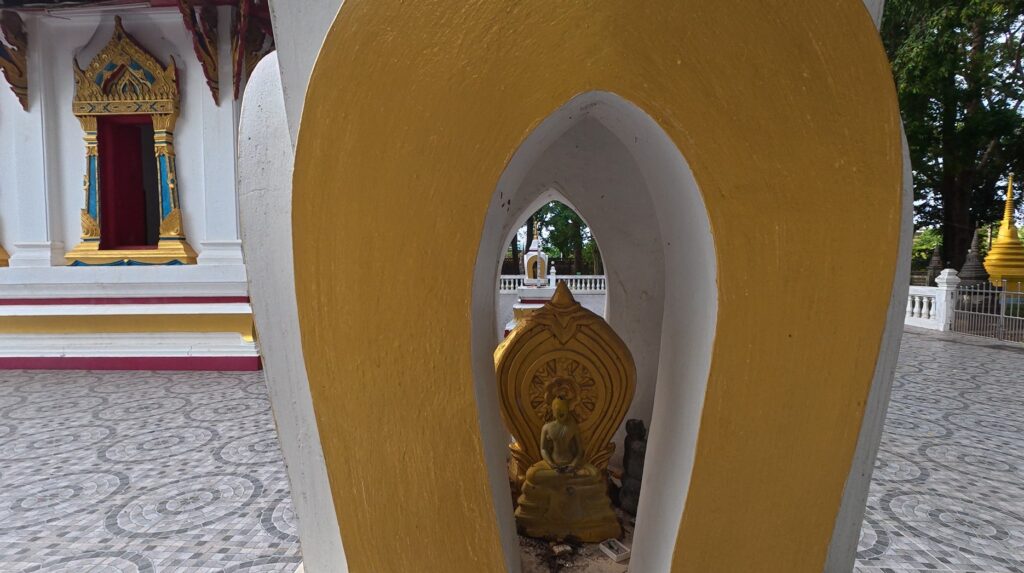
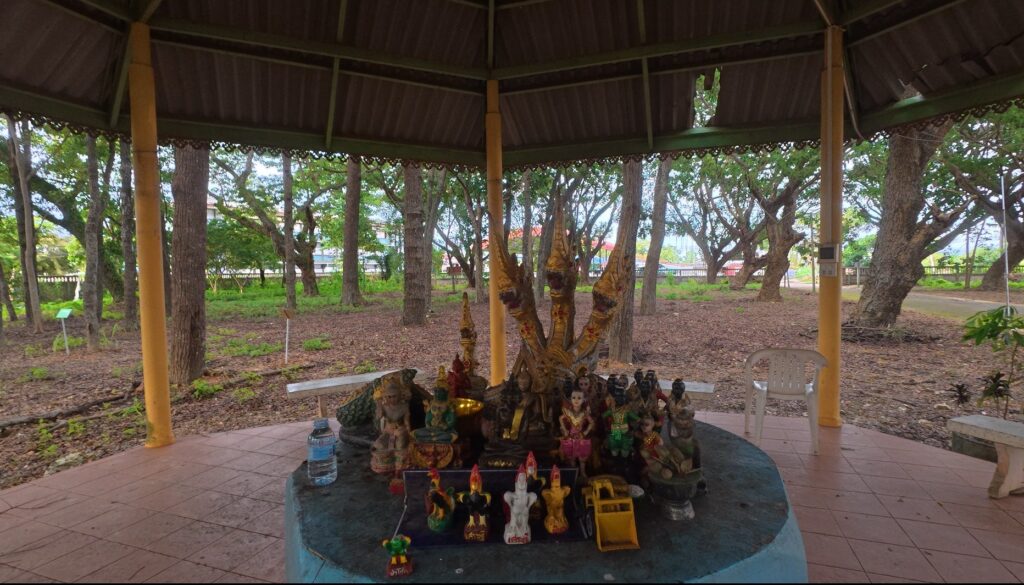
Behind the main temple buildings, I found several small chedis and a simple roofed shrine. Inside were small figures with traces of incense and offerings.
Their exact identity was not clearly marked, so it would be misleading to give them a definite name. What was clear, however, was that people still stopped here to pray.
Scenes like this are easy to miss in Thailand’s larger and more famous temples. Yet in a village temple, they reveal how religious life actually works. Theravada Buddhist practice can exist comfortably beside older spirit traditions and Hindu-influenced imagery, each finding a small place within the same sacred landscape.
Nothing here was monumental. Perhaps that was precisely why it felt so personal.
An Ordinary Afternoon at the Temple
Walking back toward the main buildings, I passed a small traditional-style structure that looked much older than its size might suggest. A plaque on the building records B.E. 2526 (1983), reminding me once again that appearances alone cannot tell the full history of a temple.
Then I noticed an elderly monk quietly pulling weeds from the garden.
There was no ceremony around him and no one watching. Beside him, a dog rested comfortably, apparently accustomed to following the monk through his daily routine.
It was one of the simplest scenes of my visit, but also one of the most memorable.
Ancient trees, royal-era history and local beliefs tell us where Wat Takhian Ngam came from. But an elderly monk tending the garden and a dog resting nearby showed me what the temple is today — not a museum of the past, but a place that is still being lived in.
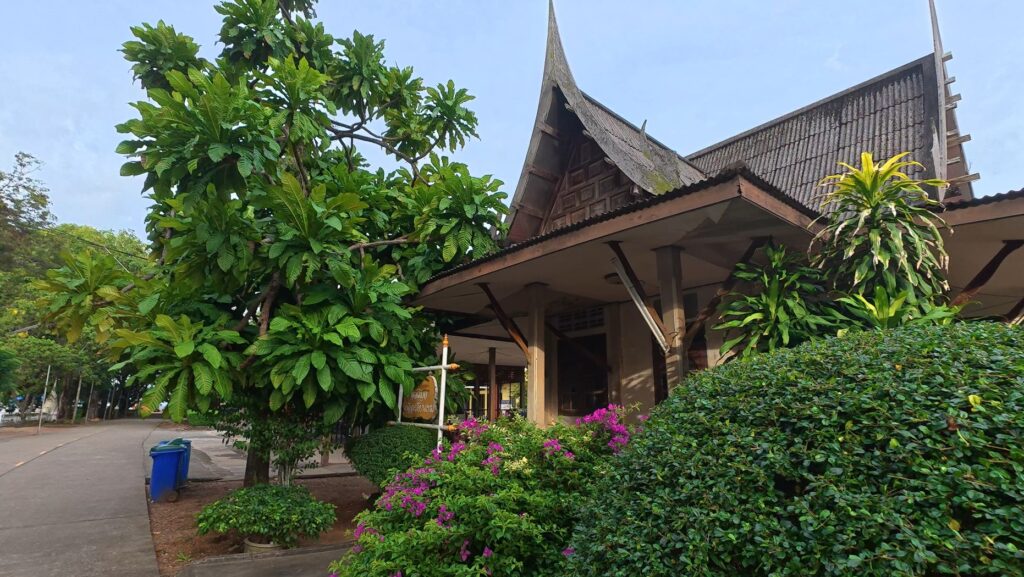
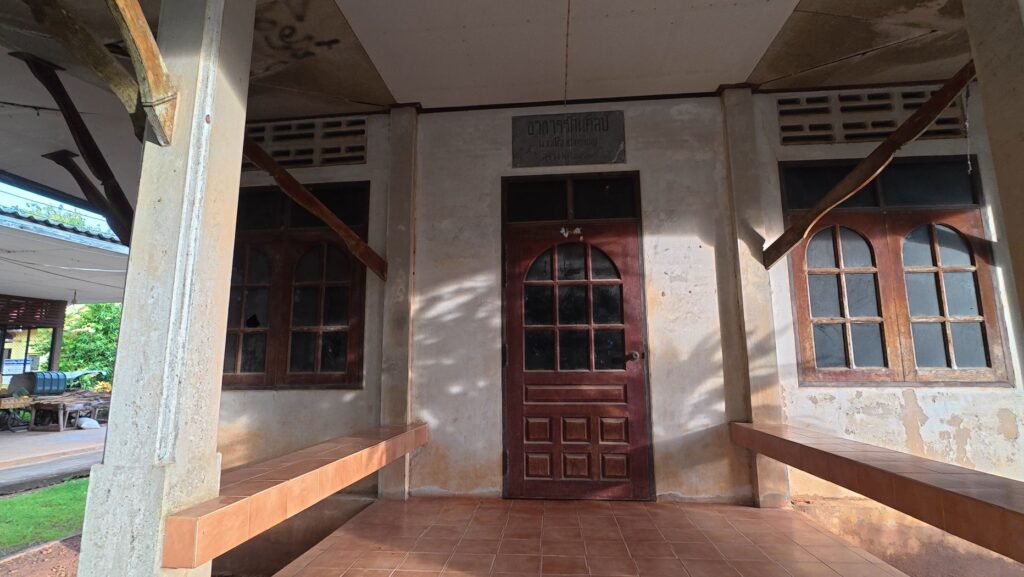
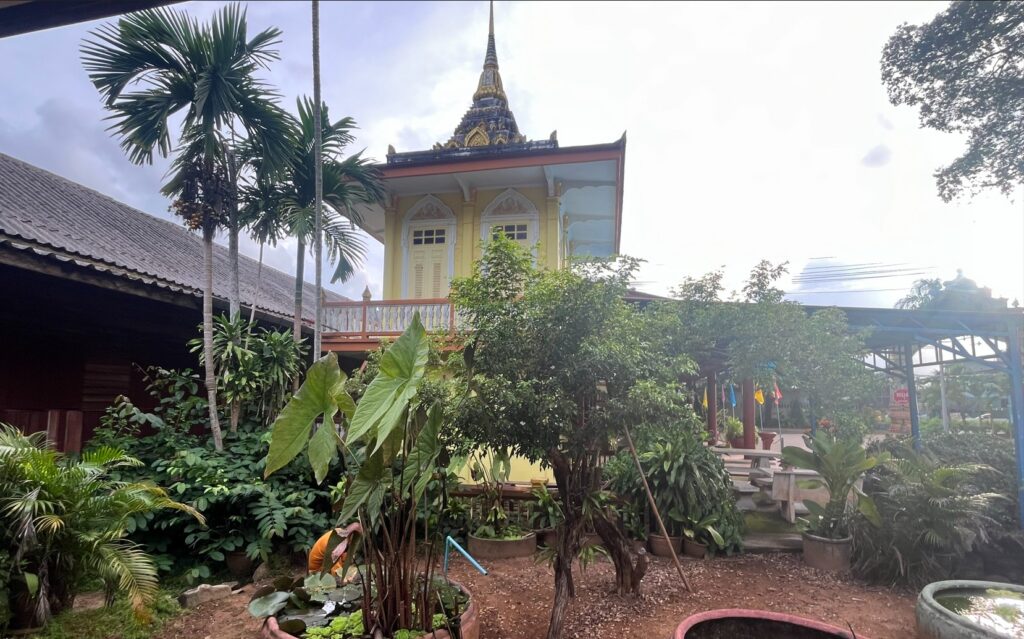
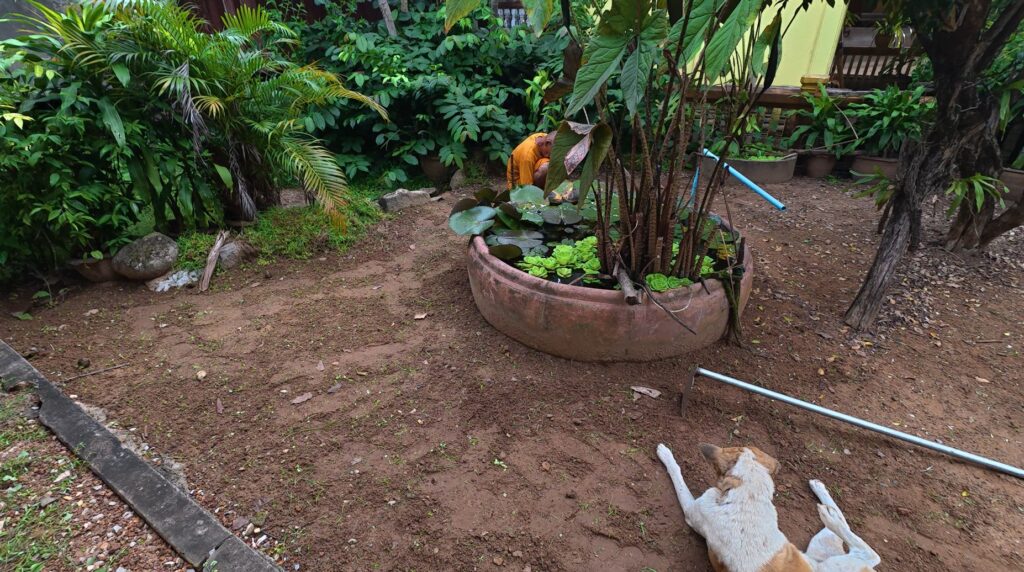
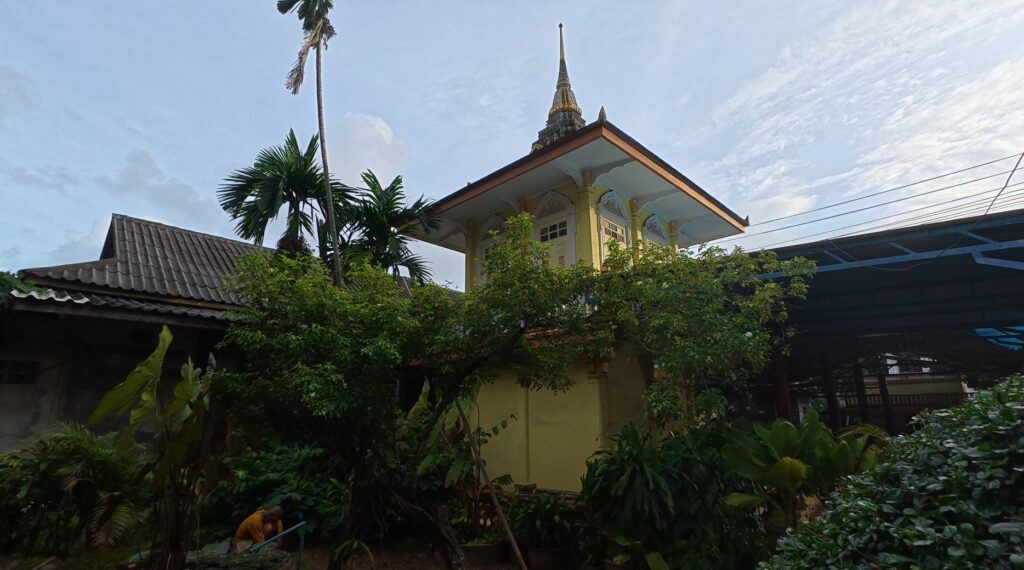
Away from the ancient trees and sacred spaces, everyday life continues quietly at Wat Takhian Ngam — an elderly monk tending the garden, simple temple buildings, and the peaceful rhythm of a village monastery.
Leaving the Temple at Dusk
By the time I returned to Woncub, the afternoon light had begun to soften.
Wat Takhian Ngam had never tried to impress me with size or decoration. Its character came from something quieter — ancient trees, village memory, small shrines, weathered buildings, monks at prayer, and ordinary people who had kept returning here for generations.
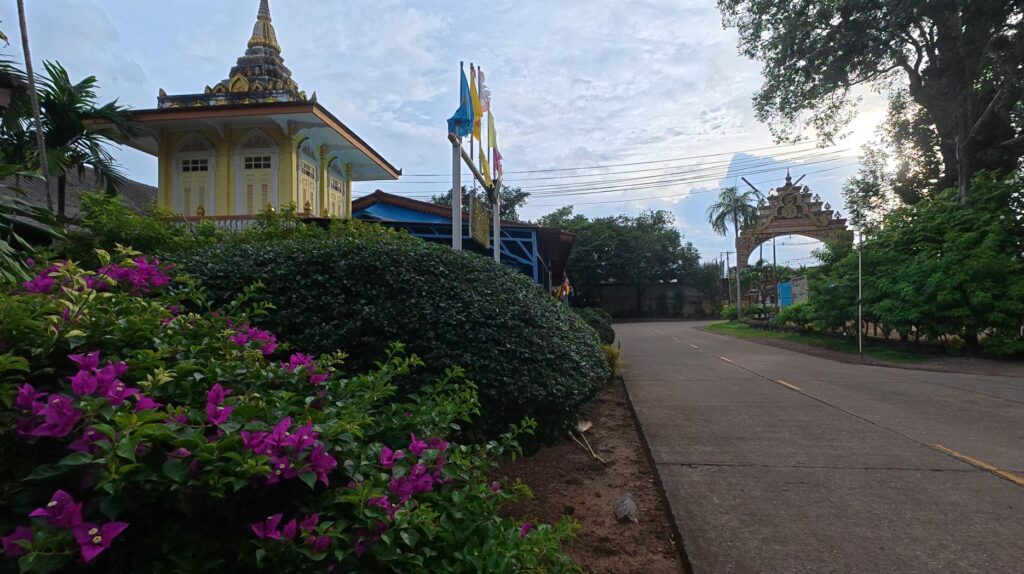
I rode away through the same narrow lanes that had brought me in.
For a while, the temple disappeared behind the trees.
But the day was not quite finished.
A Quiet Place to End the Day
My accommodation for the night was only a short ride away.
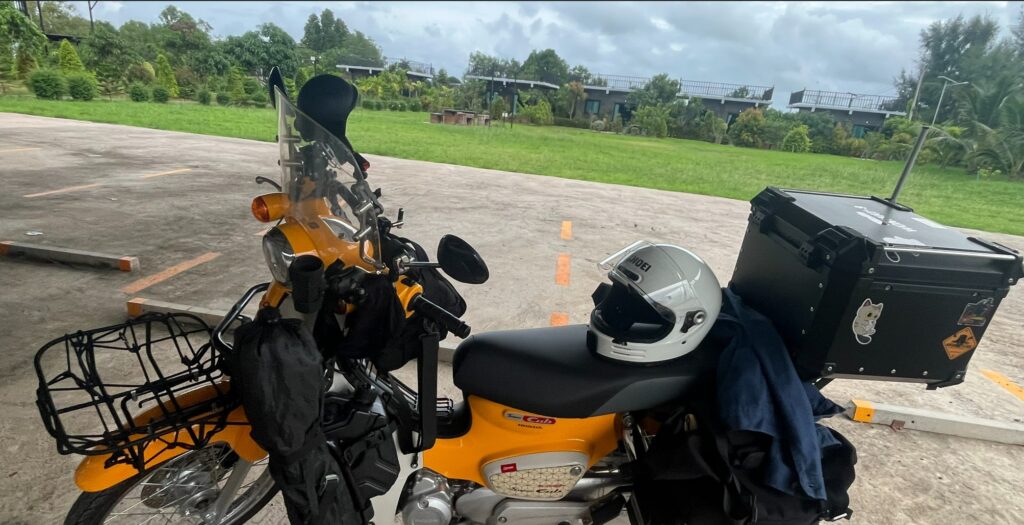
The small local resort was simple, peaceful and surprisingly spacious. There were ponds, gardens and plenty of room to park Woncub safely under cover. At 600 baht for the night, it felt like exactly the kind of place a tired rider hopes to find at the end of a long day.
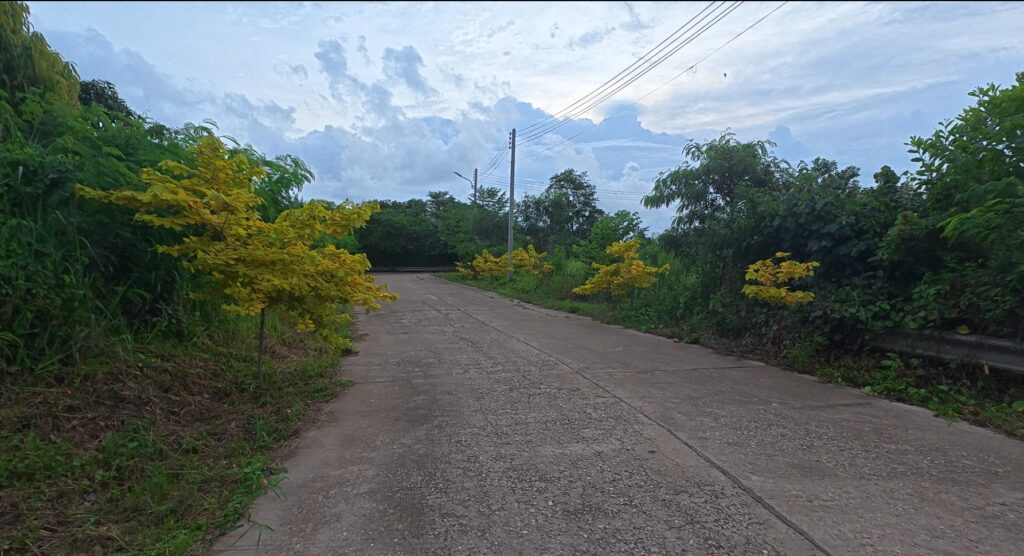
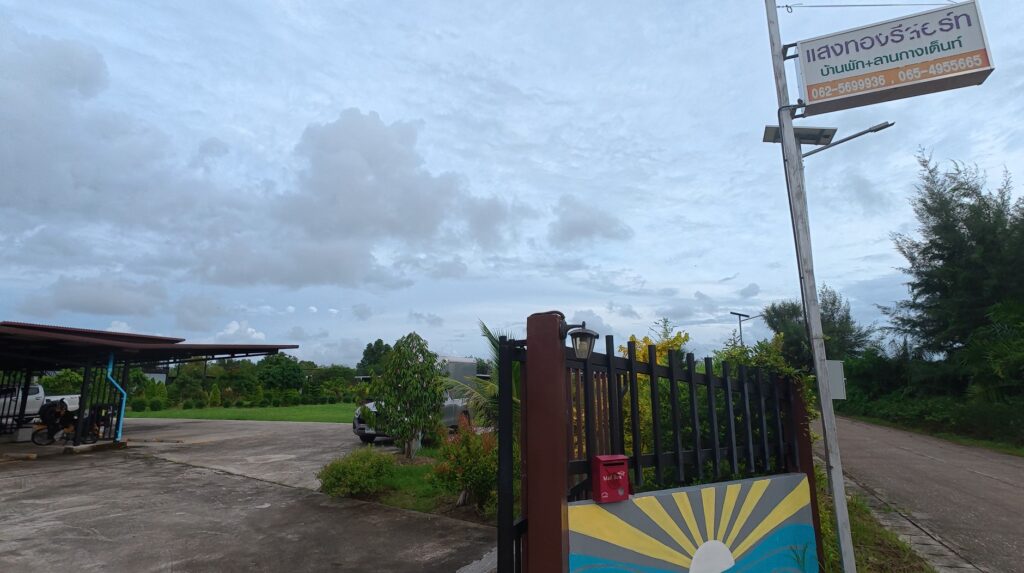
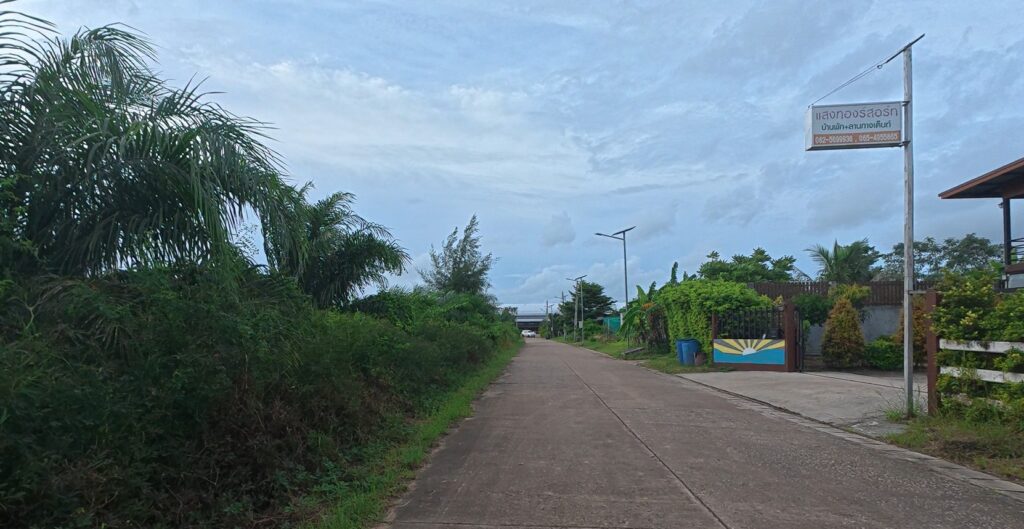
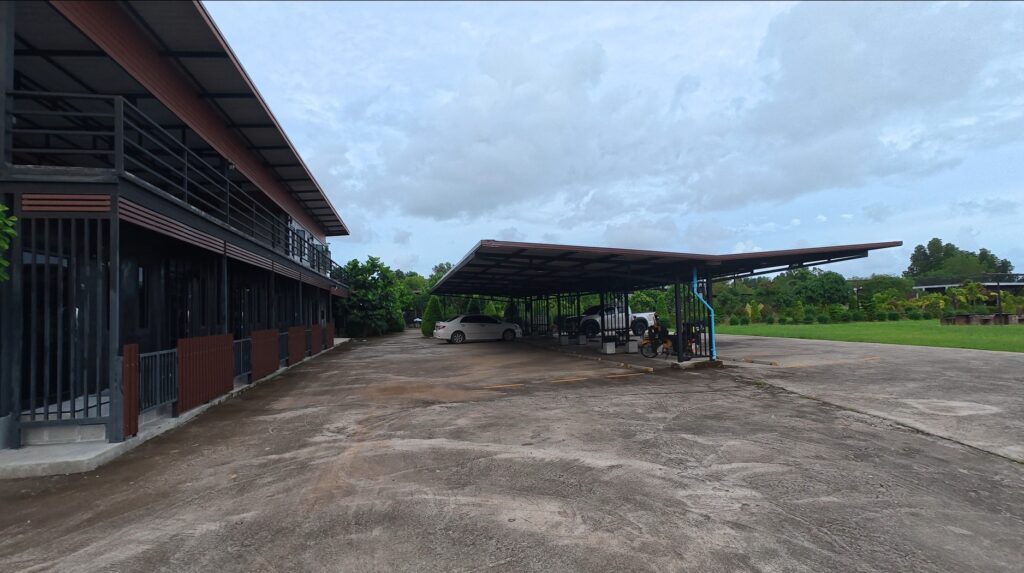
Leaving Wat Takhian Ngam in the late afternoon, Woncub follows the quiet village lanes toward a small local resort for the night.
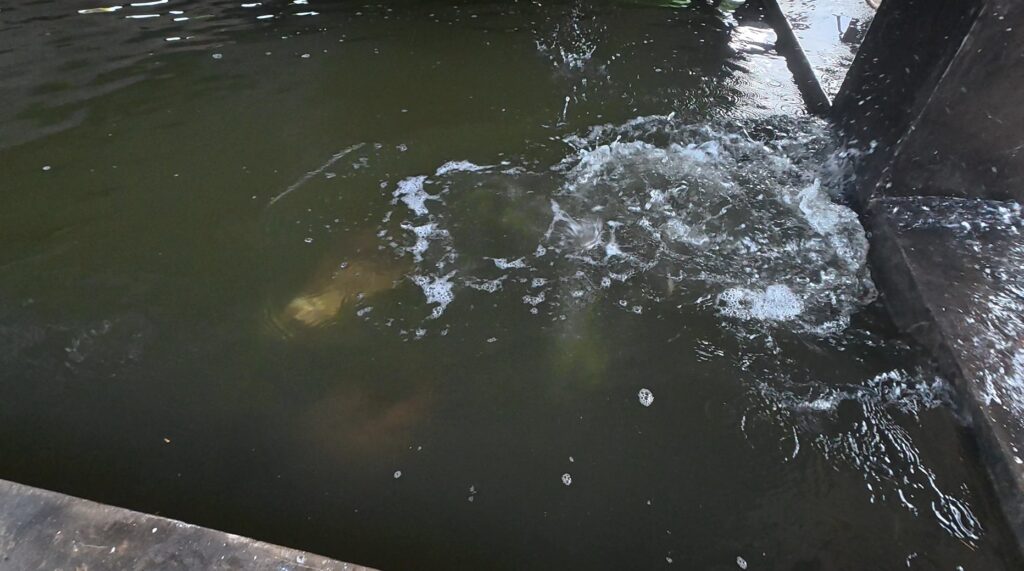
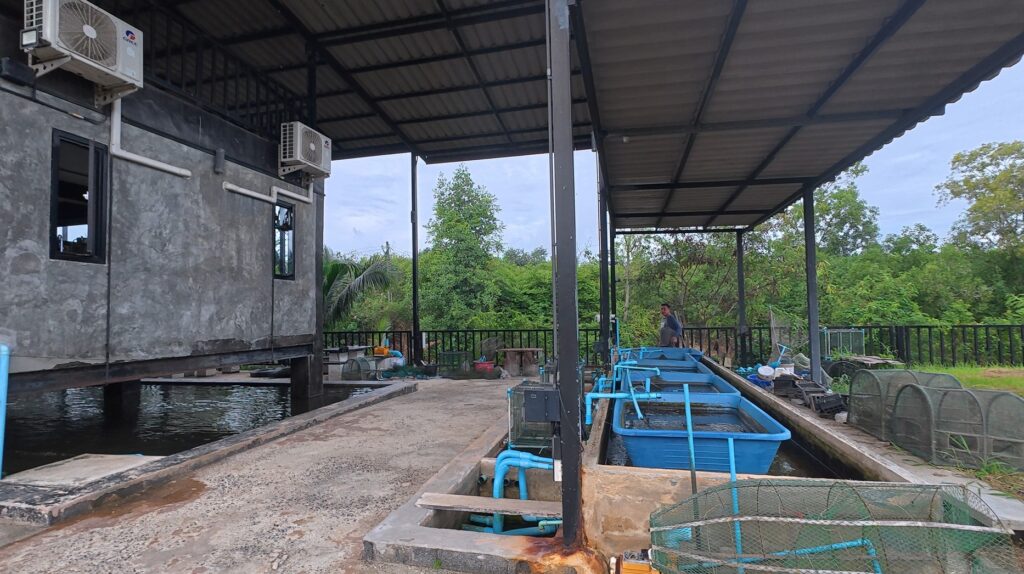
The owner showed me around and handed me some food for the fish in the pond. The moment the food touched the water, the calm surface suddenly exploded as the fish rushed upward.
For a few seconds, the peaceful resort became unexpectedly lively.
Then the water settled again.

The Chanting That Followed Me Home
As evening settled over Pak Nam Prasae, I heard something familiar.
From the direction of Wat Takhian Ngam came the distant sound of monks chanting.
Only a short time earlier, I had stood beside the ubosot listening to those same voices. Now, from my room at the resort, the sound was still drifting through the village.
It felt like a fitting end to the day.
More than four hundred years ago, fishermen returning from the sea looked for the great Takhian trees to guide them toward home.
That evening, I could no longer see those trees.
But I could still hear the temple that had grown beside them.
The road was quiet, Woncub was resting, and the chanting continued softly in the distance.
Won Cub Life continues.
Location & Visitor Information
Wat Takhian Ngam (วัดตะเคียนงาม)
Pak Nam Prasae, Klaeng District, Rayong, Thailand
Admission: Free. Donations to the temple are welcome.
Best Time to Visit: Morning or late afternoon. Visiting toward evening may also offer a chance to experience the quiet atmosphere of the temple as monks prepare for evening chanting.
Dress: Modest clothing covering the shoulders and knees is recommended when entering Buddhist religious areas.
Photography: Photography around the temple grounds is generally possible, but avoid photographing monks at close range during chanting or religious ceremonies without permission.
Visit Time: Allow approximately 45–90 minutes if you want to explore the ancient Takhian trees, shrines, ubosot and quieter areas of the temple without rushing.
Footwear: Comfortable walking shoes or sandals are sufficient. Remove footwear before entering areas where temple etiquette requires it.
Google Maps — Wat Takhian Ngam:
https://maps.app.goo.gl/8QoVusGPZS4j7UV49?g_st=ic
Where I Stayed
After leaving Wat Takhian Ngam, I rode only a short distance through the village to a small local resort where Woncub and I stopped for the night.
The accommodation was simple but peaceful, with plenty of open space, ponds and convenient covered parking directly beside the room. I paid 600 baht for the night during my visit.
What made the stay memorable was not the price, however. As evening settled over the village, I could still hear Buddhist chanting drifting from Wat Takhian Ngam in the distance — a quiet continuation of the temple visit even after the day’s ride had ended.
Google Maps — Resort: แสงทองรีสอร์ท (Saeng Thong Resort)
https://maps.app.goo.gl/D5fMt41rK9W6P8sA6?g_st=ic
Accommodation prices and availability may change, so check directly with the property before visiting.
Explore more village temples and sacred places discovered along my Honda Cub journeys across Thailand.