Riding Through the Rain
The journey to Tham Khao Bot Temple began under a grey sky.
Rain had already darkened the road, and water sprayed from the tires as I continued toward the day’s destination. The countryside was quiet, almost empty, and the wet road seemed to stretch endlessly ahead.
Then the landscape began to change.
A limestone cliff appeared in the distance.
Its dark rock face rose sharply above the trees, standing alone against the brighter sky. As I drew closer, a small temple building came into view at the foot of the mountain.
After riding through the rain, I had finally reached Tham Khao Bot.
There was nothing grand or crowded about the place.
Only a quiet temple, a massive wall of limestone and the feeling that something much older was waiting inside.
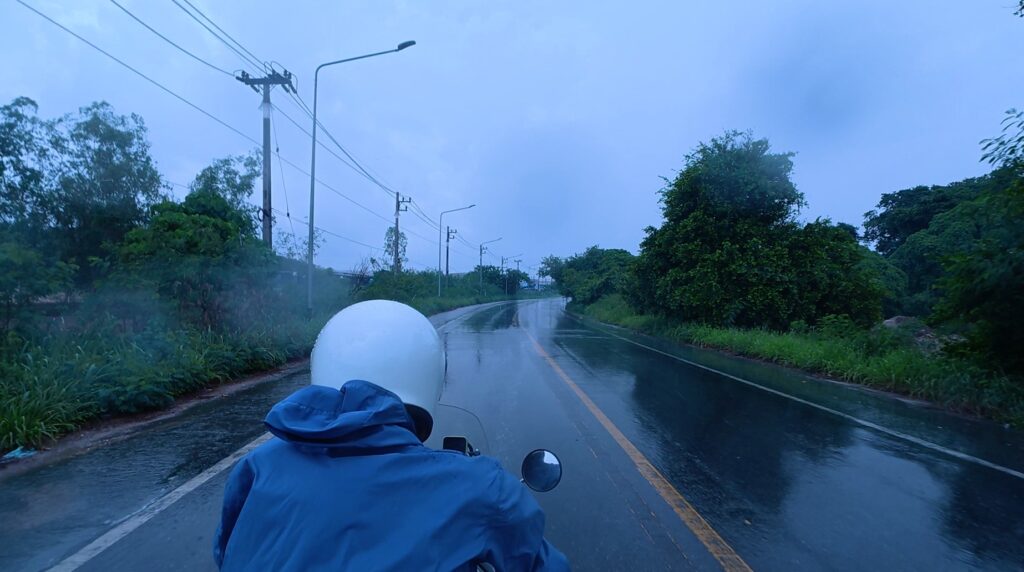
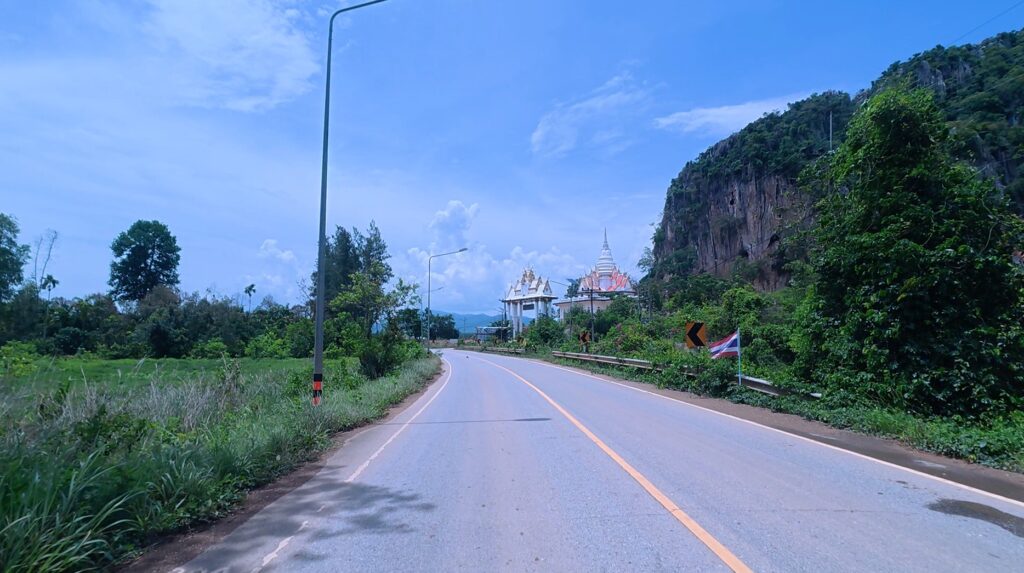
Rain-soaked roads and quiet countryside lead toward the hidden limestone sanctuary of Tham Khao Bot.
Beneath the Limestone Cliff
Before entering the cave, I spent some time looking around the temple grounds.
A simple outdoor worship area stood beneath a roof, with Buddha images quietly facing the open surroundings.
Behind them rose the mountain itself.
The contrast was striking.
The temple buildings looked small and fragile beside the enormous limestone cliff, as if the human structures had simply borrowed a little space from the mountain.
In Thailand, caves and mountains have long been associated with meditation.
They offer silence, isolation and protection from the outside world. For monks and hermits seeking to withdraw from ordinary life, such places provide a natural environment for contemplation.
Standing beneath the cliff, it was easy to understand why generations of practitioners had chosen caves as places of retreat.
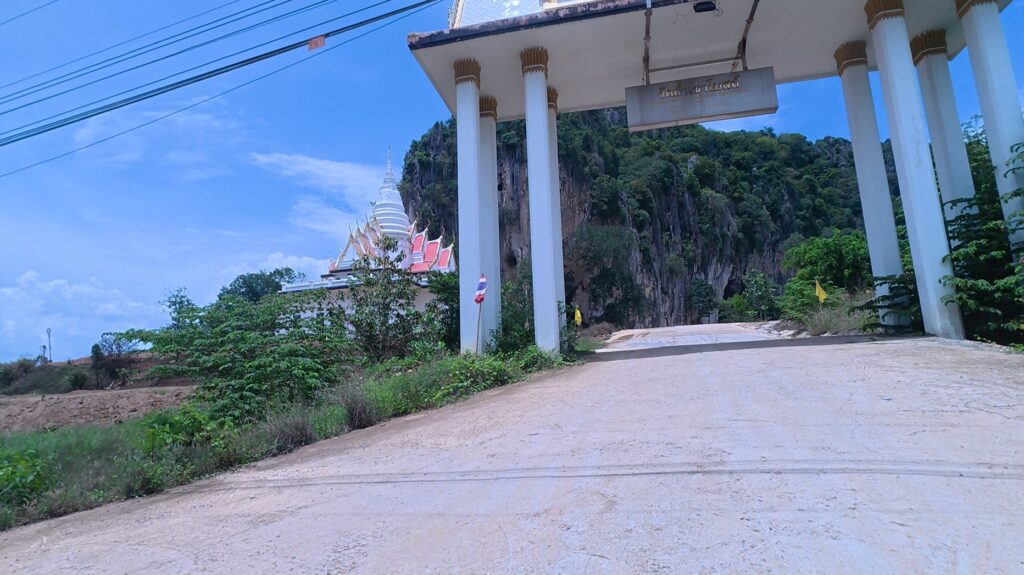
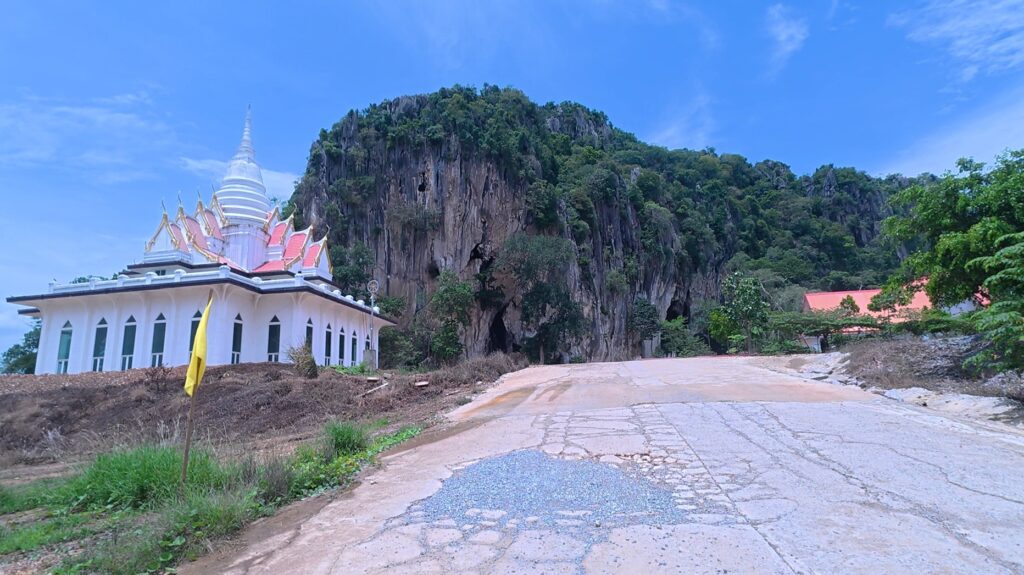
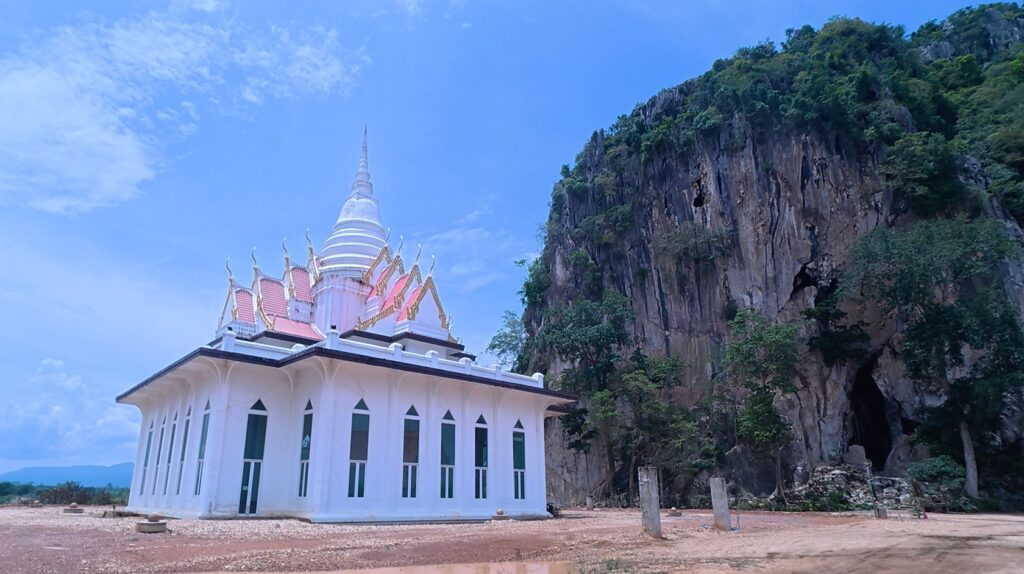
Tham Khao Bot appears beneath a towering limestone cliff, its modest temple buildings dwarfed by the mountain.
Approaching the First Cave
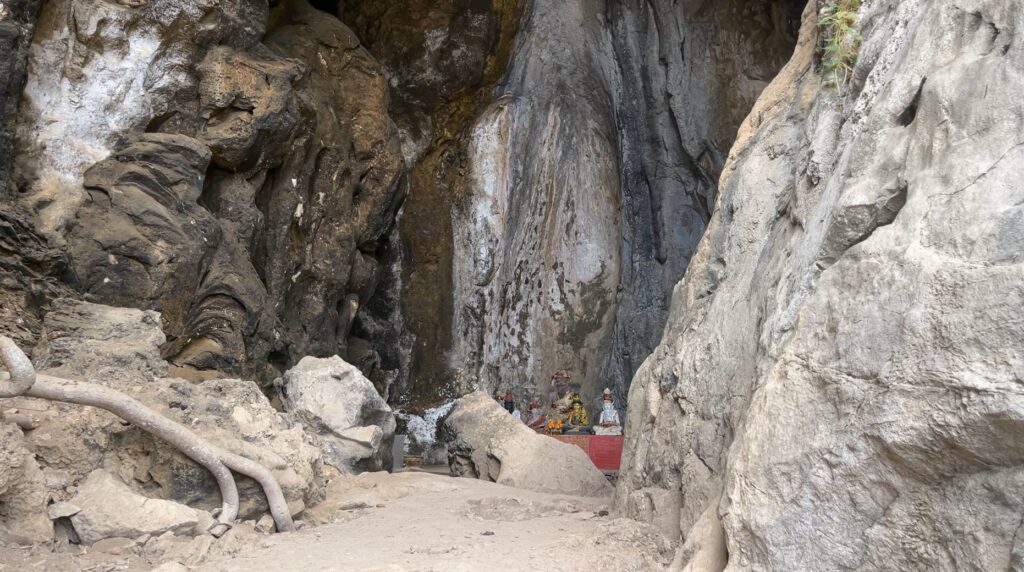
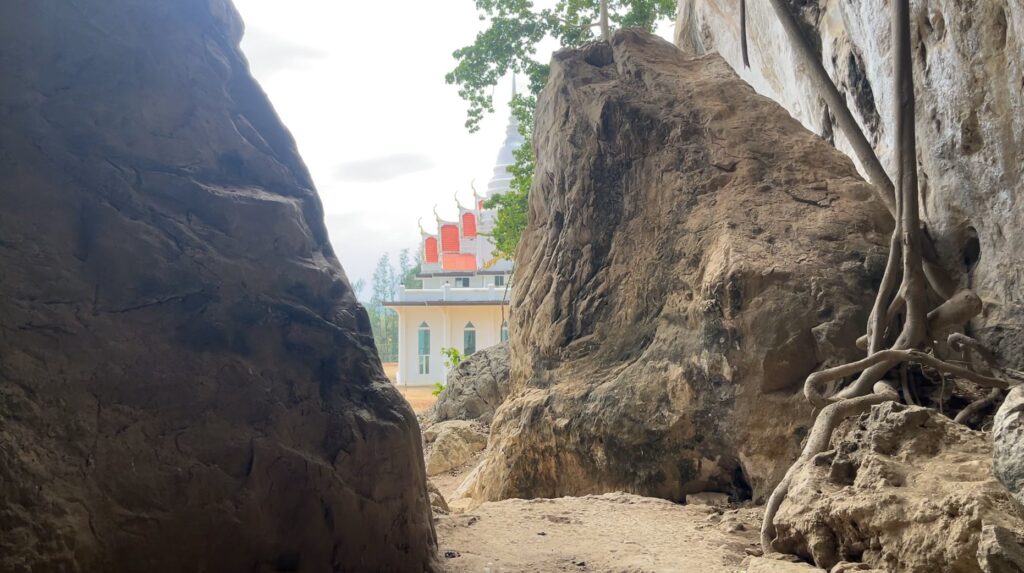
A narrow opening appeared between the rocks.
Large roots twisted across the ground, while weathered limestone formed irregular walls on either side.
The entrance did not look like a formal temple doorway.
There were no polished stairs or grand decorations.
Instead, the path felt almost natural, as though generations of visitors had simply followed the same opening into the mountain.
I stepped between the rocks and entered the smaller cave first.
The temperature changed immediately.
The outside heat faded, the light became softer and every sound seemed to slow down.
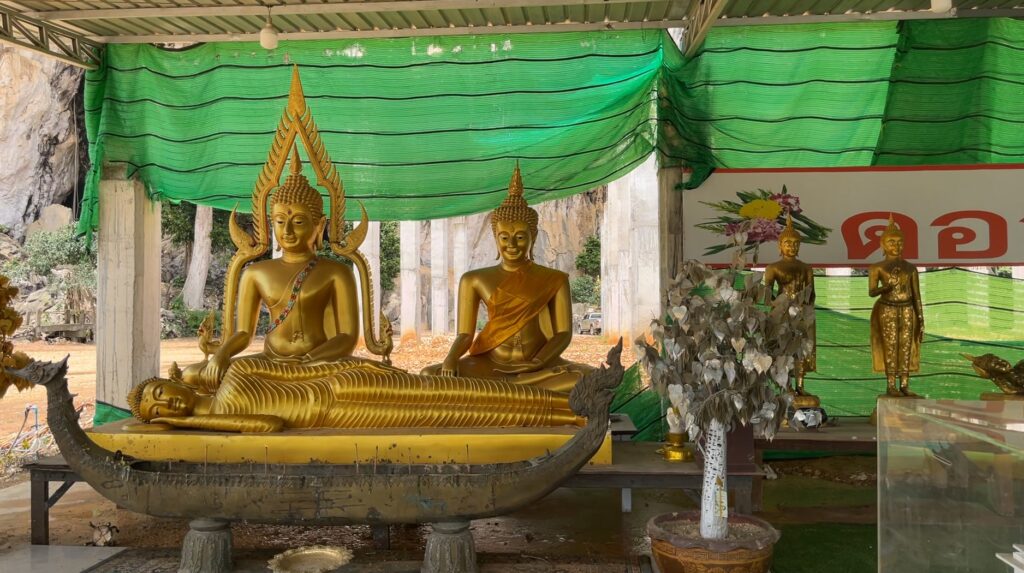
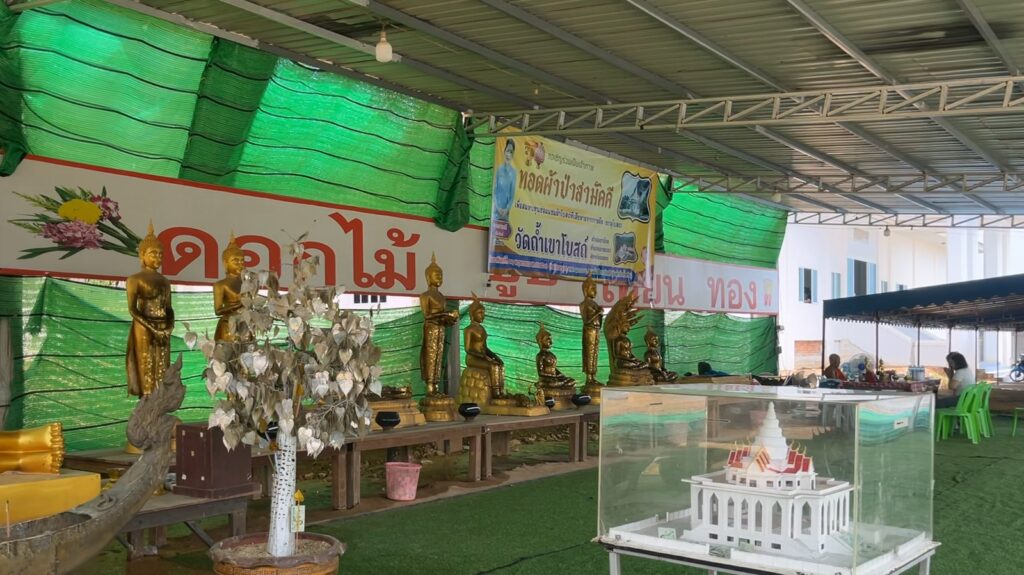
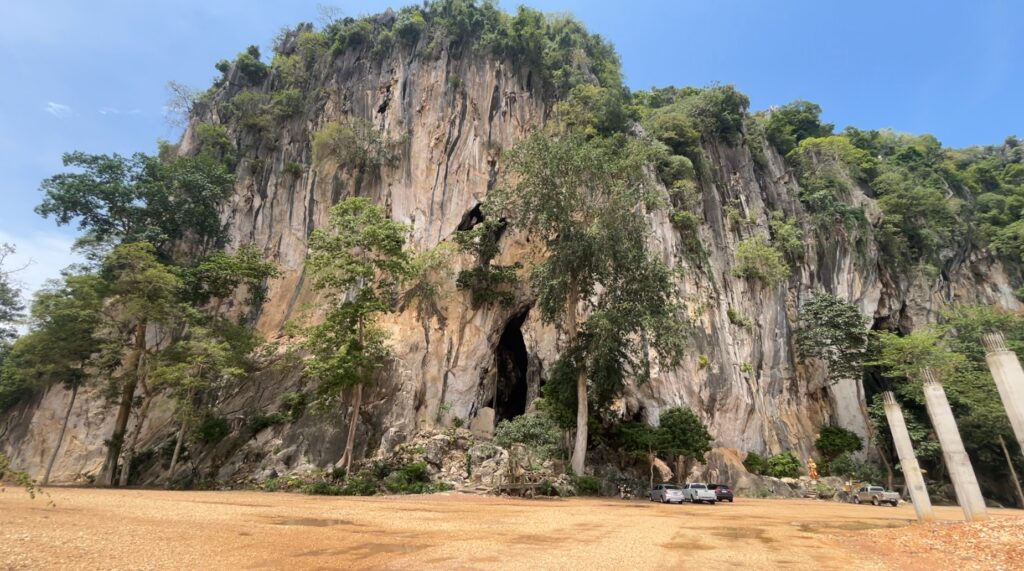
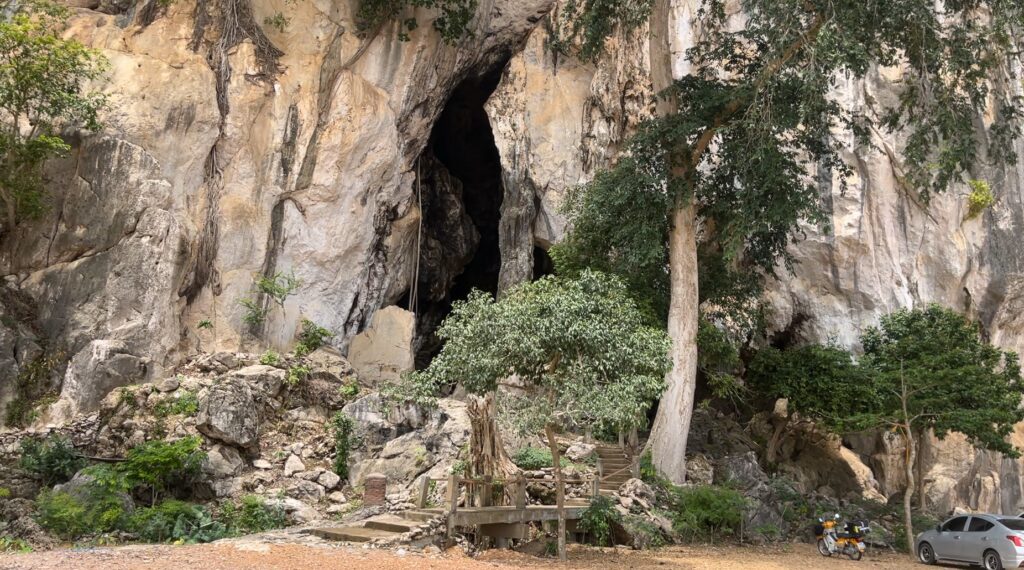
Before entering the caves, simple Buddha images and worship spaces sit quietly beneath the immense limestone wall.
Traces of a Hermit’s Life
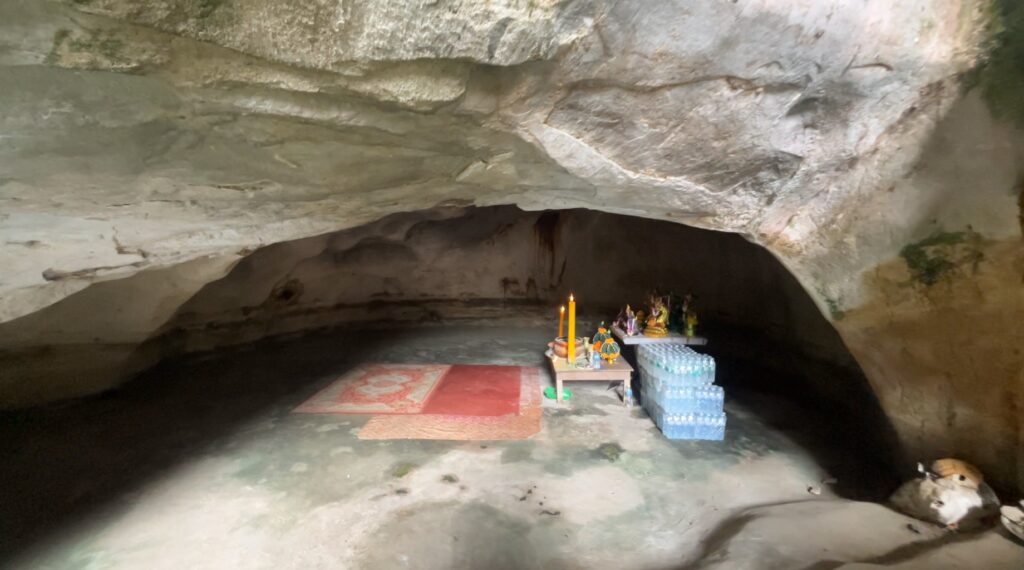
Inside the small cave were simple mats, offerings and a modest altar.
Nothing suggested wealth or comfort.
The space felt like somewhere a person might actually have stayed for long periods, surrounded by little more than stone, darkness and silence.
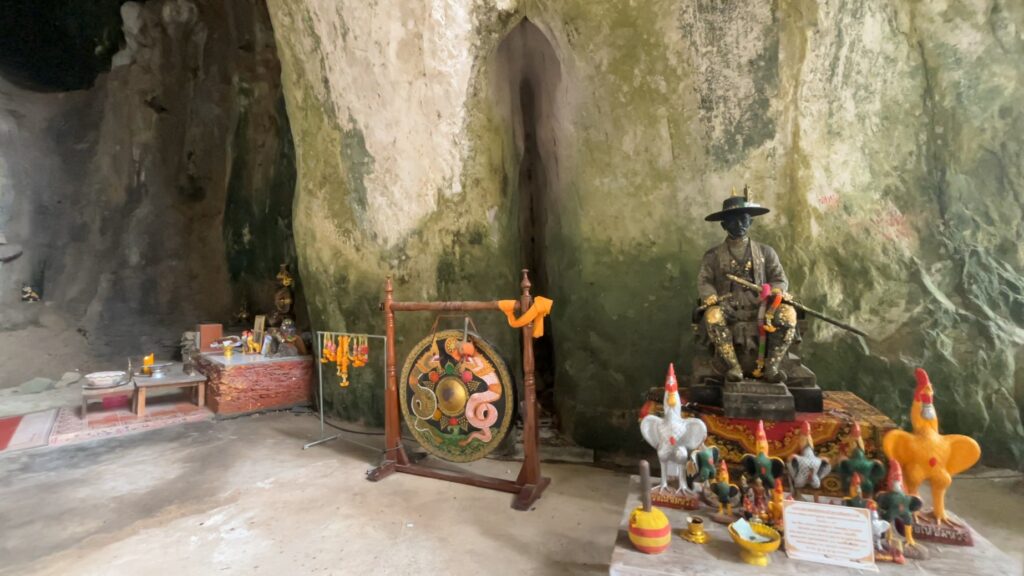
A seated figure resembling a monk or hermit watched over the small shrine.
Nearby were Buddha images, religious objects and offerings left by later visitors.
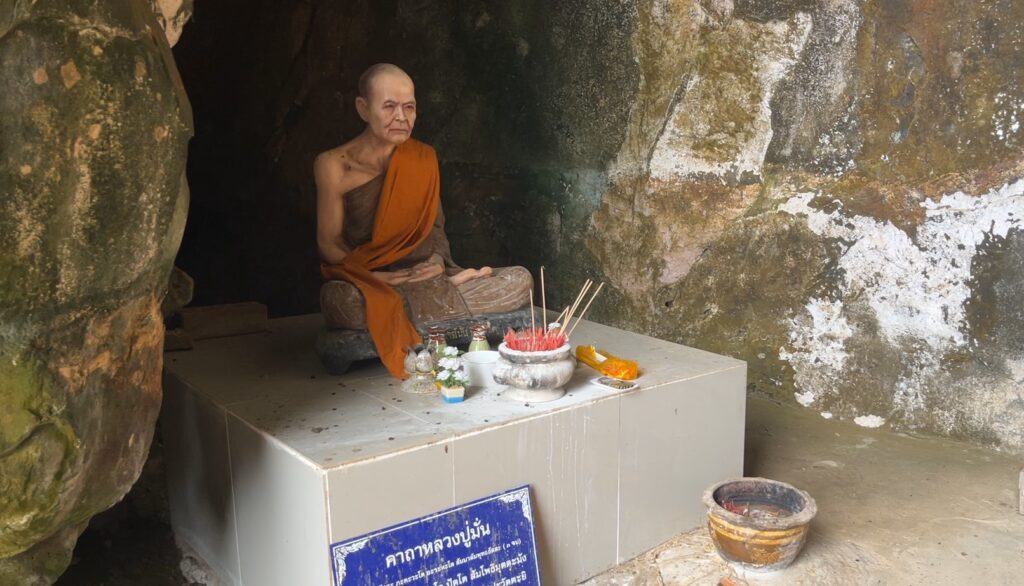
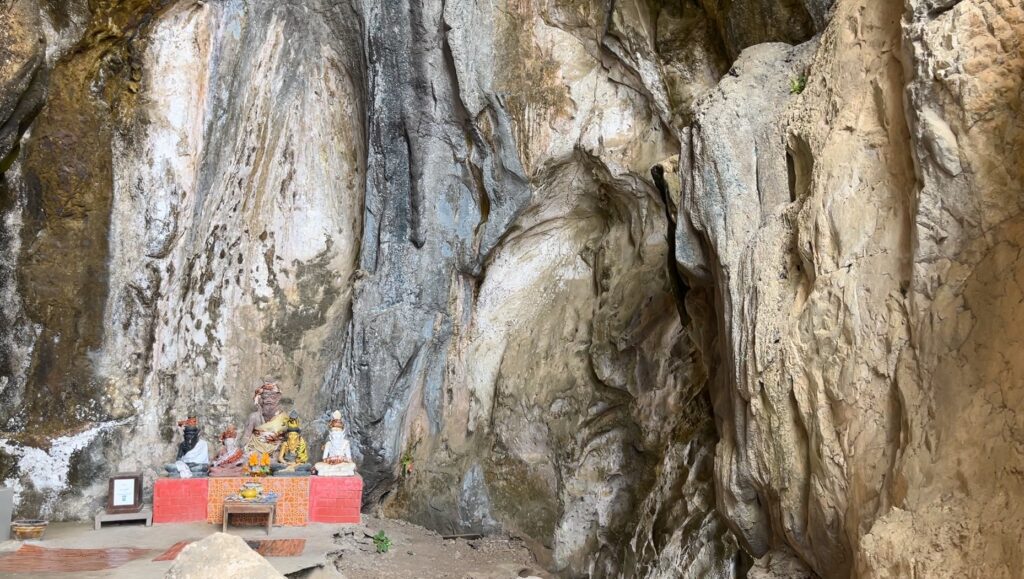
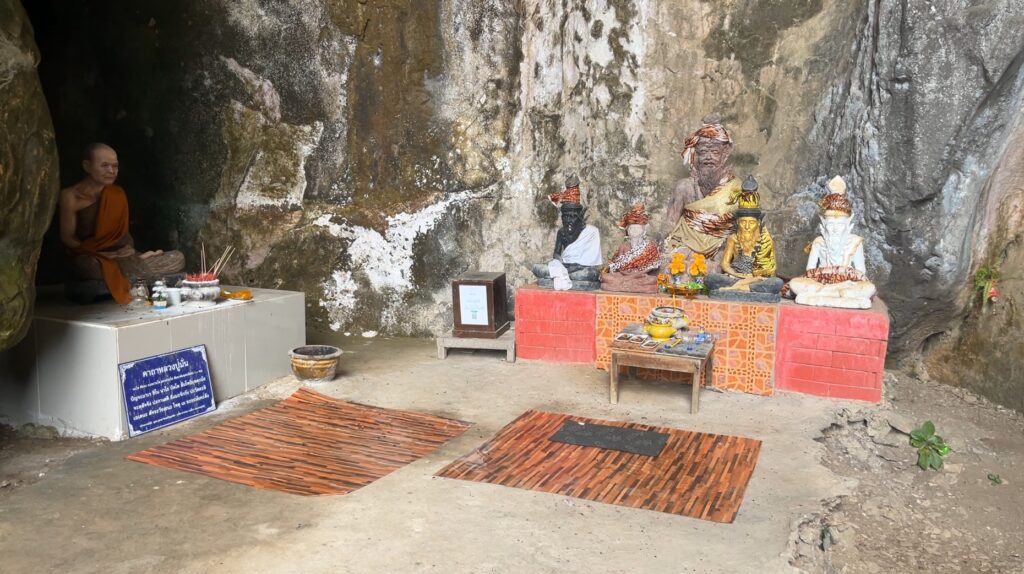
Simple mats, offerings and sacred images preserve the atmosphere of a small hermit retreat hidden within the rock.
A journey into Tham Khao Bot, where limestone caves, ancient Buddha images, Hindu mythology and traces of hermit meditation come together.
The scene made me imagine the life of someone who had chosen to remain here.
No television.
No traffic.
No ordinary schedule.
Only the rising and setting of the sun, the sound of rain outside the cave and long hours alone with one’s own thoughts.
To live in such a place would require more than physical endurance.
It would mean confronting the mind itself.
Why Caves Became Places of Meditation
The connection between caves and spiritual practice is much older than Buddhism in Thailand.
In India, wandering ascetics and sages often withdrew to forests, mountains and caves to meditate.
Buddhist monks later adopted similar environments.
The Buddha himself frequently stayed in forests and remote places, and many early Buddhist communities valued solitude as an aid to meditation.
When Buddhism reached Southeast Asia, this tradition continued.
Thai monks seeking intensive meditation often chose places far from villages—dense forests, mountains, cremation grounds and caves.
Such places were thought to reduce distraction.
But they also forced the practitioner to face fear.
Darkness.
Wild animals.
Loneliness.
Uncertainty.
In that sense, the cave became both a physical shelter and a test of the mind.
Entering the Larger Cave
After leaving the smaller retreat, I continued toward the main cave.
Tham Khao Bot Temple reveals its true character once the path enters the larger limestone cave.
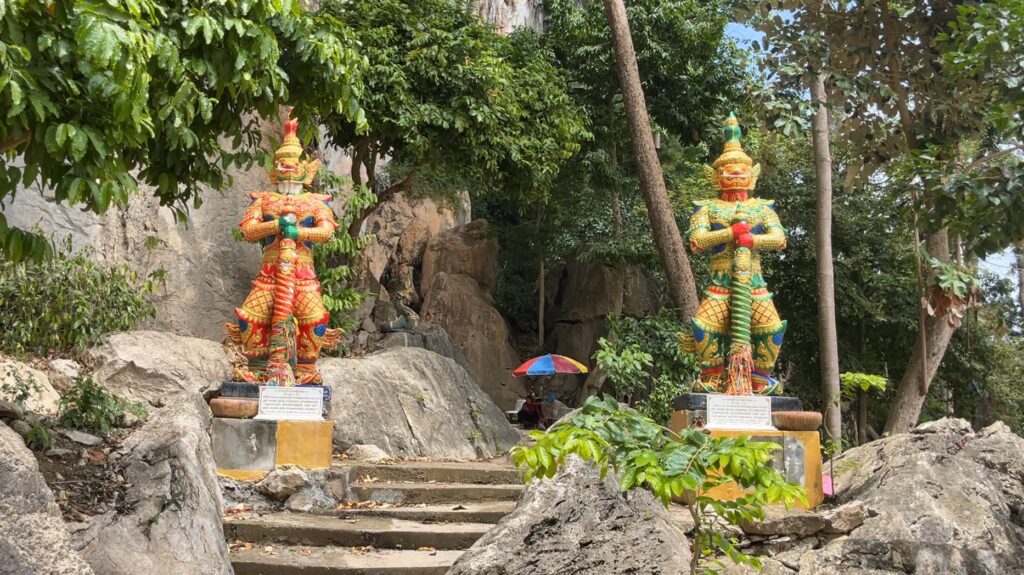
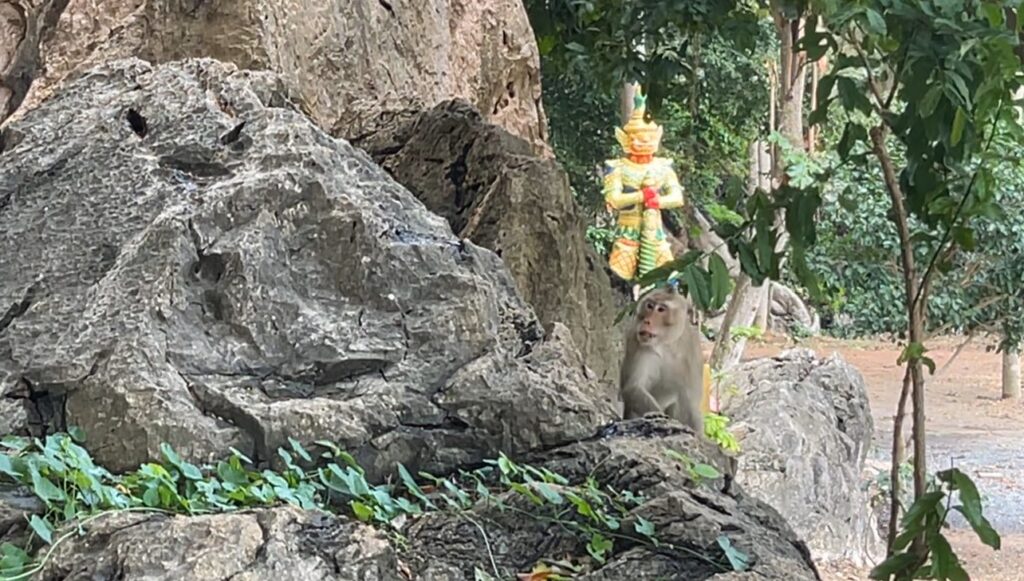
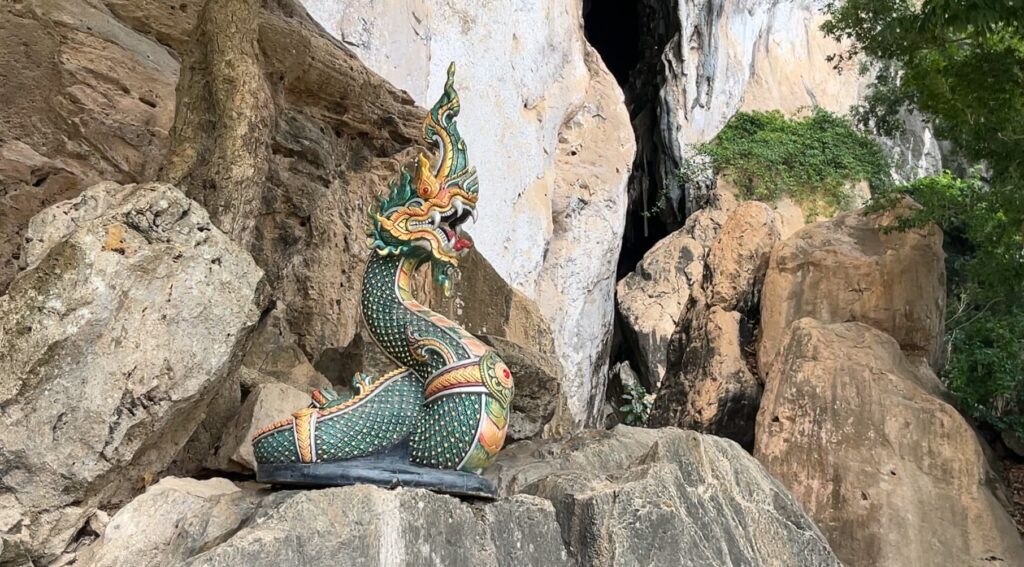
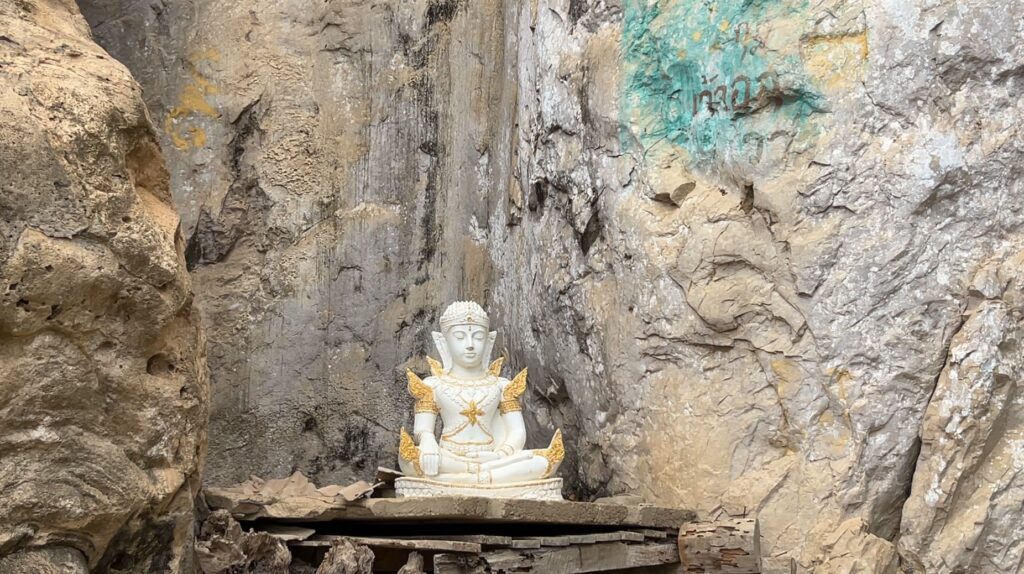
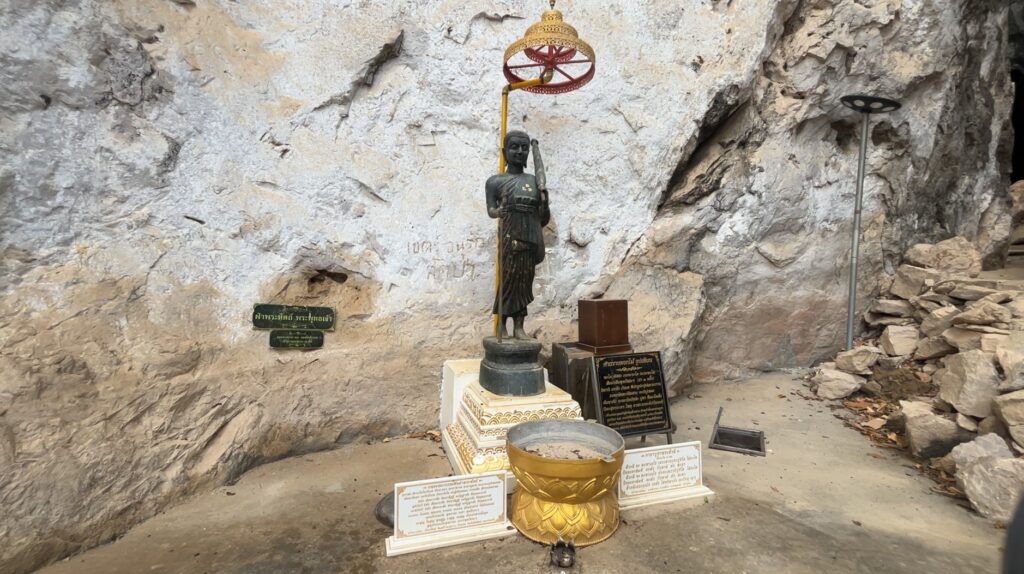
The main cave opens into a much larger chamber where natural rock formations and sacred images have gradually become one spiritual landscape.
The entrance was wider, but the interior quickly opened into something far more impressive.
The limestone walls rose high above me.
Natural chambers extended deeper into the mountain, while daylight entered through cracks and openings in the rock.
Inside were numerous Buddha images, statues, altars and offerings.
Some looked old and weathered.
Others had clearly been added more recently.
Nothing followed a strict museum-like arrangement.
Instead, the cave appeared to have grown gradually through years of devotion.
One person brought a Buddha image.
Another added flowers.
Someone placed a Hindu deity beside an older altar.
Another visitor lit candles in a deeper chamber.
Over time, the cave became a spiritual landscape created by many hands.
An Old Buddha Beneath the Rock
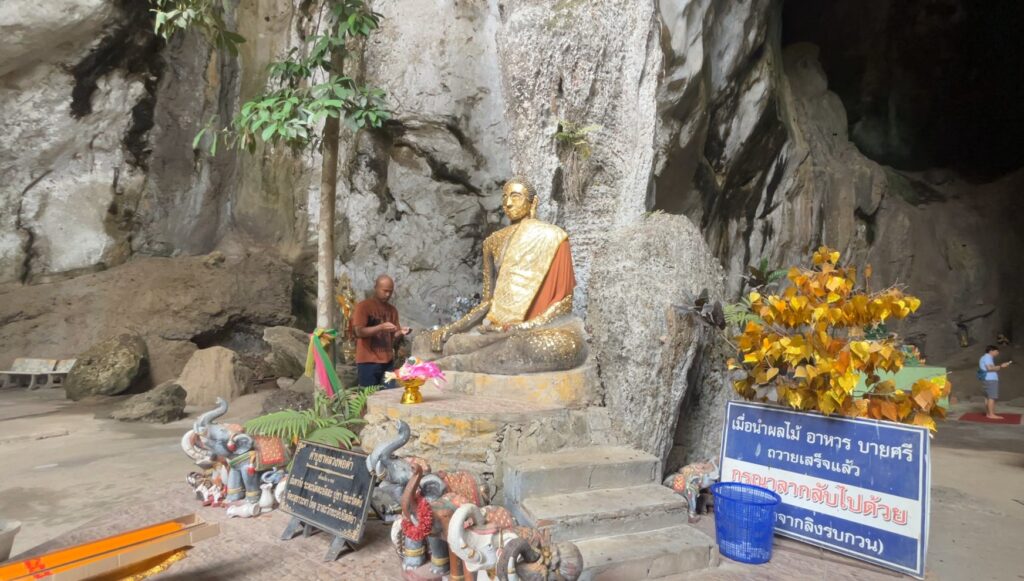
One of the most striking images was a Buddha seated directly beneath the natural limestone wall.
The rock behind him was stained by age and moisture.
Unlike the polished Buddha images of major city temples, this statue seemed almost absorbed into the cave itself.
Local visitors know this image as the Black Buddha. It is one of the cave’s most respected sacred figures, and people come here to pray for health, good fortune and protection. Its dark surface, standing quietly against the damp limestone wall, gives the image an ancient and almost timeless presence.
Unlike the bright golden Buddhas found in many Thai temples, this dark image seems to belong naturally to the cave itself. Moisture, shadow and age have softened its appearance, making it feel less like a statue placed inside the mountain and more like a Buddha that has quietly grown out of the rock.
I stood before him and placed my hands together.
There was something powerful about seeing the Buddha in such an environment.
The image did not dominate the mountain.
It seemed to belong to it.
The stillness of the Buddha and the roughness of the rock created a natural contrast between the restless world outside and the calm mind sought through meditation.
For centuries, Buddhist practitioners have used caves precisely because of this feeling.
The mountain does not speak.
The cave does not offer comfort.
It simply remains.
A Cave Built by Devotion
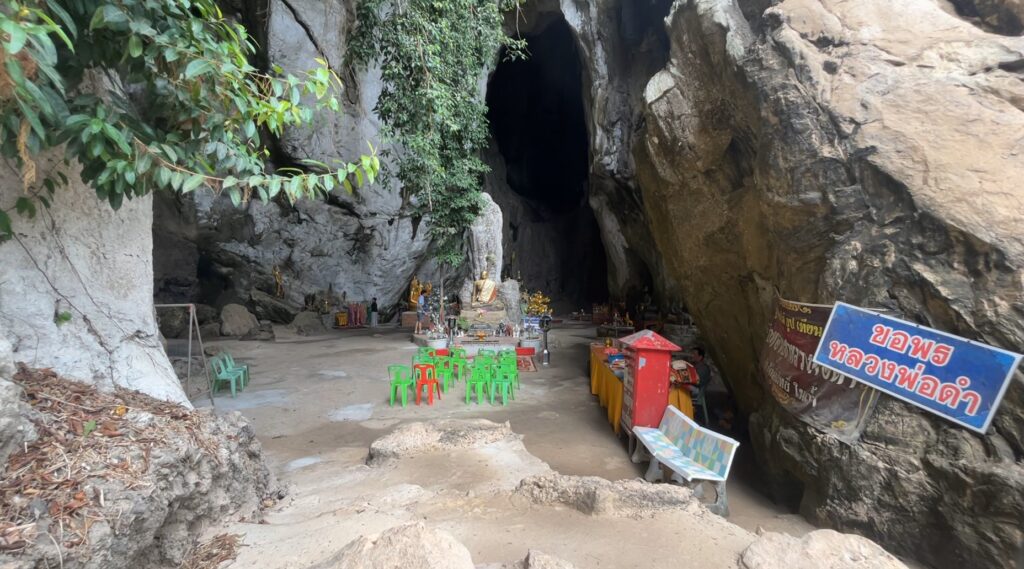
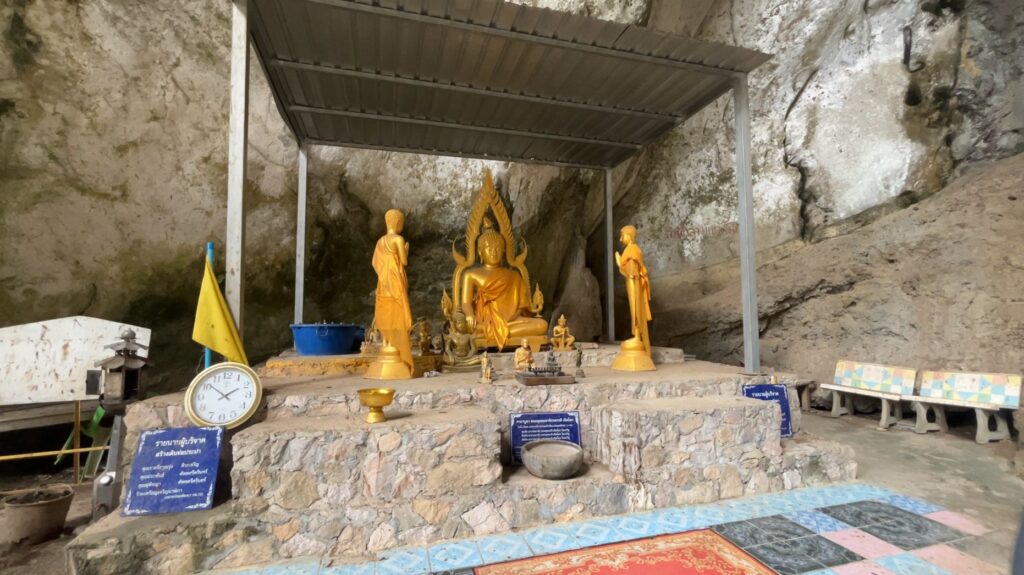
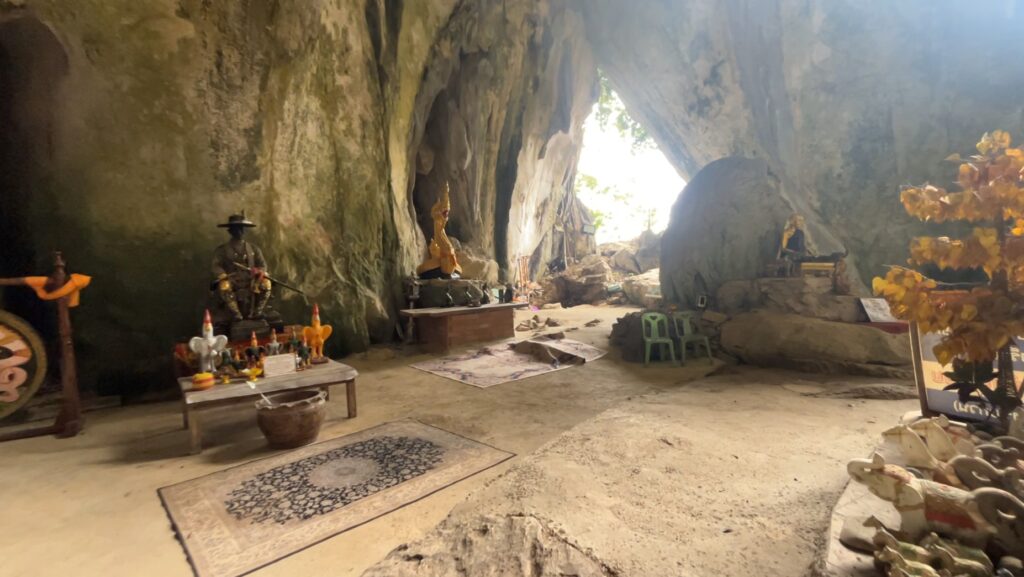
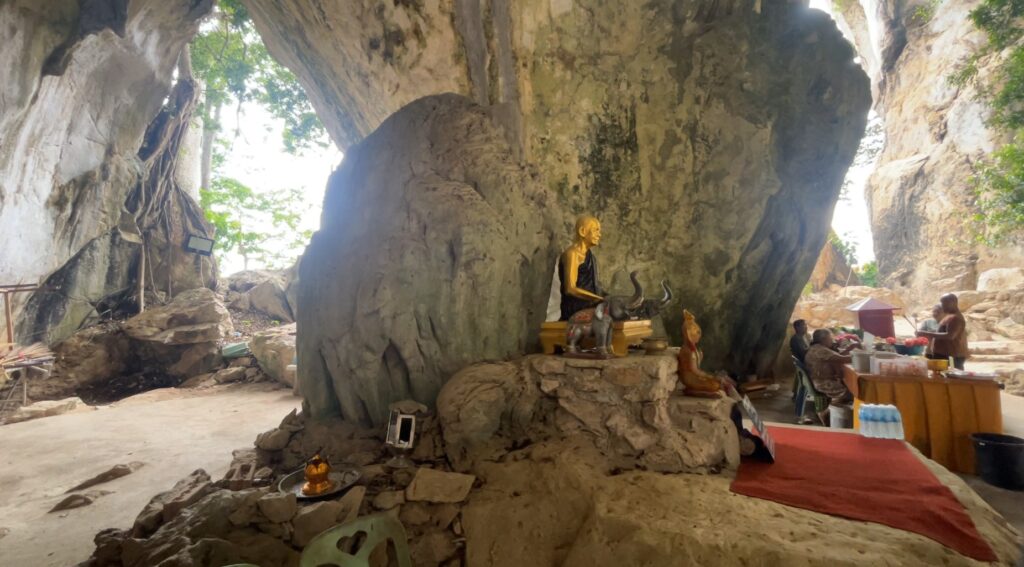
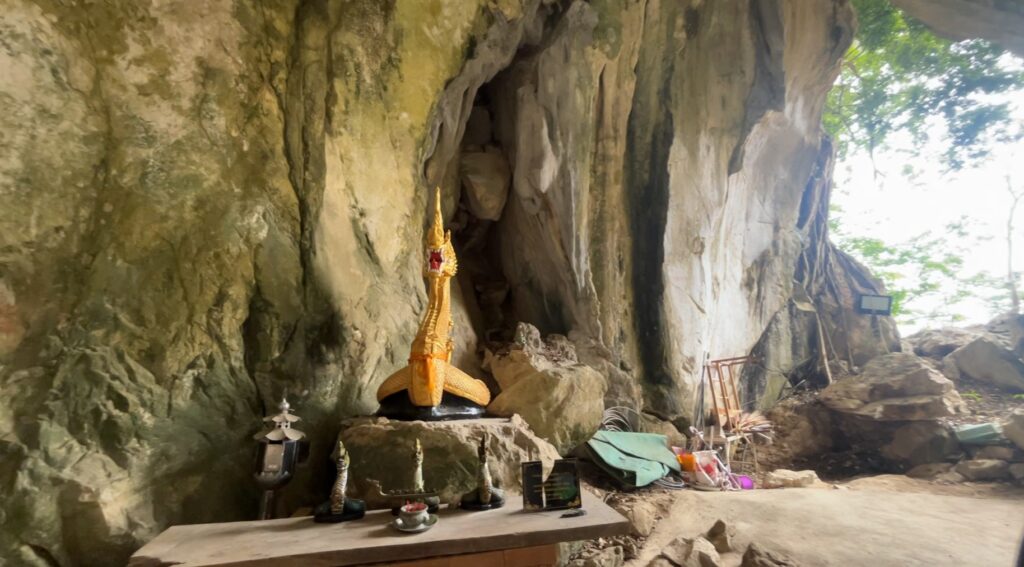
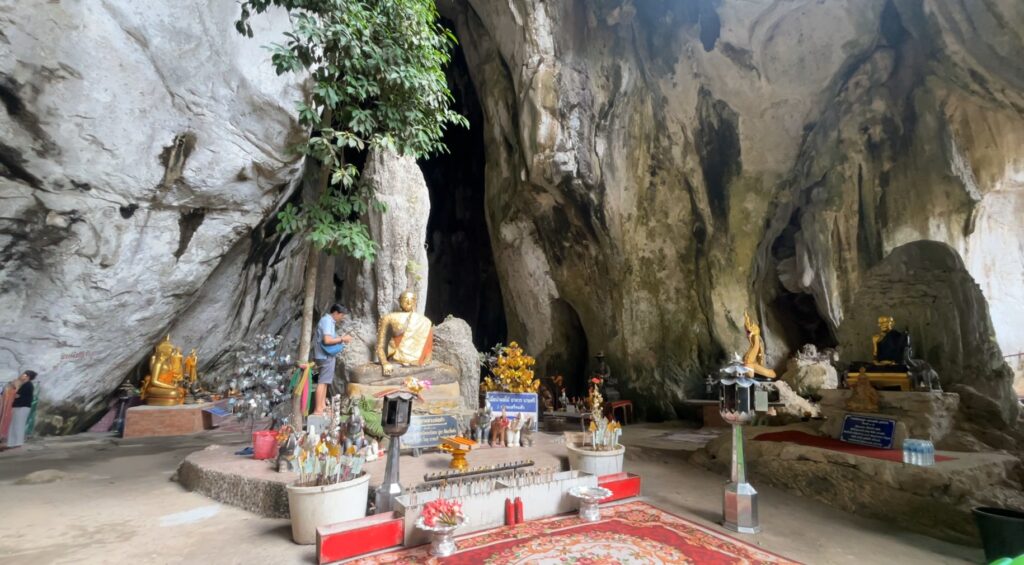
Buddha images, flowers, candles and small offerings reveal how generations of visitors have slowly transformed the cave into a place of devotion.
As I walked deeper inside, I encountered more shrines.
Some consisted of only a small Buddha and a few flowers.
Others had candles, incense, colourful cloth or handwritten signs.
There were statues representing different traditions and different periods.
At first, the collection seemed almost random.
But gradually, it began to feel like a record of human devotion.
Each object had been carried into this cave by someone.
Perhaps as an offering.
Perhaps as fulfilment of a vow.
Perhaps simply because someone wanted to leave behind an image of faith in a place they considered sacred.
The cave itself had become a living archive.
Not of written history, but of personal belief.
Hindu Deities Inside a Buddhist Cave
Among the Buddhist images were figures clearly influenced by Hindu tradition.
This is not unusual in Thailand.
Thai religious culture has never developed in complete isolation from Hindu and Brahmanical beliefs.
Ancient Southeast Asian kingdoms adopted Indian ideas of kingship, cosmology and sacred power long before Theravada Buddhism became dominant.
Even today, Hindu deities continue to appear in Thai religious life.
Ganesha is honoured for wisdom and success.
Brahma is associated with creation and cosmic order.
Shiva and Vishnu appear in royal, artistic and mythological traditions.
Their presence inside a Buddhist cave does not necessarily indicate conflict.
Instead, it reflects the layered nature of Thai belief.
Different traditions have accumulated over centuries and often occupy the same sacred space.
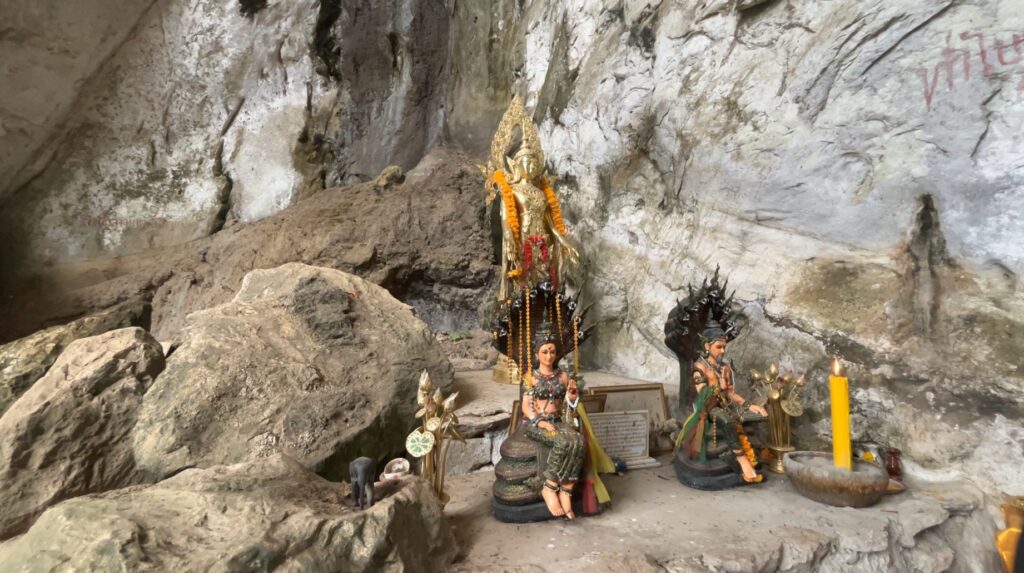
Hindu-inspired deities appear naturally among the Buddhist shrines, reflecting the layered religious traditions of Thailand.
The Monkey Guardian
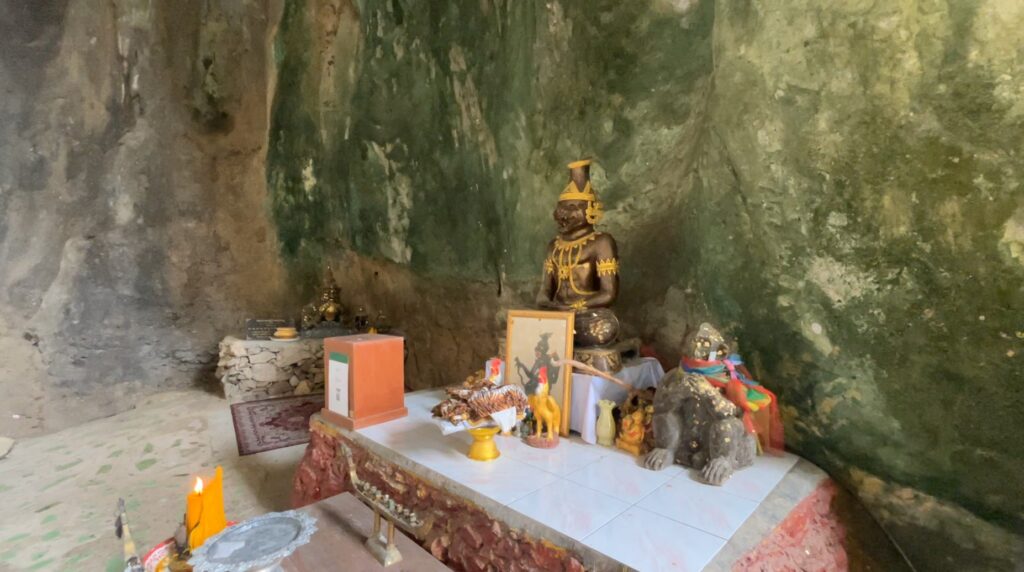
Among the figures was also a monkey-like deity.
This likely represents Hanuman, the legendary monkey warrior from the Indian epic Ramayana.
In Thailand, the Ramayana developed into the national epic known as the Ramakien.
Hanuman became one of its most beloved characters.
He is famous for strength, intelligence, courage and absolute loyalty to Prince Rama.
Unlike an ordinary monkey, Hanuman is a divine warrior capable of flying, changing form and defeating powerful enemies.
In Thai art, he appears in temples, palace murals, traditional dance and popular sculpture.
His presence in the cave reveals another connection between Indian mythology and Thai religious imagination.
The peaceful Buddha, the Hindu gods and the energetic monkey warrior may seem very different.
Yet here they coexist beneath the same mountain.
King Taksin in the Cave
Another unexpected figure was King Taksin the Great.
Taksin occupies a special place in Thai history.
After the fall of Ayutthaya to the Burmese in 1767, he gathered forces, defeated rival groups and reunited much of the country.
He established a new capital at Thonburi and helped restore both political order and Buddhist institutions.
Because of this, Taksin is remembered not only as a military leader but also as a protector of the kingdom during one of its darkest periods.
Statues of Taksin can be found in many parts of Thailand, especially in regions connected with his military campaigns.
To see his image inside this remote cave was another reminder that Thai temples often preserve national memory alongside religious devotion.
The sacred landscape includes Buddhas and monks, but also rulers who were believed to have protected the land and the religion.
To learn more about King Taksin’s legacy in Rayong, visit the official Rayong Provincial Administrative Organization page on Wat Ratchaballangk Pradittharam and its King Taksin heritage
Deeper Into the Darkness
Toward the rear of the cave, a smaller opening led deeper into the rock.
The light weakened.
The ceiling lowered.
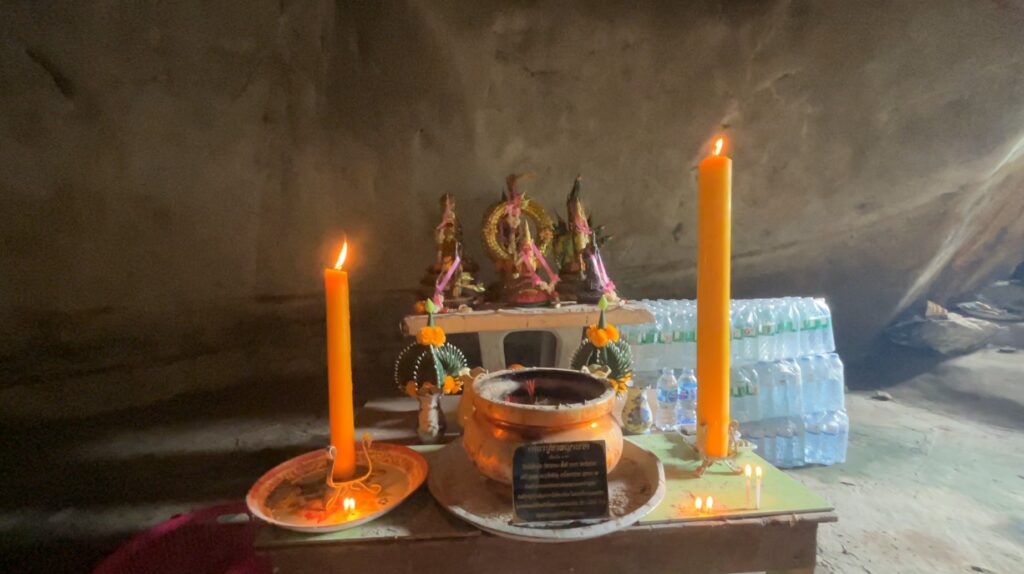
Inside this darker chamber, candles illuminated a small group of sacred figures.
The flickering flames transformed the rough limestone walls.
Shadows moved across the stone.
The figures seemed almost alive.
Here, several Hindu-influenced images had been placed together on a small altar.
The exact identities of every figure were difficult to determine, but perhaps that uncertainty was part of the atmosphere.
For the people who placed them there, the meaning was probably clear.
For a traveller entering the cave for the first time, they represented something older and more mysterious—the human desire to place sacred beings in darkness and ask them to protect, guide or witness our lives.
A smaller chamber deep inside the mountain is illuminated only by candles and sacred figures placed against the dark limestone walls.
Fire, Darkness and Sacred Space
Candles carry powerful symbolism across many religious traditions.
In Buddhism, light can represent wisdom overcoming ignorance.
In Hindu ritual, fire is a messenger between humans and the divine.
In folk belief, a small flame may simply mark a sacred presence in a place otherwise dominated by darkness.
Inside the cave, the candles had an especially strong effect.
Beyond their small circle of light was complete darkness.
That contrast made the symbolism almost physical.
Light and ignorance.
Knowledge and uncertainty.
Fear and faith.
The cave turned abstract religious ideas into something that could actually be seen.
The Emerald-Coloured Buddha
Then came one of the most memorable moments of the visit.
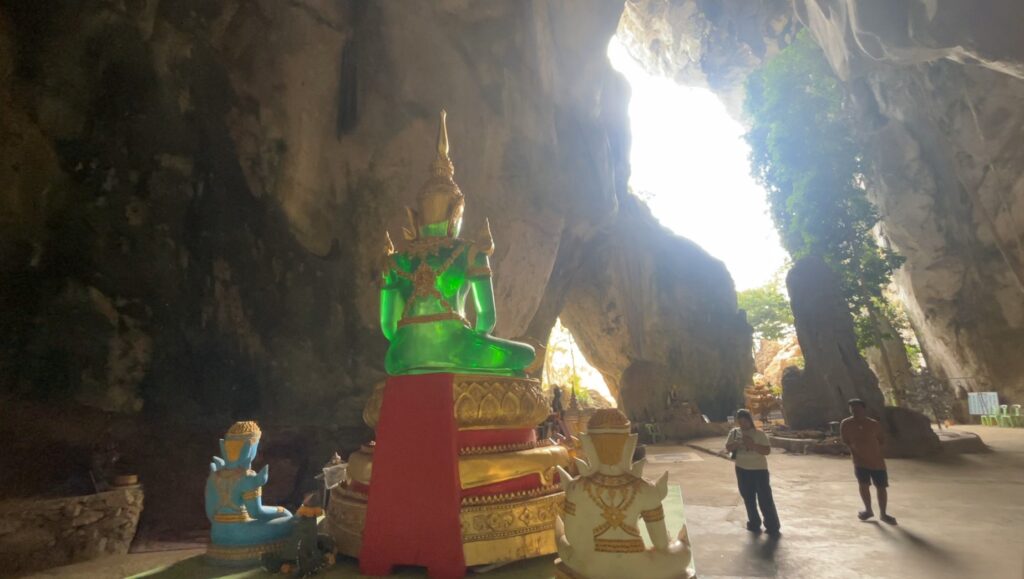
Natural sunlight entered through an opening high in the cave and struck one of the Buddha images.
For a brief moment, the statue appeared to glow with a mysterious green, almost emerald colour.
It was not a jewel-covered Buddha.
The effect came from the combination of sunlight, surrounding rock, moisture and the colours inside the cave.
Yet standing there, the image looked almost supernatural.
In Thai Buddhist culture, green or emerald-coloured Buddha images naturally recall the famous Emerald Buddha in Bangkok.
But this cave image had a completely different atmosphere.
There were no royal walls.
No ceremonial guards.
No crowds.
Only rock, light and silence.
The mountain itself seemed to have created the shrine.
Light as a Buddhist Symbol
The moment also brought to mind one of Buddhism’s most enduring metaphors.
Ignorance is darkness.
Understanding is light.
The Buddha is often described not as a god who controls the world, but as one who awakened and then showed others how to see clearly.
Inside the cave, that idea became unexpectedly vivid.
Most of the chamber remained dark.
Yet one shaft of sunlight was enough to transform the Buddha completely.
Perhaps this is why caves have such power as religious spaces.
They allow light to become meaningful.
Outside, sunlight is everywhere.
Inside a cave, even a small ray becomes precious.
The Burden of the Hermit
Standing deeper inside the mountain, I began to think again about the people who had chosen to practise here.
It is easy to romanticise the life of a hermit.
We imagine silence.
Peace.
Freedom from the noise of society.
But real isolation must also bring fear, discomfort and doubt.
The body becomes tired.
The darkness feels longer.
The mind begins producing memories, regrets and desires that cannot easily be escaped.
Perhaps that is the real challenge of cave meditation.
The practitioner is not hiding from the world.
He is removing the distractions that normally prevent him from seeing himself.
The mountain becomes a mirror.
The silence becomes a question.
And the hardest thing to face may not be the darkness of the cave, but the thoughts that arise within it.
Legends Born Inside Mountains
Across Thailand, caves often gather legends.
Some are said to have been inhabited by holy monks.
Others contain stories of Nagas, spirits or hidden treasure.
Certain caves are believed to connect to distant places through underground passages.
Others are associated with kings or wandering ascetics.
Such stories are difficult to separate completely into history and myth.
But perhaps that is not necessary.
For local communities, a cave can hold several kinds of truth at once.
Geologically, it is limestone shaped by water over millions of years.
Historically, it may have sheltered monks or travellers.
Religiously, it becomes a place of merit and meditation.
Mythologically, it may be inhabited by beings invisible to ordinary eyes.
All these meanings can exist together.
For more travel information about Rayong, see the official Tourism Authority of Thailand – Rayong guide
The Mountain as a Sacred World
The cave also reflects an ancient idea found throughout South and Southeast Asia: mountains are not ordinary landscapes.
In Hindu cosmology, Mount Meru stands at the centre of the universe.
Buddhist cosmology inherited similar imagery.
Temples, stupas and sacred mountains often symbolically reproduce this cosmic centre.
A cave within a mountain can therefore feel like entering another level of existence.
The outside world is left behind.
The path narrows.
Light disappears.
Sacred images appear deeper inside.
Finally, the visitor emerges again into daylight.
The physical journey itself begins to resemble a spiritual one.
Entering darkness.
Facing uncertainty.
Discovering sacred meaning.
Returning to the world.
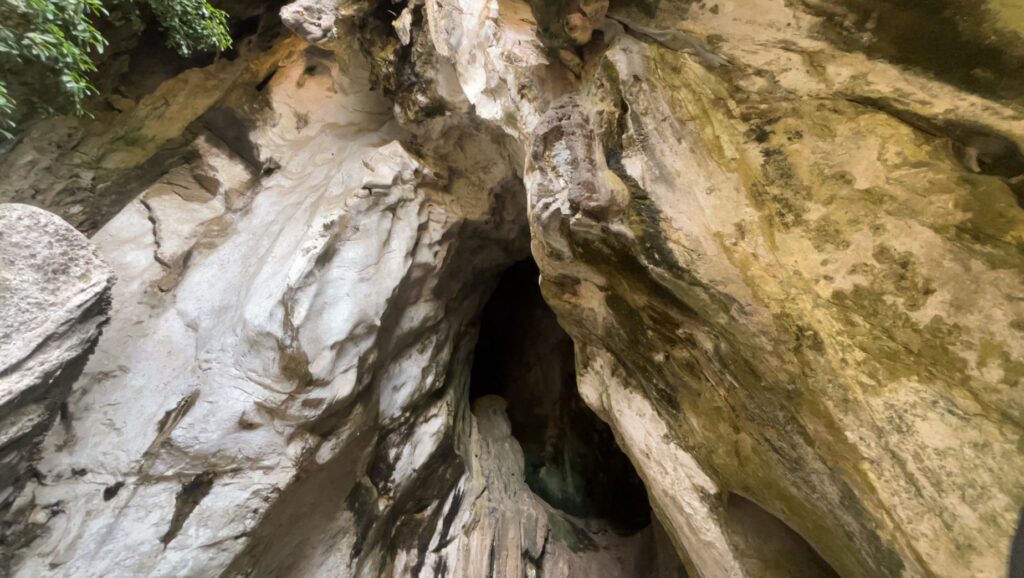
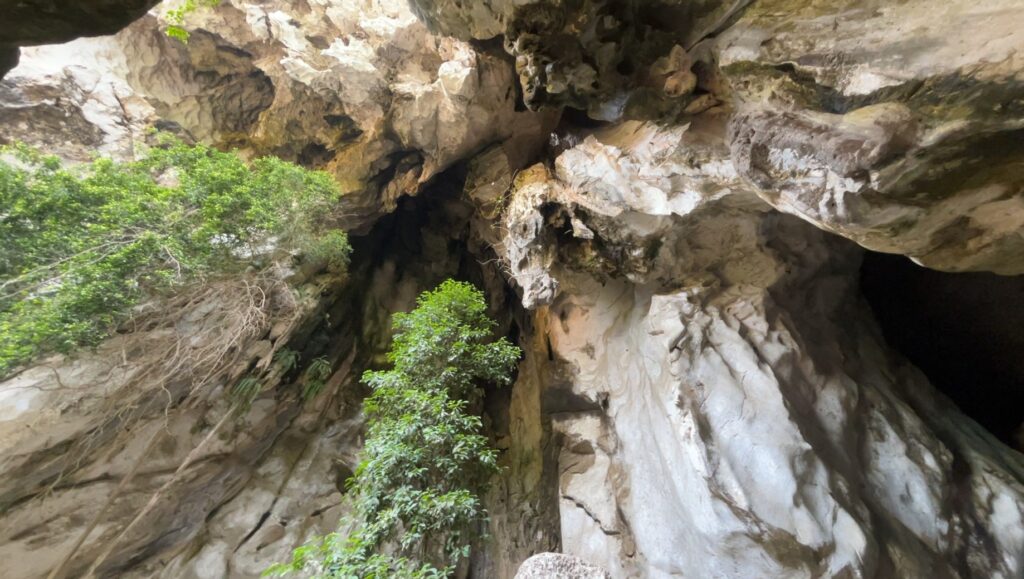
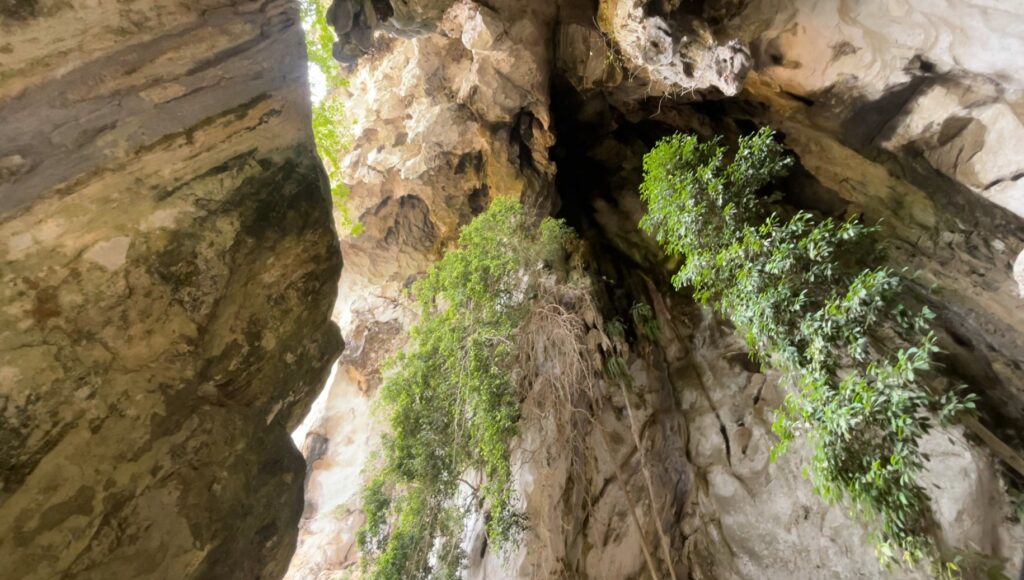
Towering limestone walls and shafts of natural light make the cave itself feel like part of the sacred architectu
Silence Before Leaving
Before leaving the cave, I stopped once more.
There was no need to understand every statue.
No need to identify every deity.
The experience itself had become enough.
Water had shaped the limestone.
Time had darkened the walls.
People had carried their faith inside.
And somewhere between the Buddha images, candles and shafts of sunlight, the cave seemed to hold all of these stories without needing to explain them.
For a moment, I simply stood there.
Listening.
Returning to the Outside World
Eventually, I walked back toward the cave entrance.
The daylight grew stronger with every step.
Trees and sky slowly replaced the darkness of the mountain.
Outside, the same temple buildings remained beneath the limestone cliff.
The Honda Cub was waiting.
The rain that had accompanied the beginning of the journey now felt far away.
I had entered expecting to see a cave temple.
Instead, I found something more complex.
A place where Buddhism met Hindu mythology.
Where King Taksin stood among sacred images.
Where Hanuman appeared beneath limestone walls.
Where candles illuminated forgotten corners.
And where a Buddha could suddenly turn emerald green when sunlight entered the mountain at just the right angle.
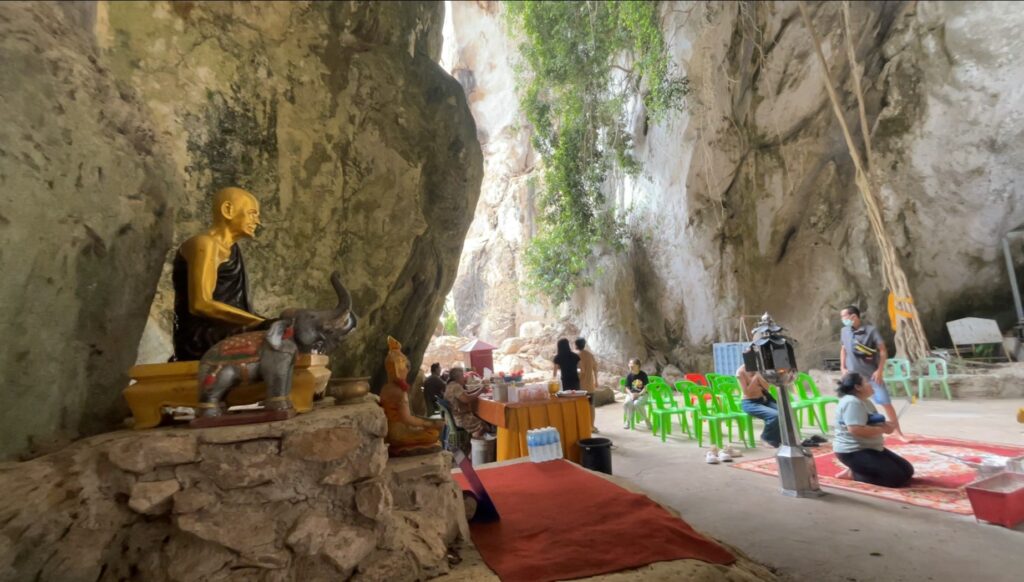
After the darkness of the cave, daylight slowly returns as the path leads back toward the temple grounds.
A Hidden Cave of Faith
Tham Khao Bot may not be one of Thailand’s famous temples.
There are no enormous crowds.
No grand ticket entrance.
No carefully arranged museum displaysBut perhaps that is why the experience feels so personal.
This cave has been shaped by nature and then slowly filled with human faith.
Buddhas.
Hermits.
Hindu gods.
Kings.
Candles.
Offerings.
Stories.
Some belong to history.
Some belong to mythology.
And some may be known only to the people who have prayed here.
Together they create a place where religion is not separated neatly into categories.
It simply exists within the mountain.
And after riding through the rain to reach it, I left with the feeling that the deepest part of the cave was not the chamber hidden behind the rocks.
It was the silence left inside the mind.
Location and Visitor Information
Tham Khao Bot Temple is located in Rayong Province, surrounded by striking limestone formations and quiet countryside. The temple is best known for its natural caves, old Buddha images and the traces of meditation practice preserved inside the mountain.
Location: Rayong Province, Thailand
Admission: Free
Best time to visit: Morning or late afternoon, when the weather is cooler and natural light enters the cave beautifully
Dress: Modest clothing covering shoulders and knees is recommended
Footwear: Wear shoes with good grip, as cave floors can be uneven, damp or slippery
Photography: Generally possible, but avoid disturbing worshippers or using strong flash near sacred images
Visit time: Allow around 60–90 minutes to explore the temple grounds and both cave areas slowly
Local Administration and Tourism
Tham Khao Bot Temple is a registered Buddhist temple, while local tourism information for the site is provided by the Rayong Provincial Administrative Organization (Rayong PAO). The provincial authority introduces the cave temple as one of Rayong’s local cultural and natural attractions.
Learn more from the official Rayong Provincial Administrative Organization guide to Wat Tham Khao Bot.
Google Maps
Use your location link here:
Tham Khao Bot Temple – Google Maps
Continue exploring Thailand’s lesser-known sacred places in the Temples of Thailand collection.