Along the Road Beside the Prison
The journey to Wat Ang Kaeo begins on an unusual road.
Rather than approaching through a busy town or a tourist district, the route passes through a quiet area connected with a correctional facility. Railway tracks, open fields and institutional buildings appear along the way, creating a landscape very different from the grand entrances usually associated with famous Thai temples.
The road is calm.
There are few vehicles, little commercial activity and almost nothing to suggest that a temple filled with such a remarkable collection of religious images is waiting nearby.
I continued slowly on the Honda Cub, following the narrow road until trees, small buildings and colourful statues began to appear ahead.
It felt almost as though the ordinary world had gradually disappeared behind me.
And then Wat Ang Kaeo came into view.
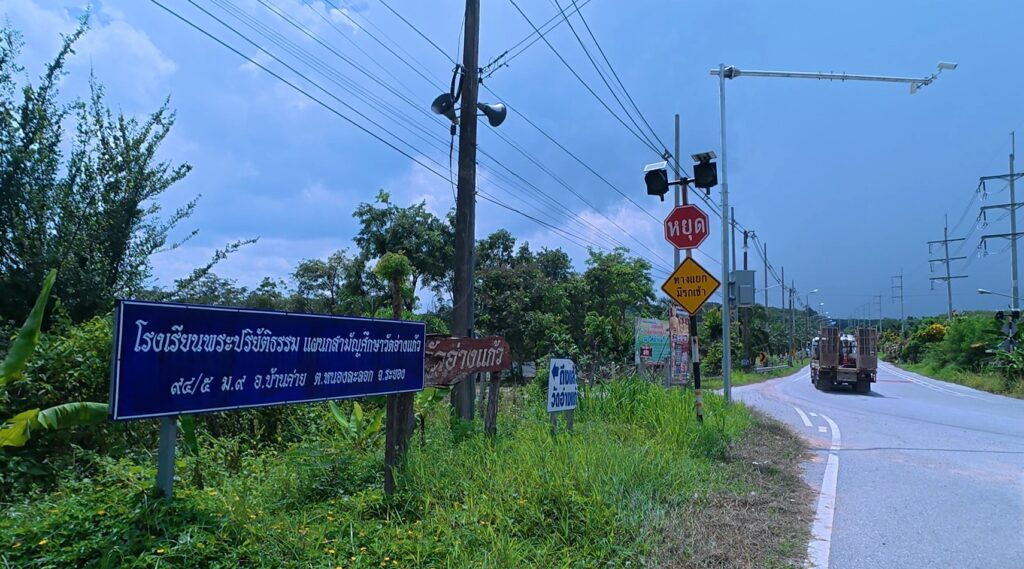
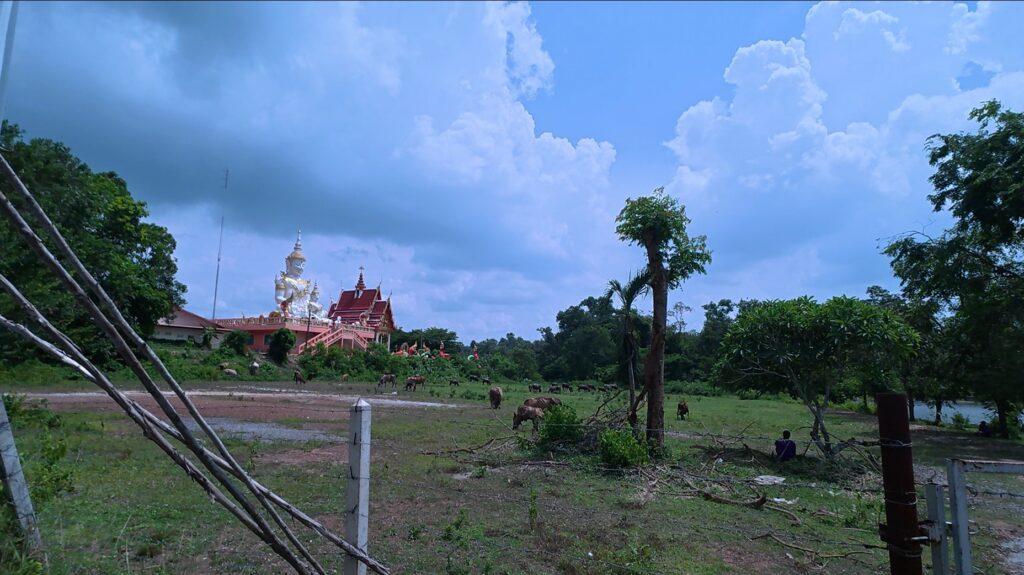
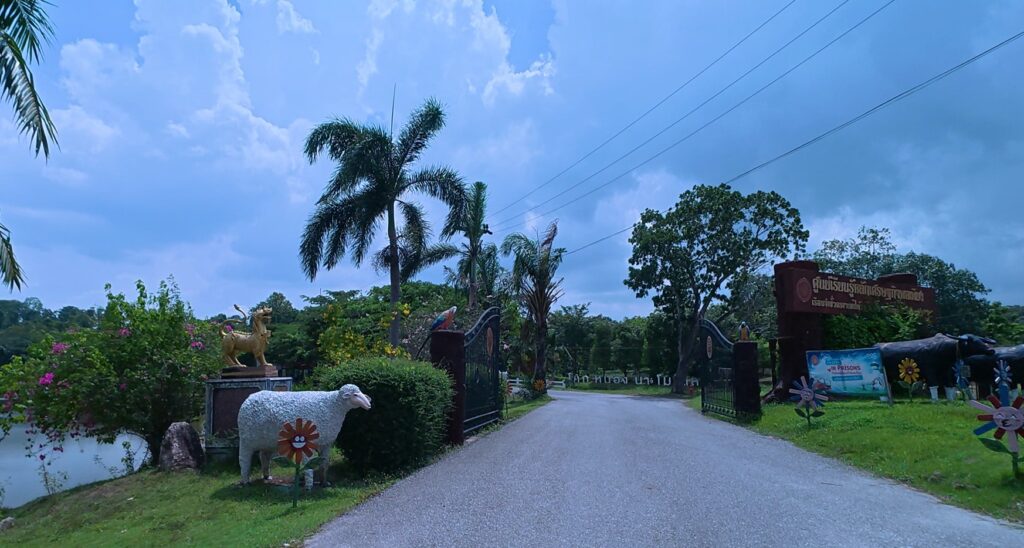
The journey to Wat Ang Kaeo begins along quiet roads leading into an unexpected correctional landscape.
Inside the Correctional Area
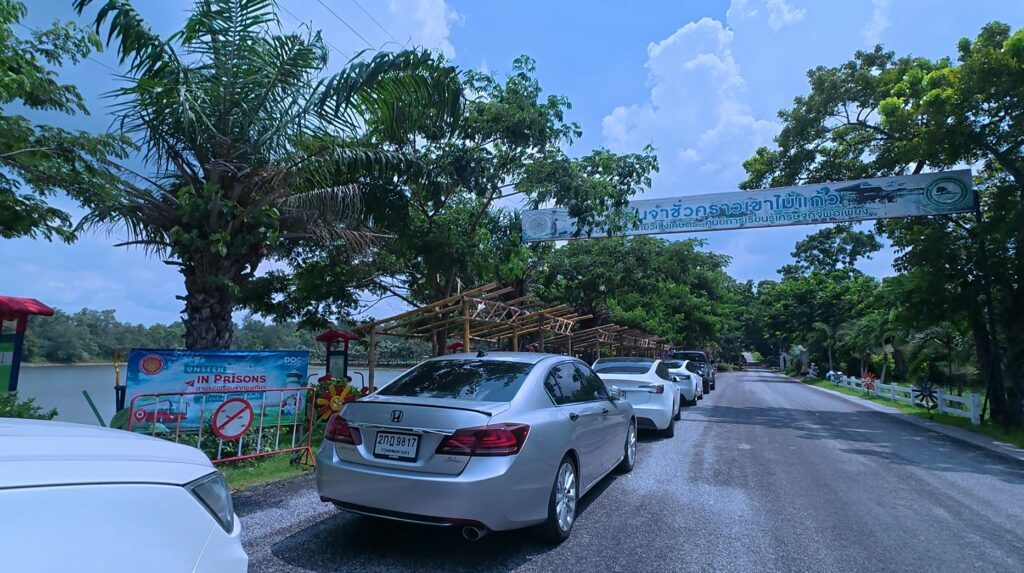
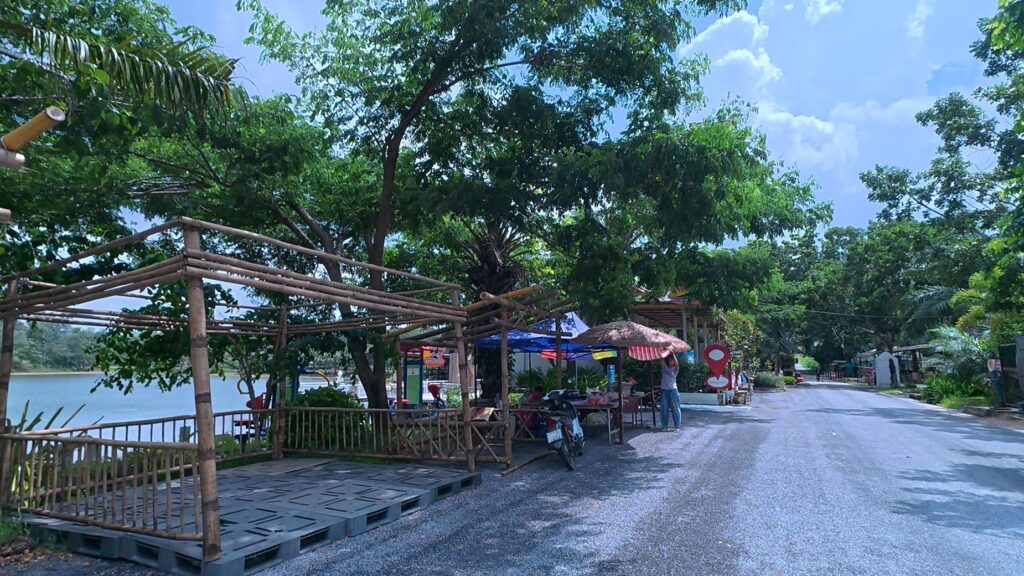
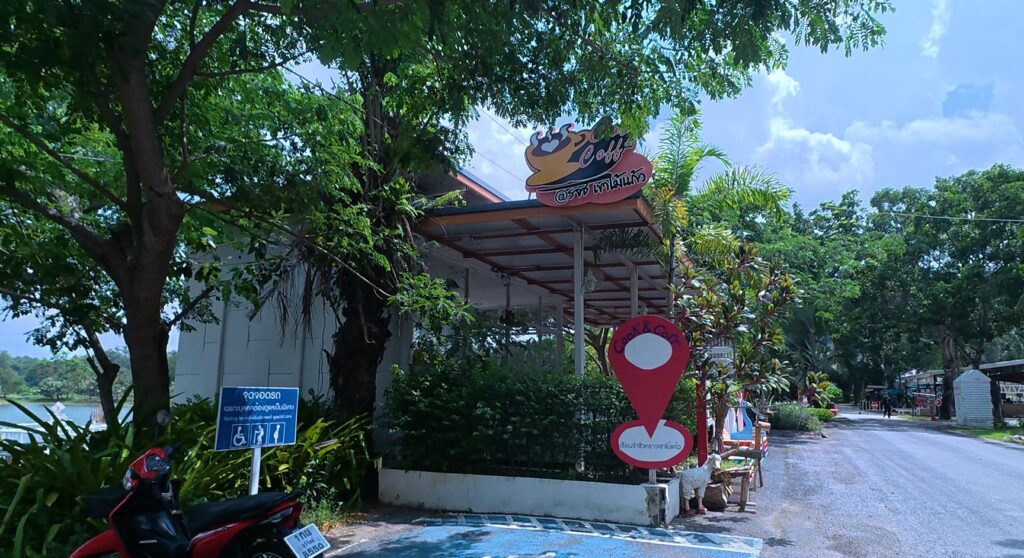
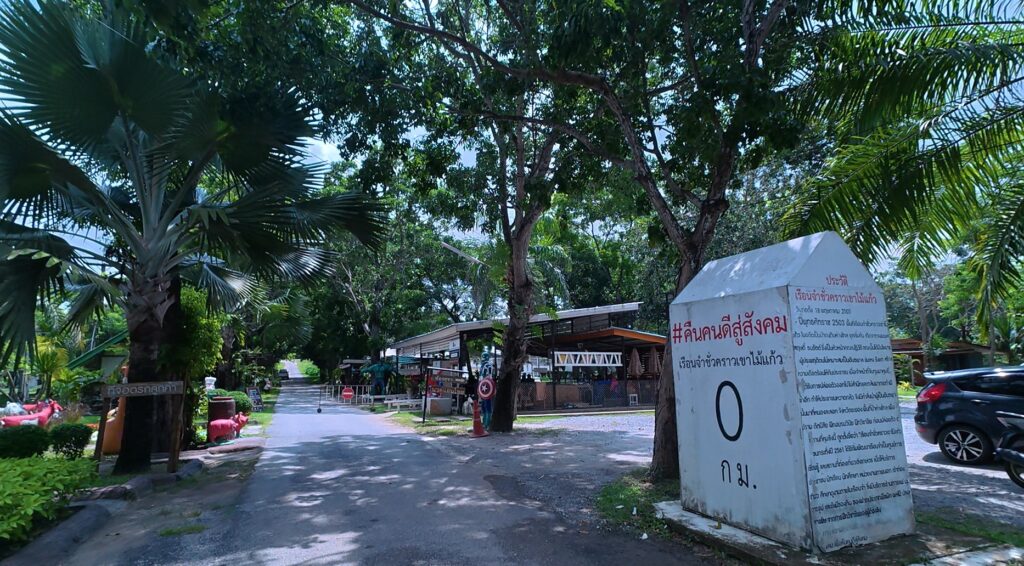
Before reaching the temple, the route continues through the correctional complex, where administrative buildings and shaded roads create an unusual setting for the journey.
Leaving the Prison Grounds
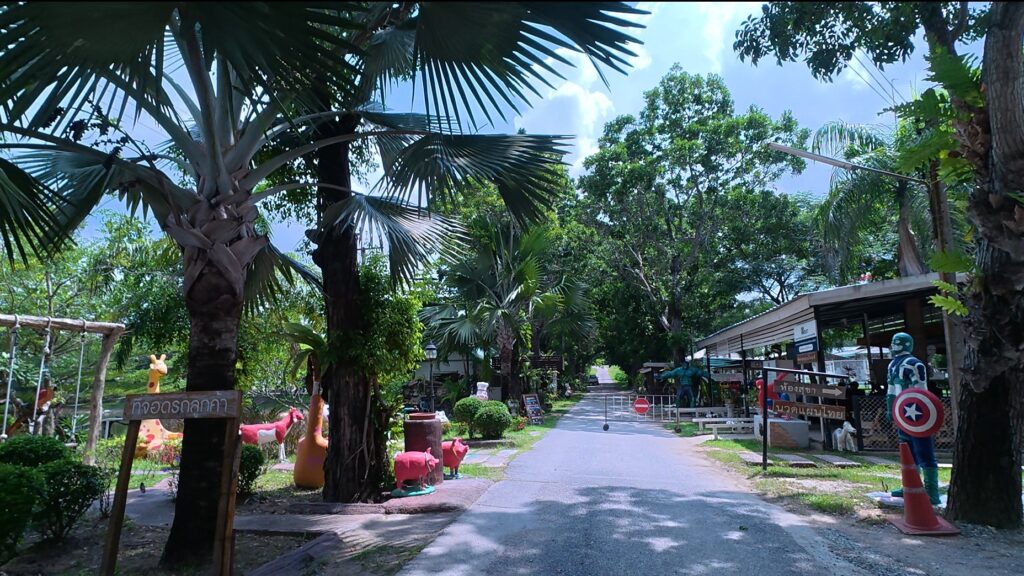
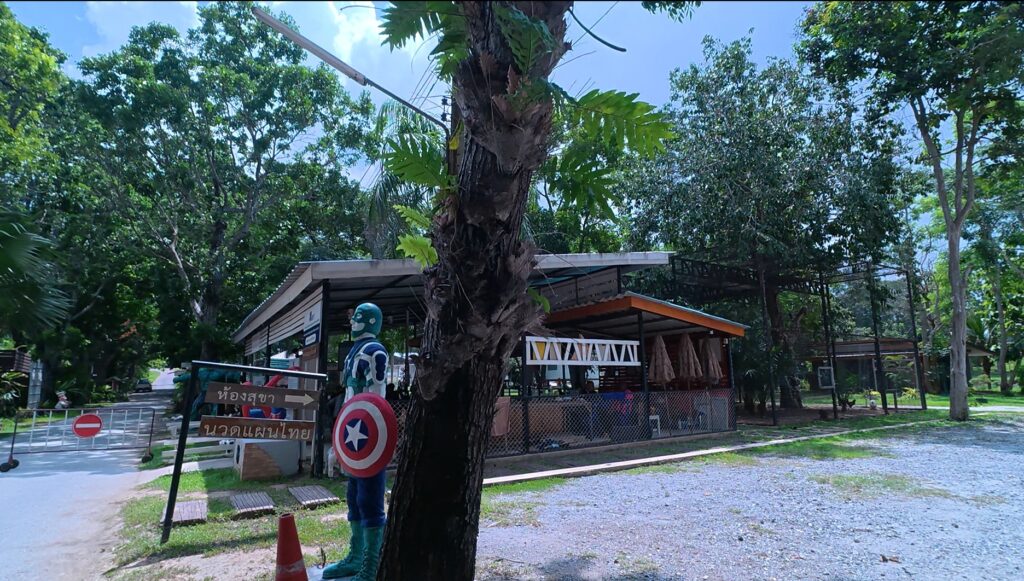
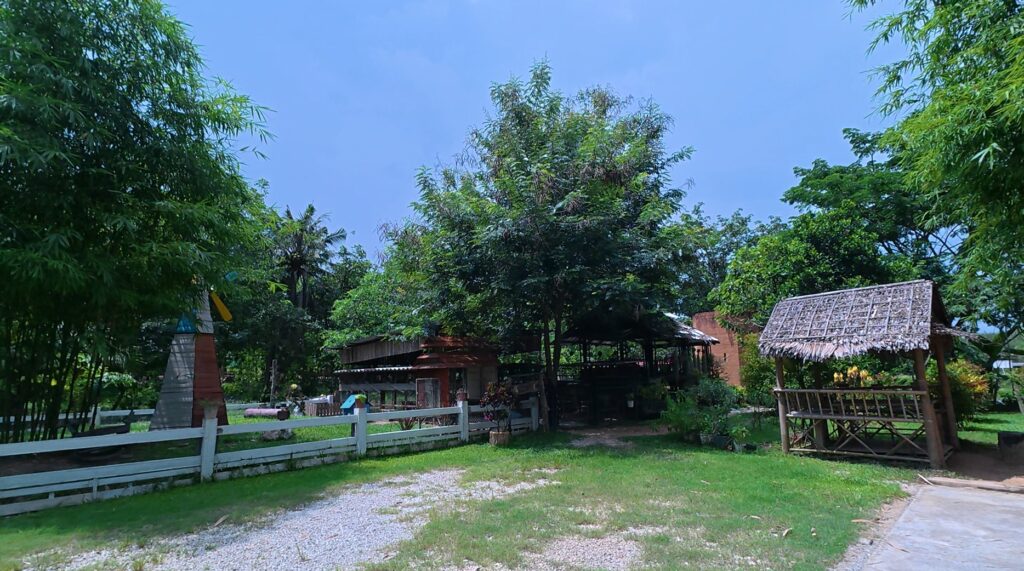
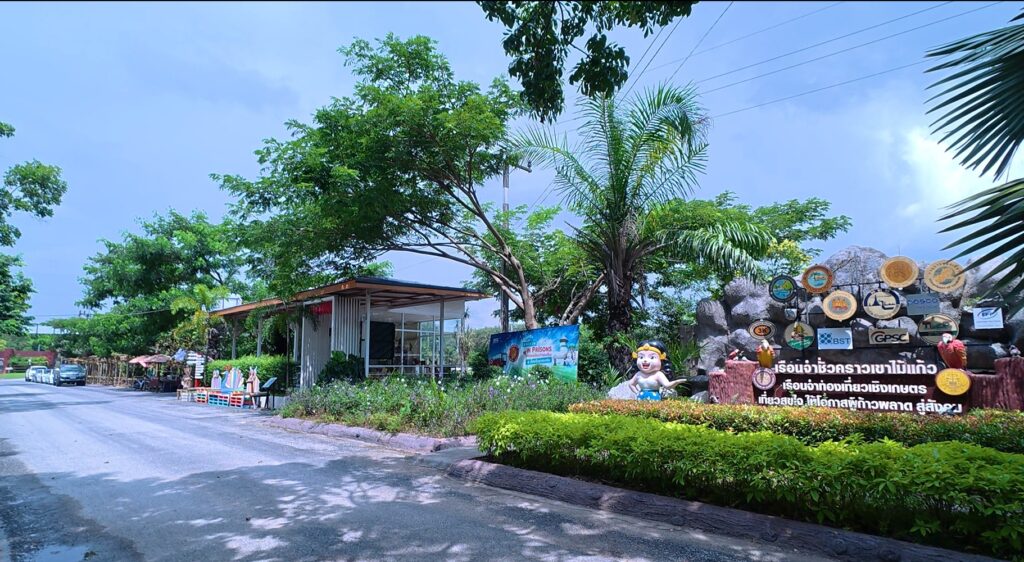
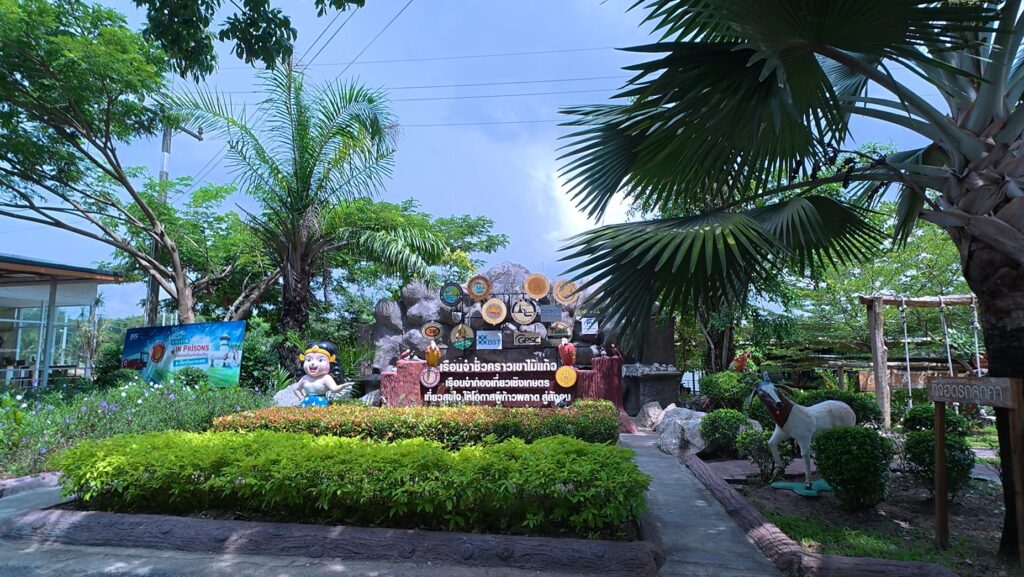
The final section through the correctional grounds gradually gives way to a quieter landscape before the temple appears.
Watch the full journey from the quiet correctional road to Wat Ang Kaeo, where Buddhist devotion, royal memory, Hindu deities and local folk beliefs come together.
From a road beside the prison to a hidden temple filled with Buddha images, Naga, Ganesha, royal memories and local faith.
Entering a Quiet Local Temple
The first impression was not grandeur.
Wat Ang Kaeo felt modest, local and lived-in.
There were shaded paths, small structures, trees and religious images scattered throughout the grounds. Unlike large royal temples where buildings are arranged according to a formal monumental plan, this place seemed to have grown gradually over time.
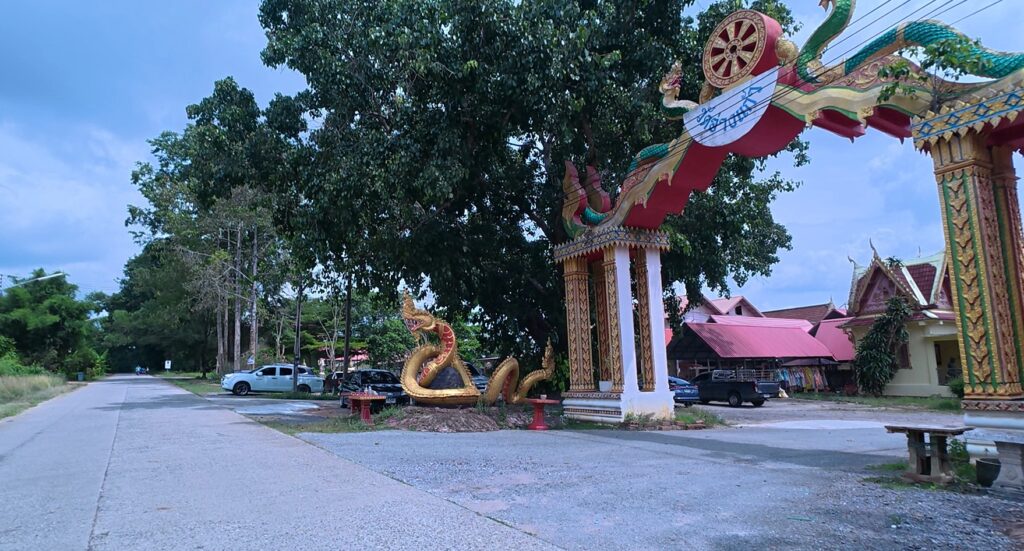
One shrine had been added beside another.
A Buddha image stood beside a royal figure.
Naga serpents appeared near Hindu deities.
Monks, elephants, guardians and folk offerings occupied their own corners.
At first, the collection seemed almost random.
But as I walked deeper into the temple, another picture began to emerge.
King Naresuan and the Roosters of Devotion
One of the first important figures I encountered was King Naresuan the Great.
King Naresuan is remembered as one of Thailand’s great warrior kings. He ruled Ayutthaya in the late sixteenth century and became a national symbol of independence, courage and military leadership.
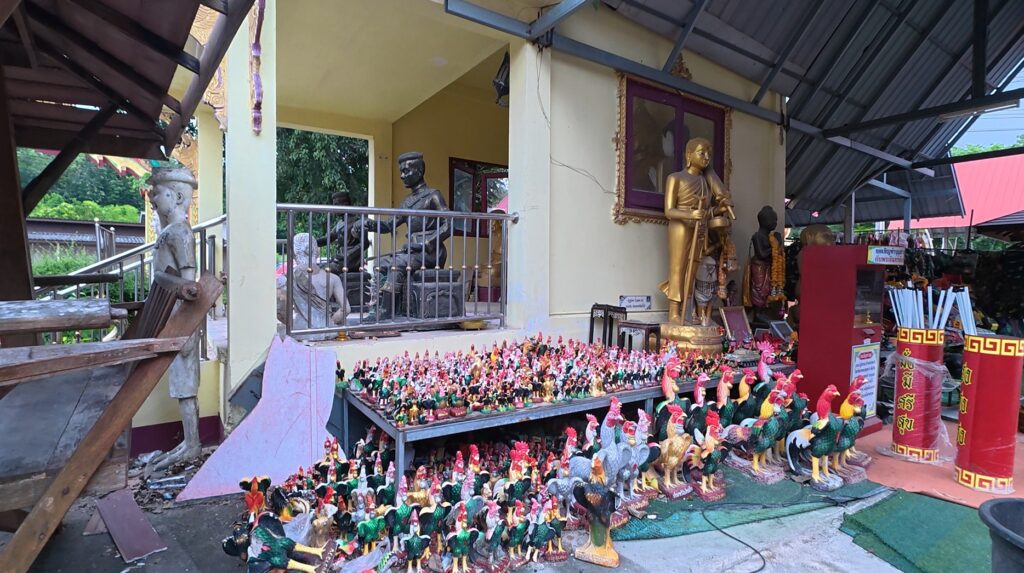
Around shrines dedicated to him, visitors often see large numbers of rooster statues.
The rooster has become closely associated with Naresuan through popular traditions concerning cockfighting during his youth. According to well-known stories, his skill and confidence in cockfighting became part of the legendary image surrounding the young prince.
Over time, the rooster became an offering made by people asking for success, strength or the fulfilment of a wish.
At Wat Ang Kaeo, the colourful rooster statues surrounding the royal shrine immediately reveal this popular tradition.
They are not merely decorations.
Each rooster may represent somebody’s prayer, gratitude or promise fulfilled.
In this way, history, legend and personal faith come together around the image of a king who lived more than four centuries ago.
Learn more about King Naresuan and his place in Thai history through King Naresuan the Great Monument
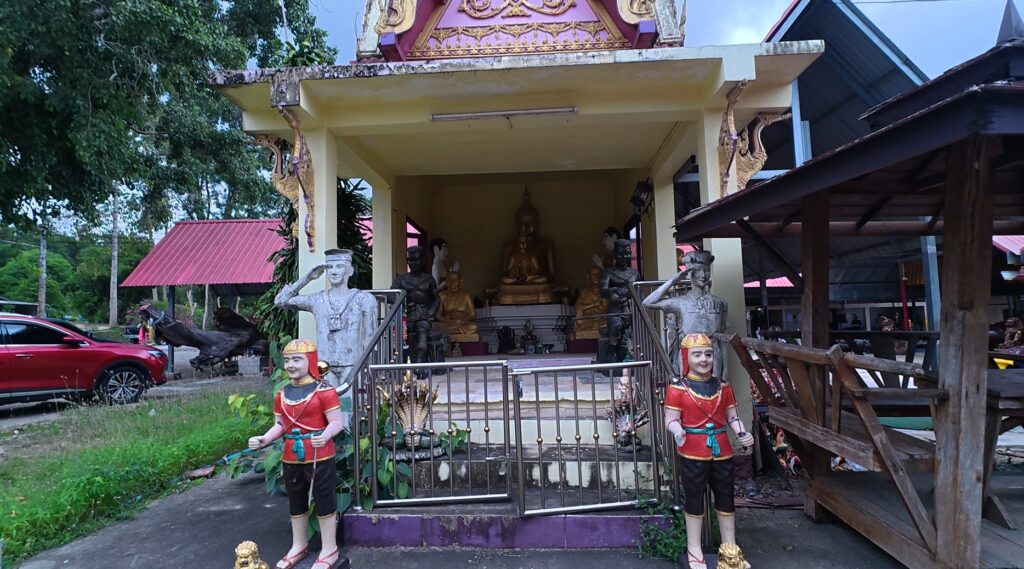
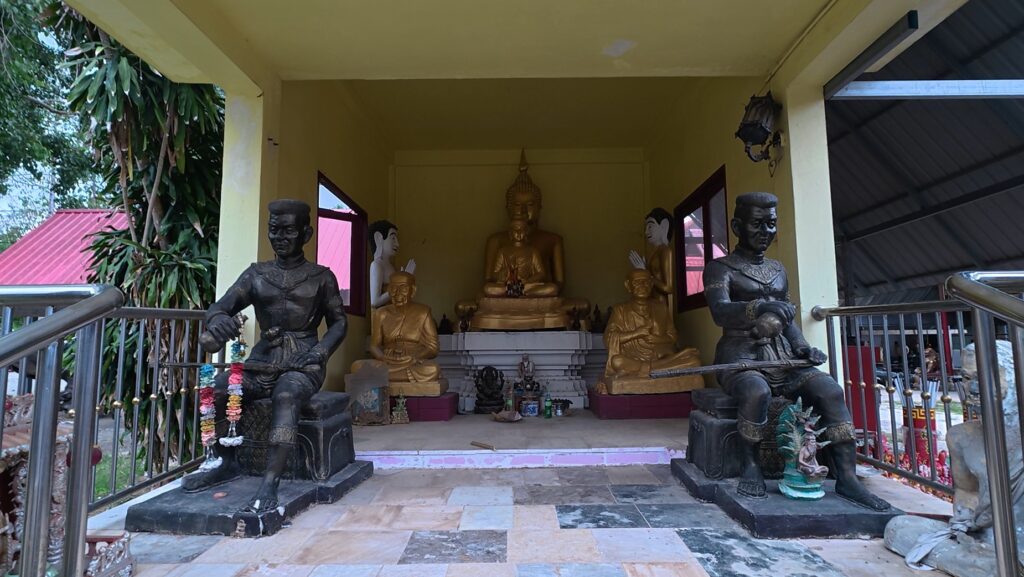
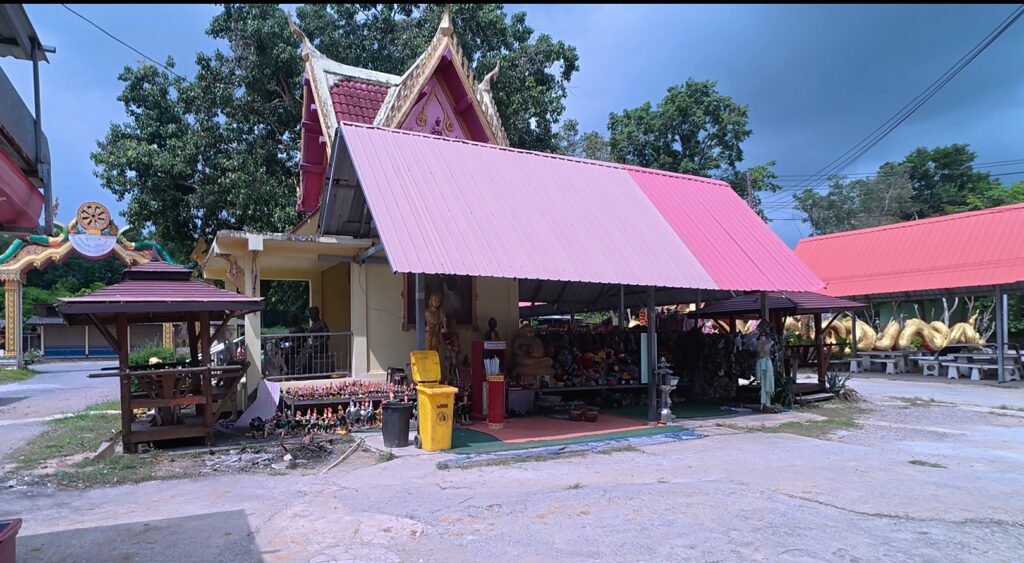
King Naresuan the Great is remembered through colourful rooster offerings, symbols of courage, gratitude and fulfilled vows.
Offerings for the Health and Safety of Children
Nearby, the atmosphere changes completely.
Instead of royal symbols and warrior legends, I found piles of children’s clothing, toys and other small objects offered at a shrine.
At first, such offerings can appear unusual.
Why would someone bring a child’s dress, a toy or a small piece of clothing to a temple?
In Thai folk belief, families sometimes make offerings when asking sacred beings to protect a child, cure an illness or bring health and good fortune.
A parent may make a vow: if the child recovers or remains healthy, an offering will later be brought to the shrine.
The object itself is therefore not important because of its monetary value.
Its meaning comes from the emotion behind it.
A small toy may represent a parent’s fear.
A tiny shirt may carry a mother’s hope.
And a colourful dress may be an expression of gratitude after a prayer has been answered.
These objects reveal an intimate side of Thai religious life—faith connected not to kings or philosophy, but to the everyday worries of ordinary families.
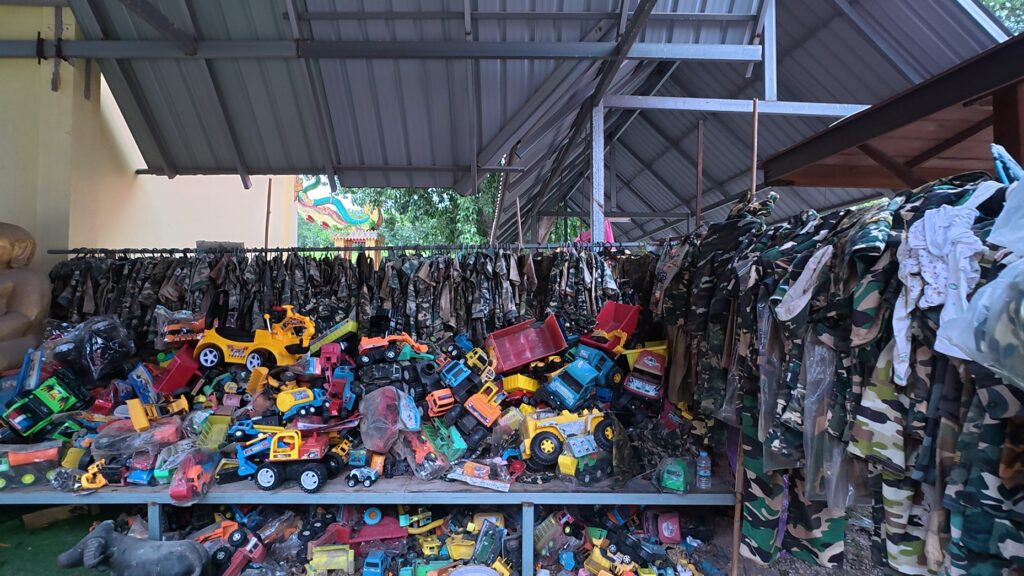
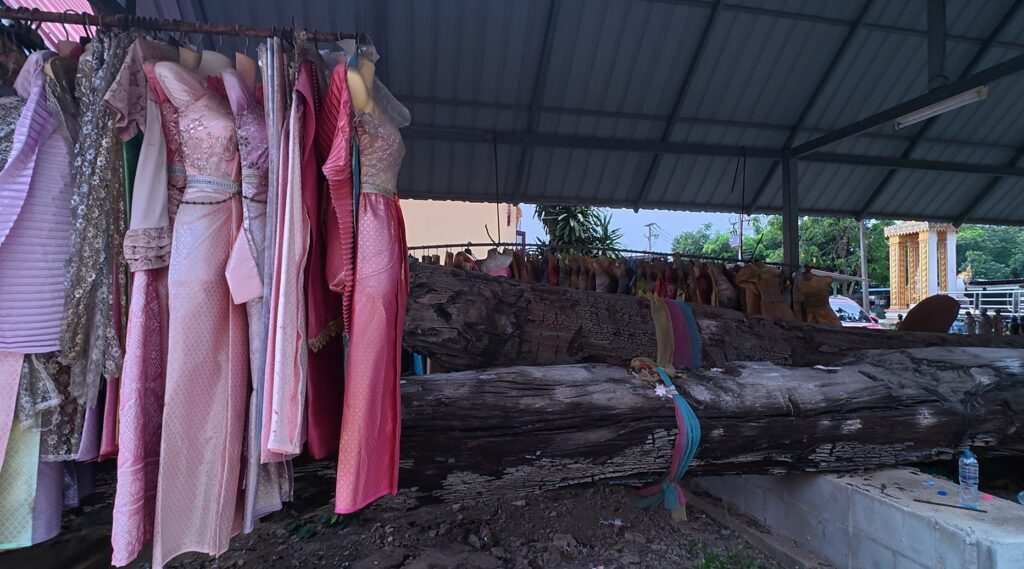
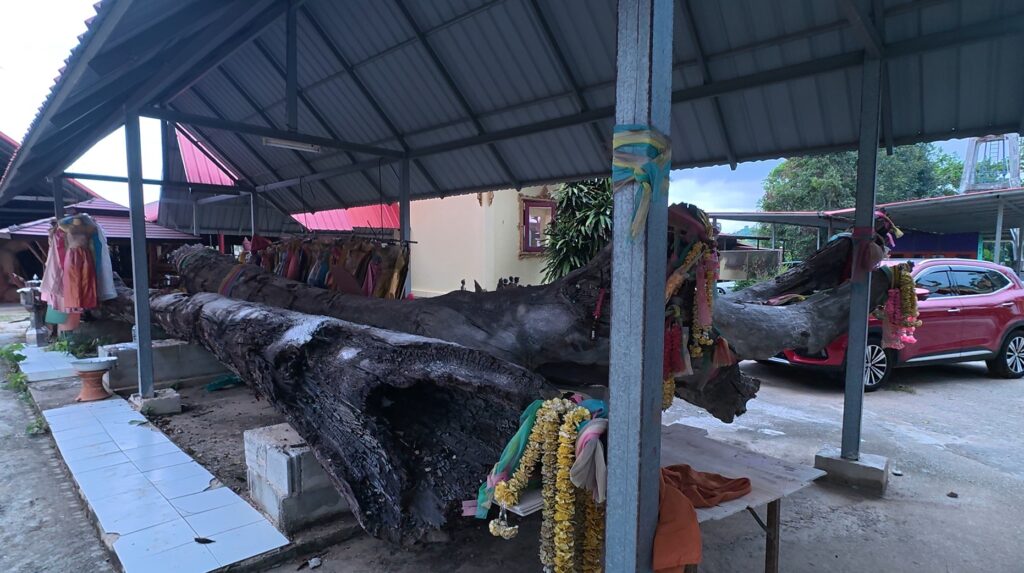
Toys and children’s clothing are offered with prayers for health, protection and the well-being of loved ones.
Monks Walking Through the Landscape of Faith
Continuing into the temple grounds, I encountered rows of monk statues.
Some appear to represent monks receiving alms, while others portray respected senior monks seated in meditation or teaching.
The image of the alms-round monk is deeply connected with daily Theravada Buddhist life in Thailand.
Early in the morning, monks traditionally leave their temple carrying their alms bowls. Laypeople offer rice and food, and the monks receive the offerings without choosing or requesting specific items.
The exchange is important to both sides.
The monk depends on the generosity of the community.
The layperson receives an opportunity to practise dana, or generosity, and to make merit.
It is one of the simplest relationships in Thai Buddhism, yet also one of the most enduring.
These statues therefore represent much more than monks walking with bowls.
They represent the connection between temple and village—the continuous exchange between those who follow the monastic path and those who support it.
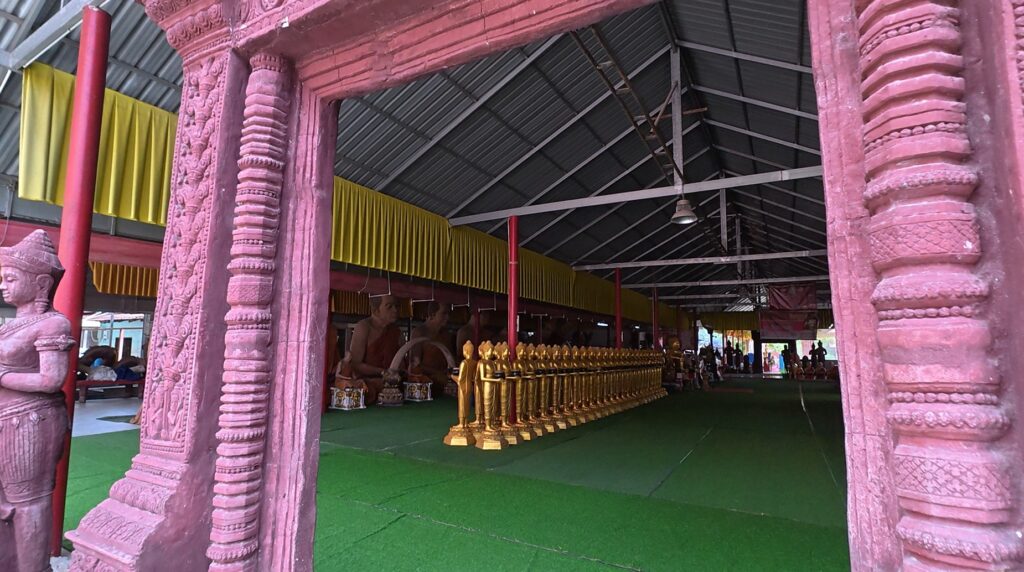
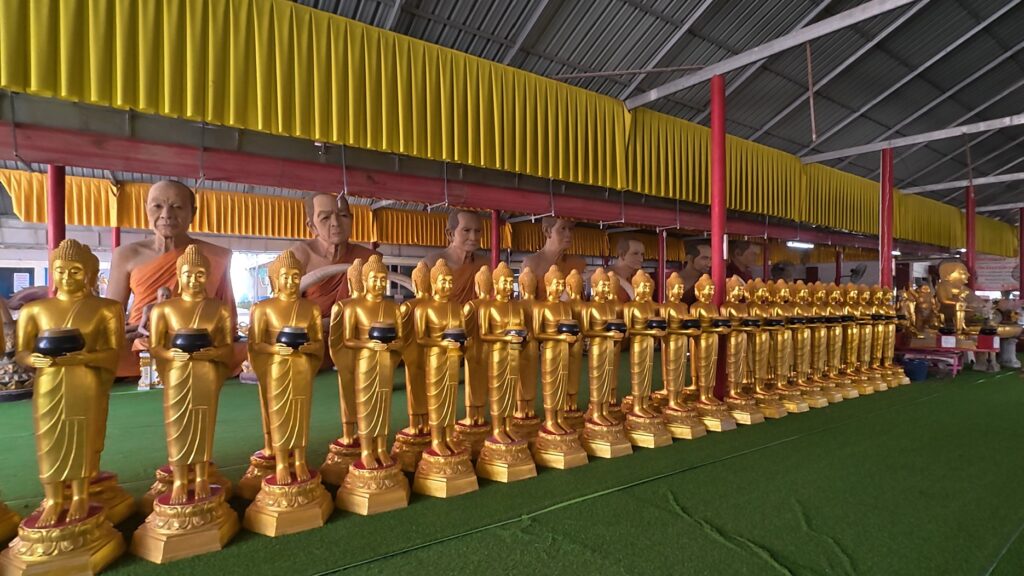
Rows of monks carrying alms bowls recall the daily bond between the monastic community and ordinary Buddhist families.
Revered Monks and the Transmission of Teaching
Other statues portray senior monks sitting peacefully.
In Thailand, images of highly respected monks are common in temples.
Some were meditation masters. Others were teachers, abbots or monks remembered for compassion, discipline or unusual spiritual abilities.
To an outsider, these statues may appear almost like another form of Buddha image.
But the meaning is different.
The Buddha represents ultimate awakening and the source of the Dharma.
The revered monk represents a human being who followed that teaching and demonstrated how it could be practised in real life.
For local devotees, a statue of a respected monk may preserve the memory of a teacher whose words once guided their parents or grandparents.
The statue becomes part religious image, part historical memory.
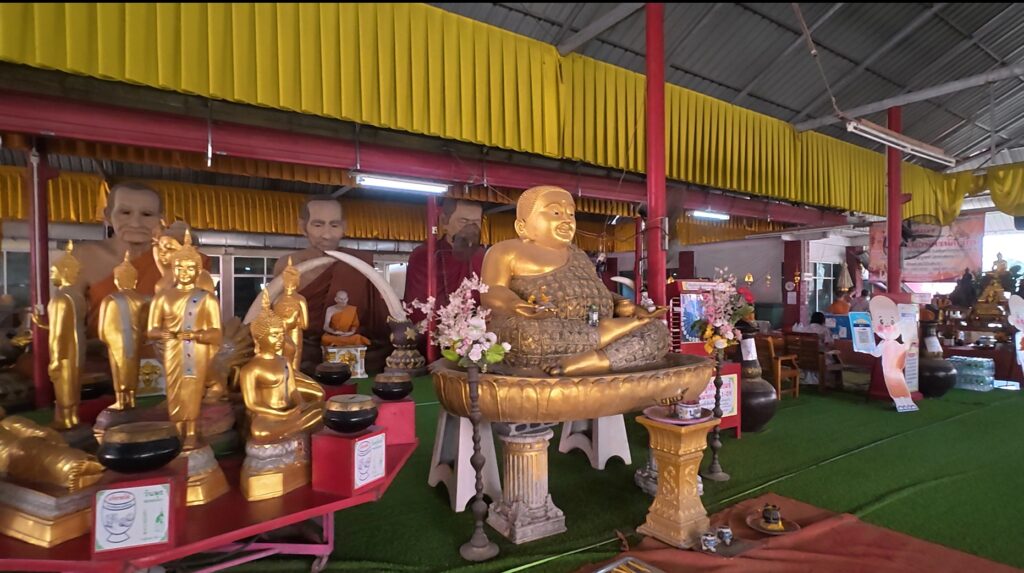
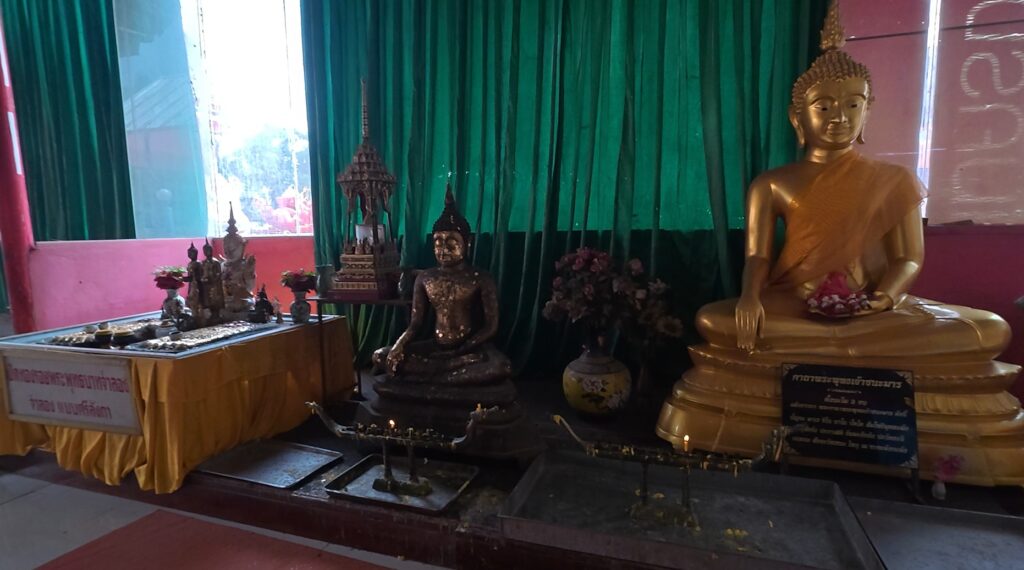
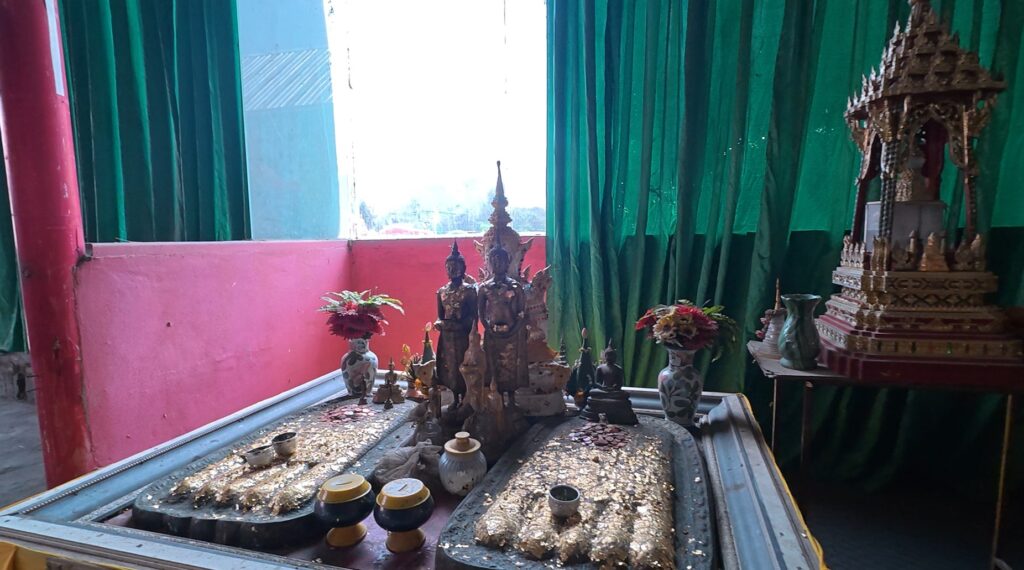
Statues of revered monks honour the teachers who preserved Buddhist practice and passed their wisdom to later generations.
The Buddha Teaching His Followers
Among the many figures are scenes showing the Buddha surrounded by followers.
These sculptural groups represent one of the foundations of Buddhism: the transmission of the Dharma.
After his enlightenment, the Buddha did not keep his understanding to himself. He taught others about suffering, impermanence, attachment and the path toward liberation.
His followers listened, practised and eventually transmitted those teachings to later generations.
Seen beside the statues of monks, the arrangement creates an almost continuous visual narrative:
The Buddha teaches.
The disciples listen.
The monks preserve the teaching.
The community continues to practise it.
Thousands of years of Buddhist tradition are condensed into a few groups of statues in a small local temple.
Faith Is Still Alive Here
Yet Wat Ang Kaeo is not simply a collection of old religious images.
As I continued walking, I saw local residents making offerings and paying respect before the shrines.
This was perhaps more meaningful than the statues themselves.
A temple survives because people continue to use it.
Someone brings flowers.
Someone lights incense.
Someone offers food.
Someone kneels quietly before a Buddha image and asks for nothing more than peace of mind.
The rituals may appear unchanged over generations, but every person arrives carrying a different worry, hope or memory.
The ancient symbols remain, while new prayers continue to accumulate around them.
The Reclining Buddha
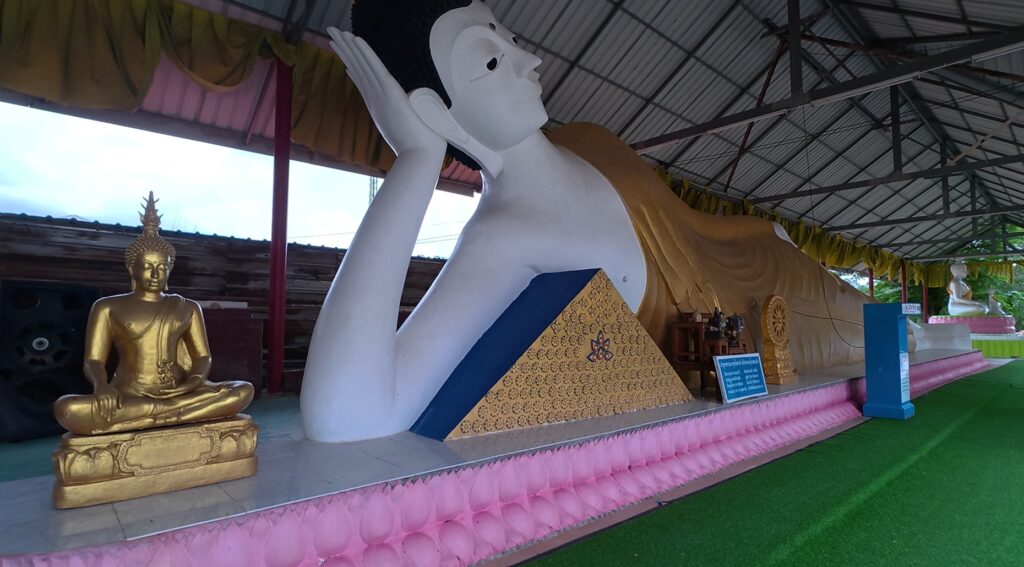
Further inside the temple is a reclining Buddha.
The reclining posture is one of the most recognisable forms of Buddhist imagery in Thailand.
It frequently represents the Buddha approaching Parinirvana, the final passing beyond the cycle of birth and death.
Unlike an image of ordinary sleep, the reclining Buddha therefore carries a profound meaning.
The Buddha lies calmly on his side because fear of death has disappeared.
The image reminds believers that everything arising in this world eventually changes and passes away.
Yet liberation is possible through wisdom and understanding.
In the quiet atmosphere of Wat Ang Kaeo, the reclining Buddha seems particularly appropriate.
Away from the noise of the city, the figure invites the visitor to contemplate impermanence and the limited time each of us is given.
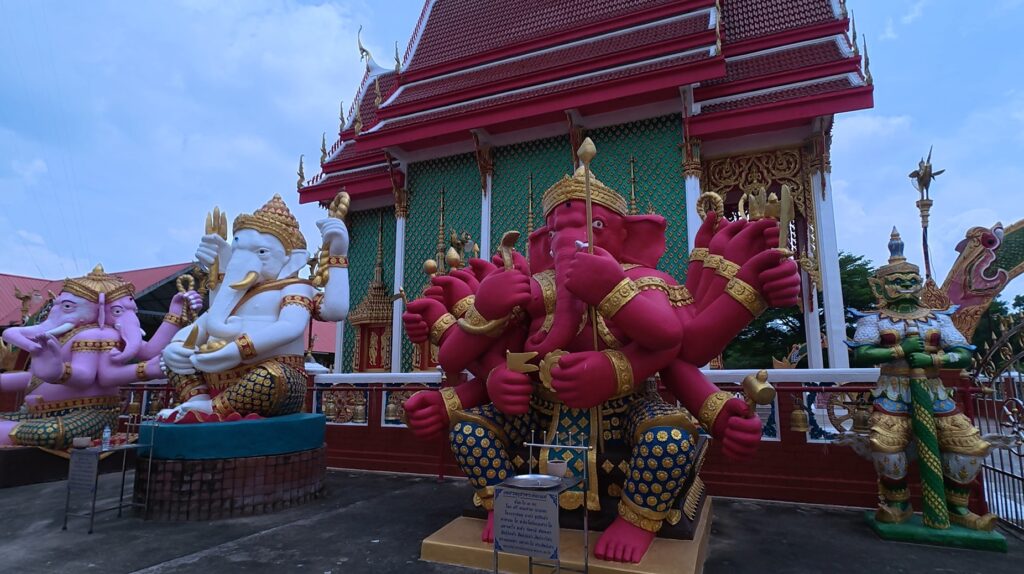
Ganesha — The Remover of Obstacles
Then another familiar figure appears.
With an elephant head and a human body, Ganesha is unmistakable.
Ganesha originates in Hindu tradition and is one of the most widely recognised Hindu deities in Thailand.
He is known as the Remover of Obstacles and is also associated with wisdom, knowledge, learning, creativity and success.
Students may seek his blessing before examinations.
Artists and performers may honour him before beginning creative work.
Businesspeople may ask for success in a new venture.
His presence in a Buddhist temple can surprise visitors who expect a strict separation between Hinduism and Buddhism.
But in Thailand, this coexistence is not unusual.
Brahmanical and Hindu traditions influenced royal rituals, mythology, art and popular belief for centuries. Rather than disappearing when Buddhism became dominant, many of these traditions became part of the wider Thai spiritual landscape.
Ganesha at Wat Ang Kaeo is a perfect example.
He does not replace the Buddha.
He occupies another place within the world of faith.
Naga — Guardian of the Sacred World
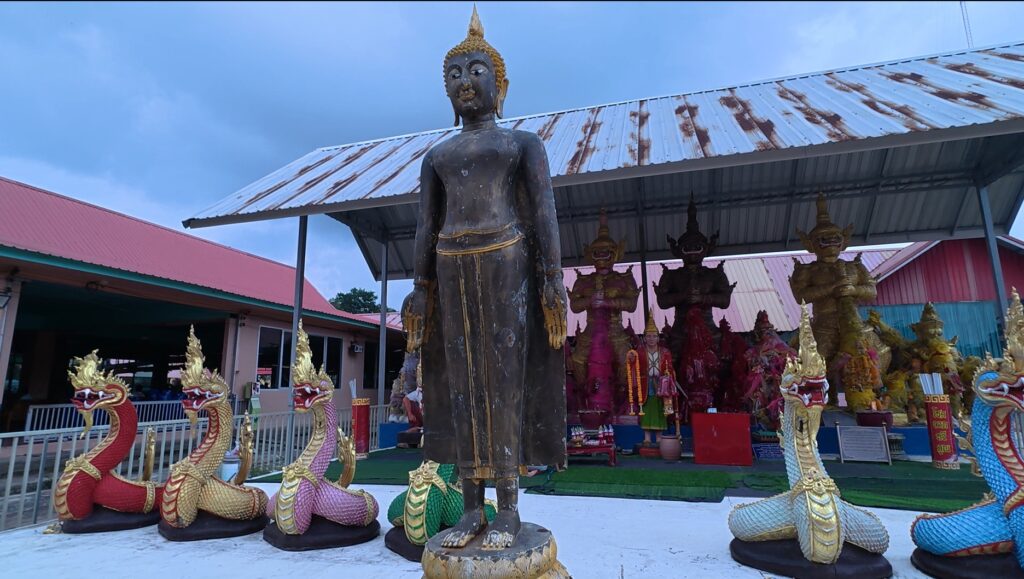
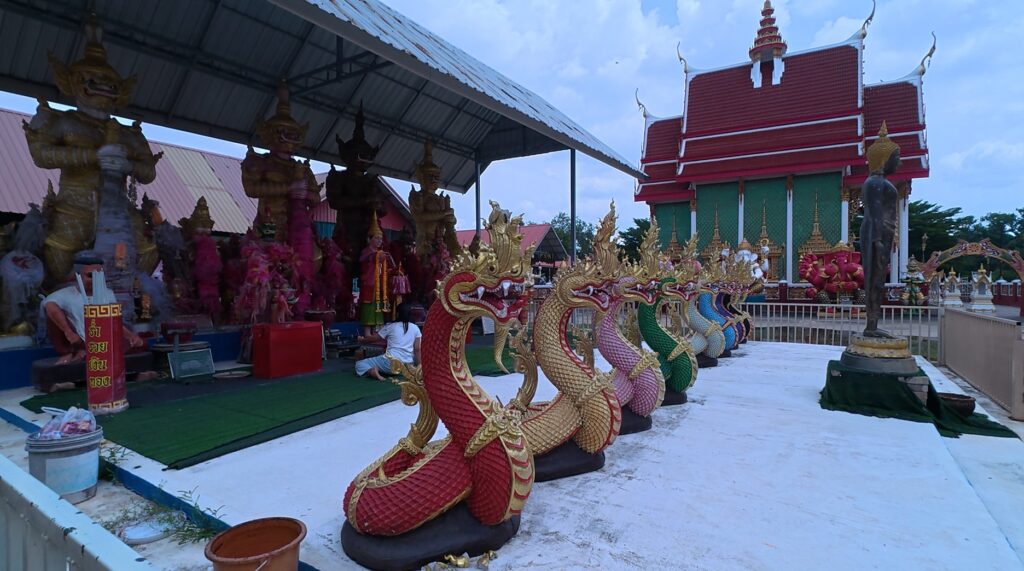
As I approached another important shrine, long serpent bodies appeared along the entrance.
These are Naga, sacred serpent beings found throughout Buddhist and Hindu traditions.
In Thailand they are often called Phaya Naga.
Naga statues frequently line temple stairways or guard entrances because they mark a transition.
One side belongs to ordinary human life.
Beyond the Naga lies sacred space.
Nagas are also strongly connected with water, fertility and protection.
One of Buddhism’s best-known Naga stories concerns Mucalinda, the serpent king who protected the meditating Buddha during a storm.
Because of such stories, the Naga became a protector of Buddhism.
Its presence at an entrance therefore carries both symbolic and protective meaning.
Passing between the serpent bodies can be understood almost as moving from the everyday world into the territory of the Dharma.
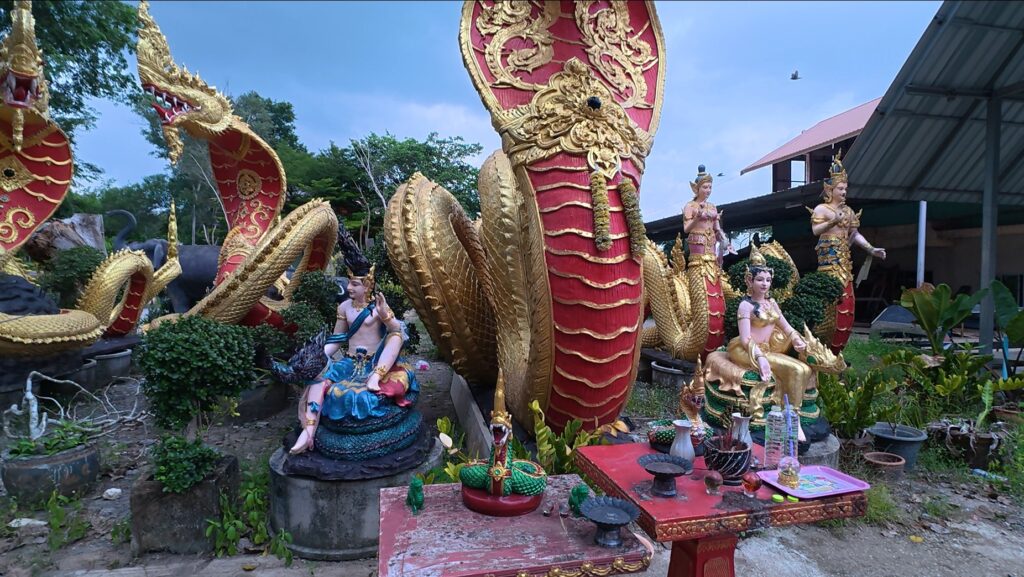
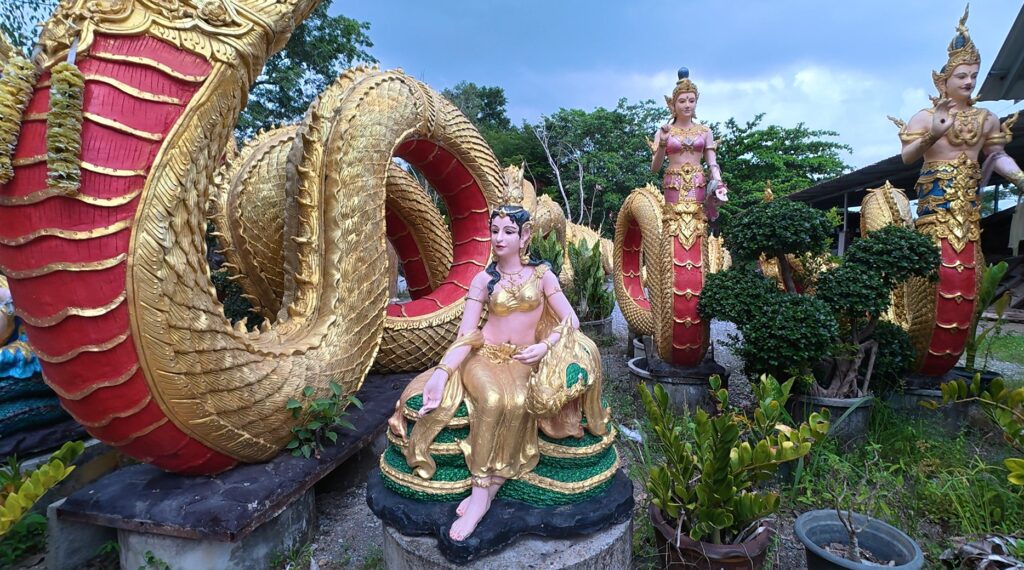
Naga serpents protect the sacred grounds, symbolising water, fertility and the passage from the ordinary world into holy space.
The Yaksha Guardians
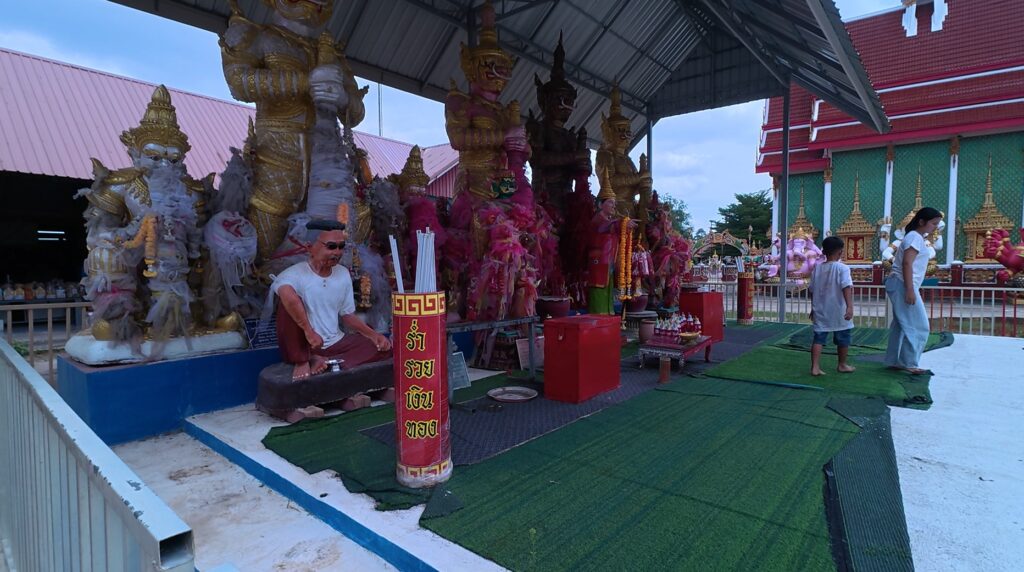
Near the sacred entrance are also powerful guardian figures resembling giants.
These beings belong to the tradition of the Yaksha, known in Thailand as Yak.
Yak guardians are familiar to anyone who has visited major Thai temples such as Wat Phra Kaew in Bangkok.
Their fierce faces, large bodies and weapons may look threatening, but their role is protective.
They stand at gateways to prevent destructive forces from entering the sacred space.
This is another interesting transformation within Thai religious culture.
A frightening supernatural being does not necessarily represent evil.
Once placed in service of the Dharma, its strength becomes protection.
The fierce guardian and the peaceful Buddha therefore belong to the same sacred landscape.
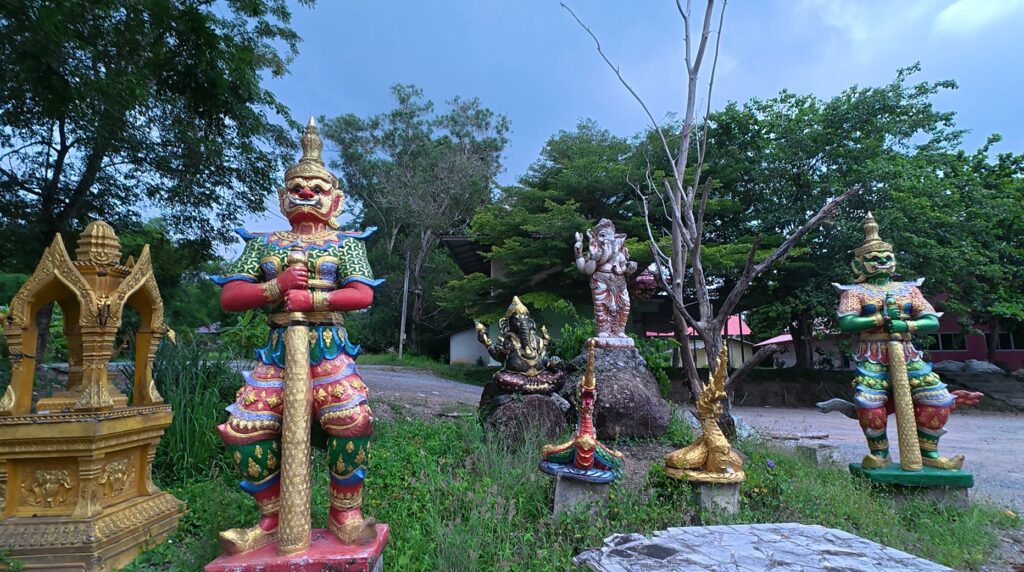
Entering the Main Buddha Hall
Passing the Naga and guardian figures, I finally approached the main Buddha hall.
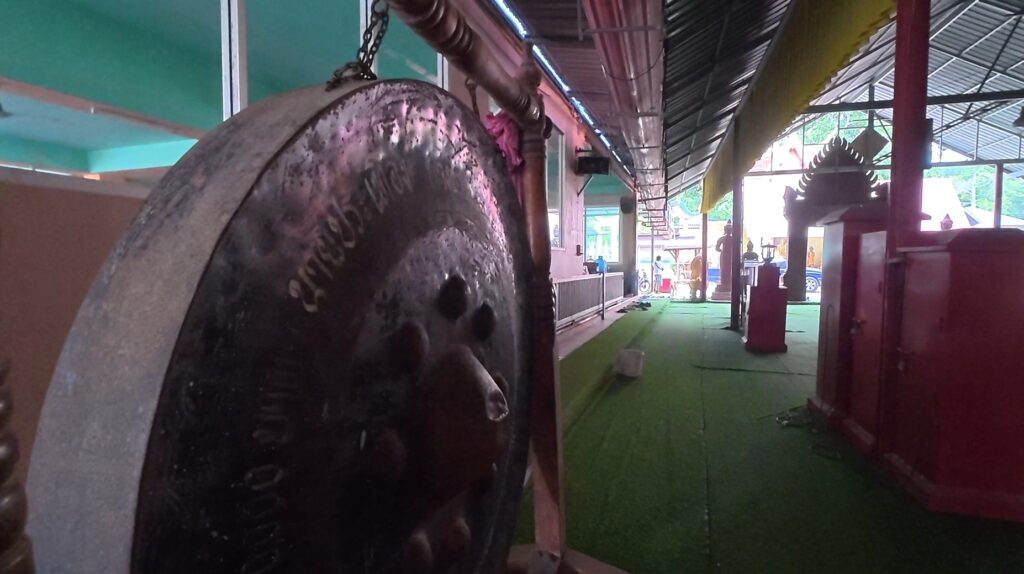
After walking among so many colourful statues—kings, monks, mythical serpents, elephants and Hindu gods—the atmosphere inside felt noticeably calmer.
The Buddha sat quietly at the centre.
Local residents continued to arrive, kneel and make offerings.
There was no need for dramatic ceremony.
A pair of hands placed together.
A flower.
A stick of incense.
A few silent moments before the Buddha.
These simple gestures have continued in Thai temples for generations.
And here, in this modest temple beside a prison road, they continue today.
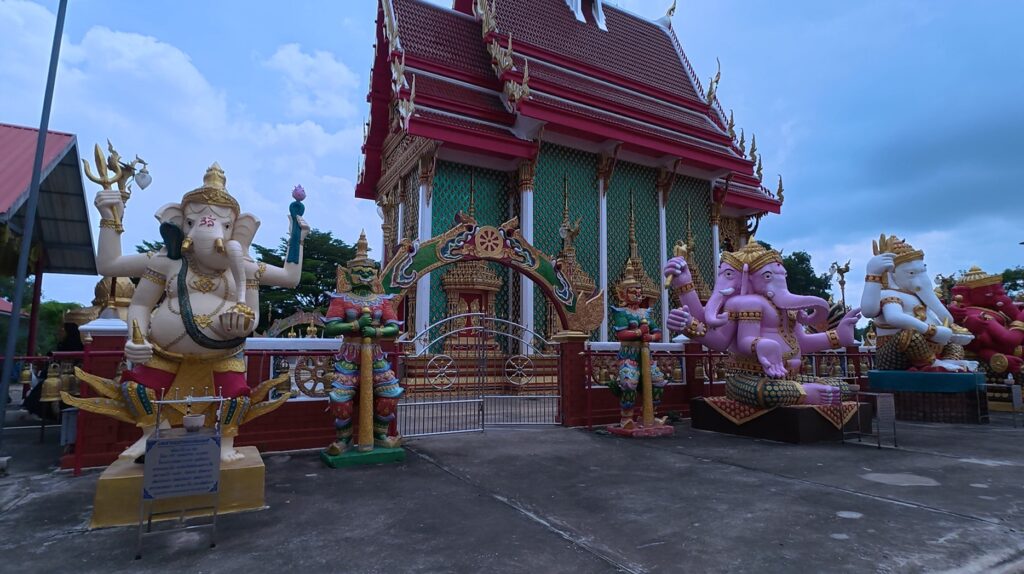
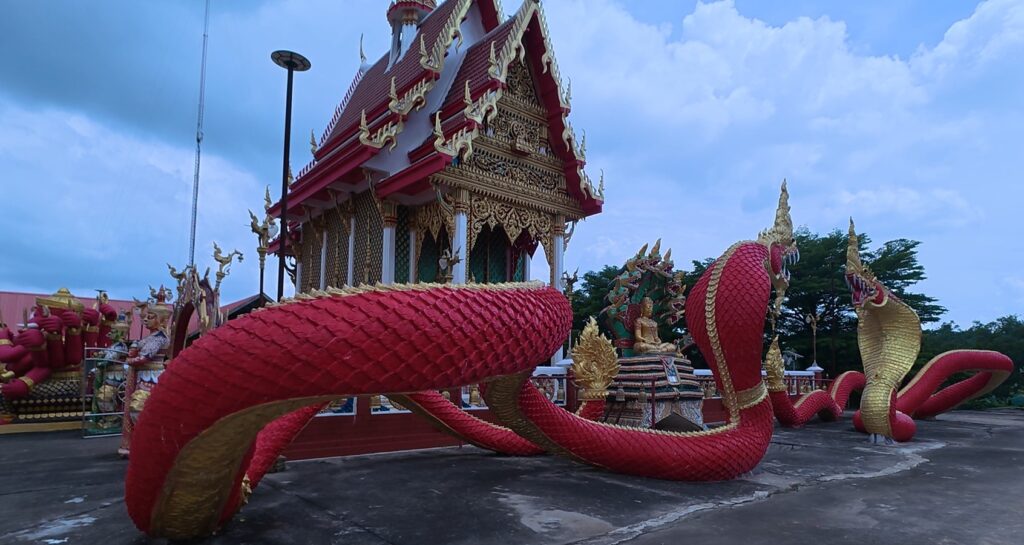
Passing between Naga and guardian figures leads toward the main Buddha hall at the heart of Wat Ang Kaeo.
Buddhism, Hinduism and Folk Belief in One Place
By now, Wat Ang Kaeo had begun to feel like a small summary of Thai religion itself.
There was Theravada Buddhism, represented by the Buddha, monks, alms rounds and teachings.
There was Hindu influence, visible through Ganesha and other mythological imagery.
There was royal memory, represented by King Naresuan and the elephant.
There were Naga and Yak guardians, inherited from older Indian and Southeast Asian mythological traditions.
And there were folk beliefs, expressed through rooster offerings, toys and clothes offered for children, vows, prayers and local devotional practices.
From a Western perspective, it may be tempting to ask:
Which of these is the “real” religion?
But perhaps that is the wrong question.
Thai religious life has developed through layers.
New beliefs arrived without necessarily erasing older ones.
Buddhism provided the central philosophical and monastic tradition, while Hindu mythology, royal ritual, ancestor memory and local spirit beliefs continued around it.
The result is not always neatly organised.
But it is alive.
A Temple Beside a Place of Confinement
There is also an unusual contrast that remains difficult to ignore.
Not far away is a prison—a place associated with restriction, punishment and the consequences of human actions.
Inside Wat Ang Kaeo are teachings about karma, compassion, wisdom and liberation.
Perhaps the location gives the temple an additional meaning.
Buddhism teaches that human beings remain trapped not only by physical walls but also by anger, desire, ignorance and attachment.
A person may be physically free yet remain imprisoned by the mind.
Another may live behind walls and still search for inner peace.
The quiet temple and the nearby correctional landscape therefore create an unexpected contrast between confinement and liberation.
The Faith of Ordinary People Continues
Before leaving, I once again watched local residents moving through the temple.
Some stopped before a Buddha.
Others approached a particular shrine.
Someone had brought an offering.
Another person simply stood quietly.
The statues may come from different historical periods and religious traditions, but the people approaching them share something much simpler.
They hope.
They remember.
They ask for protection.
They give thanks.
They search for peace.
And that may be the most important meaning of Wat Ang Kaeo.
The temple is not a museum explaining Thai religion through labels and display cases.
It explains Thai faith through the way people continue to use these images today.
A Small Temple Containing a Large World
When I first turned onto the road, I expected nothing more than another quiet local temple.
Instead, Wat Ang Kaeo revealed an extraordinary collection of stories.
King Naresuan and his roosters spoke of history, courage and popular devotion.
Children’s toys and clothing spoke of parents hoping for health and protection.
Monks represented the continuation of Buddhist teaching.
The reclining Buddha reminded visitors of impermanence.
Elephants connected religion with kingship and sacred fortune.
Ganesha brought the Hindu world into a Buddhist landscape.
Nagas and Yak guardians protected the boundary of sacred space.
And ordinary residents continued to kneel before these figures, just as generations before them had done.
In one small temple, many centuries of Thai belief seemed to coexist.
Leaving Wat Ang Kaeo
Eventually, I returned to the Honda Cub.
The road outside was still quiet.
Behind me remained the colourful statues, the Buddha images, the sacred serpents, the old kings and the offerings of ordinary families.
Ahead was another road and another journey.
Wat Ang Kaeo may never become one of Thailand’s famous tourist temples.
Perhaps that is part of its charm.
It is a place where religious traditions have accumulated naturally, without being arranged for visitors.
A little Buddhism.
A little Hindu mythology.
Royal history.
Local spirits.
Personal prayers.
And the daily faith of people who still come here.
For a traveller trying to understand Thailand beyond its tourist attractions, places like this can sometimes reveal far more than the famous temples.
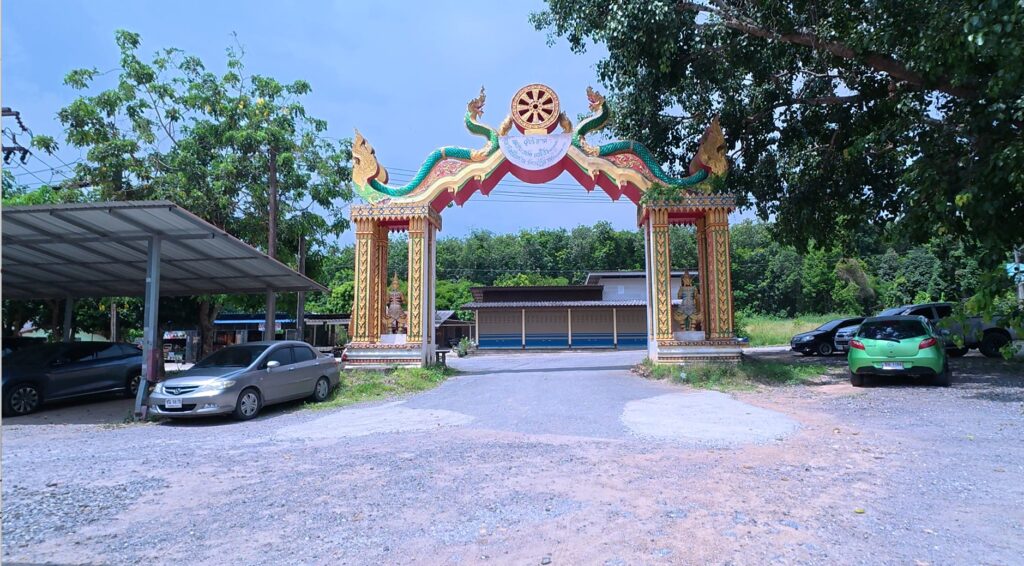
Location and Visitor Information
Wat Ang Kaeo is located in Nong Lalok, Ban Khai District, Rayong Province, close to the Khao Mai Kaeo correctional area. The unusual approach through quiet roads and correctional facilities is part of what makes the visit memorable.
Location: Nong Lalok, Ban Khai District, Rayong 21180, Thailand
Admission: Free
Best time to visit: Morning or late afternoon, when the temple grounds are cooler and quieter
Dress: Modest clothing covering shoulders and knees is recommended
Photography: Generally suitable around the grounds, but be respectful around worshippers and inside sacred halls
Visit time: Allow around 45–60 minutes to walk slowly through the statues, shrines and main temple area.
Google Maps: Wat Ang Kaeo
Wat Ang Kaeo is not a major tourist temple, but visitors who take the time to explore its grounds can discover an unusually rich mixture of Buddhist devotion, royal history, Hindu mythology and local Thai beliefs.
Continue exploring more hidden sacred places in the Temples of Thailand collection.