Introduction — The Many Faces of Faith in Thai Temples
Thai temple gods and guardian spirits reflect a fascinating blend of Buddhism, Hindu mythology, and local spiritual traditions. From Vishnu and Ganesha to Naga, Hanuman, and Thao Wessuwan, these sacred figures reveal the rich symbolism found throughout Thailand’s temples.
Visitors to Thailand often encounter more than Buddha images inside Buddhist temples. Statues of Hindu gods, mythical serpents, powerful guardian kings, monkey warriors, and female deities frequently appear alongside traditional Buddhist architecture.
Thai Temple Gods are not always Buddhist figures. Many originate from Hindu mythology, while others reflect ancient local beliefs that continue to shape Thailand’s religious traditions.
The diverse representations of Thai Temple Gods reveal how Buddhist teachings, Hindu mythology, and traditional guardian spirits have become interconnected in Thai temple culture.
Why are these different figures found together?
The answer lies in Thailand’s long religious and cultural history. Theravada Buddhism became the country’s principal religious tradition, while Hindu mythology, Brahmanical court rituals, and local spirit beliefs continued to influence Thai society.
Many of these traditions gradually developed alongside one another, creating the rich religious landscape visible in Thai temples today.
Understanding Thai Temple Gods helps visitors recognize the different religious traditions represented by statues and sacred figures throughout Thailand.
Many Thai Temple Gods and guardian spirits reflect centuries of interaction between Buddhism, Hinduism, and local folk beliefs.
This guide introduces some of the most recognizable gods, guardians, and sacred figures encountered during our temple journeys with Won Cub Life.
Table of Contents
1. Vishnu — The Preserver of the Universe
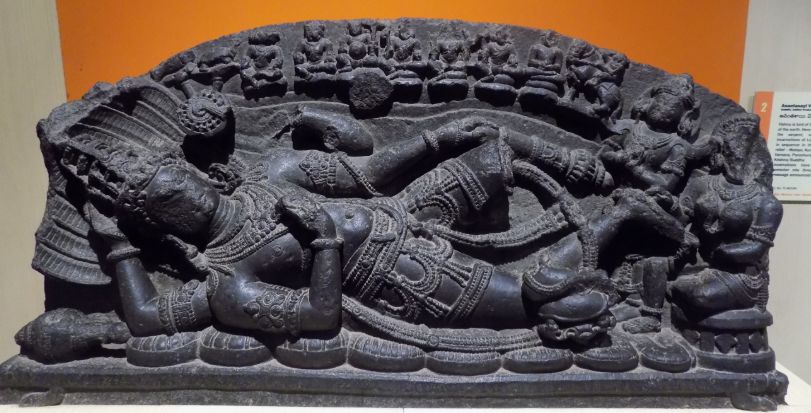
Vishnu is one of the principal deities of Hinduism, associated with the preservation of cosmic order.
In the image known as Vishnu Anantasayin, Vishnu reclines upon the cosmic serpent Ananta or Shesha. A lotus emerges from his navel, carrying Brahma, the creator deity.
This scene symbolizes the renewal of the universe through successive cosmic cycles.
Vishnu also appears in different incarnations, or avatars, to restore cosmic balance.
Vamana — The Dwarf Incarnation
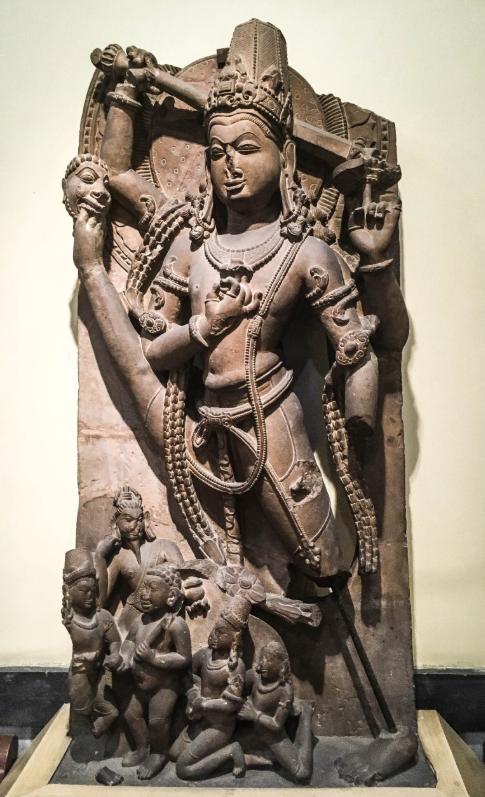
In the story of Vamana, Vishnu appears as a dwarf Brahmin and asks King Bali for three steps of land.
Vamana then assumes an immense cosmic form and measures the universe in three strides.
The story represents the restoration of divine order and the limitation of excessive power.
2. Shiva — The Cosmic Dancer

Shiva is associated with destruction, transformation, and renewal.
One of his most famous representations is Shiva Nataraja, the Lord of Dance.
Shiva dances within a circle of flames, symbolizing the dynamic nature of the universe.
The small drum represents the rhythm of creation, while the flame signifies destruction and transformation.
Beneath his foot lies a small figure representing ignorance.
Rather than simply depicting destruction, the image expresses the continuous transformation of existence.
3. Ganesha — The Elephant-Headed God
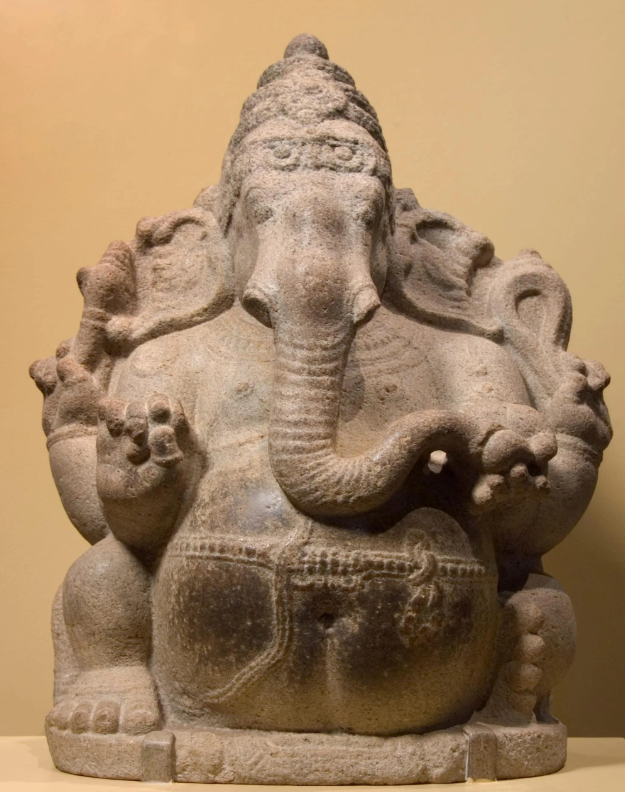
Ganesha is among the most recognizable Hindu deities in Thailand.
He is traditionally regarded as the son of Shiva and Parvati.
According to a well-known legend, Shiva unknowingly severed the head of the child created by Parvati. To restore him to life, an elephant’s head was attached to his body.
Ganesha is widely worshipped as the remover of obstacles and a patron of wisdom, learning, and successful beginnings.
His statues are frequently encountered in Thai religious compounds, businesses, and cultural institutions.
4. Garuda — The Sacred Bird of Royal Power
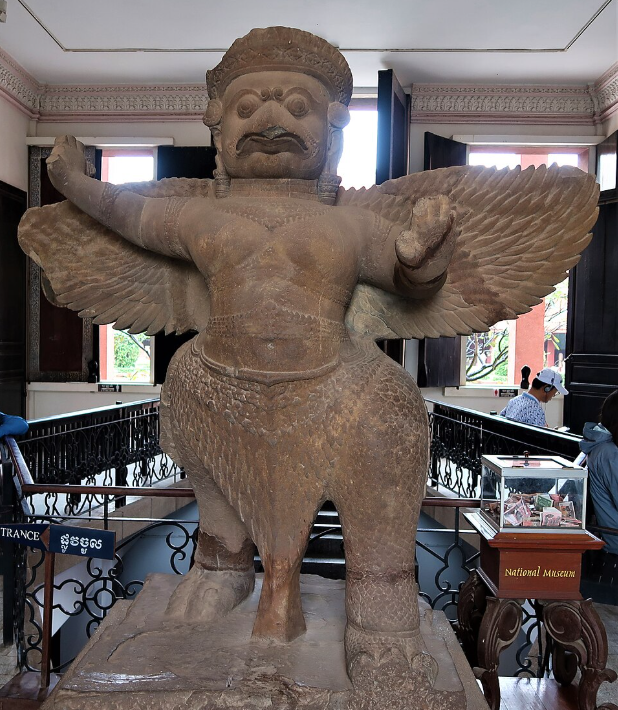
Garuda is a powerful mythical bird associated with Vishnu.|
In Hindu mythology, Garuda serves as Vishnu’s mount and is frequently portrayed as an enemy of serpents.
In Thailand, Garuda is known as Phra Khrut (พระครุฑ).
Garuda has a particularly important relationship with Thai kingship and appears as a symbol of royal authority and the Thai state.
His wings, powerful body, and dramatic posture express supernatural strength, speed, and sovereignty.
5. Naga — The Sacred Serpent
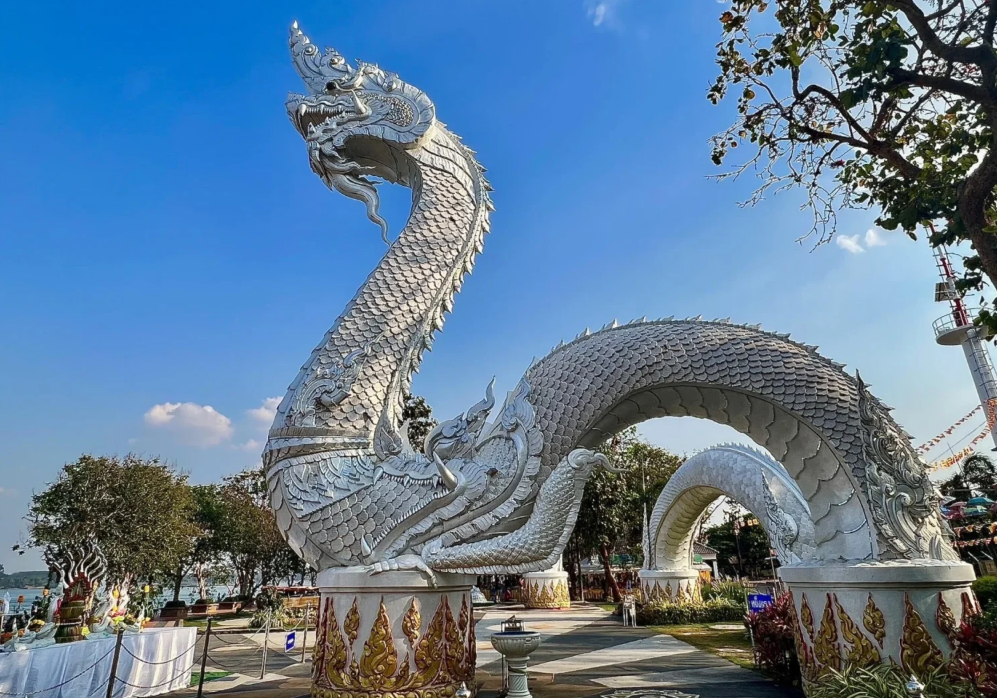
Naga is a supernatural serpent associated with water, fertility, protection, and the unseen world.
Naga traditions are found in Hinduism, Buddhism, and the religious cultures of Southeast Asia.
In Thai Buddhist architecture, naga figures frequently decorate stairways leading to ordination halls, temples, and sacred monuments.
One of the best-known Buddhist stories concerns Mucalinda, the naga king who protected the meditating Buddha from a storm.
The Buddha image depicting this event is called Pang Nak Prok (ปางนาคปรก).
Nagini — The Female Serpent
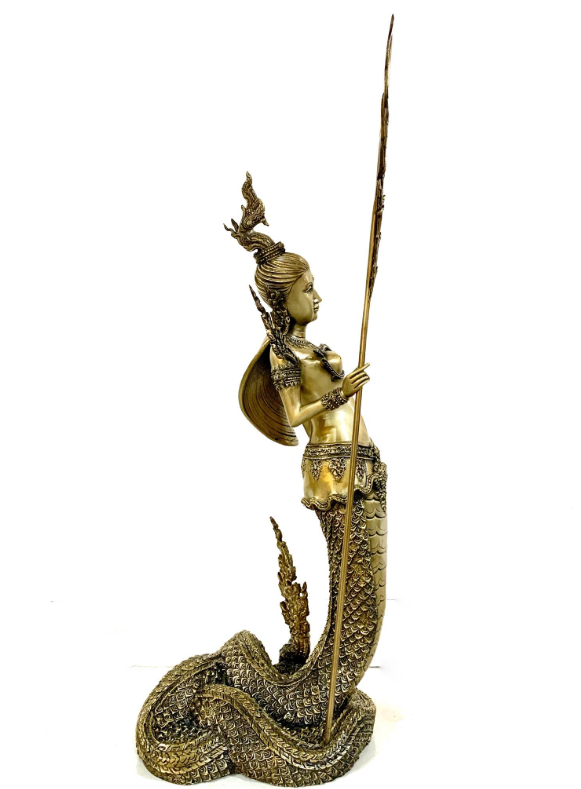
Nagini is the feminine form of naga.
Female naga figures may be represented as beautiful women, serpents, or beings combining a human upper body with a serpent’s lower body.
They are associated with water, fertility, protection, and the supernatural realm.
In Thailand, these images also reflect the influence of regional folk beliefs.
Individual statues should be identified carefully, since their specific names and stories can differ between temples.
6. Singha — The Mythical Lion Guardian
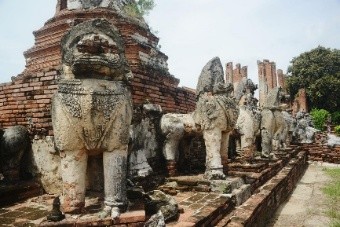
Singha is a lion-like guardian commonly encountered in Thai religious architecture.
Its imposing appearance symbolizes strength, protection, and authority.
Singha figures often stand near entrances, stairways, or important religious structures.
In Southeast Asian mythology, mythical animals are also associated with the Himavanta forest, a legendary realm inhabited by extraordinary beings.
The placement of lion guardians emphasizes the transition from ordinary surroundings into a sacred space.
7. Thao Wessuwan — The Guardian King of the North

Thao Wessuwan (ท้าวเวสสุวรรณ) is one of Thailand’s most widely revered protective deities.
He corresponds to Vaiśravaṇa in Buddhist tradition and is associated with Kubera, the Indian deity of wealth.
In Buddhism, Vaiśravaṇa is one of the Four Heavenly Kings and protects the northern direction.
In Korean Buddhism, the corresponding figure is known as Damuncheonwang (다문천왕, 多聞天王).
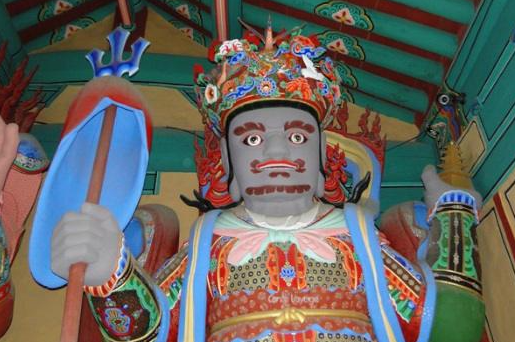
한국의 다문천왕과 태국의 타오 웻수완은 같은 불교적 신격의 지역적 표현
Thai representations often show Thao Wessuwan as a powerful yaksha with a fierce face, an elaborate crown, and a large club.
Devotees seek his protection against harmful spirits and misfortune. He is also associated with prosperity and the safeguarding of wealth.
His fearsome appearance symbolizes protective power rather than evil.
8. Hanuman — The Legendary Monkey Warrior
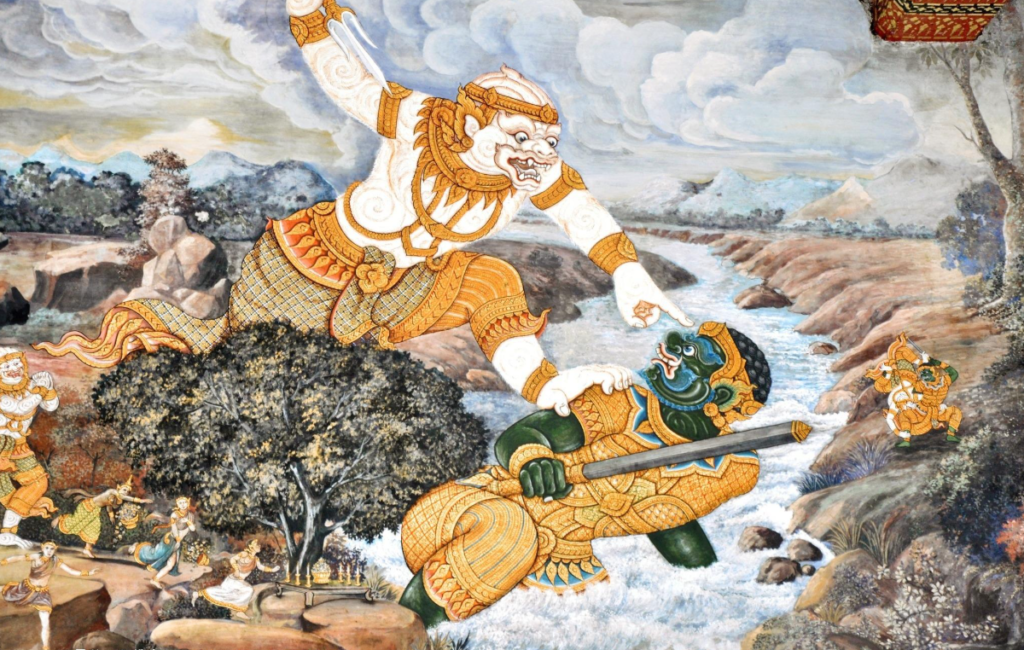
Hanuman (หนุมาน) is the celebrated monkey hero of the Indian epic Ramayana.
In Thailand, he appears prominently in the Ramakien (รามเกียรติ์), the Thai adaptation of the epic.
Hanuman serves Prince Rama as a courageous and loyal warrior.
He possesses extraordinary strength, supernatural abilities, and the power to transform himself.
Thai artistic representations commonly portray Hanuman with a white monkey face, elaborate royal ornaments, and dynamic fighting postures.
Hanuman symbolizes courage, loyalty, intelligence, and victory over adversity.
Unlike Thao Wessuwan, Hanuman is not one of the Four Heavenly Kings. His origins lie primarily in the Hindu epic tradition, although he has also become a protective figure in Thai popular belief.
9. Phra Mae Thorani — The Earth Goddess-지모신(地母神) 대지여신(大地女神)
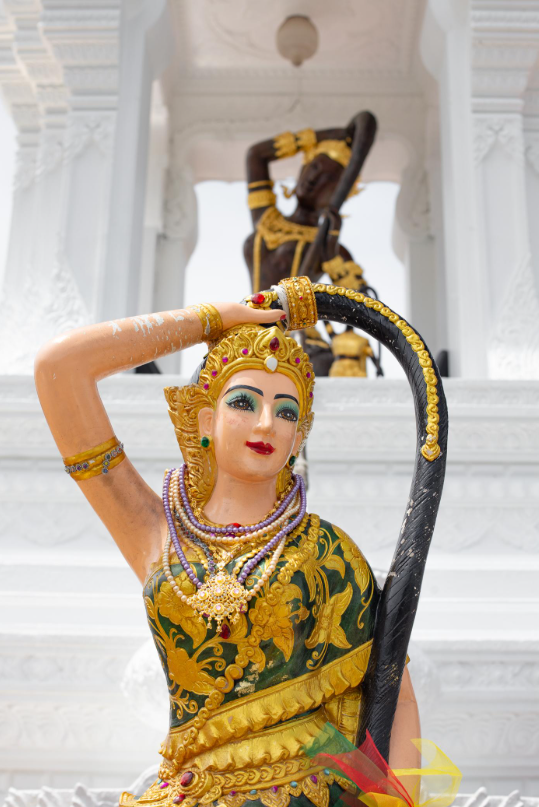
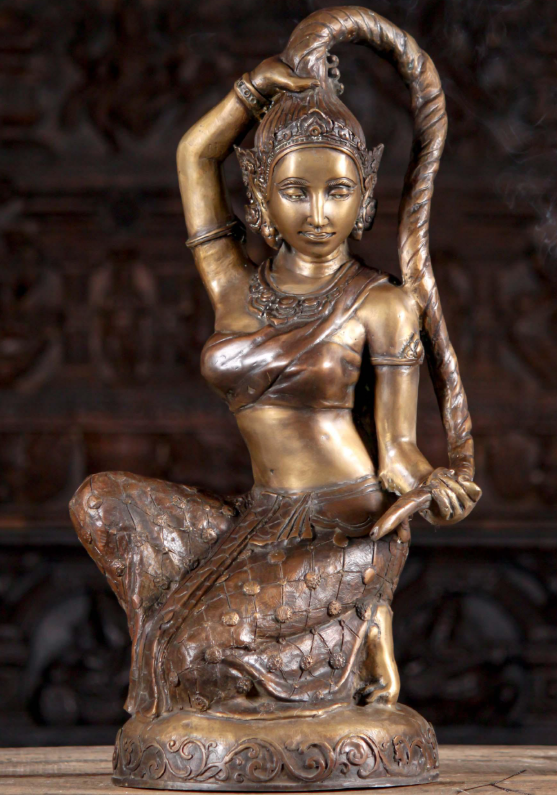
Phra Mae Thorani (พระแม่ธรณี) — The Earth Goddess. A sacred figure in Thai Buddhist tradition who witnessed the Buddha’s accumulated merit. According to legend, water flowing from her hair swept away Mara’s army, symbolizing the triumph of virtue over evil.
Phra Mae Thorani (พระแม่ธรณี) is the Earth Goddess associated with the Buddha’s enlightenment.
She is usually represented as a beautiful woman wringing water from her long hair.
According to Southeast Asian Buddhist tradition, Mara attempted to prevent the Buddha from attaining enlightenment.
The Earth Goddess appeared as a witness to the Buddha’s accumulated merit.
When she wrung her hair, a great flood swept away Mara’s forces.
The water symbolizes the merit accumulated through the Buddha’s past acts of generosity.
This image is especially recognizable in Thai temples and represents the triumph of spiritual virtue over evil.
10. Buddha Images and Their Postures
Thai Buddhist art uses the term Pang (ปาง) to describe particular postures or episodes represented by Buddha images.
These postures communicate important events and teachings from the Buddha’s life.
Pang Mara-vijaya — Subduing Mara- 항마촉지인(降魔觸地印)

The seated Buddha touches the earth with his right hand, recalling the moment when the earth was called to witness his merit.
깨달음을 얻을 때 마라의 유혹을 물리친 장면. 땅의 여신이 부처님의 공덕을 증언했다고 전해집니다.
Pang Samadhi — Meditation -선정인(禪定印)
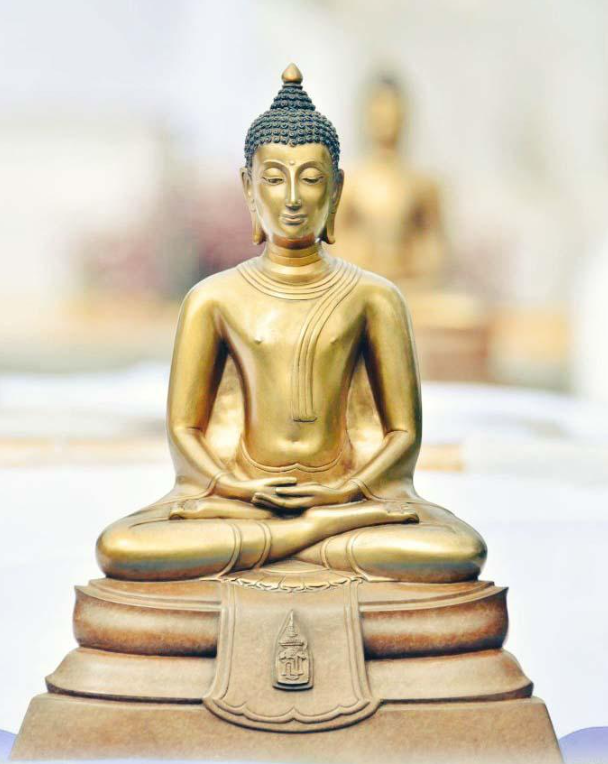
The Buddha sits in meditation with both hands resting in his lap, symbolizing concentration and inner peace.
고요히 선정에 든 모습으로, 집중과 마음의 평정을 상징합니다.
Pang Ham Yat — Restraining Relatives-시무외인(施無畏印)

The standing Buddha raises one hand to prevent conflict, traditionally associated with a dispute among his relatives over water.
물을 둘러싸고 다투던 친족들을 부처님이 말린 이야기와 연결됩니다.
Pang Ham Samut — Calming the Waters- 양수시무외인(兩手施無畏印) 진해불(鎭海佛)
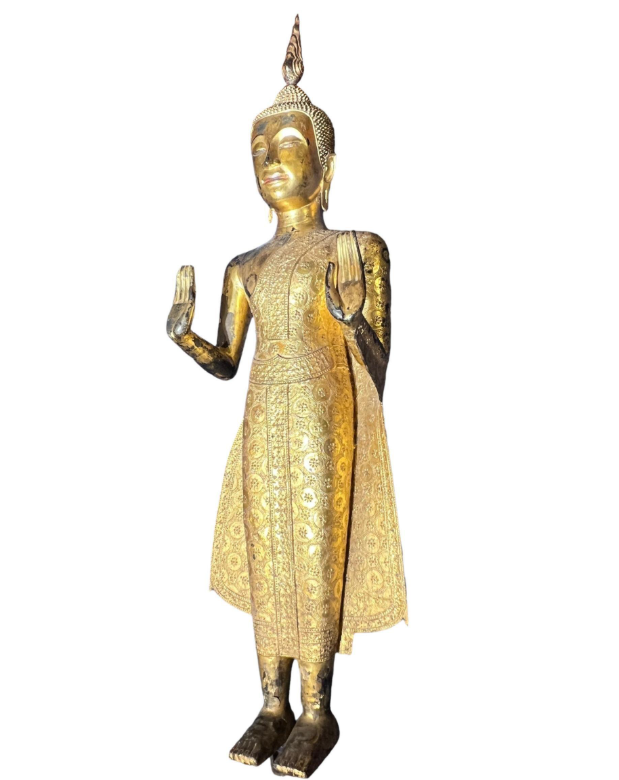
The standing Buddha raises both hands with the palms facing outward, symbolizing the restraint of threatening waters.
비와 물의 위협을 멈추게 한 이야기와 관련됩니다. 앙실라 옛 우보솟의 두 입상도 이 빰으로 소개되어 있어요.
Pang Nak Prok — Protected by the Naga -나가호불상
(龍王護佛像)
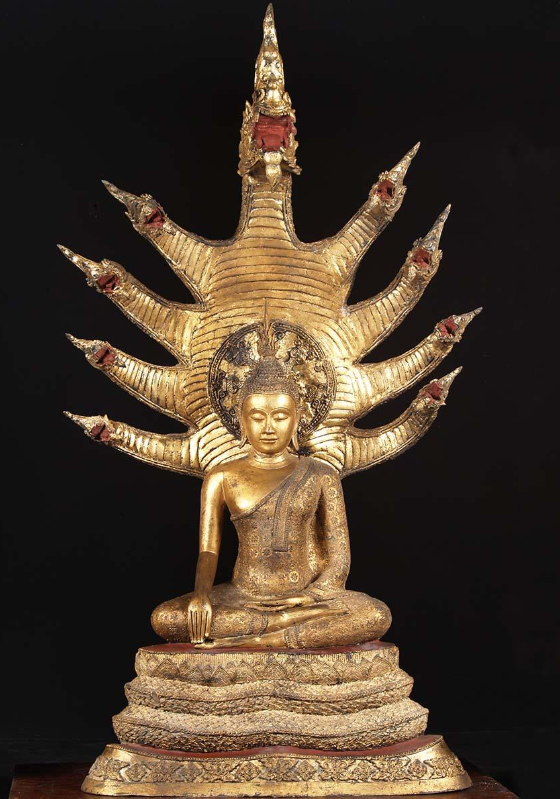
The seated Buddha is sheltered beneath the expanded hood of the naga king Mucalinda.
깨달음 뒤 폭풍우가 닥치자 무짤린다 나가가 부처님을 비바람에서 보호한 장면입니다.
Pang Prathan Phon — Bestowing Blessings-여원인(與願印)

The Buddha extends a hand in a gesture associated with blessings and benevolence.
소원을 들어주는 불상,자비와 축복을 베푸는 모습을 나타냅니다.
Pang Sai Yat — Reclining Buddha-와불(臥佛), 열반상(涅槃像)
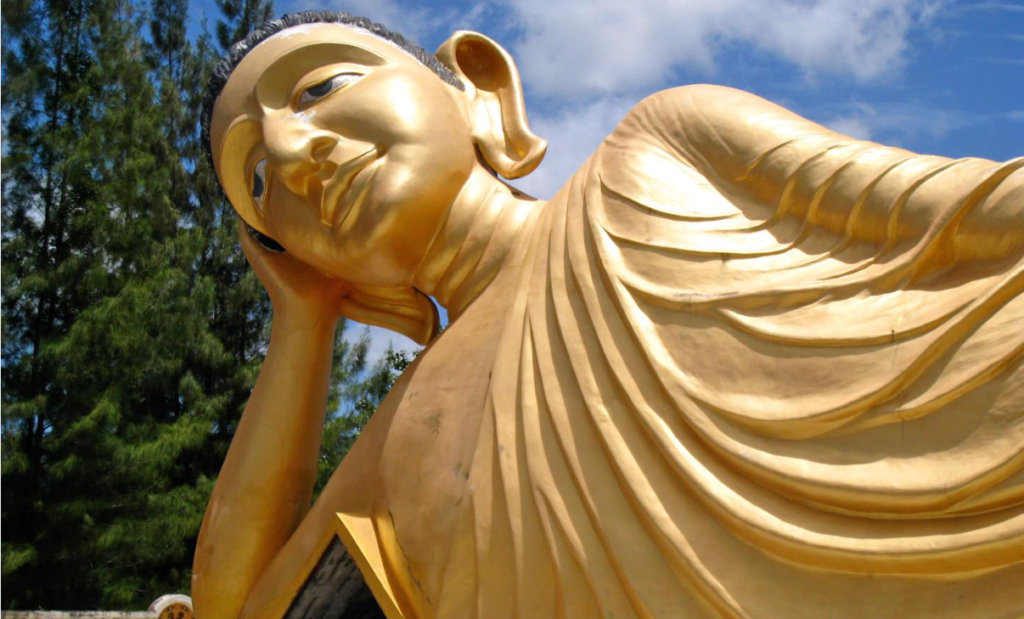
The reclining posture often represents the Buddha’s final passing into Parinirvana, although the meaning depends on the particular image.
부처님의 열반 장면을 나타내는 경우가 많습니다. 다만 누운 형상은 다른 일화를 표현하기도 합니다.
Pang Leela — Walking Buddha-유행불(遊行佛), 보행불상(步行佛像)
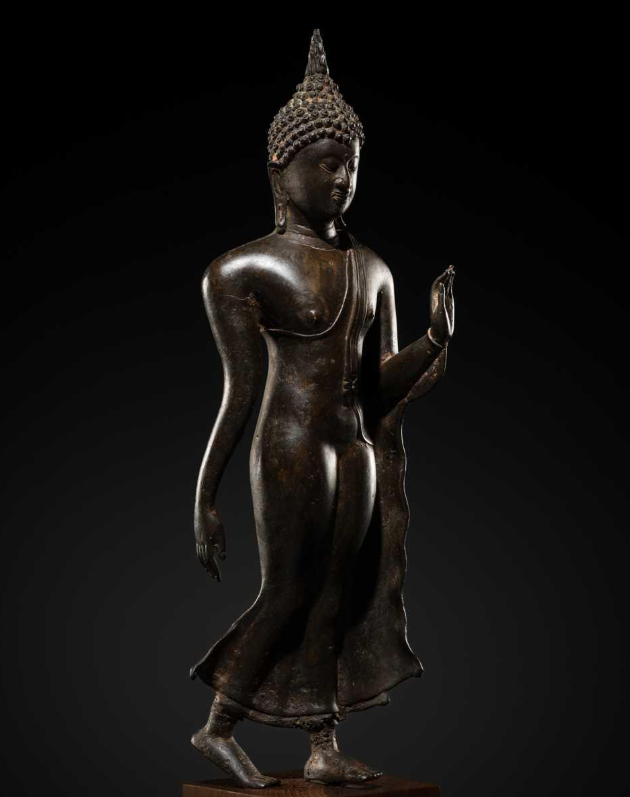
The graceful walking Buddha is especially associated with Sukhothai artistic traditions.
부처님의 이동과 가르침을 표현하며, 수코타이 양식의 대표적인 불상 형상으로 꼽힙니다
Pang Pathom Thetsana — First Sermon-초전법륜(初轉法輪), 전법륜인(轉法輪印)
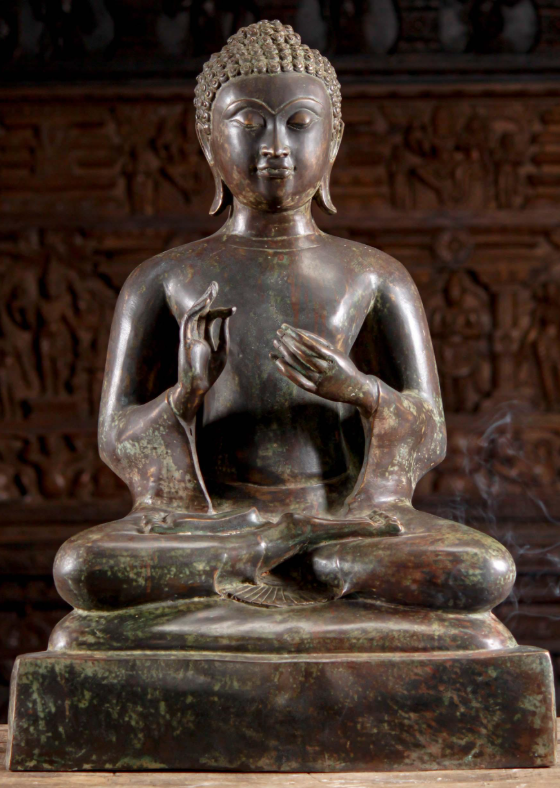
The Buddha is depicted teaching the Dharma, recalling the first sermon at the Deer Park.
사슴공원에서 첫 설법을 하며 법의 바퀴를 굴린 일을 나타냅니다.
11. Understanding Thailand’s Religious Traditions
The presence of many sacred figures within Thai temples does not mean that all belong to the same religion.
They represent several overlapping traditions.
Buddhism provides the principal religious framework of most Thai temples, emphasizing the Buddha’s teachings, merit-making, meditation, and liberation.
Hinduism contributes important deities, mythological stories, royal symbolism, and artistic traditions.
Local spirit beliefs contribute protective spirits, sacred landscapes, and practices associated with prosperity, health, and protection.
These traditions have interacted for centuries, but their distinct origins and meanings remain important.
Conclusion — Discovering the Stories Behind the Statues
A journey through Thai temples becomes more meaningful when we understand the figures encountered along the way.
A naga guarding a staircase, a fierce Thao Wessuwan holding his club, Hanuman standing as a warrior, or Phra Mae Thorani wringing water from her hair each tells a different story.
Together, these images reveal the historical relationship between Buddhism, Hindu mythology, regional traditions, and everyday religious life in Thailand.
For another example of how Buddhist and traditional spiritual imagery coexist in Thailand, explore our visit to Anan Burapharam Sanctuary.
Through our journeys with Won Cub Life, we will continue exploring these fascinating stories and the cultural heritage preserved in Thailand’s temples.
Won Cub Life — Exploring Thailand’s Temples, History, Culture and Hidden Places.