A Quiet Temple with an Unexpected History
Rayong continues to surprise me. Just when I think I have visited most of the interesting temples in the area, another small village temple reveals a history that stretches back through generations.
This time, my journey brought me to Wat Na Ta Kwan (วัดนาตาขวัญ), a Buddhist temple in Na Ta Khwan Subdistrict, Mueang Rayong District.
At first glance, the temple appears much like many others in rural Thailand. A large golden Buddha statue welcomes visitors, traditional temple buildings stand around an open courtyard, and the atmosphere is peaceful.
But behind this ordinary appearance lies a much older story.
The temple is associated with local traditions dating back to the Ayutthaya period, although its exact founding date remains uncertain. Its historical treasures include an old ordination hall, a bell-shaped chedi, and a remarkable wooden preaching pulpit.
What makes this temple especially interesting is the connection between its name and the surrounding agricultural community.
According to local tradition, the temple was established on land associated with an elderly man named Ta Khwan. The word na means rice field, while Ta Khwan refers to the man remembered in the village’s founding story.
It is a simple name, yet one that preserves the memory of the people who once lived and farmed here.
As I explored the temple grounds, I gradually discovered that this quiet place had much more to tell than its modest appearance suggested
The Legend of Ta Khwan and the Origins of the Temple
The name Wat Na Ta Kwan (วัดนาตาขวัญ) carries a story that connects the temple to the early agricultural community of this area.
According to local tradition, a wealthy landowner named Ta Khwan once lived here. He owned extensive rice fields but reportedly had neither a wife nor children. As a devoted Buddhist, he decided to donate part of his land for the establishment of a temple.
The villagers remembered his generosity by naming the temple after him.
In Thai, na (นา) means rice field, ta (ตา) is a respectful term for an elderly man or grandfather, and Khwan (ขวัญ) was his name.
Thus, Wat Na Ta Kwan can be understood as “The Temple of Grandfather Khwan’s Rice Field.”
The Story of Two Brothers
Another local tradition tells of two brothers, Ta Khan and Ta Khwan, who migrated to this area and established their homes near a stream.
According to the story, the brothers divided the surrounding farmland between them and began cultivating the land.
Over time, a temple was established on the land associated with Ta Khwan. The name of the temple eventually became closely connected with the identity of the surrounding village.
These stories are local oral traditions rather than independently verified historical accounts. Nevertheless, they offer an interesting glimpse into how rural communities remembered their founders and benefactors.
How Old Is Wat Na Ta Kwan?
The temple’s exact founding date remains uncertain.
Some local accounts suggest that its origins may extend as far back as the late Ayutthaya period, with one tradition placing its establishment around 1657.
Other historical information associates the temple’s establishment with 1792, during the reign of King Rama I of the early Rattanakosin period.
The old ordination hall is generally associated with a later period, possibly the reign of King Rama III (1824–1851).
These different dates should not necessarily be interpreted as evidence of a single continuous building history. The original religious community, the formal establishment of the temple, and the construction or reconstruction of its surviving buildings may have occurred at different times.
Without further documentary or archaeological evidence, it is difficult to determine precisely when the first temple was built.
What remains clear is that Wat Na Ta Kwan preserves traditions linking Buddhist religious life with the development of the surrounding farming community.
For me, this connection between a village, its rice fields, and an old Buddhist temple is one of the most appealing aspects of exploring rural Rayong.
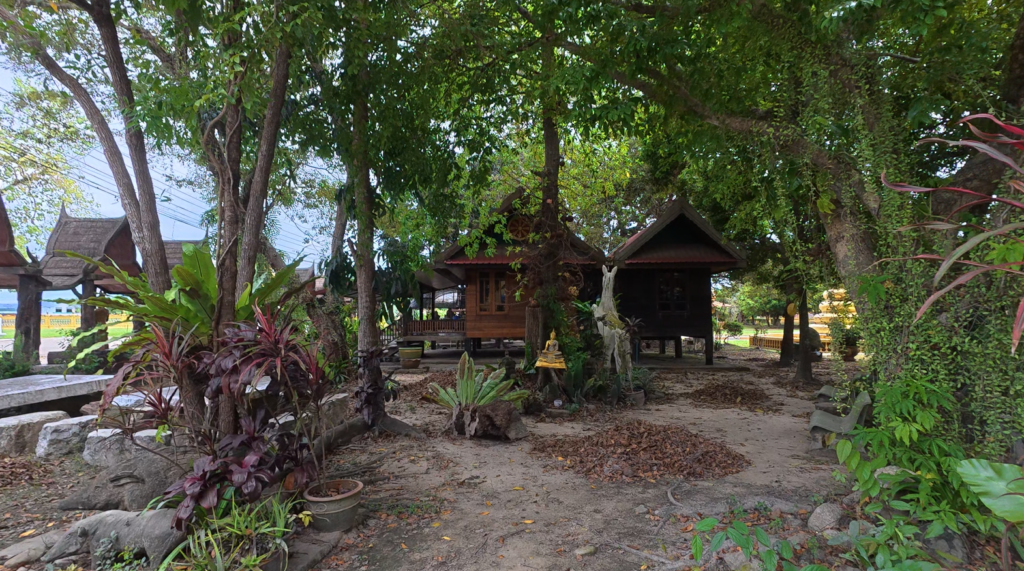
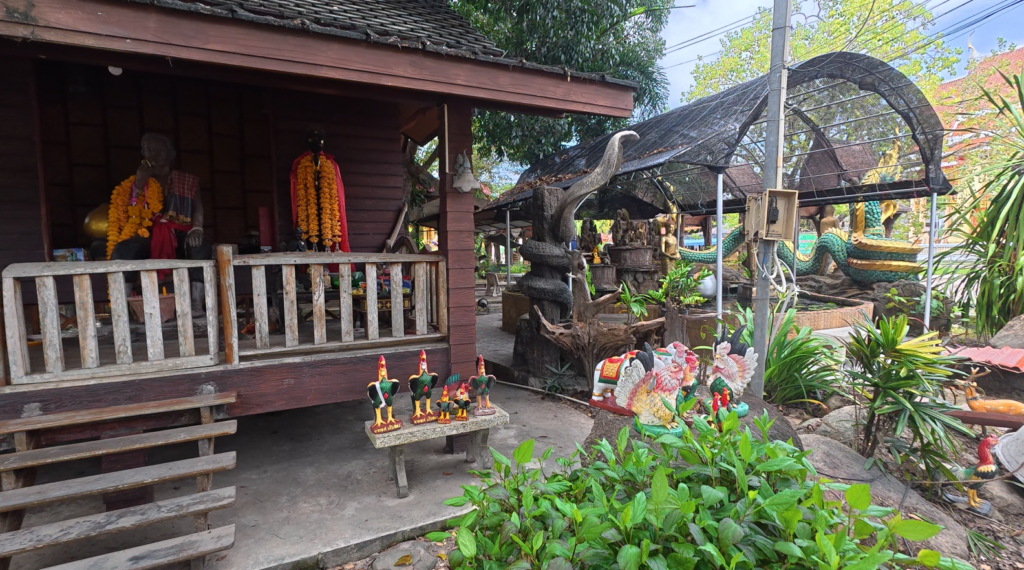
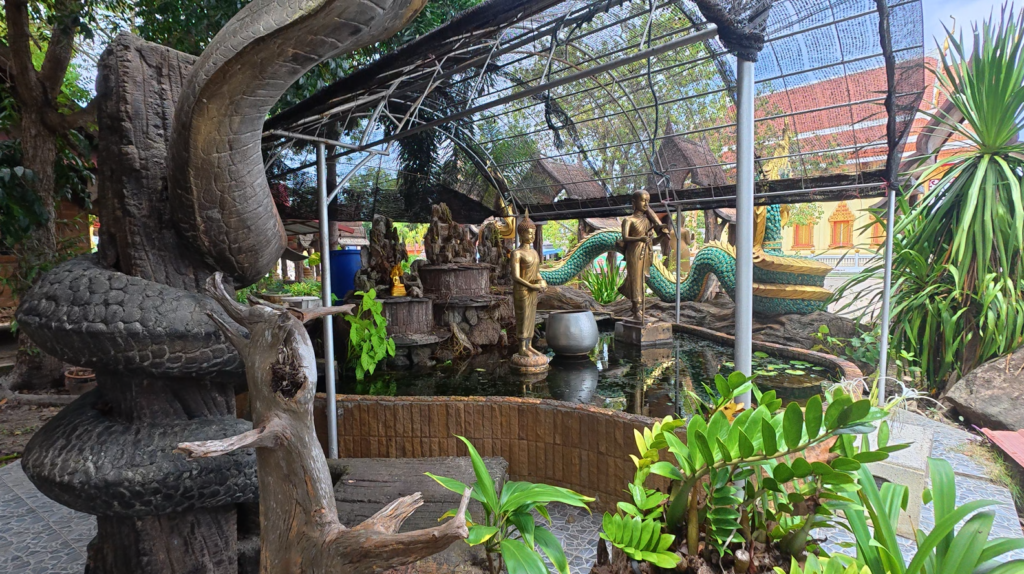
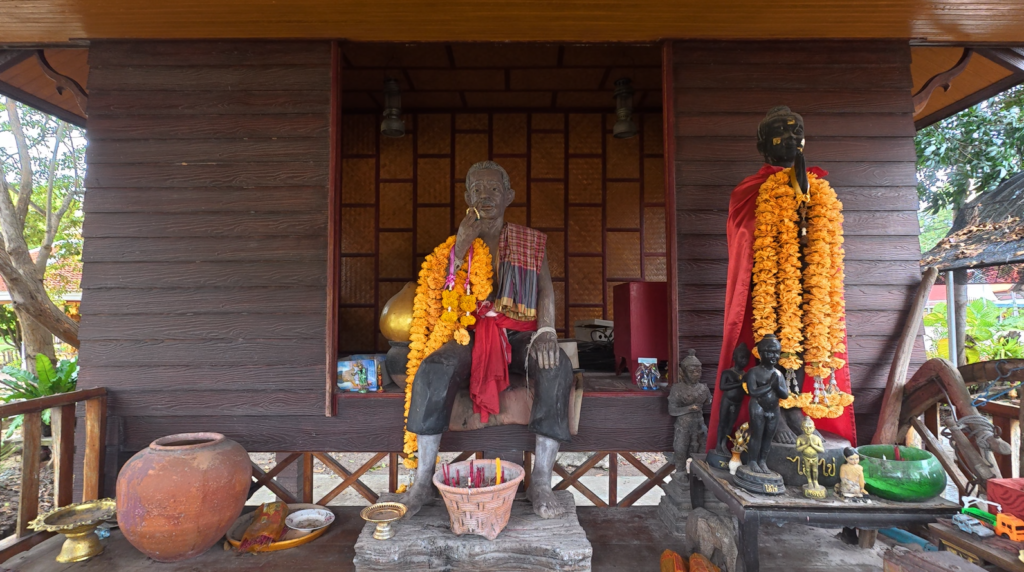
Scenes from Wat Na Ta Kwan, a historic village temple in Rayong, Thailand. Local traditions connect its origins to Ta Khwan, a landowner who is remembered for donating his rice fields to establish a Buddhist temple. These photographs offer a glimpse of the temple grounds and the community’s enduring Buddhist heritage.
The Old Ubosot – A Surviving Piece of Rayong’s History
One of the most historically significant structures at Wat Na Ta Kwan is its old ubosot, the Buddhist ordination hall.
Unlike the larger and more elaborate buildings found in many modern Thai temples, this modest structure preserves the architectural character of an earlier period.
The old ubosot is believed to date from the early Rattanakosin era, possibly during the reign of King Rama III (1824–1851). However, the temple itself may have existed long before the present building was constructed.
Traditional Architecture of the Old Ordination Hall
The old ubosot was built using brick masonry covered with plaster, a construction technique commonly employed in traditional Thai religious buildings.
Historical descriptions give its approximate dimensions as 6.5 metres wide and 17.75 metres long.
Its relatively narrow rectangular plan, raised base, and restrained architectural details reflect the practical character of a provincial Buddhist temple.
Walking around the building, I was particularly interested in the old masonry, the elevated foundation, and the surviving details that reveal how the structure was built and maintained over time.
These features are important because they provide physical evidence of the temple’s architectural history, beyond the stories preserved through local tradition.
Bai Sema – The Sacred Boundary of the Ubosot
Another important feature of a traditional ordination hall is the presence of bai sema (ใบเสมา), the sacred boundary markers associated with the Buddhist monastic community.
In Thai Theravada Buddhism, the ubosot is not simply a prayer hall. It is a formally designated sacred space where monks conduct important ceremonies, including ordination and certain communal acts of the Sangha.
The boundary is established through a consecration process involving luk nimit (ลูกนิมิต), traditionally stone spheres buried at designated boundary locations.
The visible bai sema markers indicate the sacred boundary, while the formal monastic boundary is defined through the prescribed Buddhist procedure.
These markers therefore have religious and historical significance beyond their decorative appearance.
A Protected Historical Monument
The old ubosot at Wat Na Ta Kwan has been recognized as part of Thailand’s architectural heritage.
The Fine Arts Department designated the historic site for protection in 2001, and conservation work was reportedly undertaken in 2015.
Such preservation is particularly important for smaller provincial temples, where old religious buildings can easily disappear as communities replace them with larger modern structures.
For visitors interested in Thai history, this old ubosot offers an opportunity to observe a surviving example of traditional Buddhist architecture in Rayong.
Standing beside the building, I was reminded that the history of Thailand is preserved not only in royal palaces and famous temples, but also in quiet village monasteries that have served their communities for generations.
Distinctive Features of the Old Ubosot
According to a local historical description, the exact construction date of the old ubosot remains unknown.
The building has a rectangular brick-and-plaster structure with a traditional wooden roof frame and overlapping roof tiles.
Unlike many elaborate Thai Buddhist temples, the roof lacks the ornamental chofa and bai raka decorations commonly found along traditional rooflines.
The hall has a single entrance at the front, a solid rear wall, and five windows along each side.
These restrained architectural features give the building a distinctive appearance and reflect the simpler traditions of provincial Buddhist architecture.
The historical description records approximate dimensions of 6 metres in width and 10.50 metres in length, although other published measurements differ.
The building has undergone restoration, including replacement of its original roof tiles.
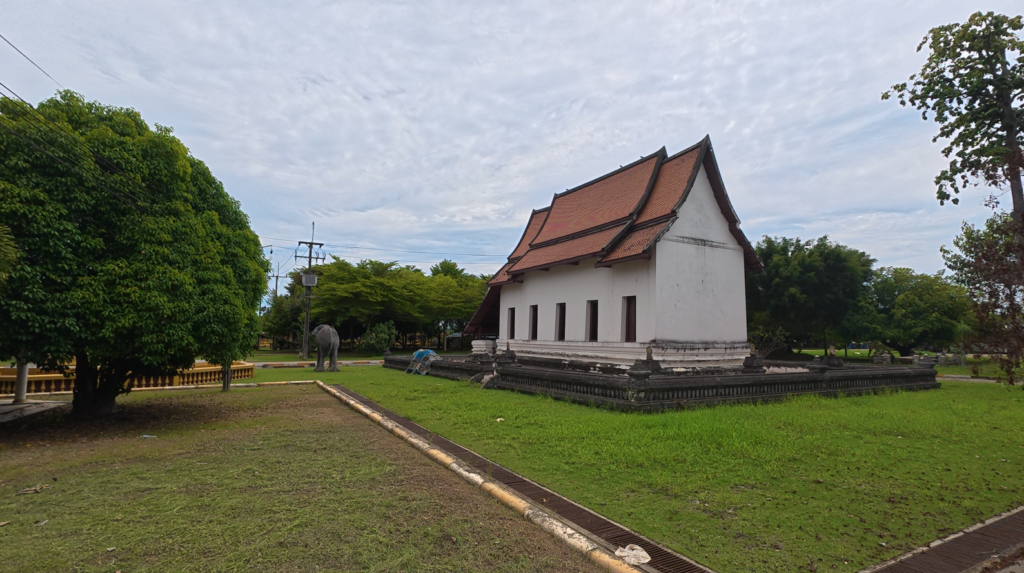
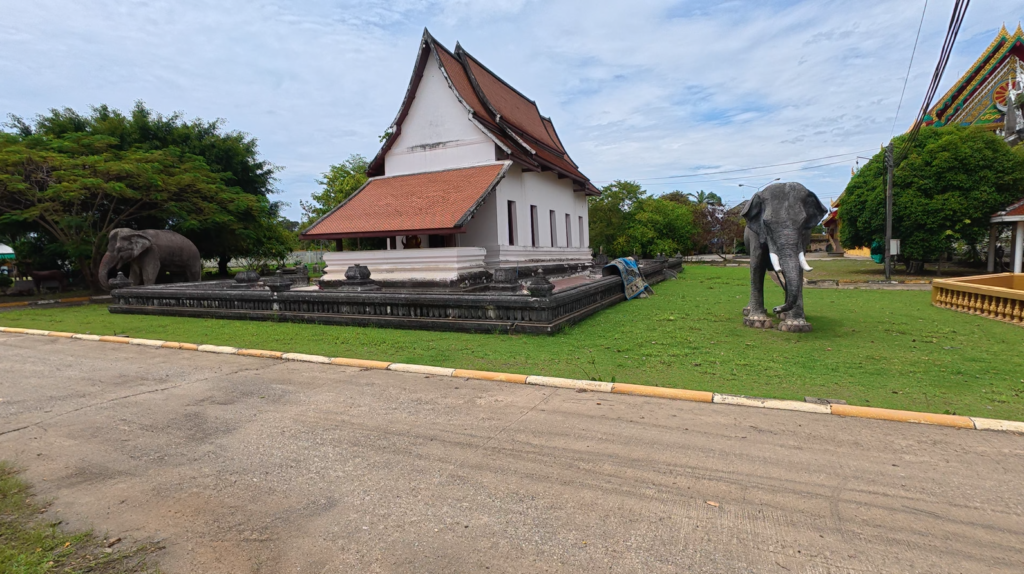
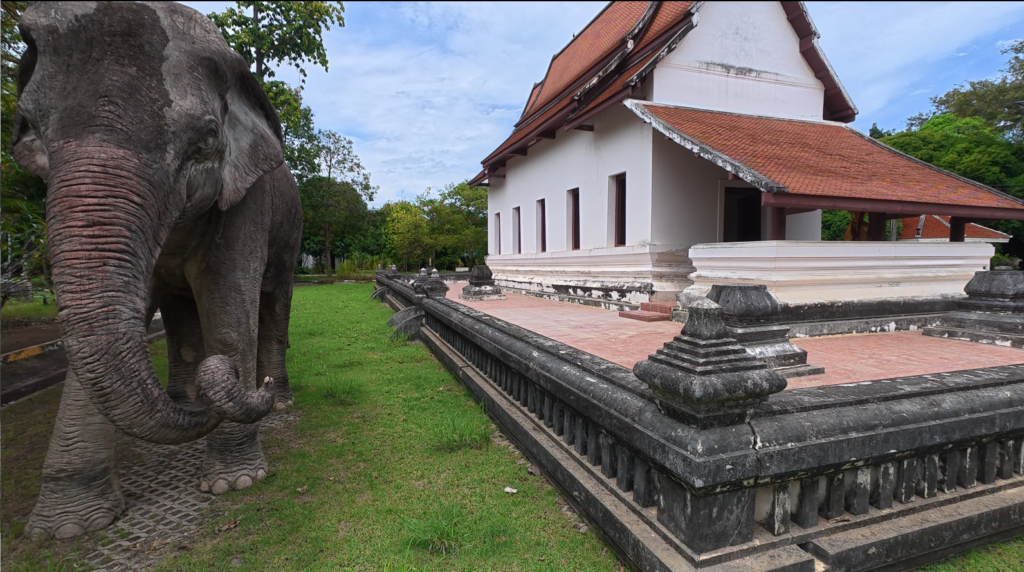
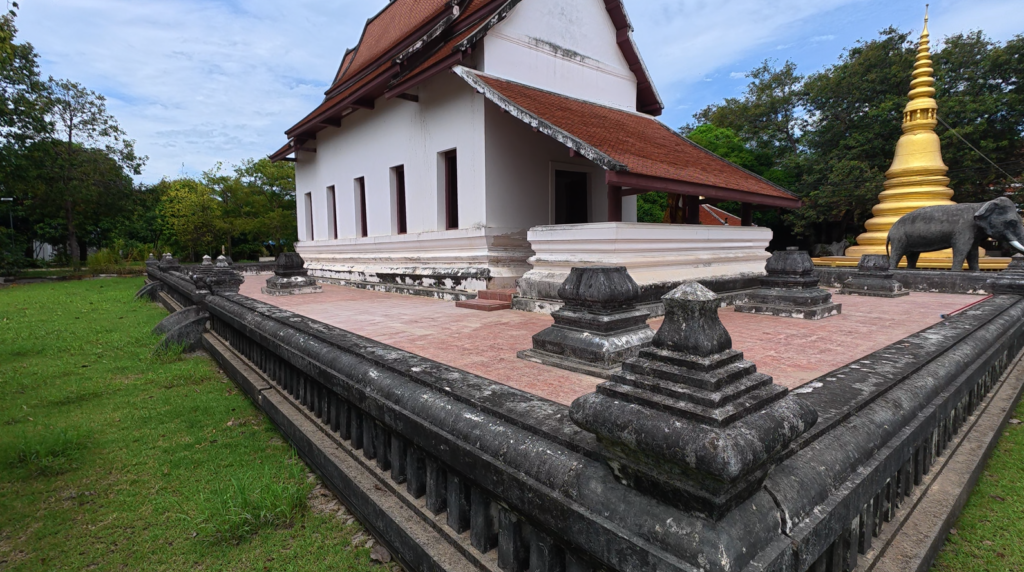
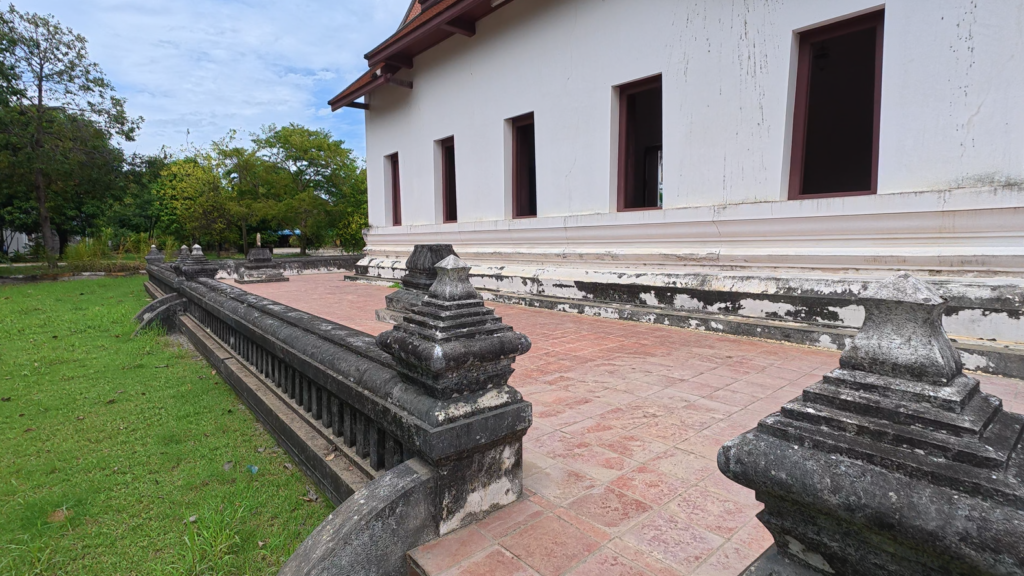
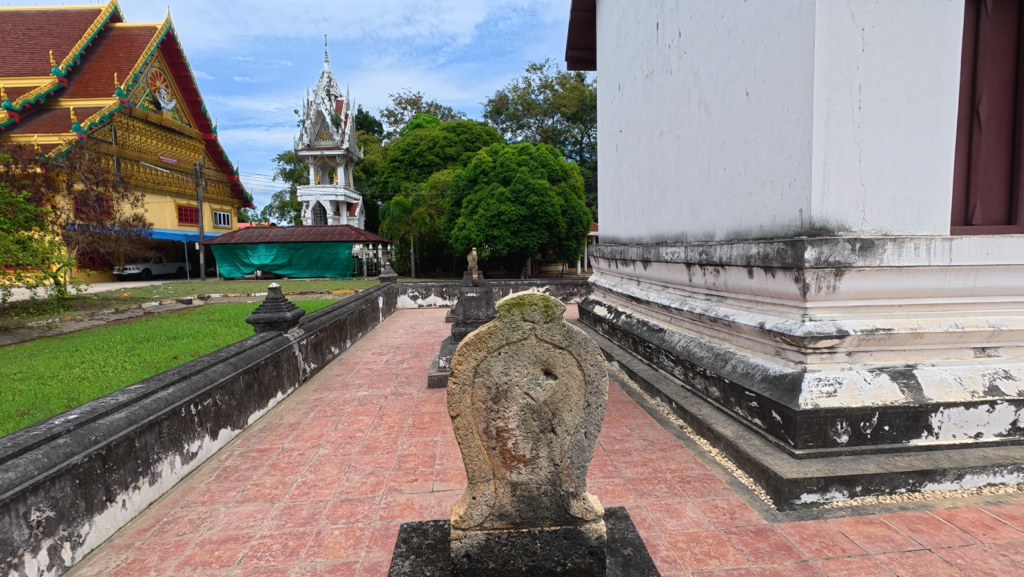
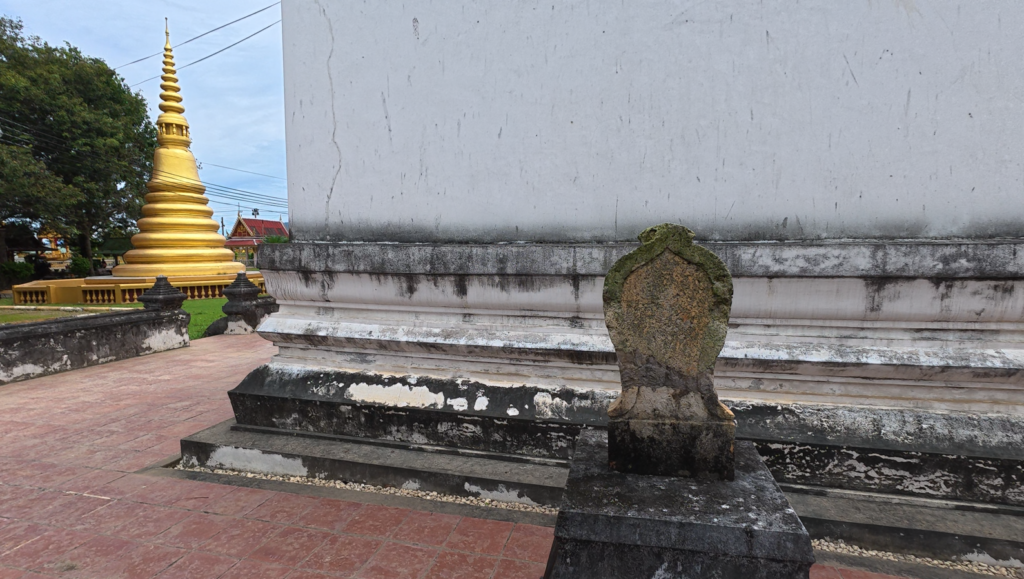
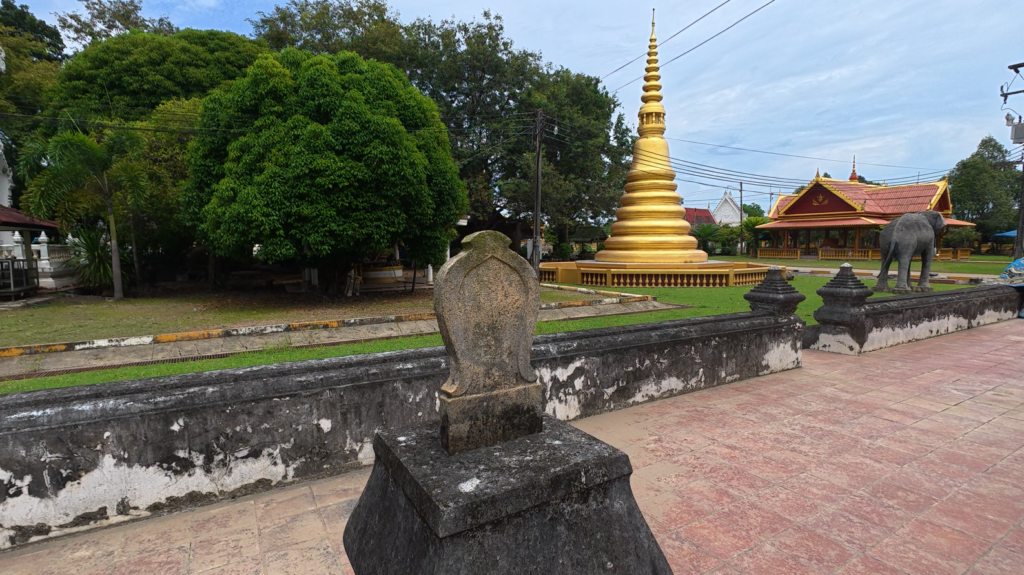
The historic ordination hall of Wat Na Ta Kwan, showing its traditional brick-and-plaster construction, raised foundation, architectural details, and sacred boundary markers. The building preserves an important part of Rayong’s early Rattanakosin-period Buddhist heritage.
For additional historical and architectural information, see the Fine Arts Department of Thailand’s official record of Wat Na Ta Kwan.
The Ancient Bell-Shaped Chedi – A Silent Witness to the Past
Standing near the old ordination hall of Wat Na Ta Kwan is another fascinating historical structure: an ancient bell-shaped chedi.
Although much smaller and simpler than the magnificent stupas found in Thailand’s famous royal temples, this old structure represents an important part of the temple’s religious and architectural heritage.
The chedi stands to the north of the old ubosot, forming part of the historic temple complex.
Traditional Bell-Shaped Architecture
The chedi follows the traditional chedi song rakhang (เจดีย์ทรงระฆัง), or bell-shaped stupa, a form widely used in Thai Buddhist architecture.
Historical descriptions identify a brick-and-plaster structure with an octagonal base and a bell-shaped upper section.
The bell-shaped form has a long history in Thailand, appearing in Buddhist architecture from the Sukhothai and Ayutthaya periods through the Rattanakosin era.
However, the architectural style alone is not sufficient to establish the precise date of this particular chedi.
Its exact construction period remains uncertain.
What Was Enshrined Inside the Chedi?
In Thai Buddhist tradition, chedis may be built for several religious purposes.
Some enshrine relics believed to be associated with the Buddha, known as Phra Borom Saririkathat (พระบรมสารีริกธาตุ).
Others contain the cremated remains of respected monks, religious teachers, or important individuals.
A chedi may also be constructed as an act of merit-making or as a memorial without containing physical relics.
At Wat Na Ta Kwan, I have not found reliable documentary evidence confirming whether the old chedi contains relics of the Buddha or the remains of a particular monk or benefactor.
It would therefore be inappropriate to describe it as a confirmed Buddha-relic stupa.
Nevertheless, the structure remains an important historical monument, reflecting the Buddhist traditions of the local community.
A Connection with the Old Ubosot
The close relationship between the chedi and the old ordination hall is particularly interesting.
Together, these structures form a surviving part of the temple’s earlier religious landscape.
The ubosot served as a sacred space for monastic ceremonies, while the chedi provided a focus for Buddhist devotion and remembrance.
Whether the two structures were built during the same period remains uncertain.
Looking at the old chedi, I found myself wondering who had commissioned its construction, what religious purpose it originally served, and how many generations of villagers had gathered here to make merit.
These are questions that may only be answered through further examination of temple records, inscriptions, or local oral traditions.
For now, the ancient chedi stands quietly beside the old ubosot, preserving another fragment of Rayong’s Buddhist history.
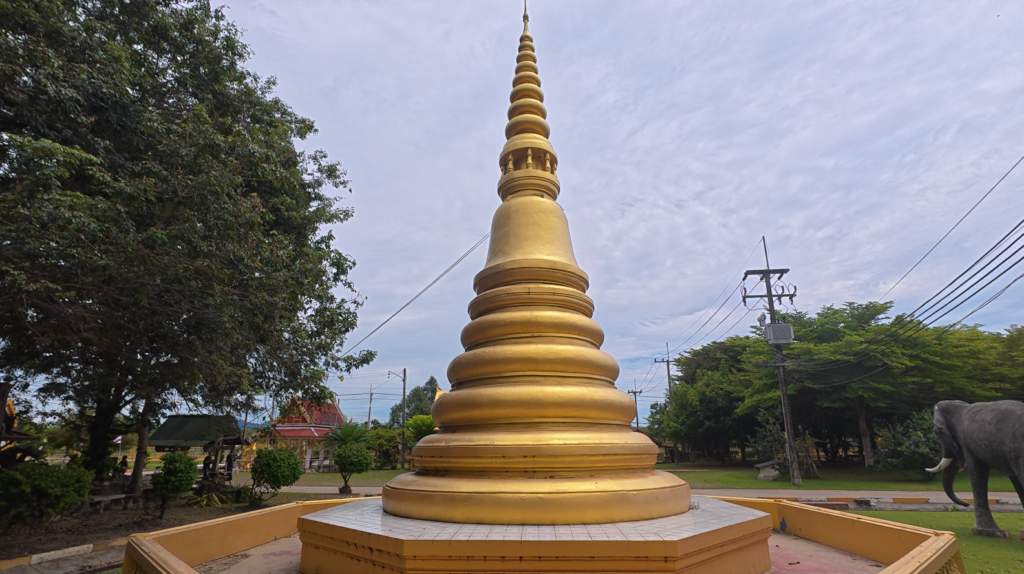
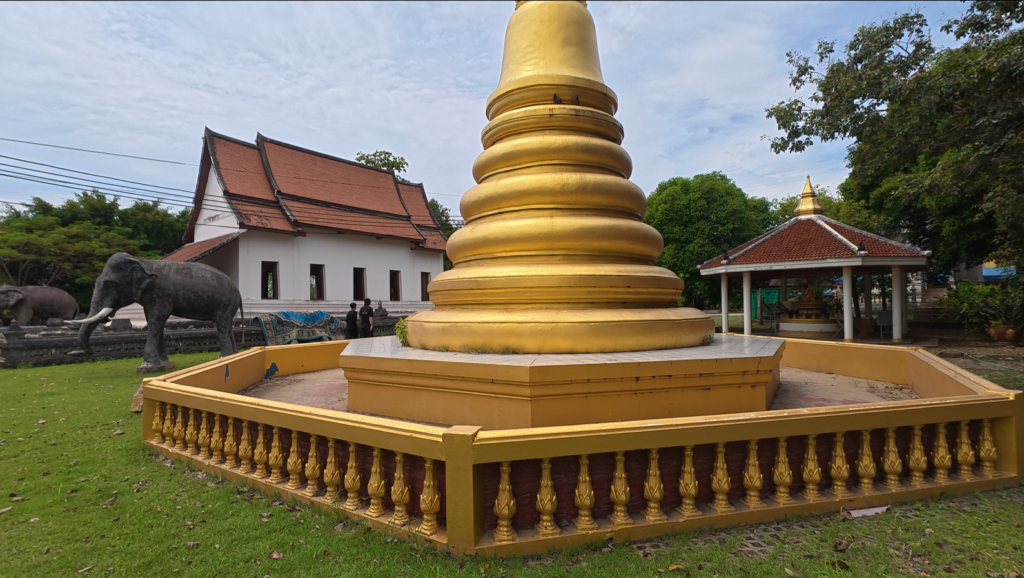
The ancient bell-shaped chedi beside the old ordination hall at Wat Na Ta Kwan, Rayong. Built in traditional brick-and-plaster construction, this historic stupa reflects the temple’s long Buddhist heritage, although its original construction date and relic enshrinement remain undocumented.
Inside the Old Ubosot – The Principal Buddha and Sacred Interior
After examining the exterior of the old ordination hall, I stepped inside to explore the religious space that had served generations of Buddhist monks and villagers.
The atmosphere was noticeably different from that of the larger, more modern temple buildings.
There was a sense of simplicity and age, with the old walls, modest interior space, and principal Buddha image creating a quiet setting for Buddhist devotion.
The Principal Buddha Image
At the heart of the old ubosot stands the principal Buddha image, the spiritual focus of the ordination hall.
The image represents the Buddha seated in meditation, with the right hand lowered toward the earth in the Bhumisparsha Mudra, commonly known in Thailand as Maravijaya (ปางมารวิชัย), or the posture of Subduing Mara.
This gesture recalls the moment before the Buddha’s enlightenment, when he called upon the earth to witness the accumulated merit of his previous lives.
According to Buddhist tradition, Mara attempted to disturb Siddhartha Gautama as he approached enlightenment beneath the Bodhi tree. The earth-touching gesture symbolizes his unwavering determination and the triumph of wisdom over temptation and ignorance.
Although this posture is found throughout Thailand, the artistic details of individual Buddha images can reveal differences in regional craftsmanship and historical periods.
The precise date of the principal Buddha image at Wat Na Ta Kwan has not yet been established.
It should not automatically be assumed that the image was created at the same time as the present ordination hall.
The Old Walls and Interior Architecture
The interior of the ubosot offers another opportunity to appreciate traditional temple construction.
The brick-and-plaster walls, the proportions of the hall, and the arrangement of the principal Buddha image reflect the practical requirements of a Buddhist ordination space.
Unlike modern temple interiors that are often decorated with elaborate murals and bright ornamental finishes, the surviving historical elements here deserve attention for their simplicity.
Some visible surfaces may reflect later repairs or restoration rather than the building’s original appearance.
Distinguishing original construction from subsequent conservation work would require a more detailed architectural study.
An Unidentified Stone Structure
Among the objects photographed inside the old ubosot, one dark stone structure particularly attracted my attention.
Its appearance suggests that it may have served a religious or architectural function, but its precise purpose cannot be established from the available photographs alone.
Rather than assigning it an uncertain identification, I prefer to record it as an unidentified stone feature pending further information from the temple or historical authorities.
Small details like this often make visits to old provincial temples especially rewarding.
An object that appears ordinary at first glance may preserve evidence of an earlier religious practice or building tradition.
A Place of Living Buddhist Tradition
An old ubosot is more than a historic building.
In Thai Theravada Buddhism, the ordination hall is associated with some of the most important ceremonies of monastic life, including the ordination of monks and formal gatherings of the Sangha.
Even when an older ubosot is no longer used regularly for these ceremonies, it remains part of the temple’s religious memory.
Standing inside Wat Na Ta Kwan’s old ordination hall, I was reminded that the history of Buddhism in Thailand is not preserved only through written chronicles.
It also survives in Buddha images, sacred boundaries, old masonry, and the religious spaces maintained by generations of local communities.
For me, these quiet interiors are often among the most memorable discoveries of a temple journey.
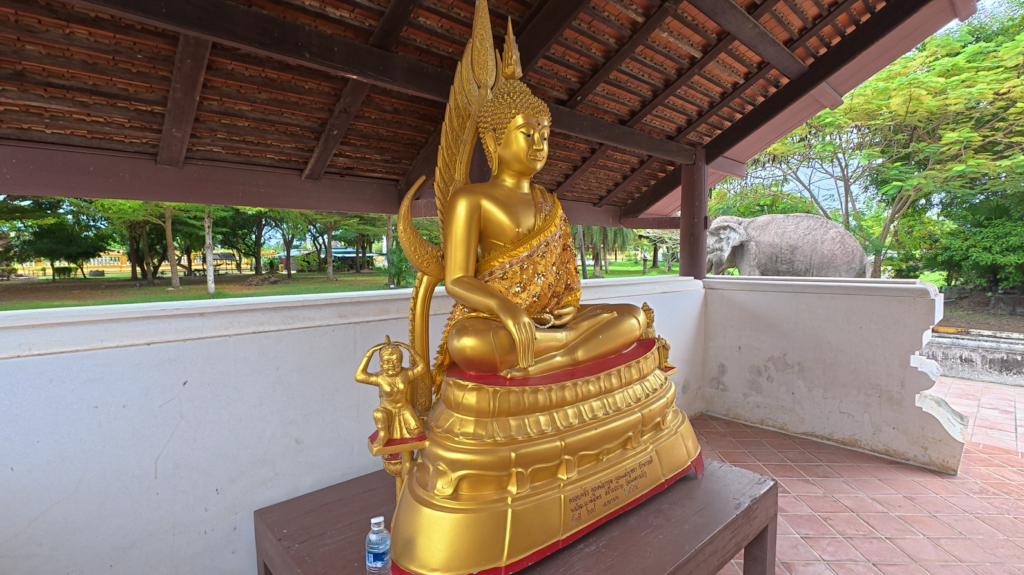
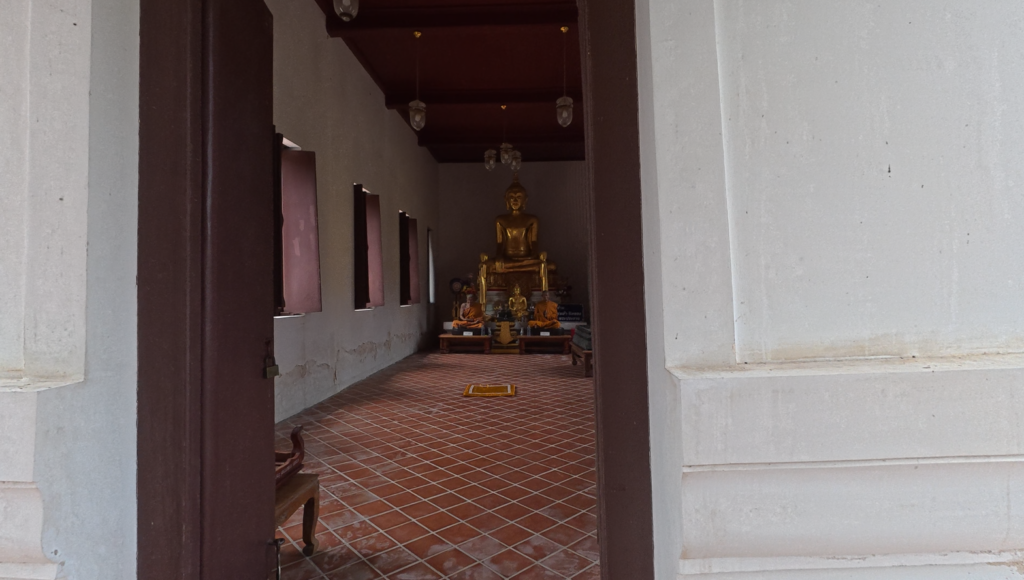
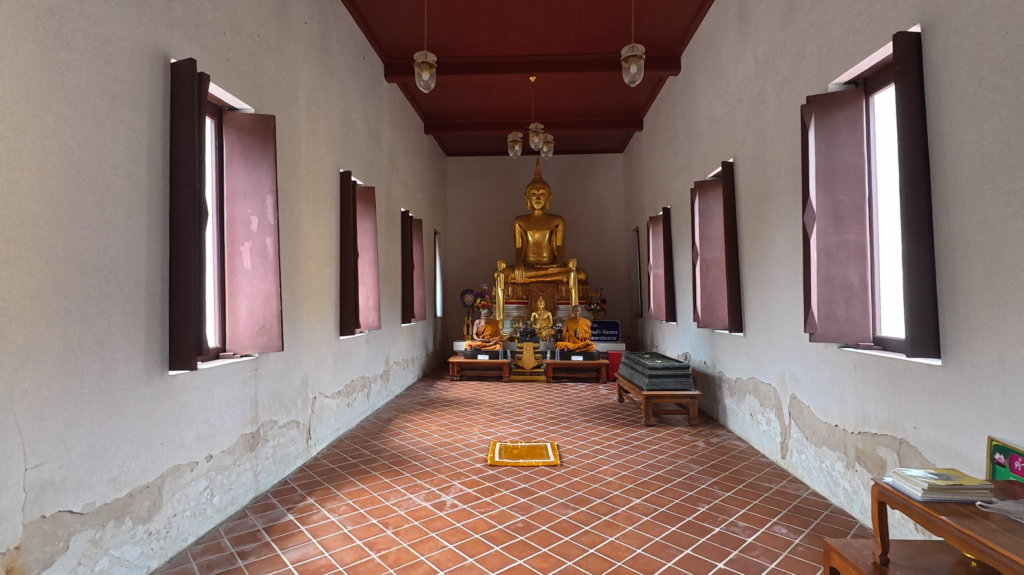
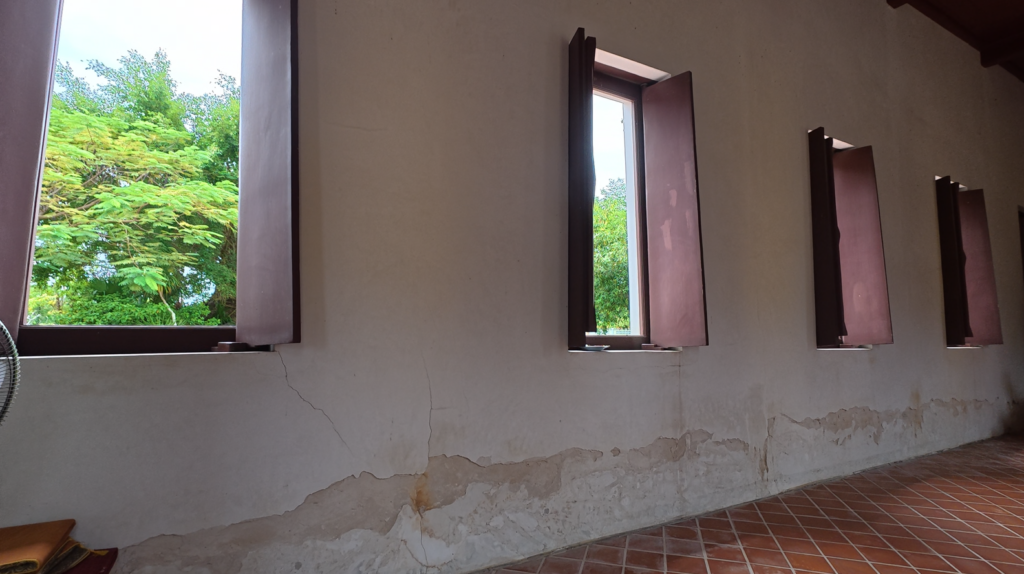
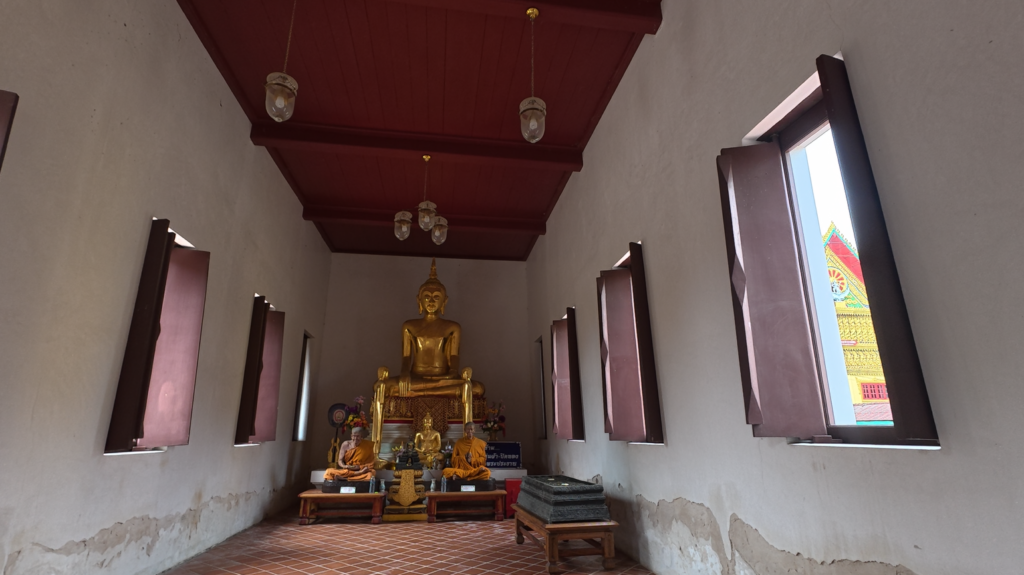
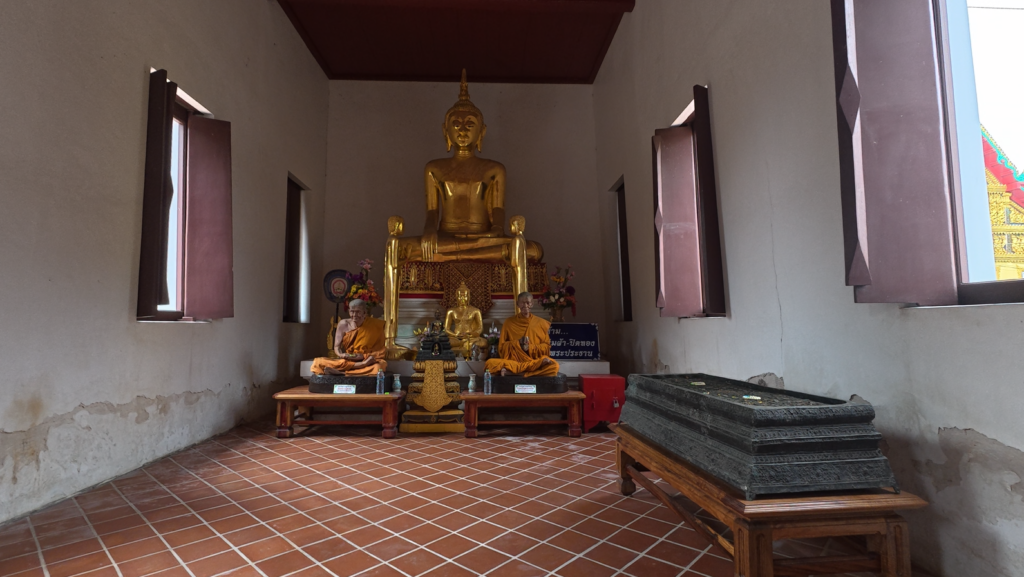
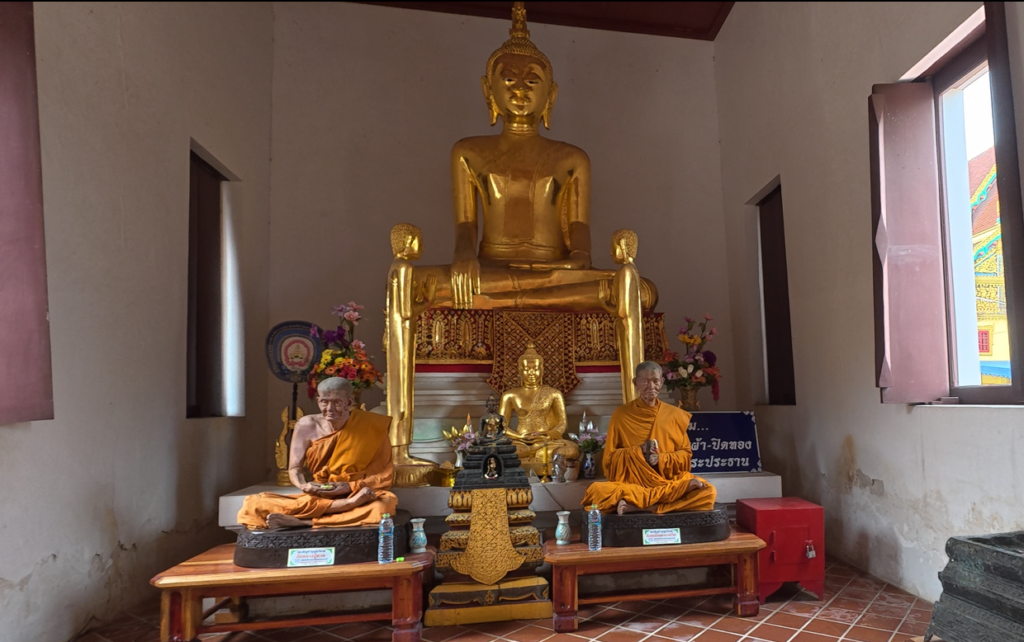
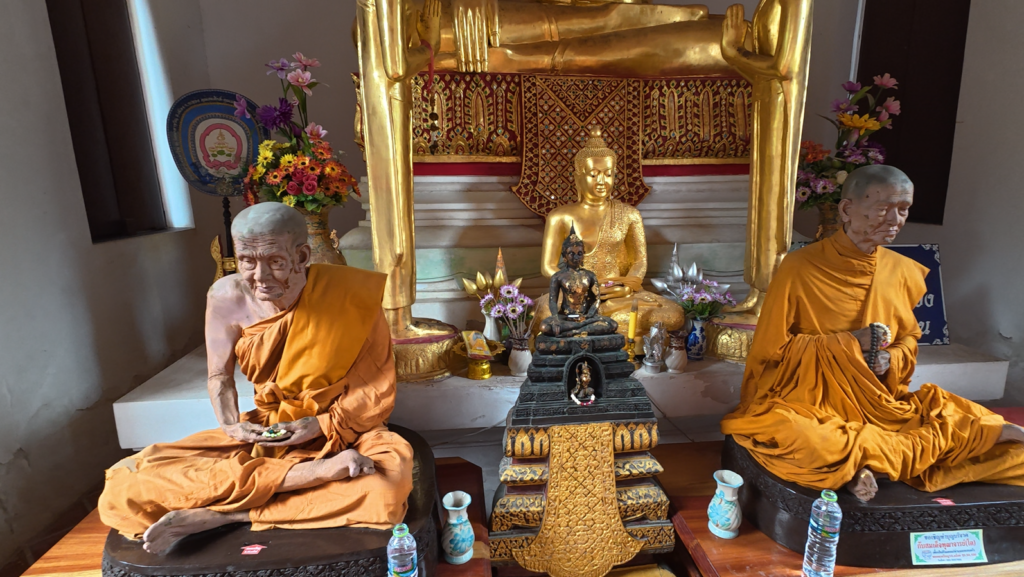
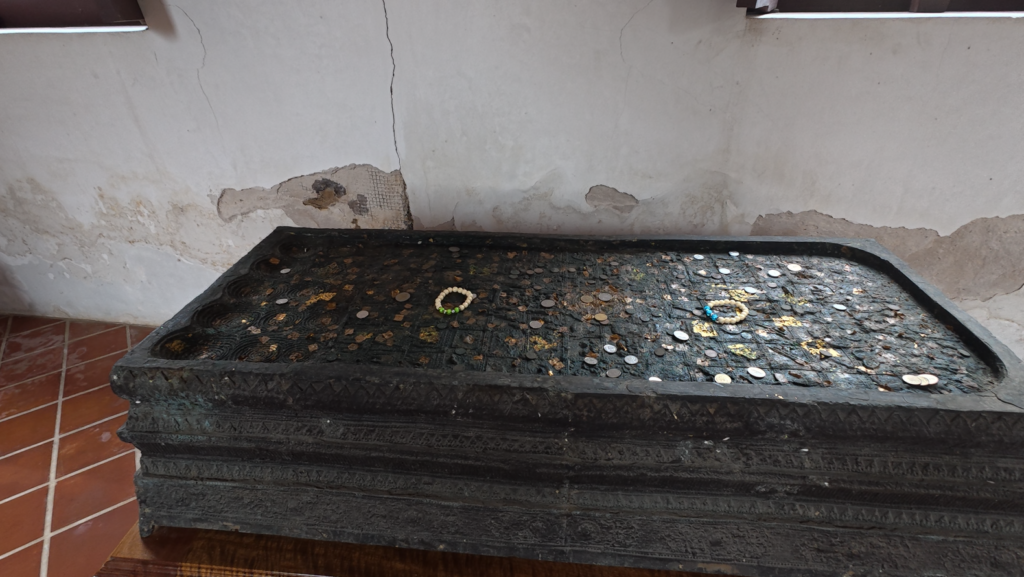
Inside the historic ubosot of Wat Na Ta Kwan, Rayong. The photographs show the principal Buddha image in the earth-touching posture, the old interior walls, traditional architectural details, and surviving stone features that reflect the temple’s religious heritage.
A Moment of Prayer and Offering
Before leaving the old ubosot, I took a moment to make an offering and pay my respects to the principal Buddha image.
After spending time examining the temple’s old architecture and historical features, this quiet moment of prayer reminded me that Wat Na Ta Kwan is not simply a place where the past is preserved.
It remains a place of Buddhist faith and devotion.
For generations, local people have come here to make offerings, pray, and seek peace of mind.
Today, I was one of those visitors.
It was a simple but meaningful moment during my journey through the old temples of Rayong.
During my earlier visit to Wat Taphong Nai in Rayong, I also explored an old ordination hall and the sacred boundary markers associated with traditional Buddhist ceremonies. Both temples offer fascinating glimpses into Rayong’s religious heritage.
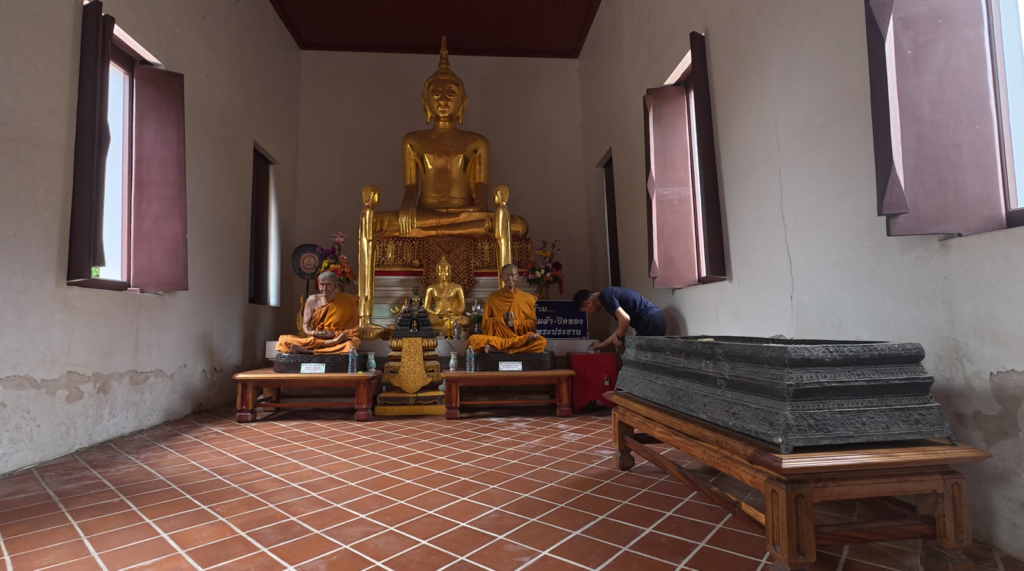
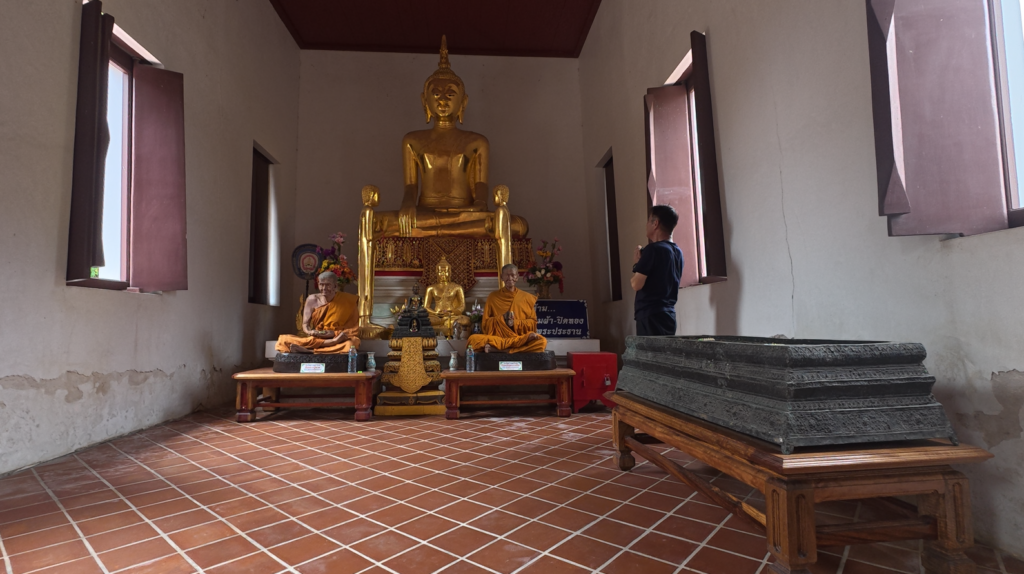
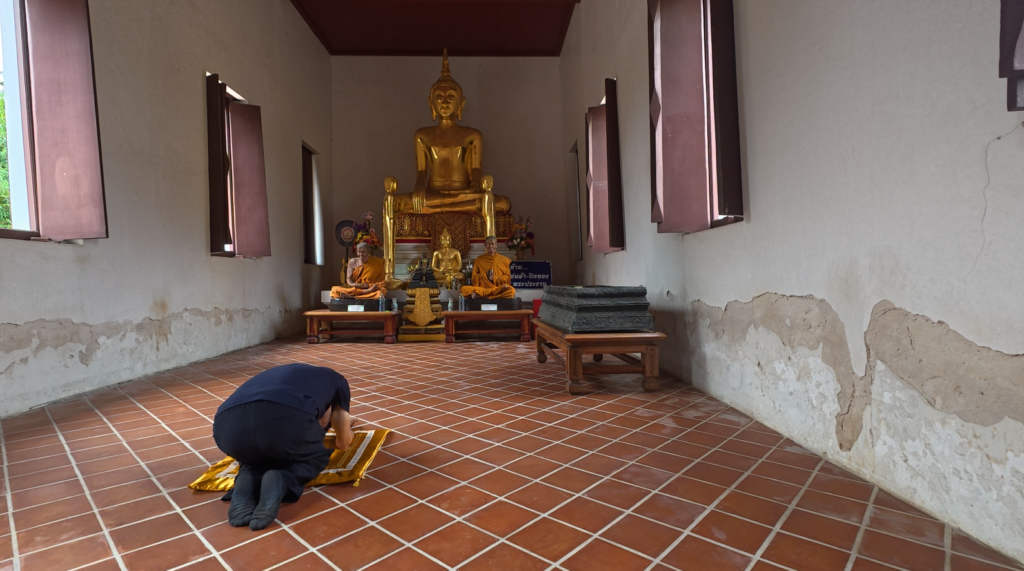
A personal moment of Buddhist devotion inside the old ubosot of Wat Na Ta Kwan. I made an offering and bowed respectfully before the principal Buddha image, following a tradition of faith that has continued through generations.
Ancient Trees and Stone Remains – Traces of the Temple’s Past
After leaving the old ubosot, I continued walking around the temple grounds, where large trees and weathered stone objects caught my attention.
These quieter corners of Wat Na Ta Kwan offered a different perspective on the temple’s history.
While the old ordination hall and chedi are the most recognizable historical structures, the surrounding landscape also contributes to the character of this traditional village monastery.
Old Trees and the Temple Landscape
Large, mature trees provide shade and create a peaceful atmosphere around the temple.
In many rural Thai communities, Buddhist temples have long served as places where old trees are protected and allowed to grow.
Some trees may survive through several generations of villagers, becoming familiar landmarks within the community.
Although the exact ages of the trees at Wat Na Ta Kwan are unknown, their presence adds a sense of continuity to the historic temple grounds.
Walking beneath their branches, I was reminded that a temple’s history is not recorded only in buildings and inscriptions. It can also be reflected in the landscape that surrounds them.
Weathered Stone Objects
Several stone objects and architectural fragments can be seen around the temple grounds.
Their weathered surfaces suggest long exposure to the elements, although appearance alone cannot establish their age.
Such objects may have been associated with earlier temple buildings, religious structures, or subsequent renovations.
Without inscriptions or archaeological documentation, their original functions remain uncertain.
I found these remains particularly interesting because they raise questions about how the temple complex may have changed over time.
Were they once part of an earlier structure? Were they moved here during restoration work? Or did they serve a religious purpose that is no longer immediately recognizable?
These questions remain open.
Preserving the Smaller Details of History
When visiting historic temples, attention naturally turns toward the principal Buddha image, the ordination hall, or the main chedi.
Yet smaller objects and fragments can also be valuable parts of a temple’s heritage.
Even when their original purpose is uncertain, photographing and documenting them helps preserve a visual record of their present condition.
At Wat Na Ta Kwan, the combination of old architecture, stone remains, and mature trees gives the temple grounds a character that is quite different from that of a newly constructed monastery.
It is another reminder of why I enjoy exploring the lesser-known temples of Rayong.
Sometimes, the most interesting discoveries are found not in the main buildings, but in the quiet spaces around them.
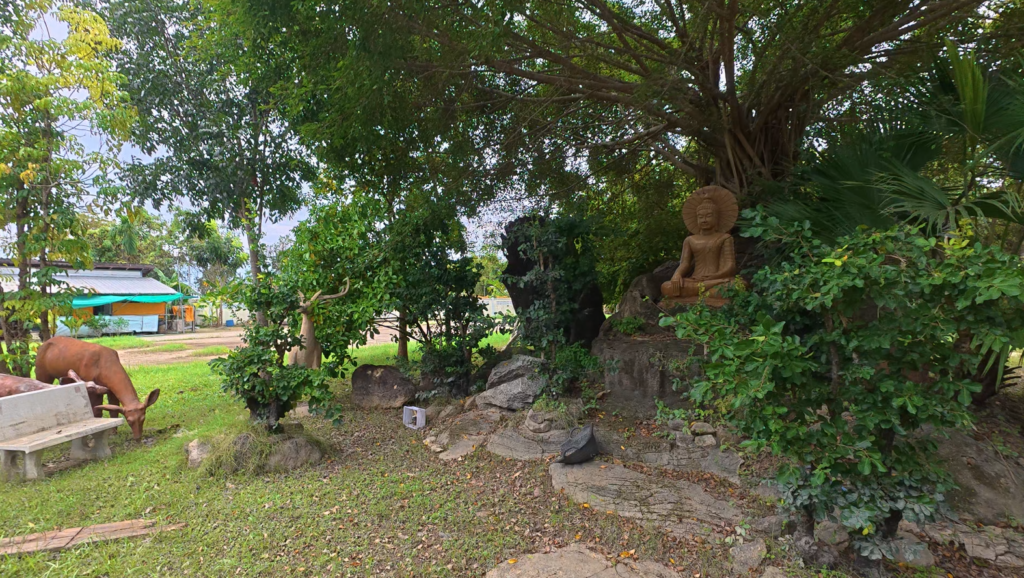
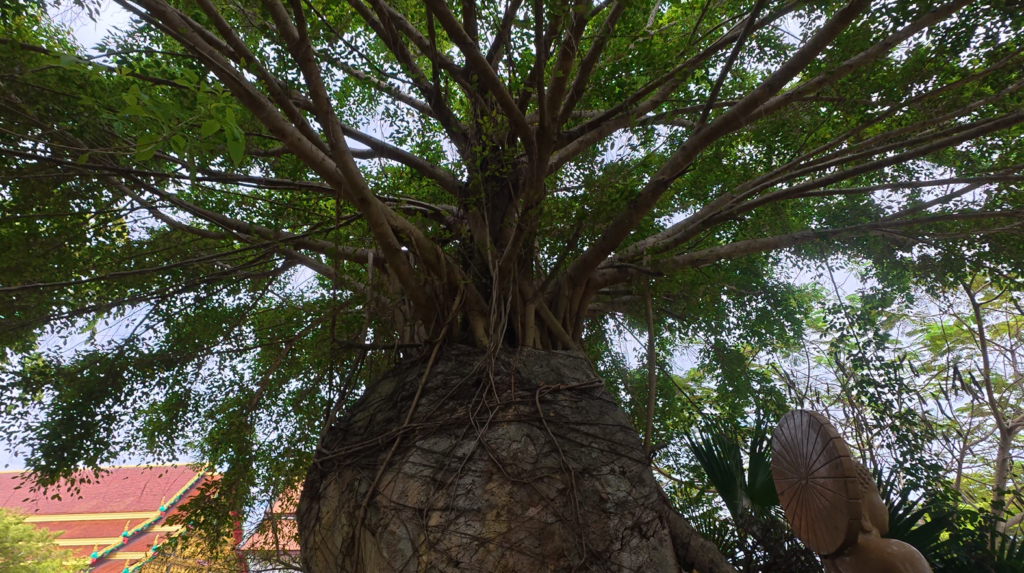
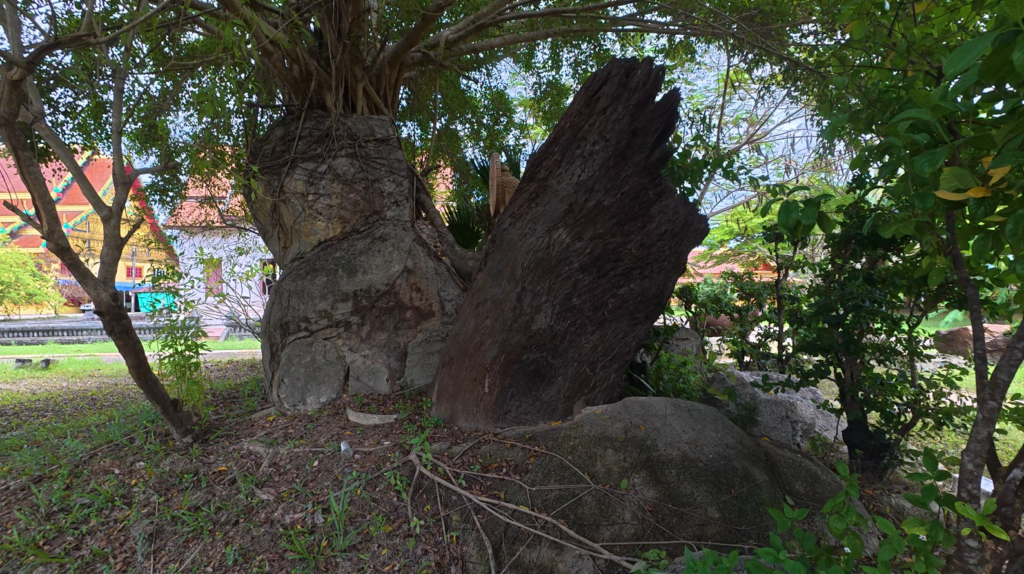
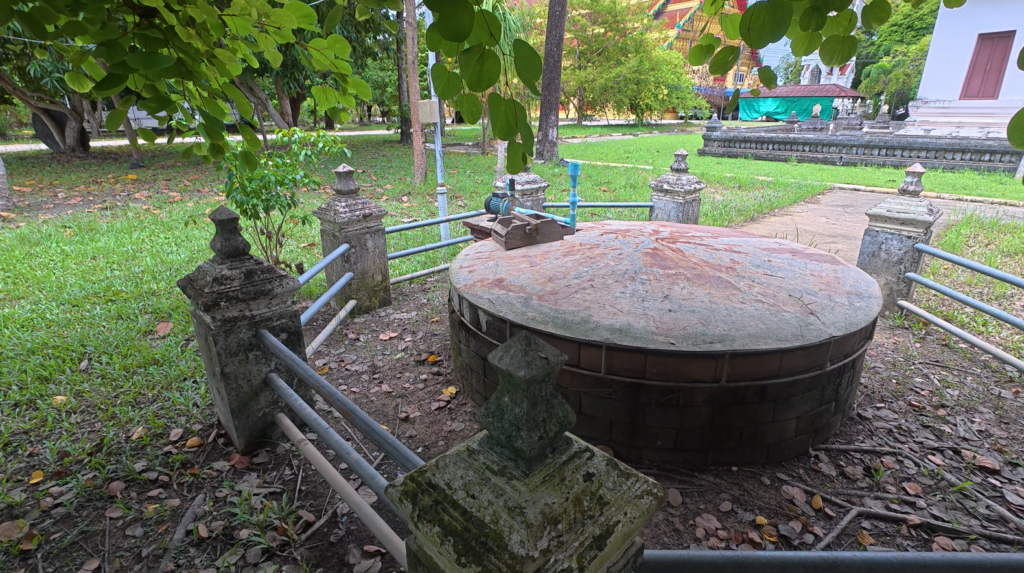
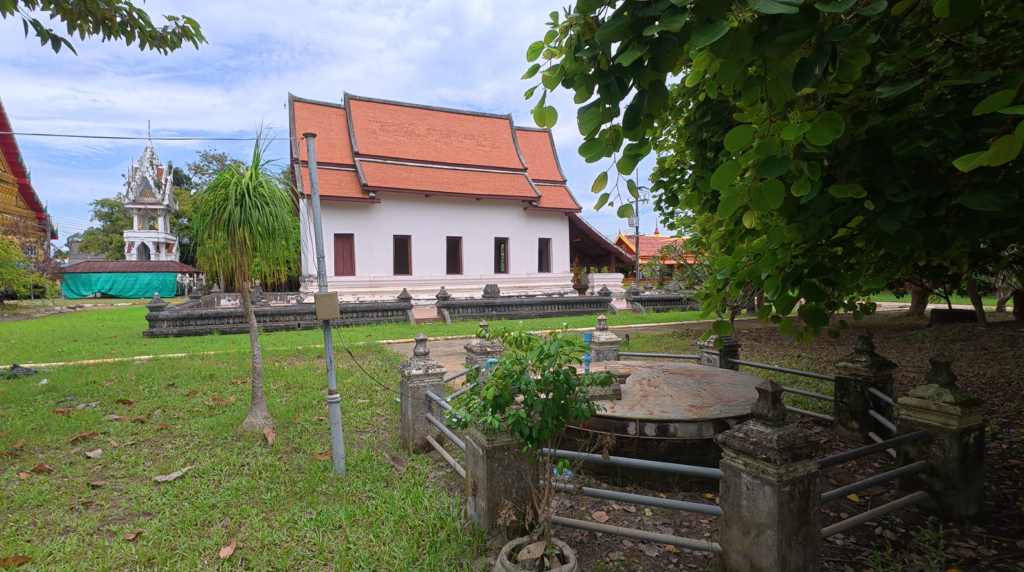
Mature trees and weathered stone objects around Wat Na Ta Kwan, Rayong. These quiet corners of the temple grounds preserve traces of its changing landscape and provide a glimpse into the surroundings of this historic Buddhist monastery.
The Modern Temple Buildings – Buddhist Art and Living Traditions
After exploring the historic structures of Wat Na Ta Kwan, I continued toward the newer buildings within the temple compound.
The atmosphere here was noticeably different from that of the old ubosot.
While the historic ordination hall preserves the architectural character of an earlier period, the newer buildings reflect the continuing religious activities of the local Buddhist community.
This contrast between old and new is one of the most interesting aspects of visiting traditional temples in Thailand.
A New Generation of Temple Architecture
The modern buildings at Wat Na Ta Kwan display decorative features commonly associated with contemporary Thai Buddhist architecture.
Ornamental roof elements, carefully finished surfaces, and more spacious interiors distinguish these structures from the modest brick-and-plaster construction of the old ordination hall.
These buildings serve the changing needs of the temple community while maintaining a connection with traditional Buddhist design.
In many Thai temples, new structures are built through donations from local residents and other supporters who wish to make merit.
Such contributions allow temples to maintain their religious functions while accommodating larger gatherings and community activities.
Buddha Images and Sacred Spaces
Inside the newer religious buildings, Buddha images remain the principal focus of devotion.
The arrangement of the images, offering spaces, and religious furnishings reflects the importance of Buddhist worship in everyday Thai life.
Visitors may come to light candles, offer flowers, make donations, or spend a quiet moment in prayer.
These practices are part of the continuing relationship between the monastery and the surrounding community.
Although the buildings may be relatively modern, the religious traditions practiced within them have much deeper historical roots.
Buddhist Murals and Religious Teachings
The painted decorations and Buddhist imagery inside the temple add another dimension to the visitor’s experience.
In Thai Buddhist temples, murals frequently illustrate episodes from the Buddha’s life, the Jataka tales of his previous births, or teachings concerning karma, generosity, and moral conduct.
Such paintings are not merely decorative. They have traditionally helped communicate Buddhist teachings to people who may not have studied religious texts.
At Wat Na Ta Kwan, the interior artwork contributes to the religious atmosphere of the newer buildings.
The precise subjects and identities of individual painted figures would require closer examination before they could be confidently identified.
The Past and Present Together
What I found particularly meaningful was the coexistence of the old and new temple structures.
The historic ubosot and ancient chedi preserve evidence of earlier generations, while the modern buildings demonstrate that the temple remains part of contemporary community life.
Rather than viewing the newer structures as separate from the temple’s history, I see them as another stage in its continuing development.
Wat Na Ta Kwan is therefore more than a collection of old monuments.
It is a living Buddhist monastery where the architectural past and the religious present exist side by side.
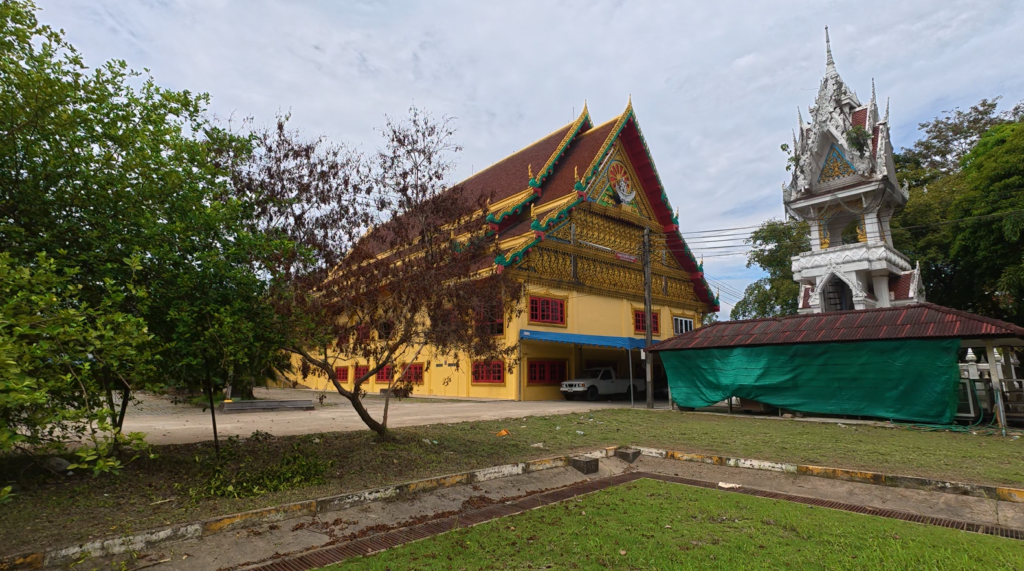
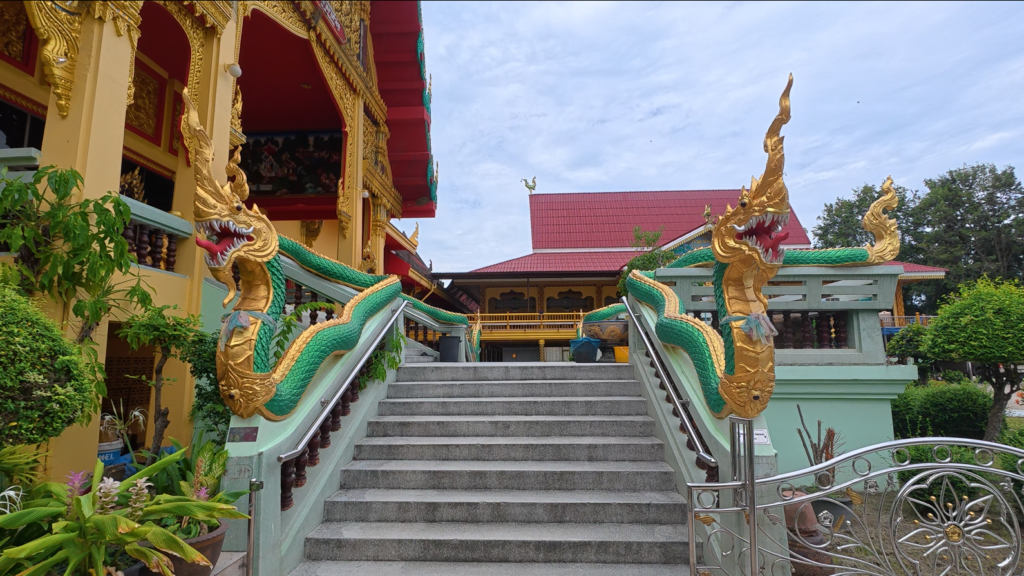
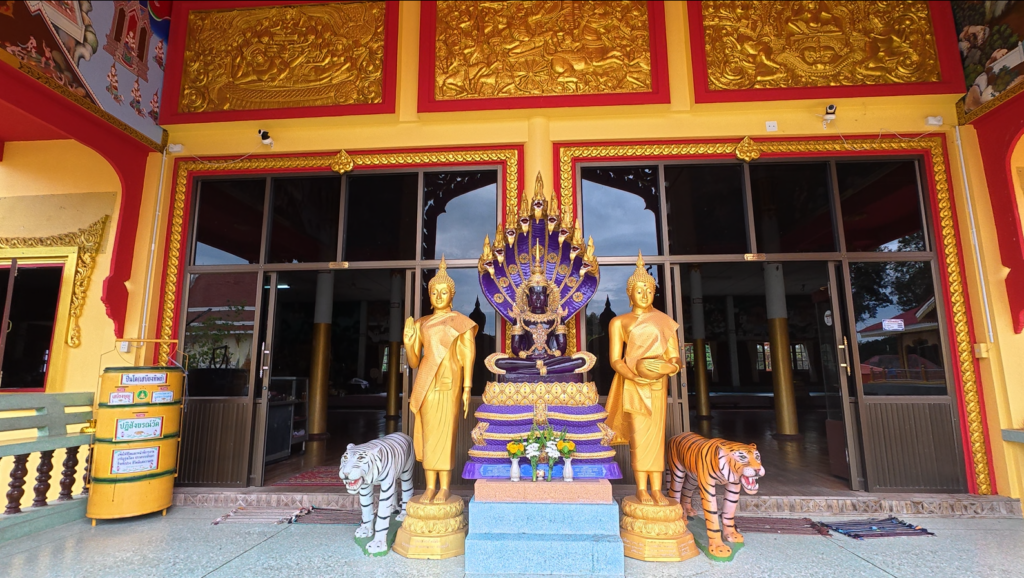
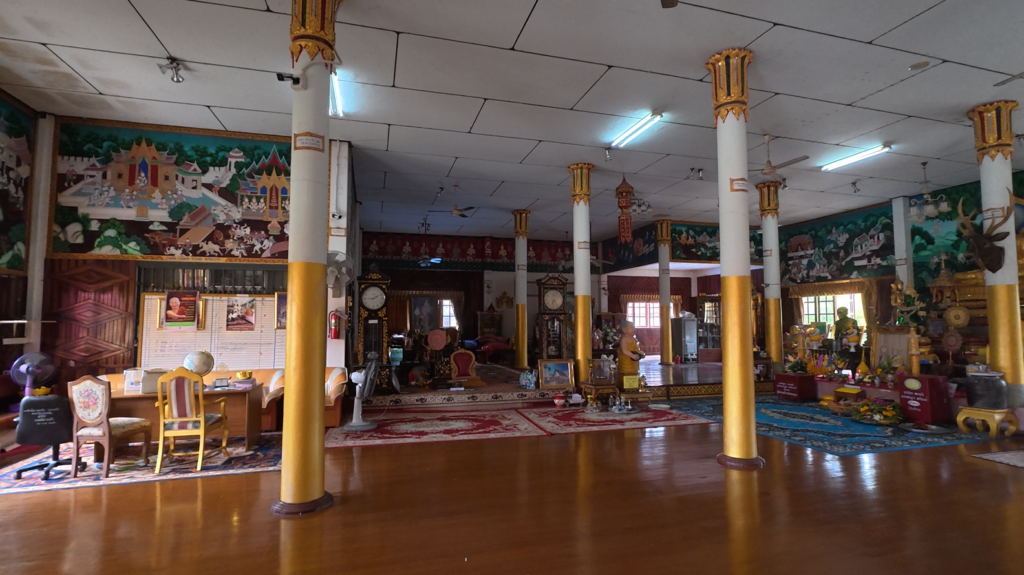
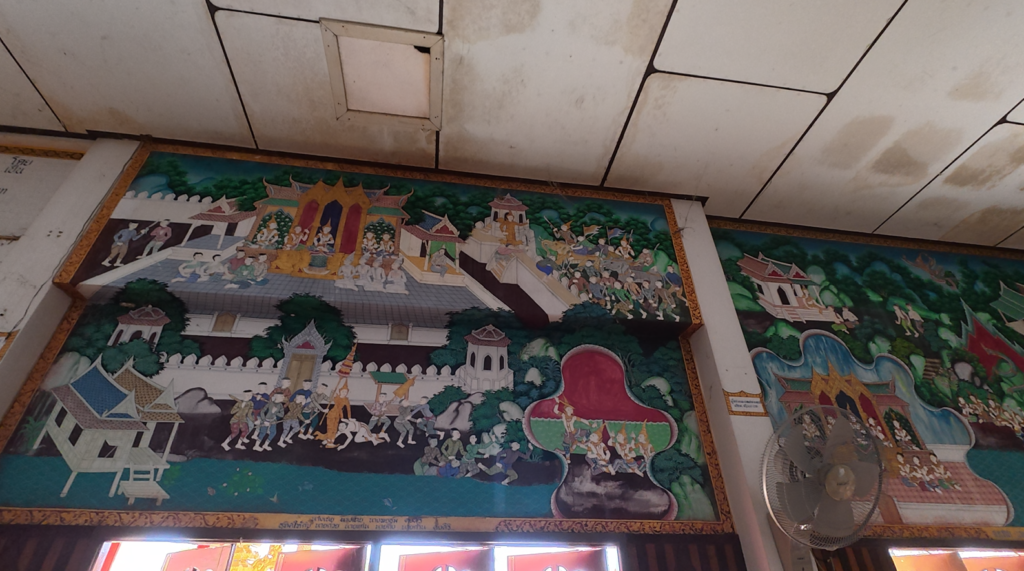
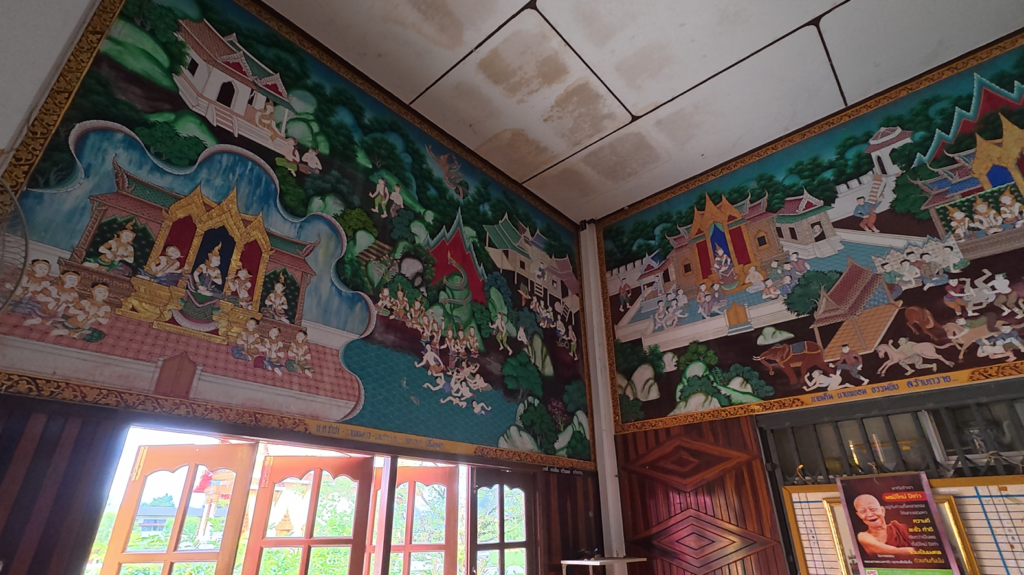
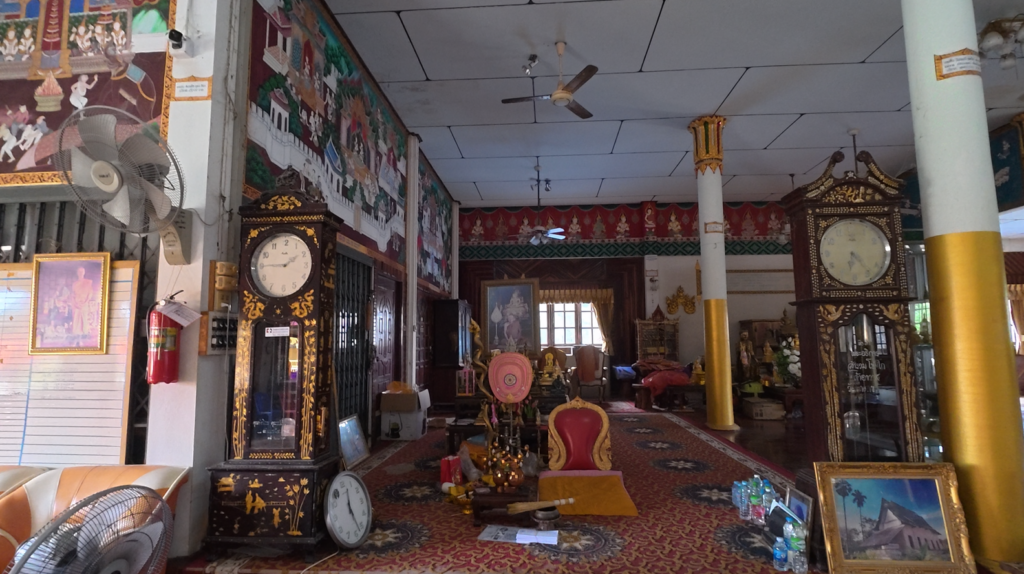
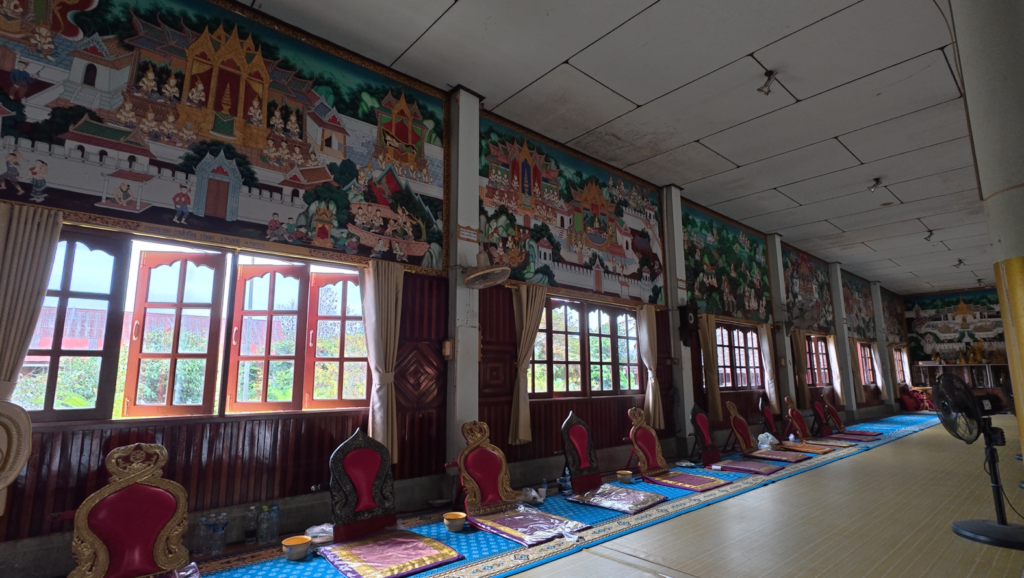
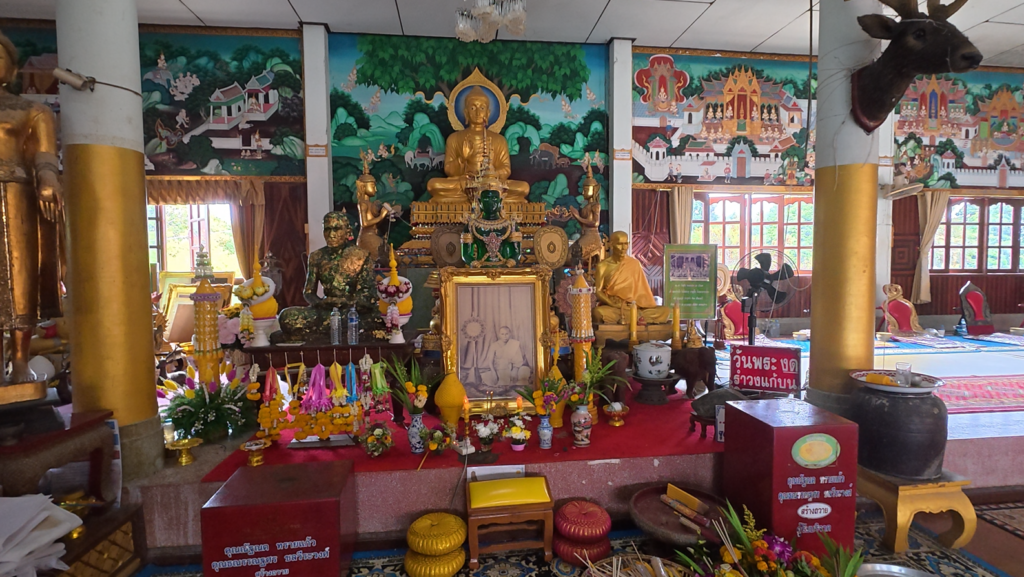
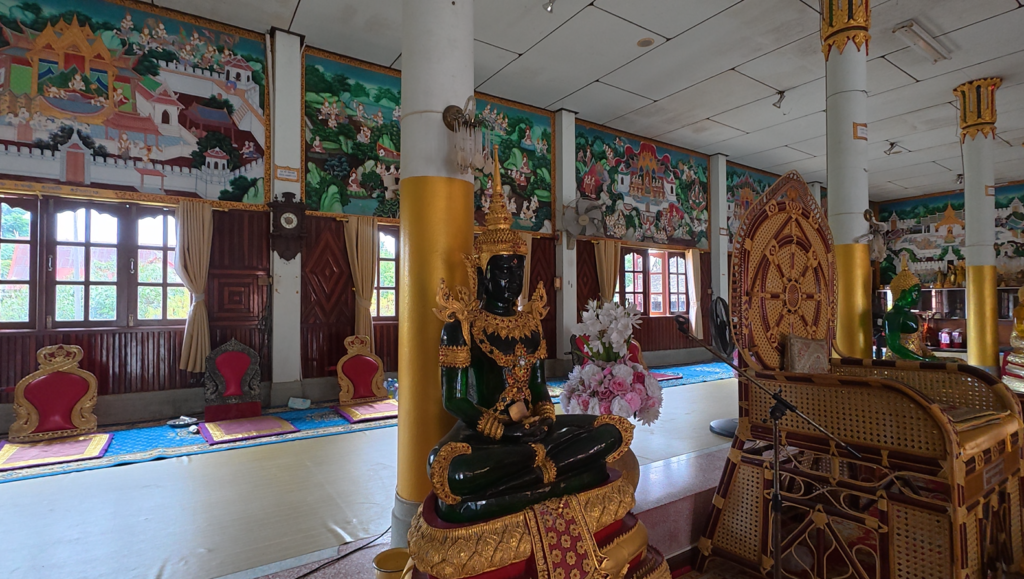
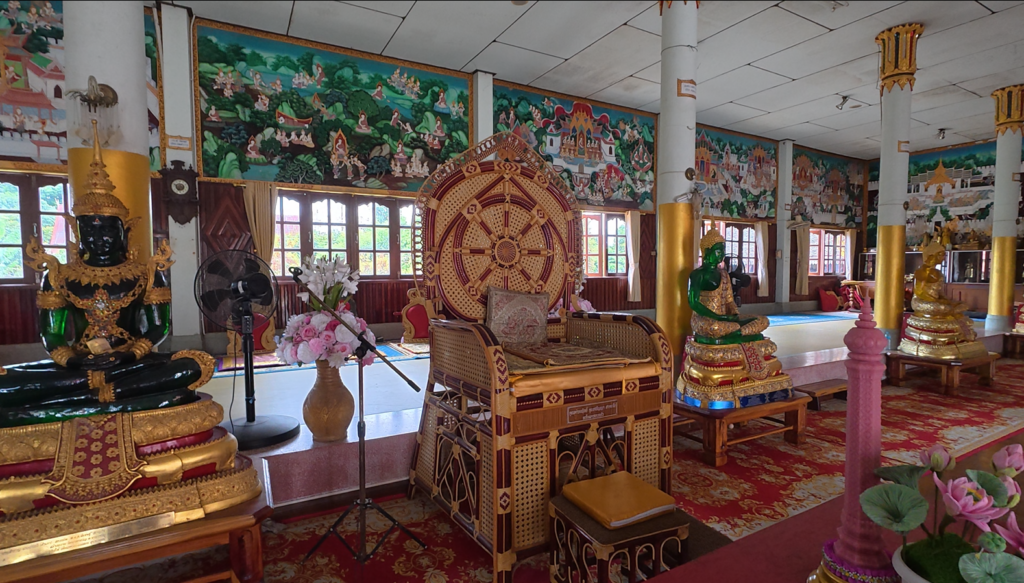
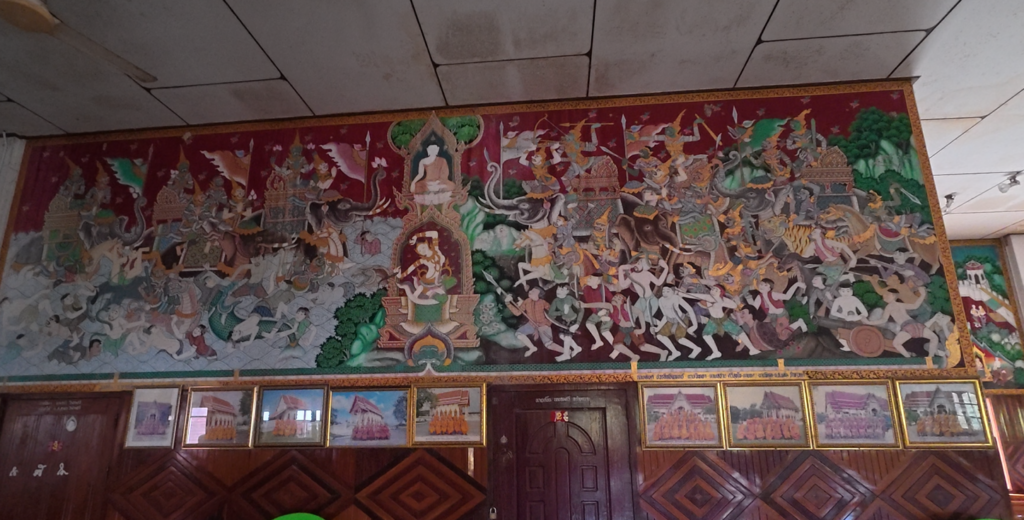
The modern religious buildings of Wat Na Ta Kwan, Rayong, featuring traditional Thai architectural decorations, Buddha images, painted Buddhist artwork, and spaces for worship. Together with the historic ubosot and chedi, these buildings reflect the continuing religious life of the local community.
The Historic Wooden Preaching Pulpit – A Rare Buddhist Heritage
Among the historical objects I had hoped to find at Wat Na Ta Kwan, one was particularly interesting: an old wooden preaching pulpit, known in Thai as a thammas (ธรรมาสน์).
Before visiting the temple, I had come across a local historical description suggesting that Wat Na Ta Kwan preserved an unusual wooden pulpit, reportedly distinguished by its traditional craftsmanship and architectural form.
Fortunately, during my visit, I was able to see and photograph the structure myself.
What Is a Thammas?
In Thai Theravada Buddhism, a thammas is a raised platform or elaborately decorated seat traditionally used by monks when delivering Buddhist sermons.
Unlike an ordinary chair, a traditional preaching pulpit may resemble a miniature temple pavilion, with a raised wooden seat, decorative panels, and a tiered roof.
Some examples are designed in the form of a busabok (บุษบก), a richly ornamented Thai pavilion traditionally associated with sacred or royal settings.
The elevated position of the monk symbolizes respect for the Dhamma, the teachings of the Buddha.
During religious ceremonies, particularly sermons associated with important Buddhist festivals, monks may deliver teachings from such pulpits while laypeople sit below and listen.
Traditional Woodworking and Religious Art
The old pulpit at Wat Na Ta Kwan is especially interesting because of its architectural character.
Local historical descriptions refer to a square wooden structure with a tiered roof and traditional Thai decorative elements.
Its design reflects a form of religious craftsmanship in which woodworking, architecture, and Buddhist ceremonial traditions come together.
The raised structure and roof give the pulpit the appearance of a small sacred pavilion rather than a simple preaching seat.
Although similar forms can be found elsewhere in Thailand, this particular example has been described in local historical literature as unusual within Rayong Province.
Its precise construction date and the identity of its original craftsmen remain unconfirmed.
The Tradition of Buddhist Sermons
Preaching has long been an essential part of Buddhist religious life in Thailand.
Monks explain the Buddha’s teachings to laypeople, often drawing upon stories from the Jataka, Buddhist scriptures, and traditional moral literature.
One well-known tradition is the Thet Mahachat (เทศน์มหาชาติ), a ceremonial recitation of the Vessantara Jataka, which tells the story of the Buddha’s final previous life as Prince Vessantara.
Traditional preaching pulpits were important furnishings for such religious gatherings, although there is no confirmed evidence that this particular pulpit was specifically used for Mahachat ceremonies.
As temple architecture and religious practices changed, some older pulpits were replaced by simpler platforms, chairs, or modern sound systems.
Surviving wooden examples therefore provide valuable evidence of earlier Buddhist ceremonial traditions.
A Special Discovery at Wat Na Ta Kwan
Finding this old pulpit was one of the most rewarding moments of my visit.
Unlike the old ubosot or the chedi, which are immediately recognizable as historic religious structures, the preaching pulpit represents a more intimate aspect of temple life.
It reminds us of the monks who once taught Buddhist scriptures and the villagers who gathered to listen.
The pulpit also illustrates how traditional Thai craftsmen transformed a practical religious furnishing into a work of architectural art.
For me, this was another example of the unexpected treasures that can be found in the lesser-known temples of Rayong.
Sometimes, a single wooden structure can reveal as much about a community’s religious history as an entire building.
Another memorable discovery was at Wat Banlang in Rayong, where an elderly monk showed me a collection of historic Buddhist manuscripts and palm-leaf scriptures. Together with the wooden preaching pulpit at Wat Na Ta Kwan, these objects reveal different aspects of Thailand’s traditional Buddhist learning and religious culture.
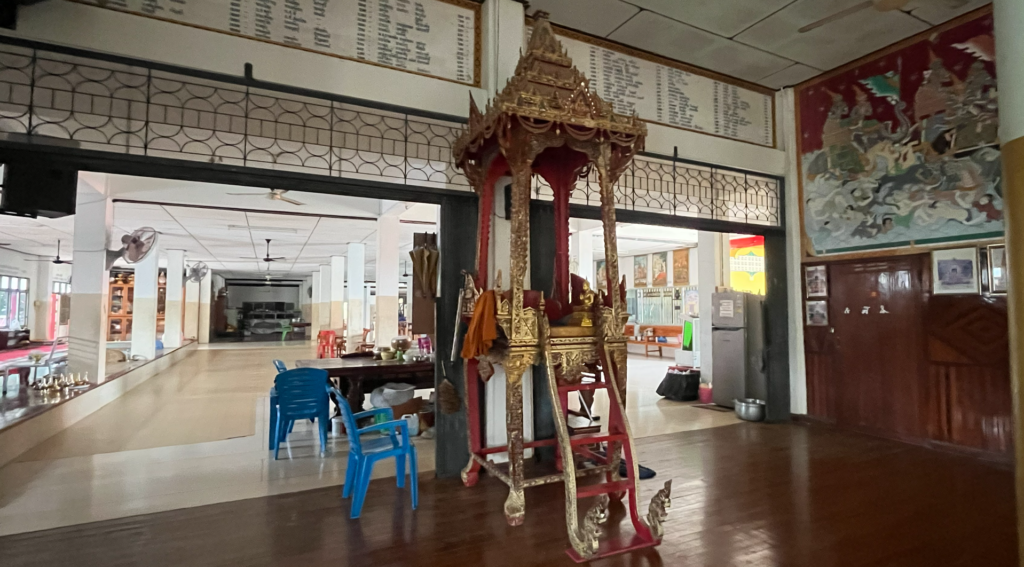
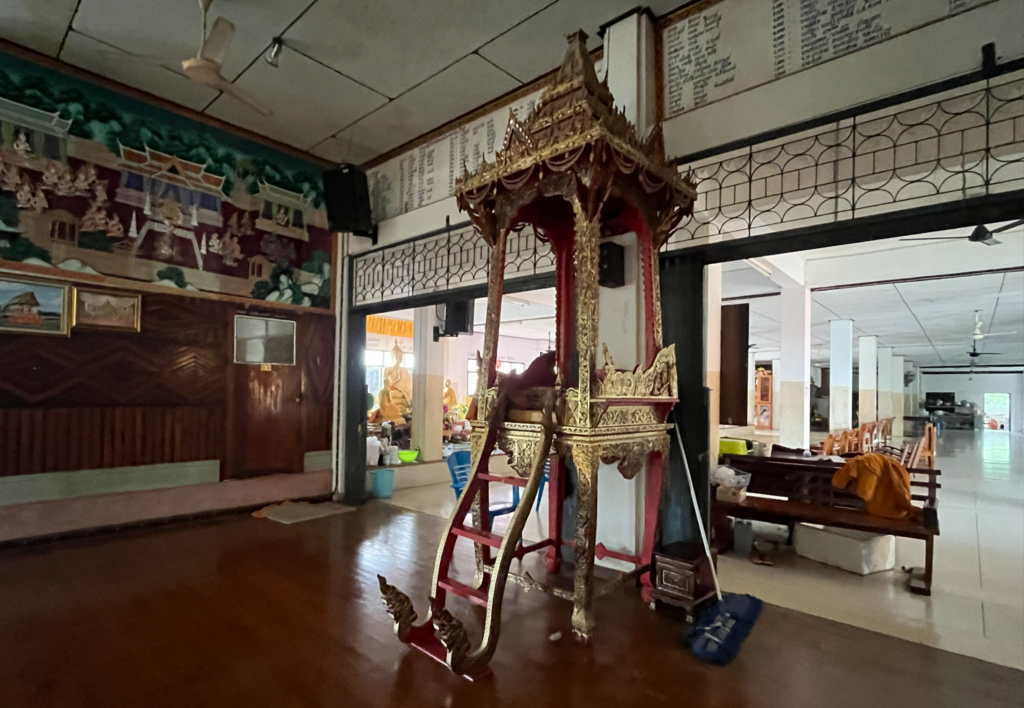
The historic wooden preaching pulpit (ธรรมาสน์) at Wat Na Ta Kwan, Rayong. Its elevated structure and traditional pavilion-style design reflect the craftsmanship and Buddhist sermon traditions of an earlier period. This unusual pulpit is among the temple’s notable cultural treasures.
The distinctive wooden preaching pulpit is also documented in Roi Rueang Mueang Rayong, page 75, a regional heritage publication describing the historical temples and traditional craftsmanship of Rayong.
Watch My Live Visit to Wat Na Ta Kwan
Join me on a live walk through Wat Na Ta Kwan in Rayong, Thailand. This unedited livestream captures the atmosphere of the temple, its historic buildings, and my discoveries during the visit.
Explore the temple as I experienced it, through the eyes of Won Cub Life.
A Connection with Rayong’s Traditional Woodcarving
A regional heritage publication describing the preaching pulpit at Wat Nong Saphan identifies similarities with examples at Wat Pa Pradu, Wat Ban Khai, and Wat Ta Khwan.
Based on these stylistic comparisons, the publication suggests that this tradition of wooden preaching pulpits may date to the reigns of King Rama V and King Rama VI (1868–1925).
Although this does not establish the exact construction date of the pulpit at Wat Na Ta Kwan, it provides an important clue to the development of traditional Buddhist woodcarving in Rayong.
Temple Architecture and the Surrounding Countryside
After discovering the historic wooden preaching pulpit, I continued exploring the remaining buildings and quieter corners of Wat Na Ta Kwan.
The temple contains a mixture of traditional architectural features and more recent structures, reflecting the changes that have taken place as the local Buddhist community has developed.
Traditional Roofs and Temple Buildings
The rooflines and decorative details of the temple buildings reveal the continuing influence of traditional Thai Buddhist architecture.
Even in relatively modern structures, familiar architectural elements remain important expressions of religious identity.
The sweeping roof forms, ornamental gables, and decorative finishes connect contemporary temple construction with styles that have developed over many centuries.
Although not every building at Wat Na Ta Kwan is historically old, the combination of different architectural periods helps illustrate how the temple has continued to evolve.
Wooden Structures and Everyday Temple Life
Some of the smaller buildings and wooden architectural features are less imposing than the principal religious structures, but they also contribute to the character of the temple.
In rural Thailand, Buddhist monasteries traditionally serve many purposes beyond religious ceremonies.
They may provide spaces for community gatherings, religious education, merit-making activities, and quiet reflection.
The everyday surroundings of a temple can therefore tell us something about its relationship with the people who live nearby.
Rice Fields and the Meaning of Na Ta Khwan
One of the most interesting aspects of this visit was the surrounding countryside.
The agricultural landscape brought me back to the story of Ta Khwan, the elderly landowner remembered in the temple’s founding tradition.
The Thai word na (นา) means rice field, and the temple’s name preserves this connection with the land.
According to local tradition, the temple was established on farmland associated with Ta Khwan, whose generosity became part of the community’s collective memory.
Whether every detail of the story is historically accurate remains uncertain, but the connection between Buddhist temples and agricultural communities is deeply rooted in Thai rural life.
For centuries, temples have been supported by farmers, merchants, and local families who donated land, food, money, and labor as acts of Buddhist merit-making.
In return, monasteries became important centers of spiritual and social life.
Looking across the countryside, I could imagine how closely the lives of the villagers and the temple must once have been connected.
A Quiet End to the Visit
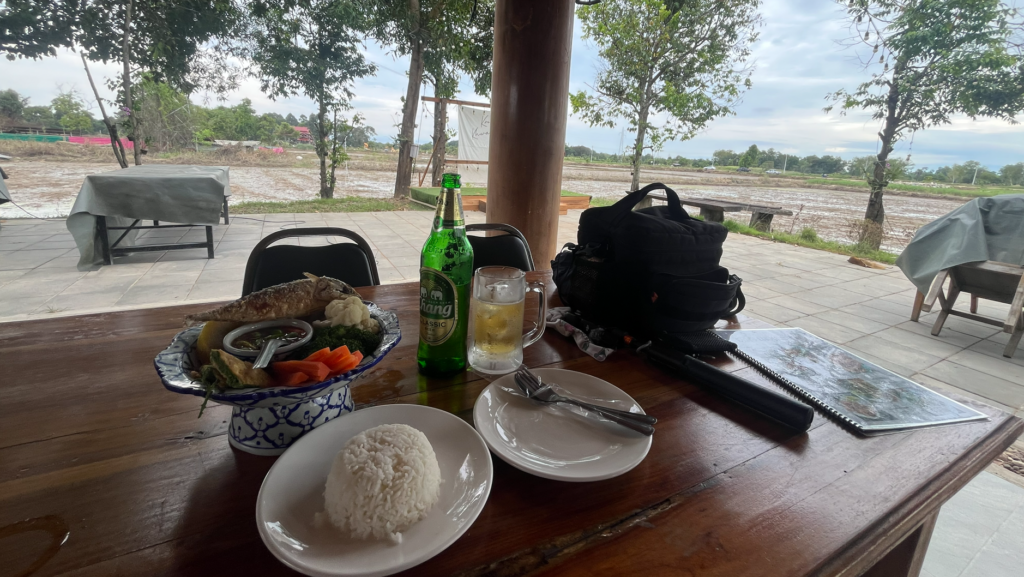
Before leaving, I spent a little time resting and enjoying the peaceful surroundings.
My visit had begun with curiosity about an old village temple and its unusual wooden preaching pulpit.
By the time I finished exploring, I had encountered much more: an old ordination hall, a bell-shaped chedi, historic Buddha images, traditional religious furnishings, and stories connecting the temple to the origins of the surrounding community.
None of these discoveries required a long journey to a famous tourist destination.
They were waiting in a quiet corner of Rayong, not far from the roads I have traveled many times on my Honda Super Cub.
This is one of the pleasures of exploring Thailand slowly.
The more I ride through its villages and countryside, the more I realize how much history remains hidden in ordinary places.
And there are still many more temples waiting to be discovered.
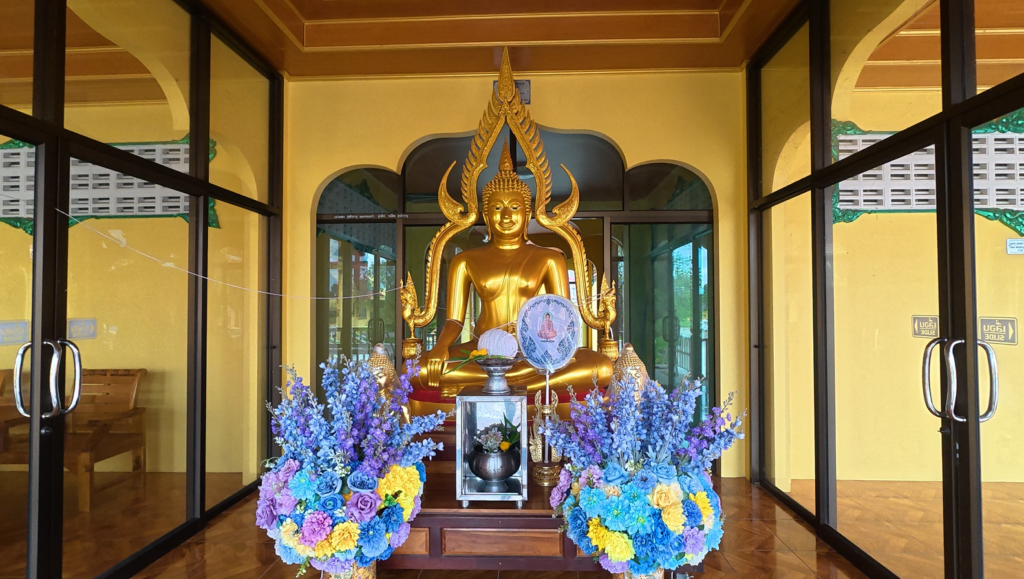
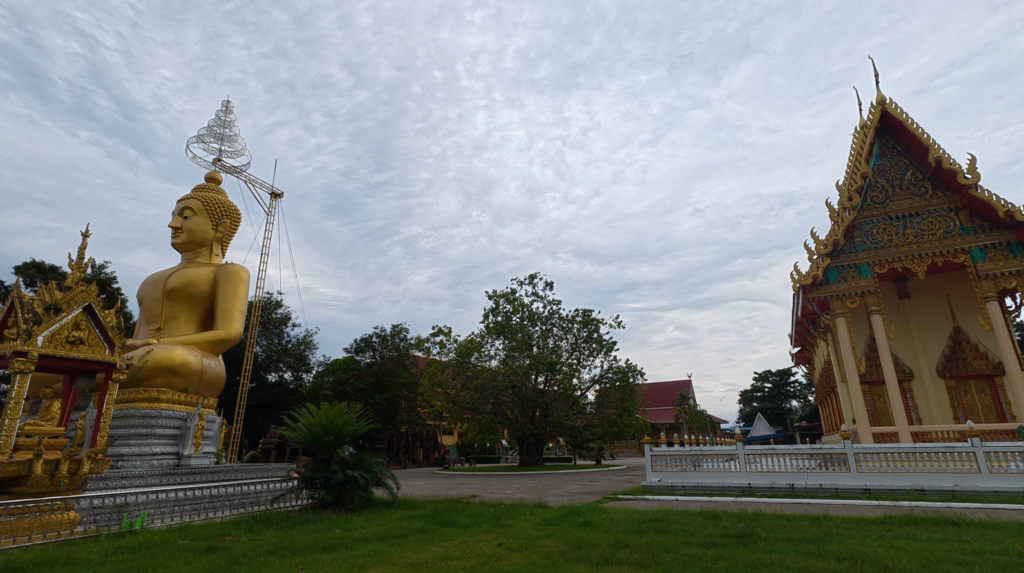
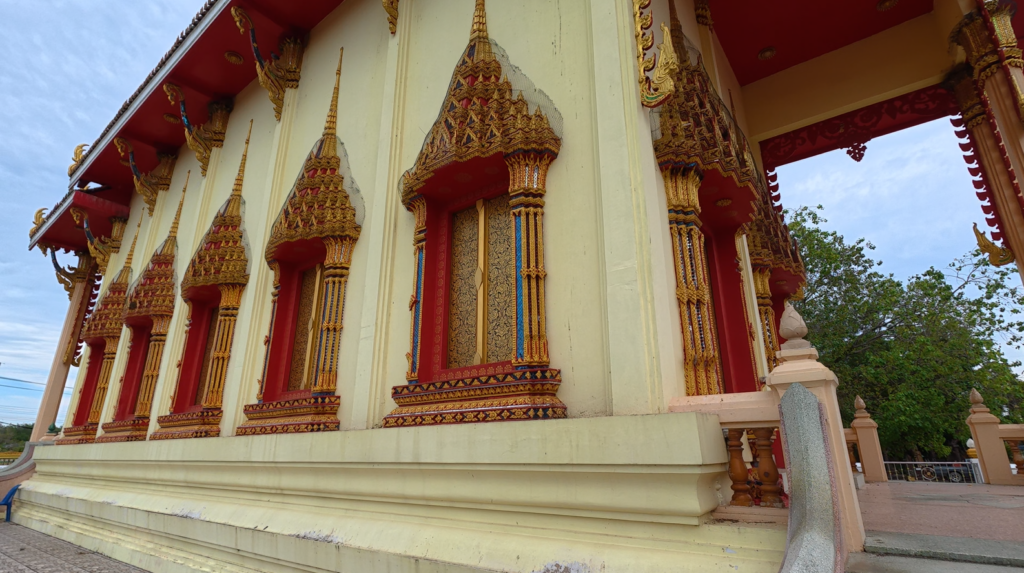
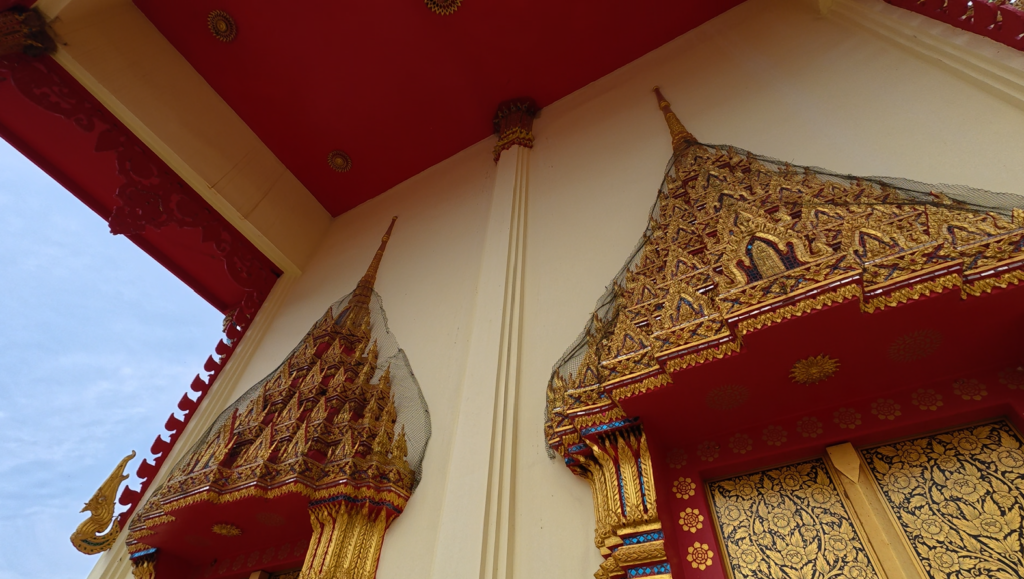
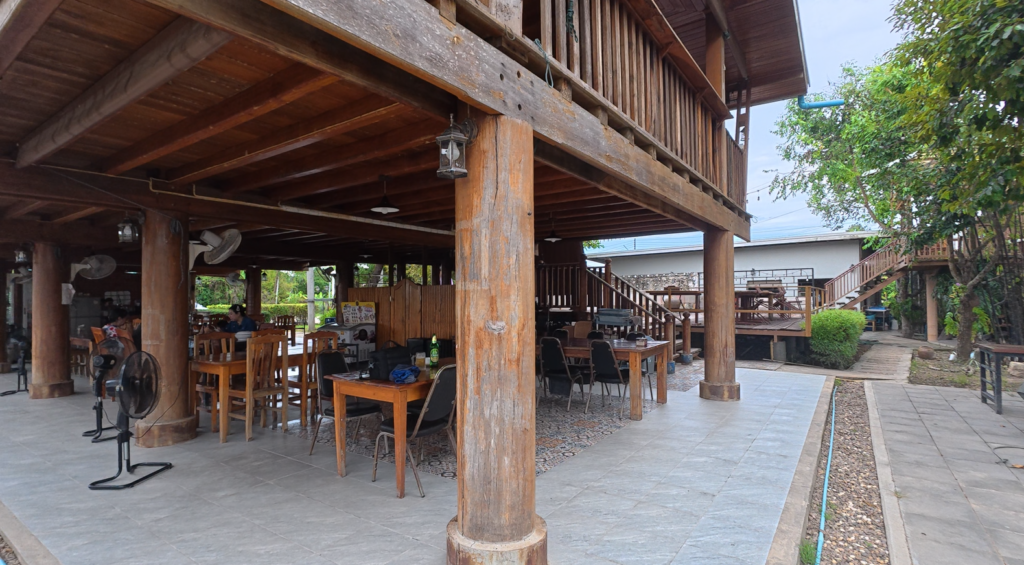
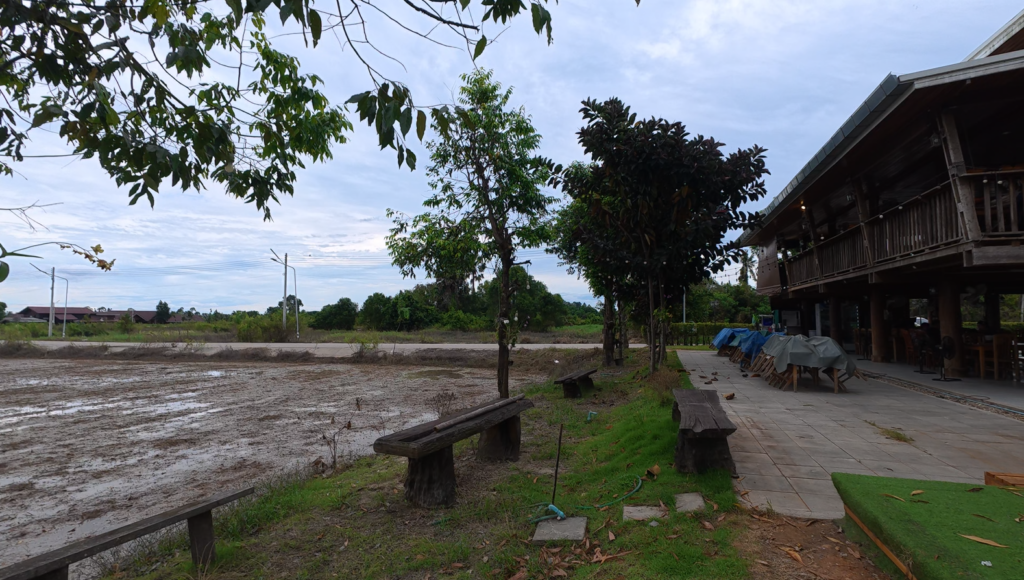
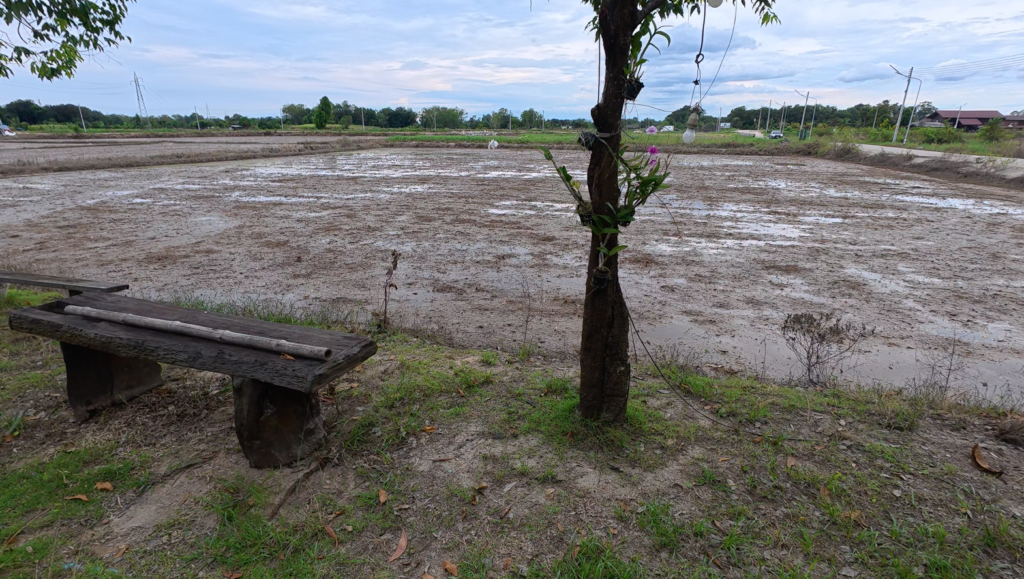
Traditional temple buildings, architectural details, wooden structures, and the peaceful countryside surrounding Wat Na Ta Kwan in Rayong. The nearby agricultural landscape recalls the local story of Ta Khwan, whose rice fields are remembered in the temple’s name.
Location, Visitor Information and Final Thoughts
Wat Na Ta Kwan (วัดนาตาขวัญ) is located in Na Ta Khwan Subdistrict, Mueang Rayong District, Rayong Province, Thailand.
Unlike the large and famous temples that attract thousands of tourists, Wat Na Ta Kwan offers a quieter experience for visitors interested in local history, traditional Buddhist architecture, and the religious heritage of rural Thailand.
Visitor Information
Temple: Wat Na Ta Kwan (วัดนาตาขวัญ)
Location: Na Ta Khwan, Mueang Rayong, Rayong Province, Thailand
Admission: No confirmed admission charge; donations to support the temple are welcome.
Recommended Highlights: The historic ubosot, the old bell-shaped chedi,
the traditional wooden preaching pulpit, and the principal Buddha images.
Visitors should dress respectfully and remove their shoes before entering sacred buildings. Permission should be requested before photographing monks, ceremonies, or restricted interiors.
Access to older buildings and historical objects may depend on temple activities and the availability of temple staff.
Final Thoughts – Discovering the Hidden History of Rayong
Wat Na Ta Kwan was another reminder that some of Thailand’s most interesting historical places are not necessarily its most famous.
The temple’s name preserves a local story about a landowner and his rice fields. Its old ubosot and chedi reflect the architectural traditions of earlier generations, while its wooden preaching pulpit offers a glimpse into the history of Buddhist sermons and religious craftsmanship.
I was especially pleased to find the old pulpit, which had been one of the main reasons for my visit.
Equally meaningful was the opportunity to make an offering and pay my respects inside the historic ordination hall.
These experiences reminded me that a temple is not simply a collection of historical buildings and religious objects. It is also a place where faith, memory, and community traditions continue to meet.
As I prepared to leave Wat Na Ta Kwan, I felt that I had discovered another small but valuable piece of Rayong’s history.
My journey through Thailand continues, one village, one temple, and one unexpected discovery at a time.