My ride to Wat Ban Laeng in Rayong began with an interest in its old ubosot and the small scripture library standing over water. Earlier that day, I had stopped at Wat Taphong Nai, where I was fortunate enough to see palm-leaf manuscripts up close. That encounter made me even more curious about the manuscripts and the buildings once used to protect them.
Walking through Wat Ban Laeng, I found weathered temple walls, an old prang, and a mango tree connected to the story of the temple’s founding. Each offered a different glimpse into the history of this place. But the most memorable part of the visit came when monks opened manuscript bundles and showed me both the inscribed leaves and the patterned cloths used to wrap them.
I had come to look at old buildings. I left feeling that I had seen a treasure.
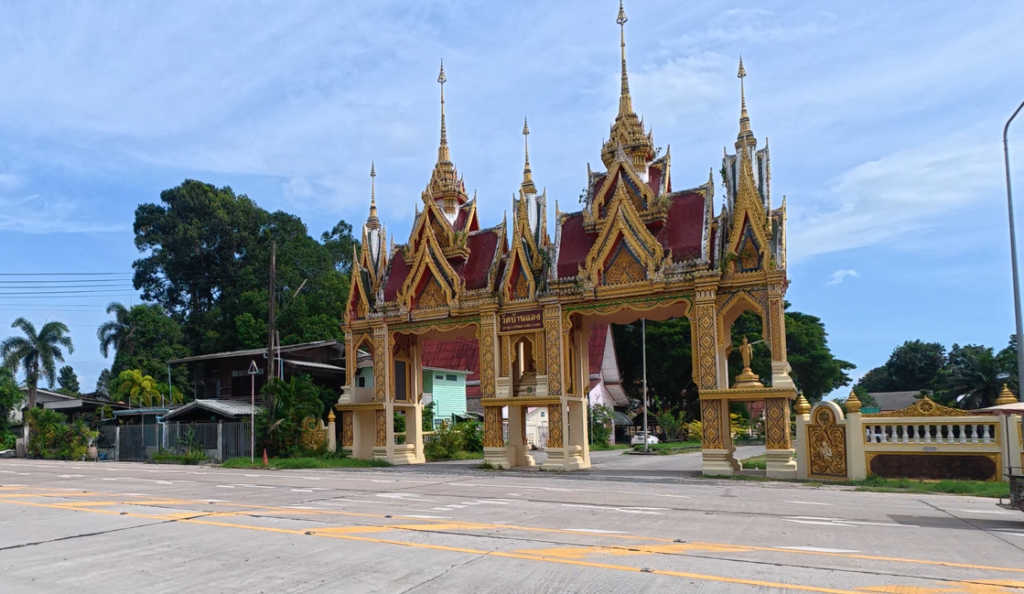
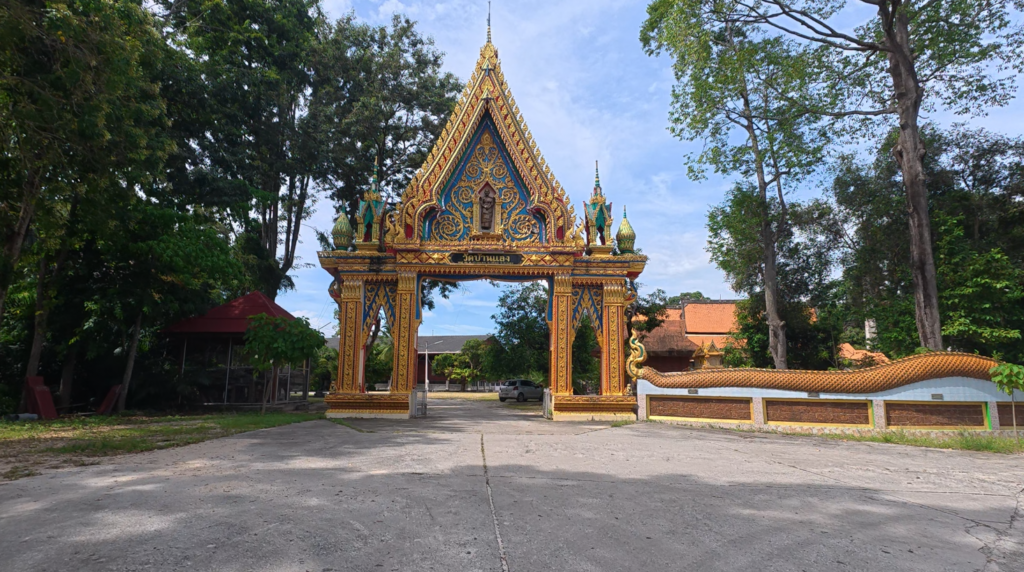
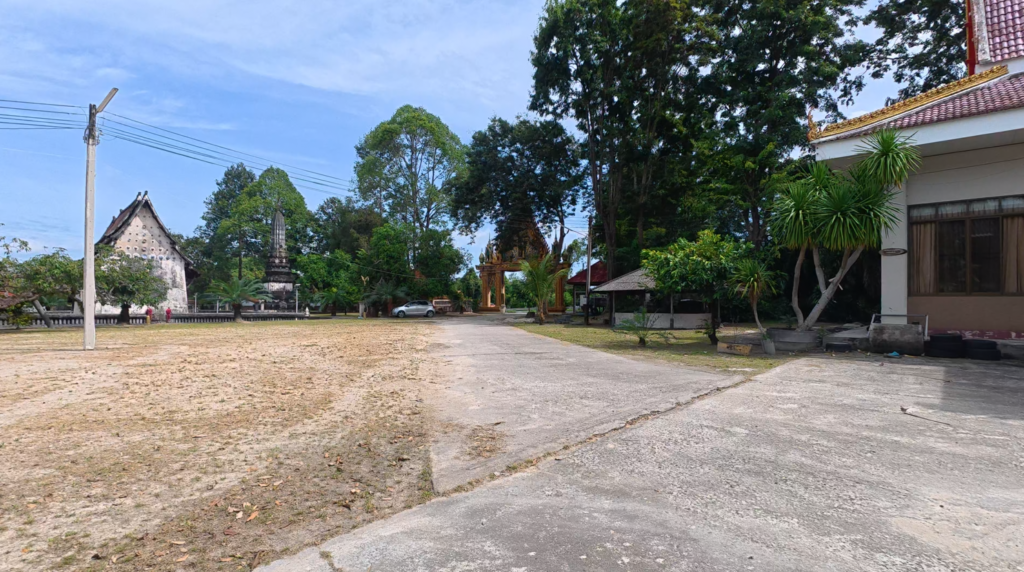
Entering Wat Ban Laeng in Rayong, following an earlier stop at Wat Taphong Nai.
Originally named Wat Chan Suwan Phothitharam (วัดจันทร์สุวรรณโพธิธาราม), the temple later became known as Wat Laeng, referring to laterite stone found locally.
A Temple That Began in a Sugarcane Field
Wat Ban Laeng traces its foundation to 1742, during the Ayutthaya period. Its beginnings are connected to land donated for the temple by Nai Chan and Nang Wan. Before becoming temple grounds, the land was used to grow sugarcane.
An old mango tree gives this founding story a physical presence. The sign beside it identifies the tree as “mamuang phran” and states that it once stood in the donors’ sugarcane field, before the temple was established. It describes the tree as approximately 300 years old, although this should be understood as the age recorded on the sign rather than a precisely verified date.
Its broad, spreading branches made me pause. Before exploring the old religious buildings, I was looking at a tree associated with the landscape that preceded them. The story of Wat Ban Laeng begins here—with cultivated land, the people who donated it, and a tree that the temple continues to remember.
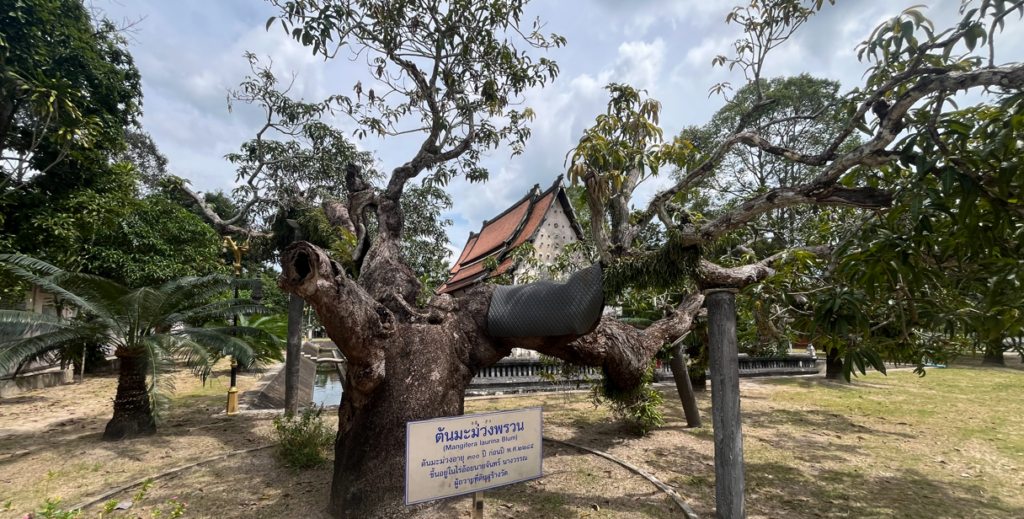
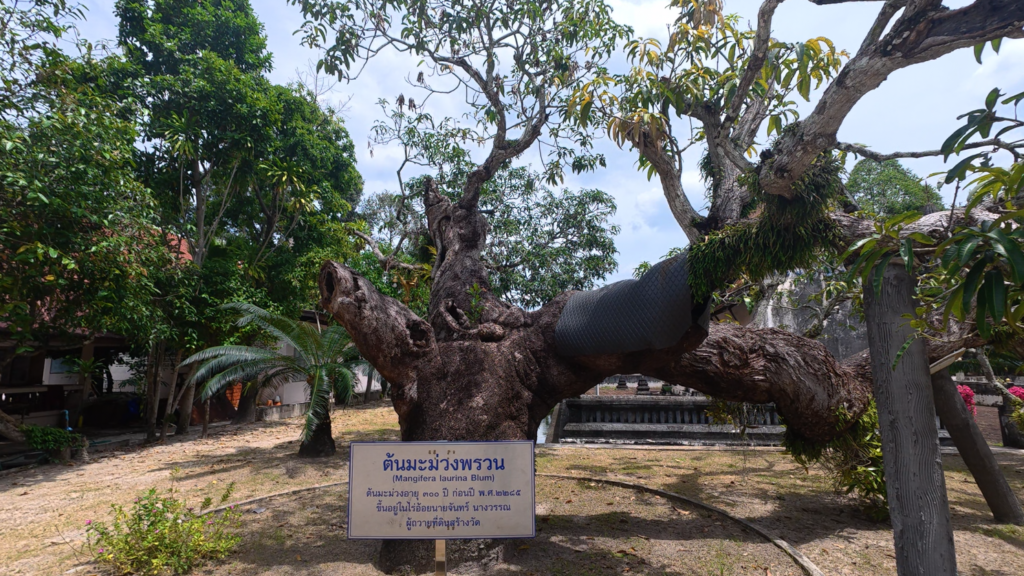
The old mango tree associated with the donors’ sugarcane field. Its sign preserves a local account of the land before Wat Ban Laeng was founded.
Walking Around the Old Ubosot
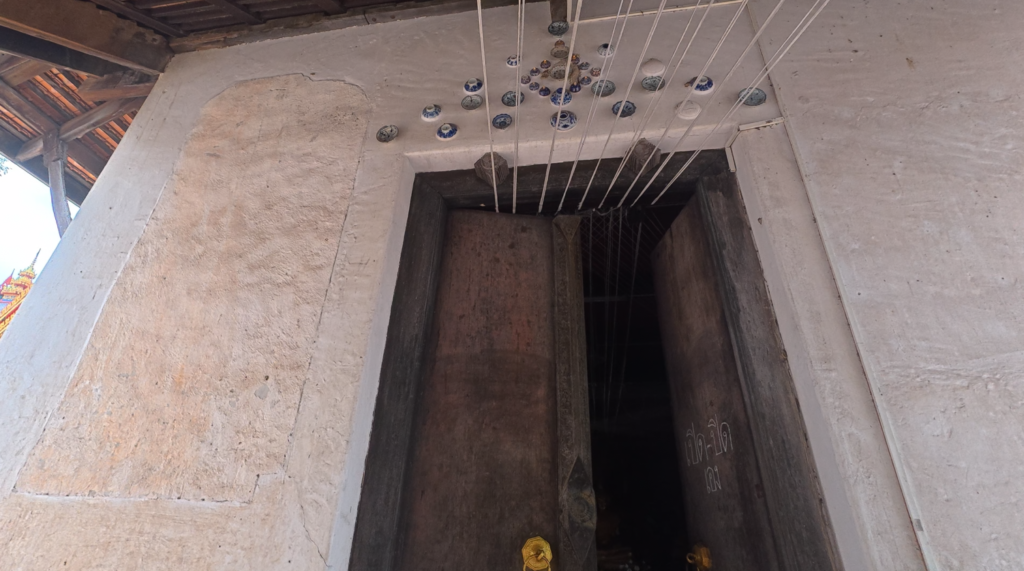
The old ubosot drew me closer with its weathered plaster walls and steep tiled roof. Walking around it, I noticed how much its character came from small details: darkened roof timbers, the sheltered entrance, and ceramic dishes set into the gable.
The provincial account dates the ubosot’s establishment to 1762. Its single entrance is described as a maha-ut arrangement. A sheltered front porch and a roof with two overlapping tiers and three slopes complete its distinctive form.
The dishes are especially noticeable against the pale plaster. From a distance, they form a decorative pattern; closer views reveal the individual pieces. Together with the worn surfaces below, they invite a slower look at the building.
The provincial account identifies Chinese blue-and-white porcelain, late-Ayutthaya Bencharong, and ceramics from Rama V’s reign among the decorations, suggesting successive repairs.
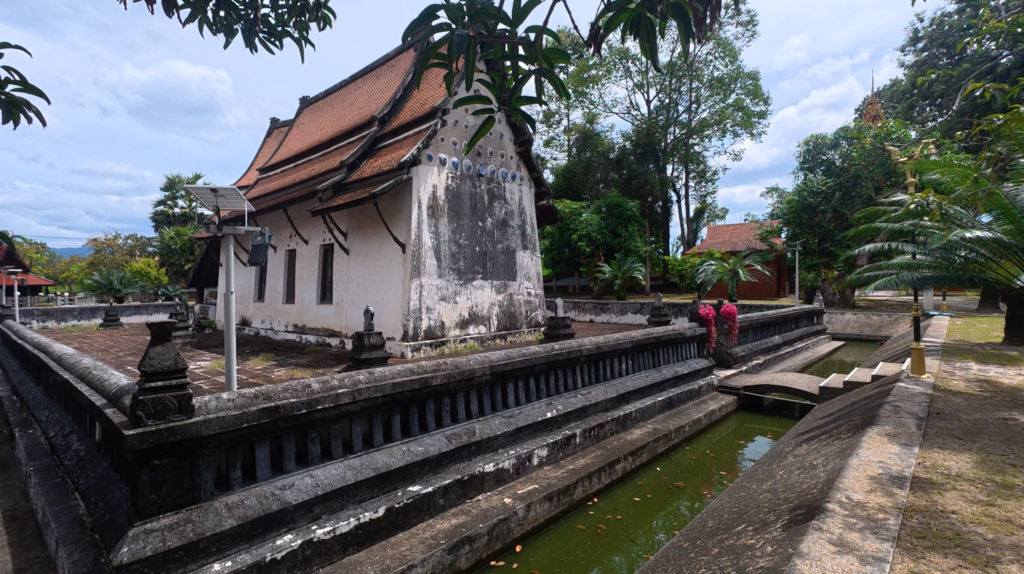
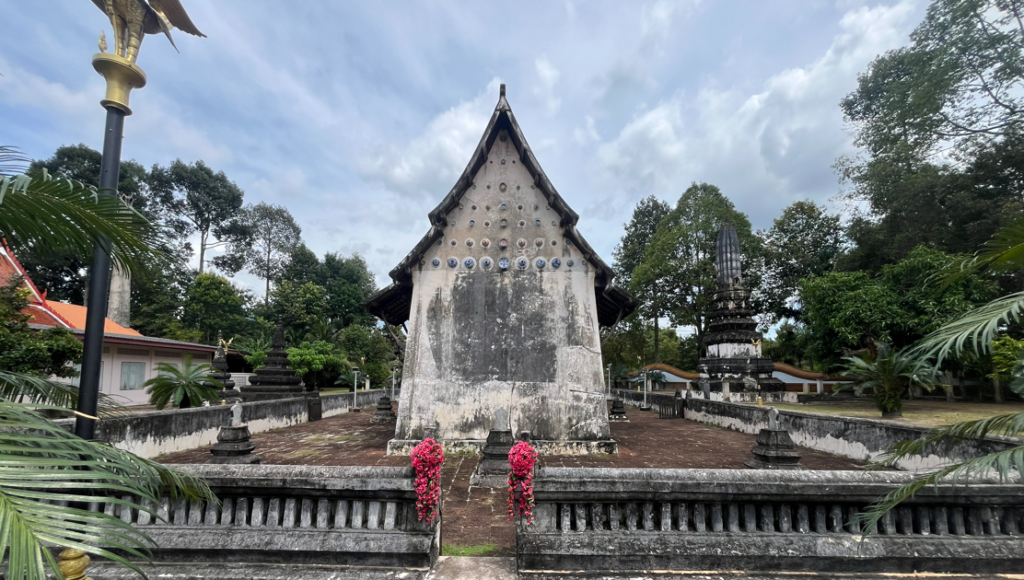
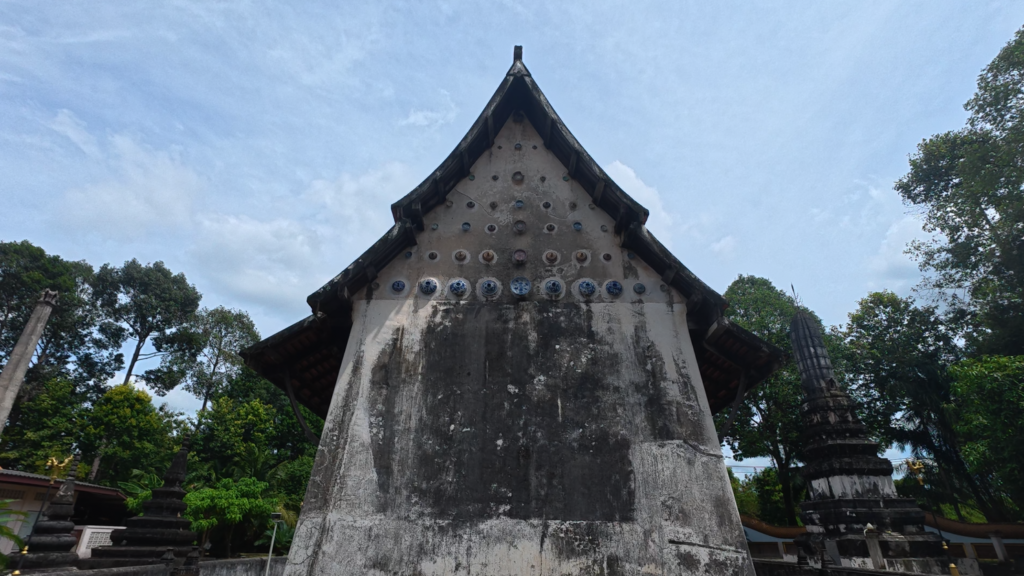
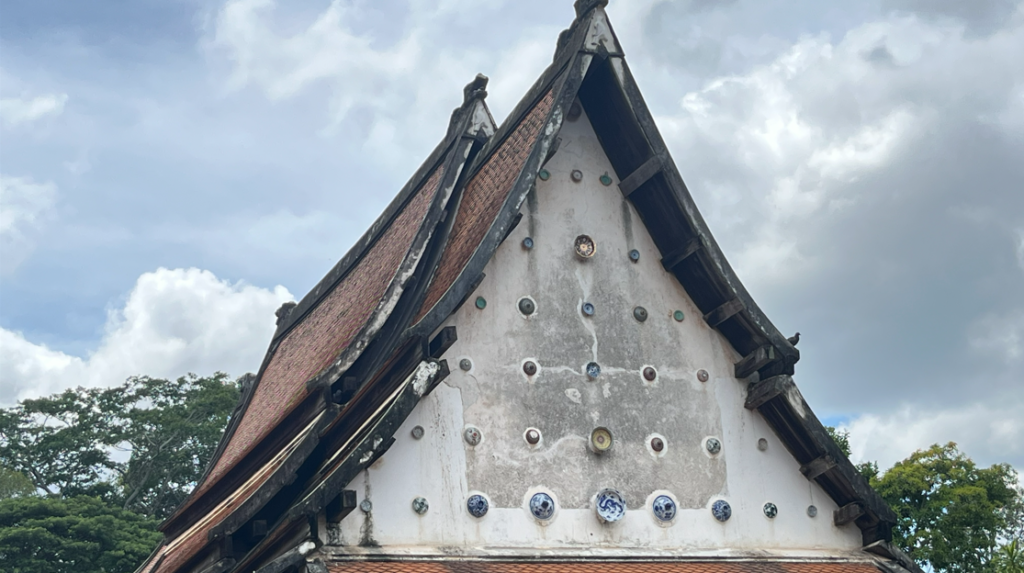
The old ubosot at Wat Ban Laeng, with weathered plaster walls, a steep tiled roof, and ceramic dishes decorating its gable.
Around the hall, leaf-shaped bai sema mark the sacred boundary associated with the ordination space. A water channel also surrounds the raised enclosure. Both are visible features of the setting, although the water alone does not establish how the ritual boundary was originally defined.
I followed the walkway around the hall, looking back at it from different angles. The nearby prang appeared beside the roofline, while the boundary stones brought my attention back down to ground level. There was much to notice before I even stepped inside.
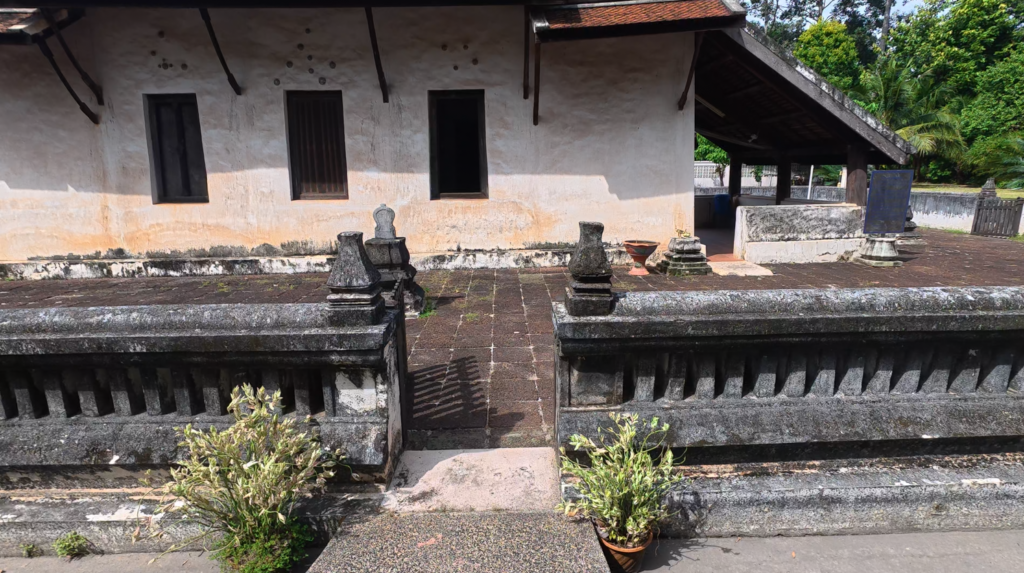
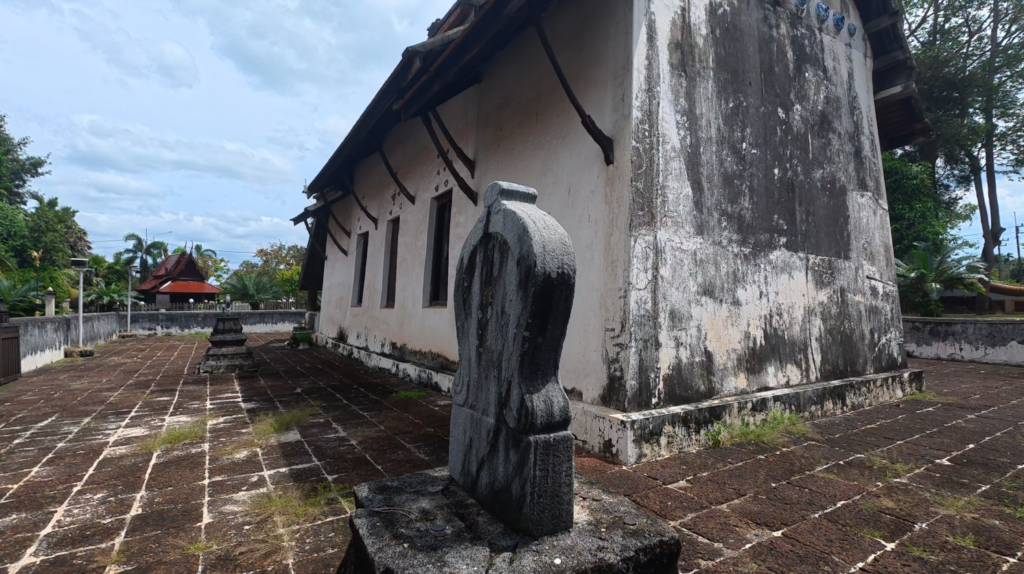
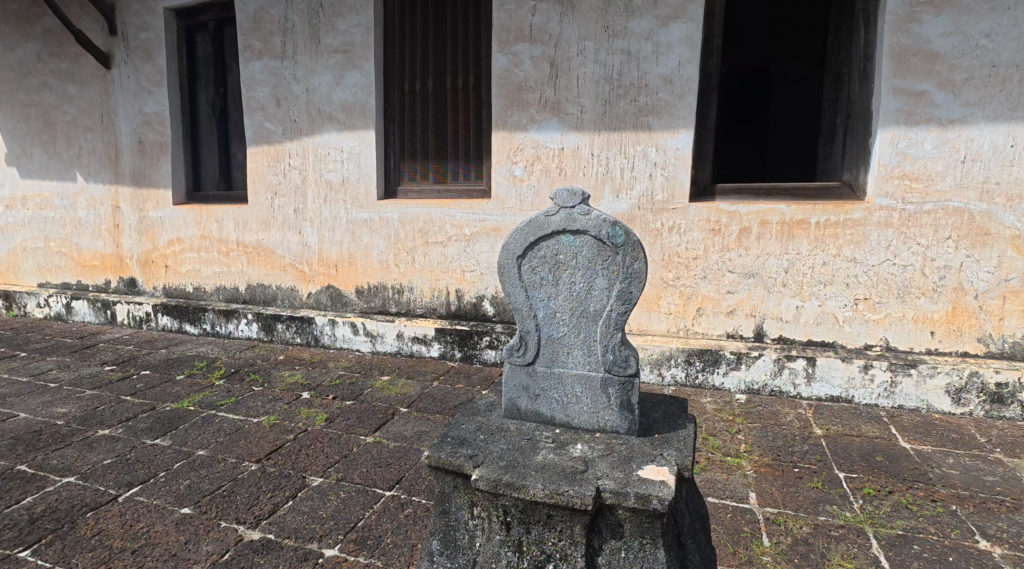
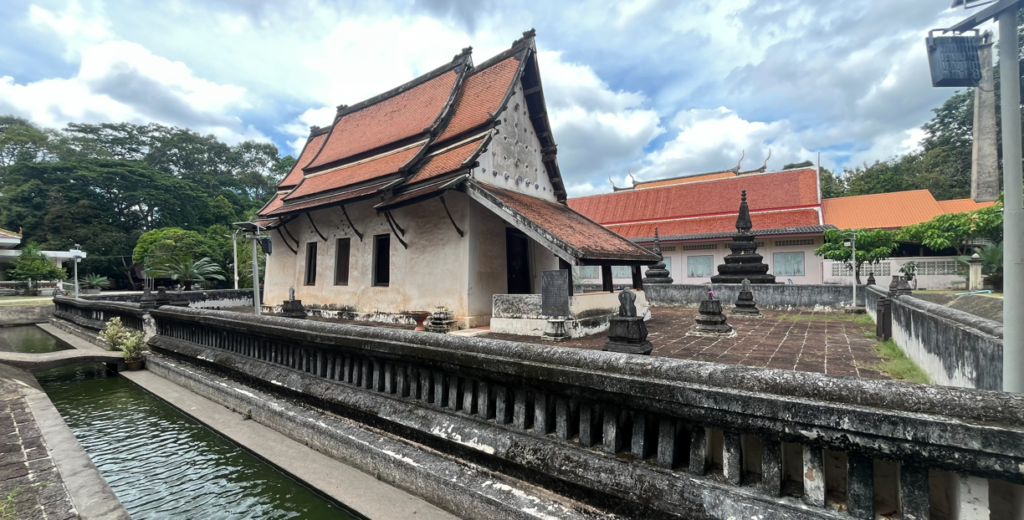
Bai sema boundary stones, the surrounding water channel, and views along the enclosure of the old ubosot.
An Old Prang with an Uncertain Beginning
Beside the ubosot stands a prang, a tower in the Khmer architectural tradition. Its stepped base and tall, tapering upper section give it a different silhouette from the hall beside it. I followed its shape upward, from the weathered base to the narrow summit.
The temple’s information board is clear about one uncertainty: there is no definite evidence establishing whether the prang was built before or after the temple’s foundation. Its appearance alone cannot provide an exact construction date.
According to the same board, the tower measures approximately 17.08 metres from its base to its summit ornament, with a square base measuring 5.20 metres on each side. It also records restoration in 2011, including repairs to the tower, reinforcement of its base, and laterite paving around it.
Seen alongside the old ubosot, the prang became one of the most striking views of my visit. Darkened surfaces and surviving decorative details gave me reasons to pause at its base before looking up once more.
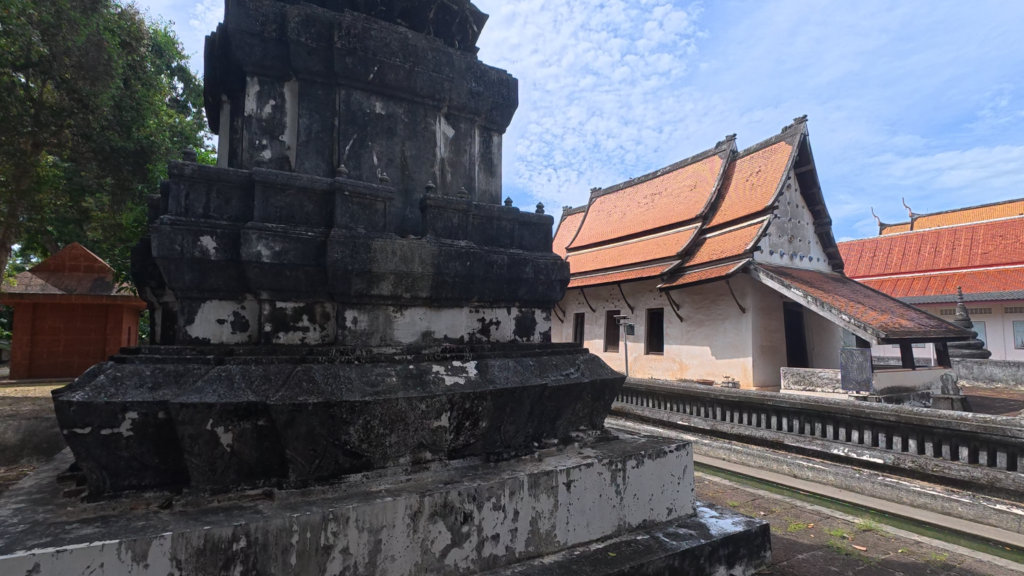
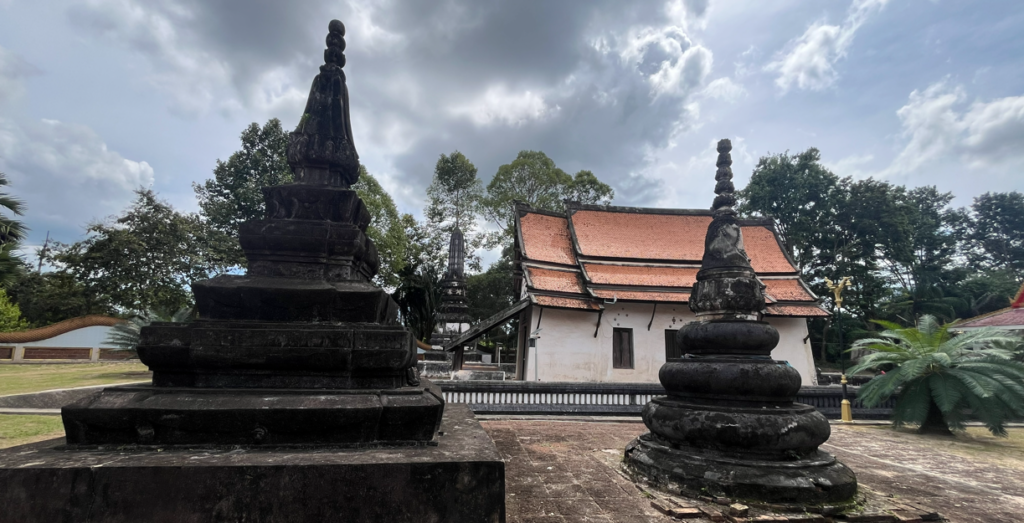
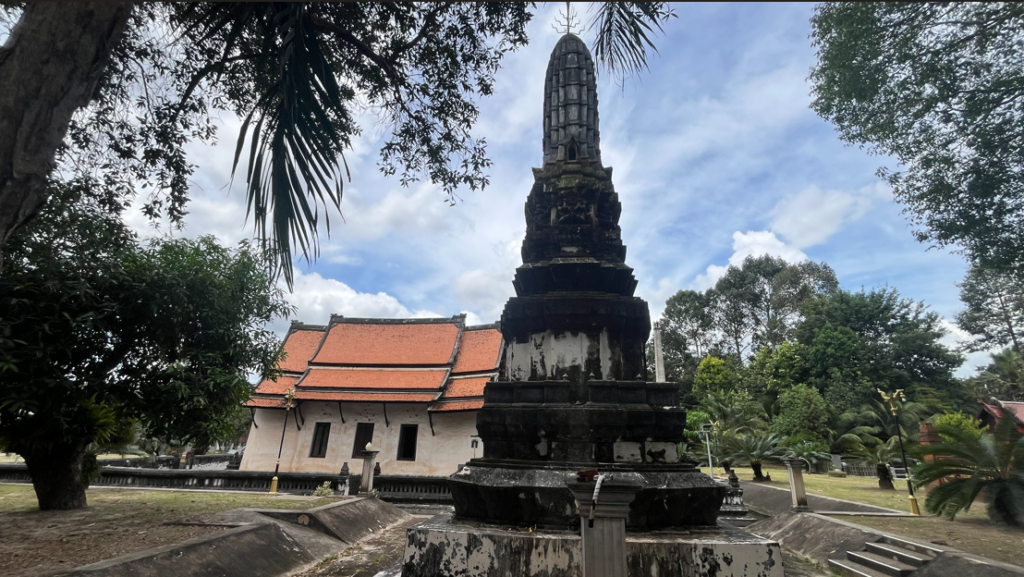
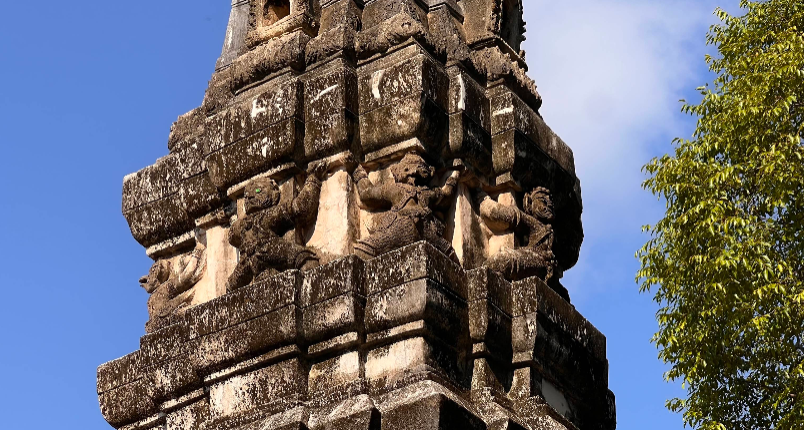
The prang beside the old ubosot at Wat Ban Laeng. The temple’s sign records its dimensions and restoration in 2011, while acknowledging that its construction date remains uncertain.
Inside the Old Ubosot
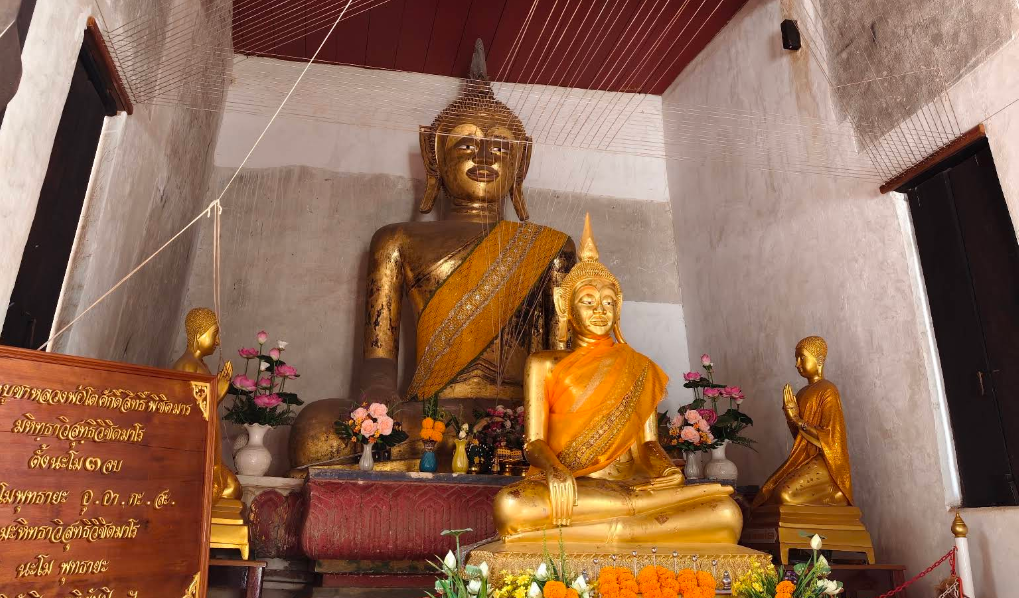
After walking around the exterior, I stepped through the entrance of the old ubosot. Beyond the doorway, the narrow hall led toward a group of Buddha images at the far end. Light entering through the windows revealed pale walls, wooden roof beams, and the space beneath the tiled roof.
The interior brought the building into a more personal scale. Outside, I had been looking at rooflines, boundary stones, and the nearby tower. Inside, my attention settled on the Buddha images and the offerings arranged before them.
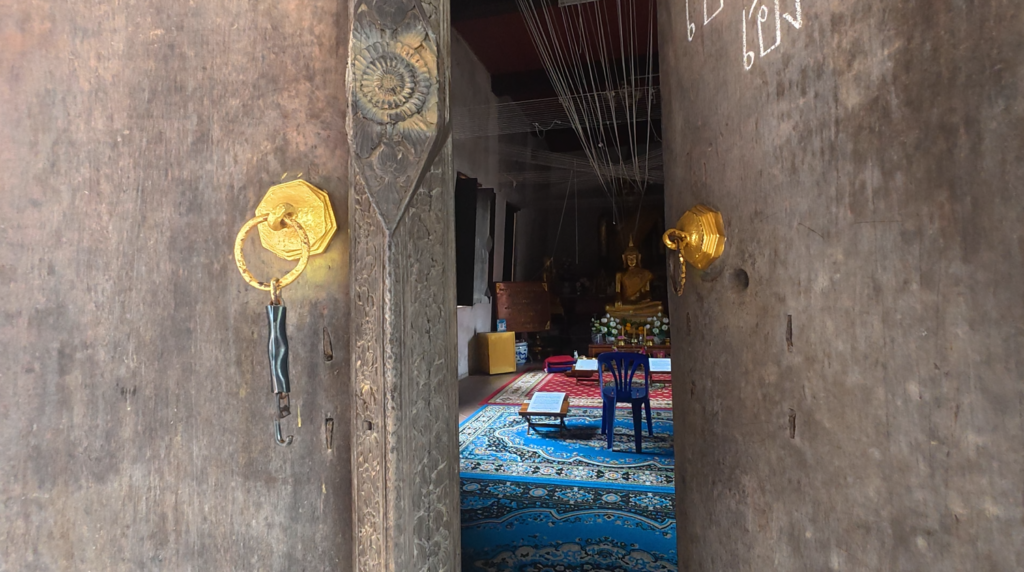
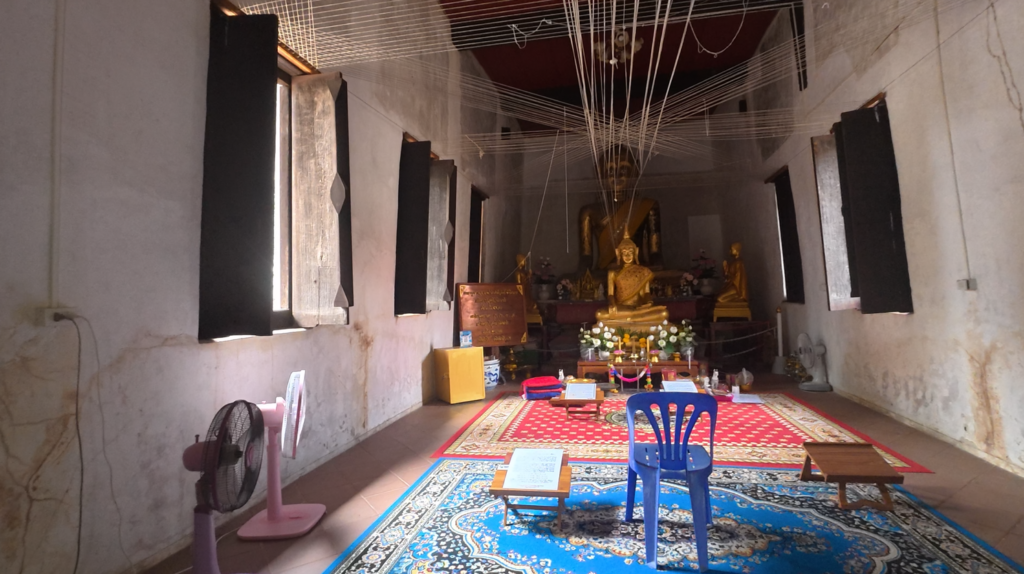
Approaching the entrance and looking into the old ubosot, where Buddha images stand at the far end of the narrow hall.
I moved closer to look at the principal image and the smaller figures surrounding it. The gold surfaces stood out against the subdued walls, while flowers and objects on the altar showed how the space continued to be cared for.
Before leaving, I looked toward the windows and up into the roof structure. These quieter details completed my impression of the hall: a historic building that remained a place of devotion.
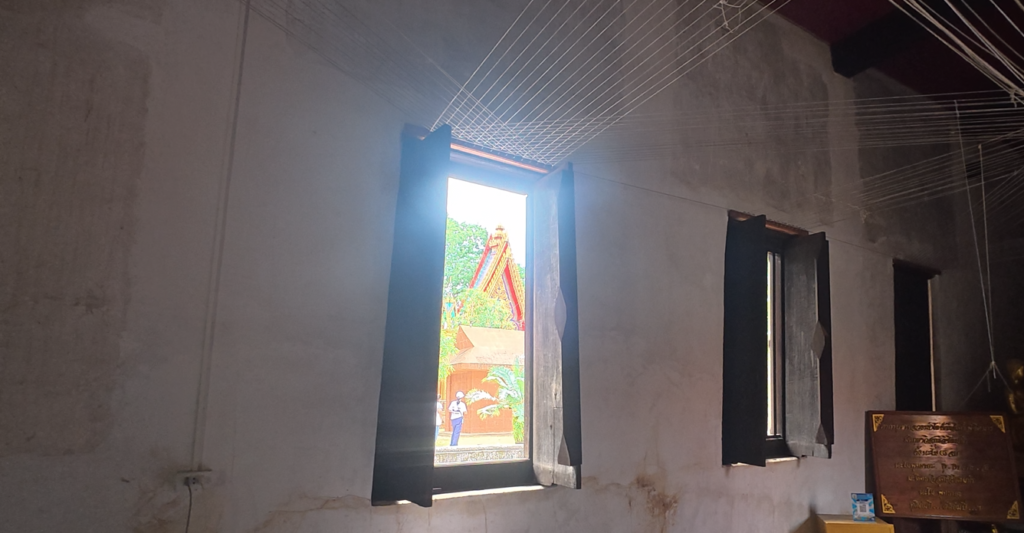
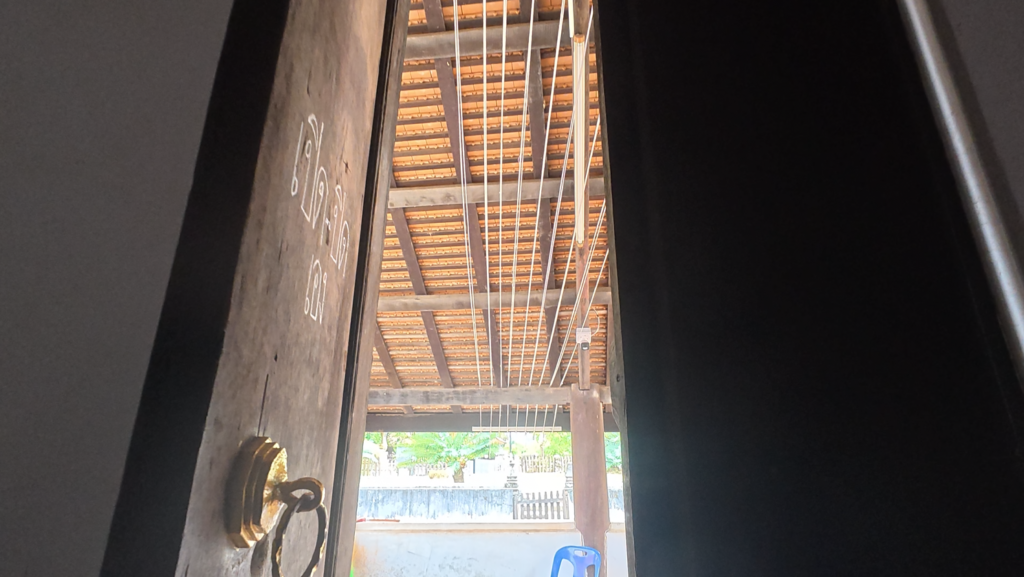
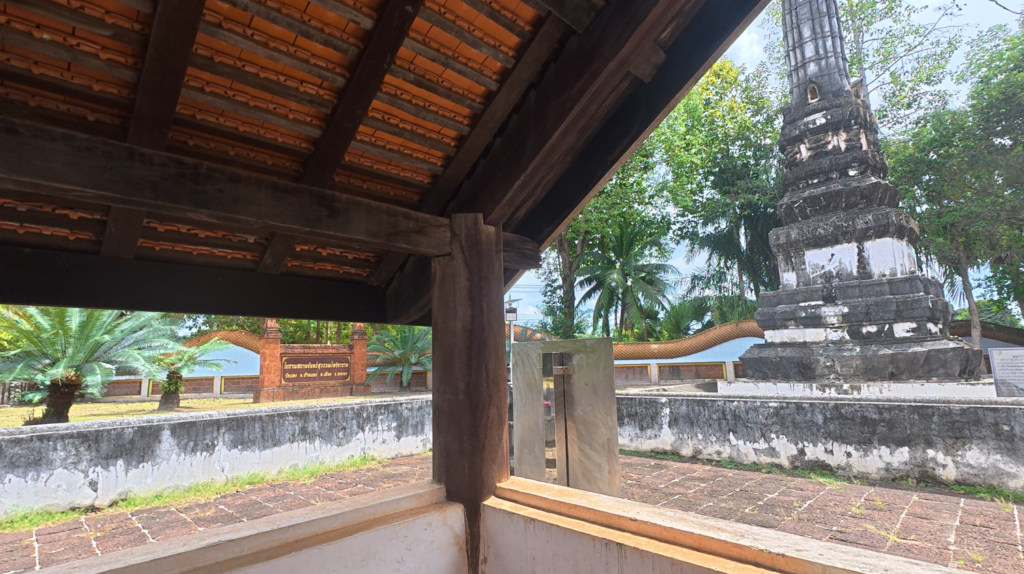
Light, roof timbers, and the sheltered entrance reveal details of the old ubosot’s construction.
The principal Buddha displays the earth-touching gesture associated with victory over Mara. The provincial description notes local craftsmanship in its facial features.
The Ho Trai: A Library Built over Water
The ho trai was one of the main reasons I had come to Wat Ban Laeng. This small wooden building stands over a pond, apart from the larger temple halls. Its purpose was to shelter Buddhist scriptures—the written teachings that generations of monks studied and preserved.
Water helped protect the manuscripts from ants and termites. The provincial account says monks formerly reached the library by boat, before a connecting walkway was added.
The name ho trai refers to a library for the Tipitaka, or “Three Baskets.” These are the three main divisions of the Buddhist canon: monastic discipline, discourses, and systematic teachings known as the Abhidhamma. The name describes the building’s purpose; it does not establish which texts survive there today.
According to the temple’s information board, this ho trai was built between 1857 and 1862. The Thai-style building measures approximately 4.50 by 6 metres. The board also records repairs in 1983, including replacement roof tiles and work on the decorative roof elements.
Standing before it, I thought back to the palm-leaf manuscripts I had seen earlier at Wat Taphong Nai. The library gave those objects an architectural setting: a building created specifically to keep written teachings safe.
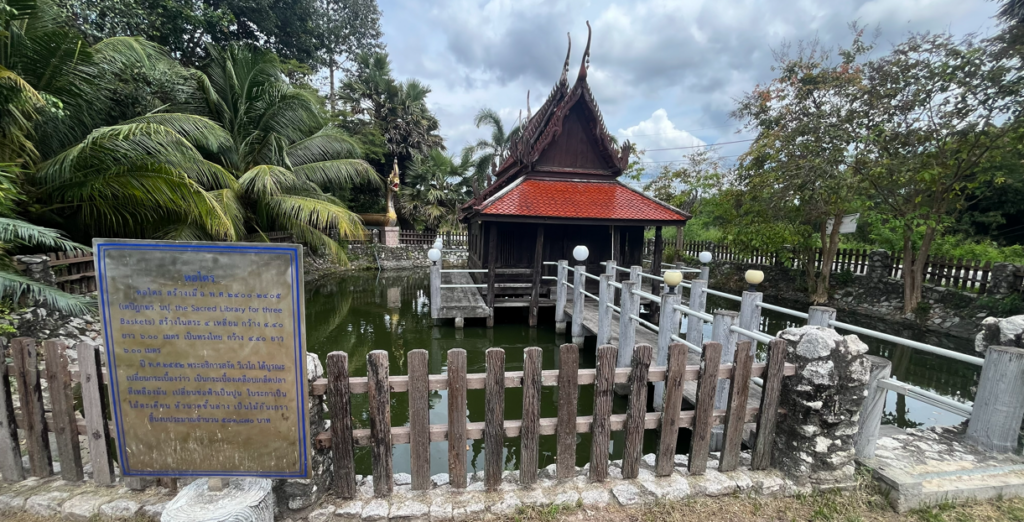
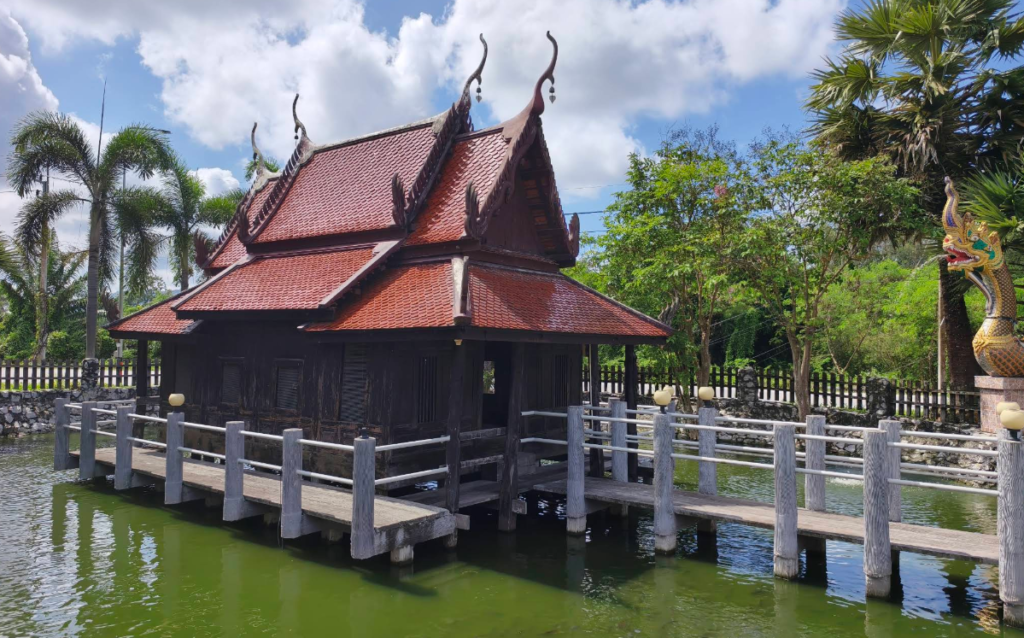
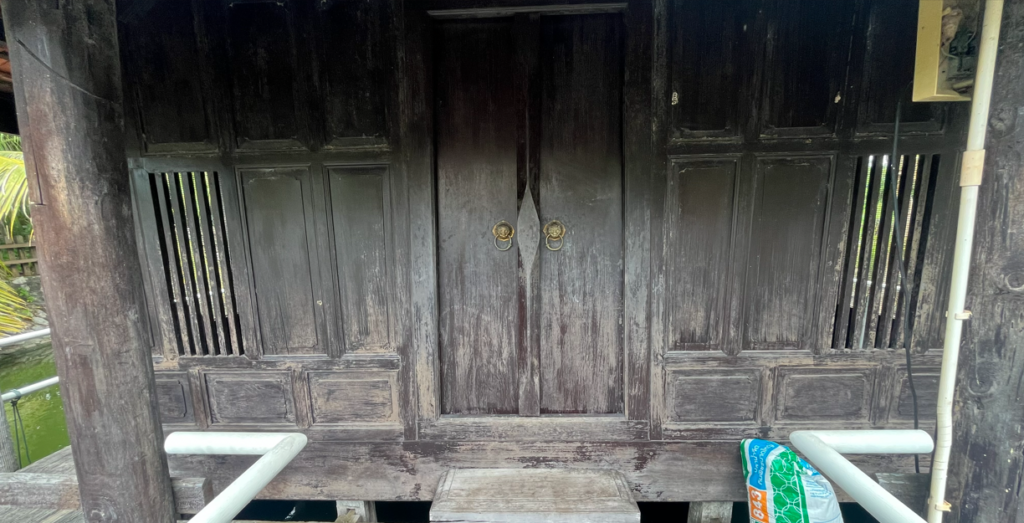
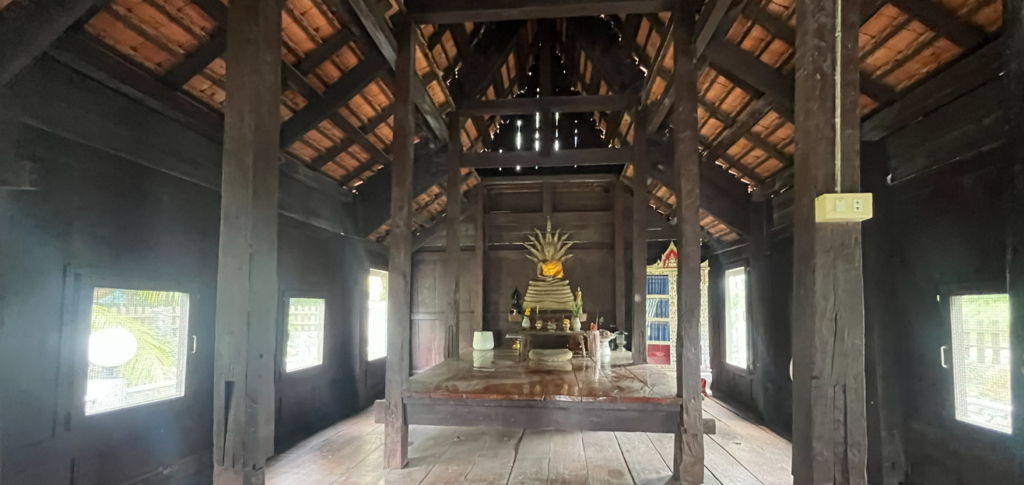
The wooden doors and interior of the historic scripture library at Wat Ban Laeng.
When the Monks Opened the Manuscripts
The visit became something more than an exploration of old buildings when the monks showed me the manuscripts. In a separate room with glass-fronted cabinets, they brought out bundles and carefully opened them so I could see the leaves inside.
I sat on the floor beside them, watching as the long, narrow leaves were revealed. Earlier that day at Wat Taphong Nai, I had already been fortunate enough to encounter palm-leaf manuscripts. To see more at Wat Ban Laeng, with monks taking time to explain and show them, felt like an unexpected continuation of that experience.
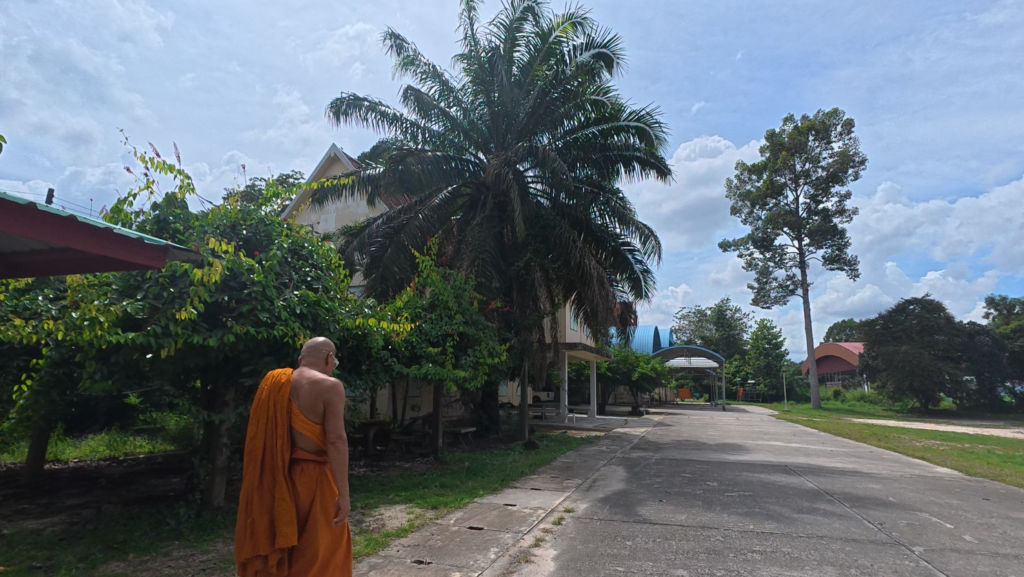
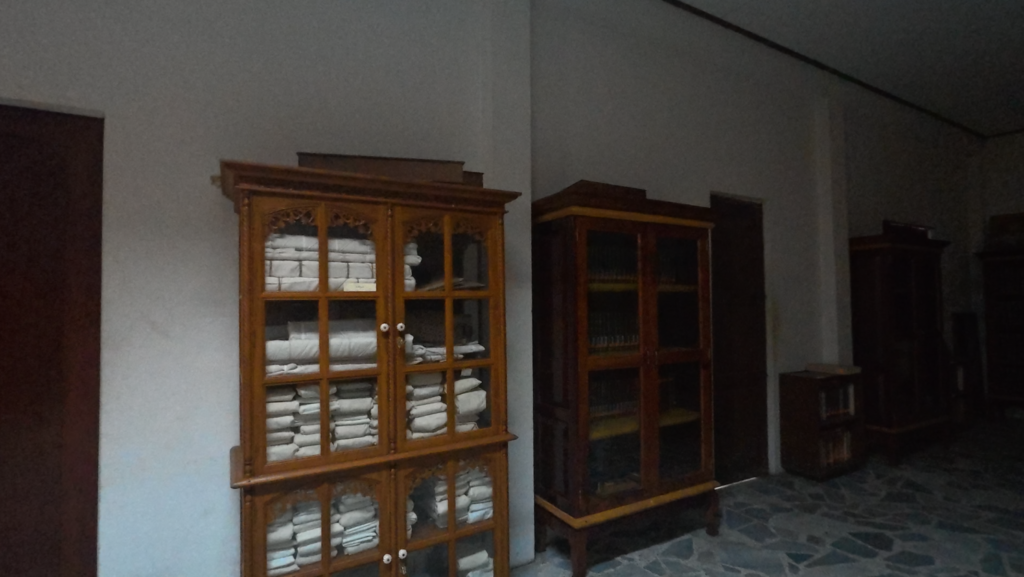
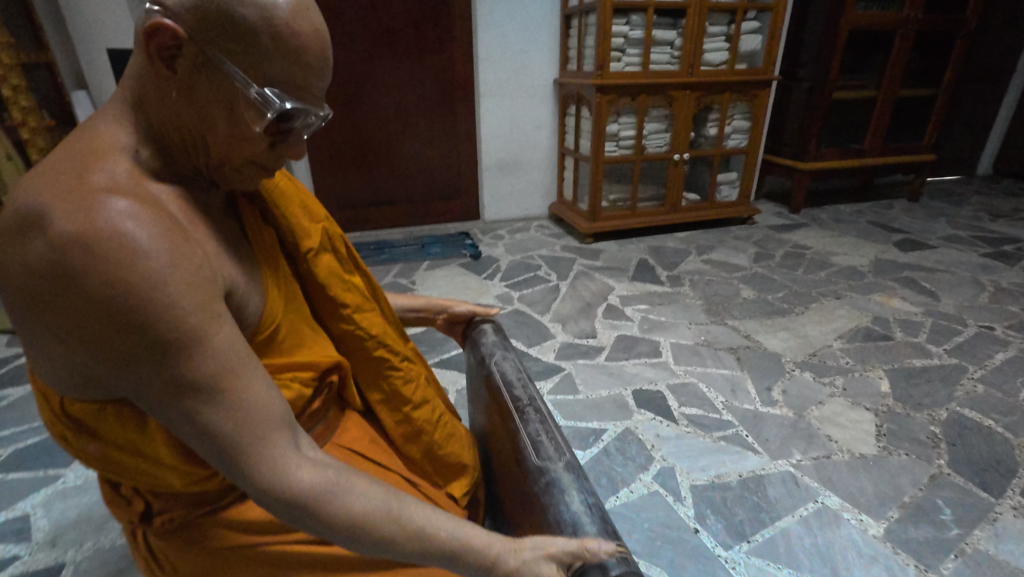
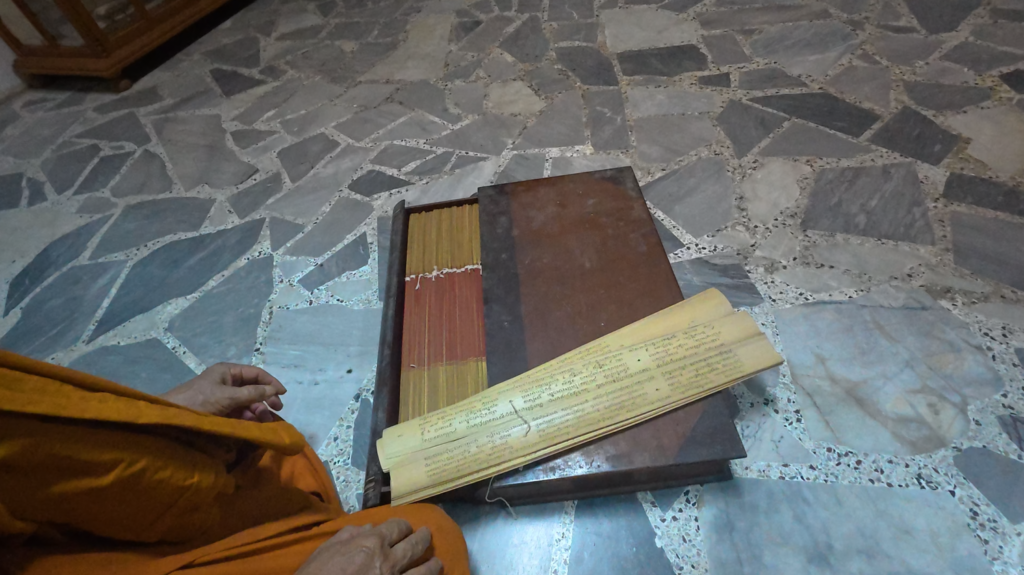
Meeting the monks and being shown manuscript bundles kept in a room with glass-fronted cabinets.
The Cloths That Wrapped the Scriptures
Then the monks brought out the cloths used to wrap the manuscripts. Spread across the floor, they revealed a variety of colours and patterns: flowers, stripes, gold-coloured decoration, and a red cloth bearing Buddhist imagery.
Some had frayed edges and worn patches. Their folds and surfaces invited a closer look, just as the lettering on the leaves had done. The wrappers added another part to the story of the manuscripts—the materials used to enclose them and keep the bundles together.
One red cloth particularly caught my attention. Celestial figures with joined palms appeared on either side of a central narrative scene. I could not confidently identify the episode from the image alone, but its detailed decoration made the wrapper memorable in its own right.
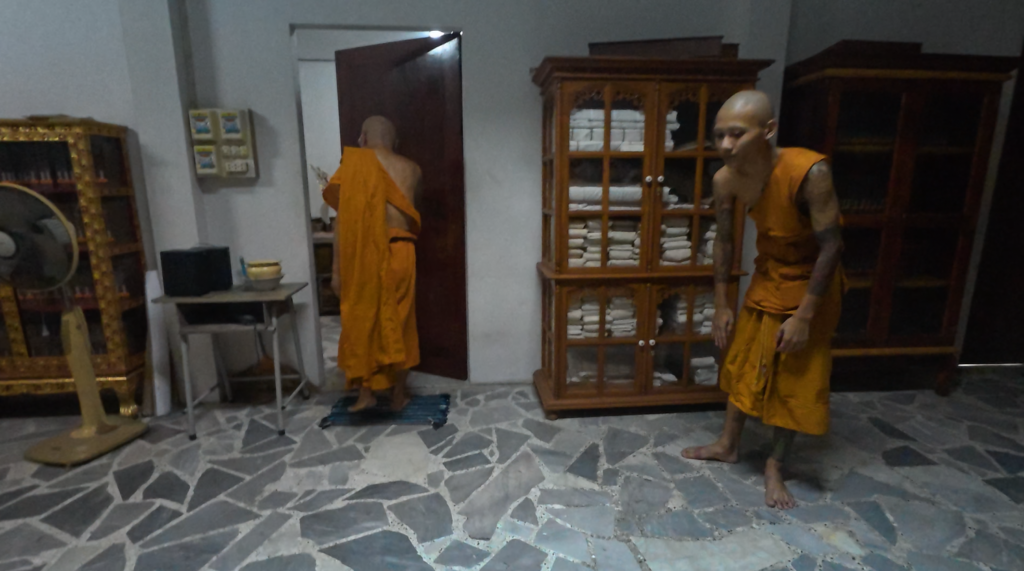
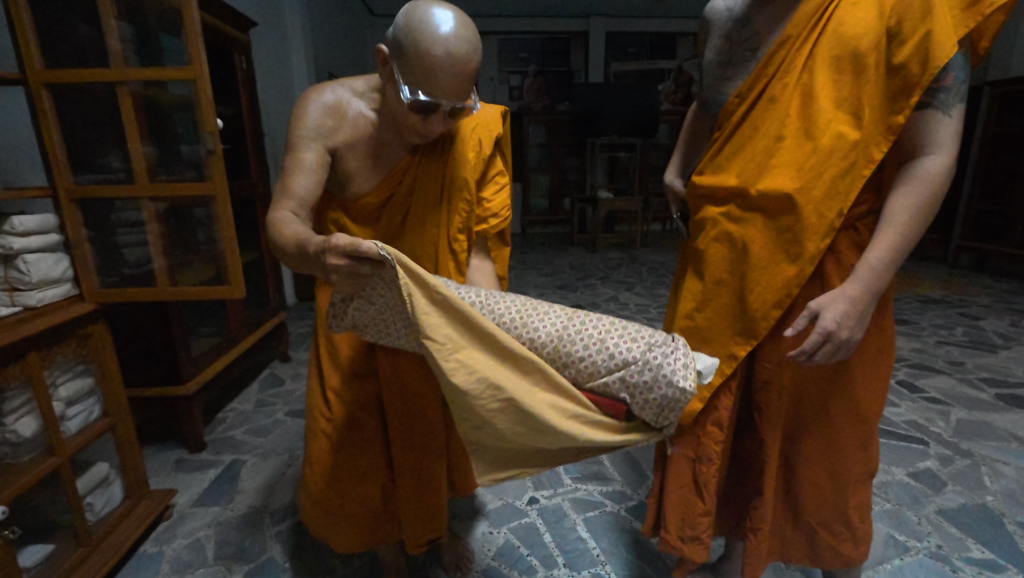
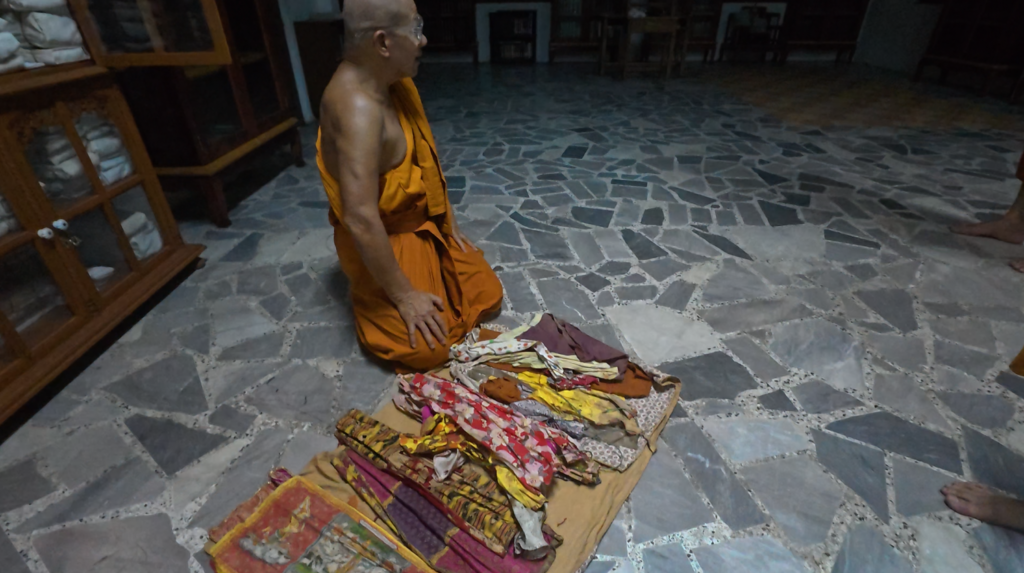
The monks brought out manuscript wrapping cloths and unfolded them for a closer look.
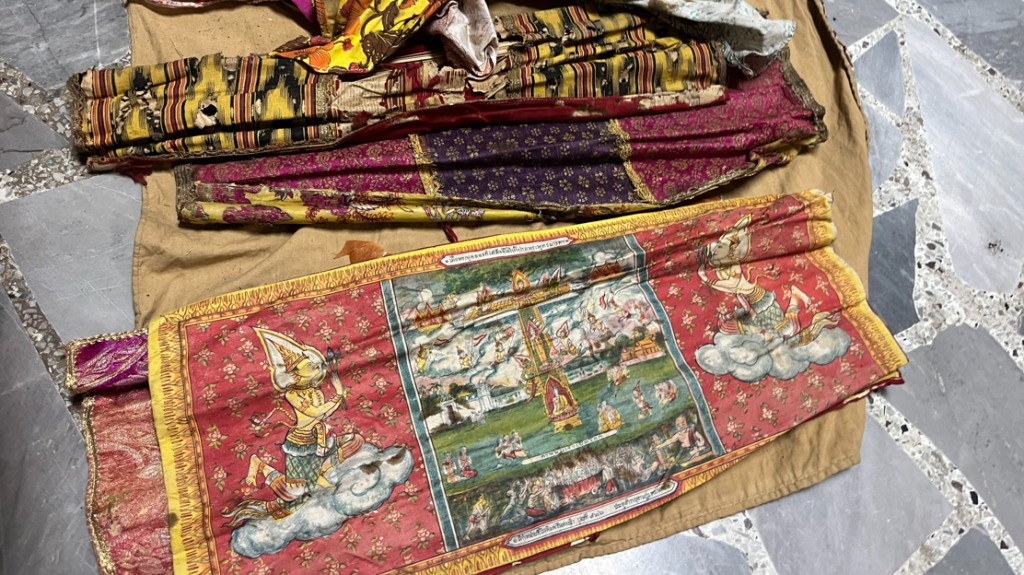
Beside the textiles, a cloth-covered bundle tied with cords showed how the manuscripts could be gathered for storage. Looking again at the exposed leaves, I noticed the contrast between their fine lettering and the simple cords passing through them.
The age of a manuscript, its wrapper, and its storage container need not be the same. Without a clear date or a readable record, I would not assign them a single age. What I could record was the collection before me: inscribed leaves, protective cloths, and the monks who took time to show them.
At that moment, I felt I had seen a treasure.
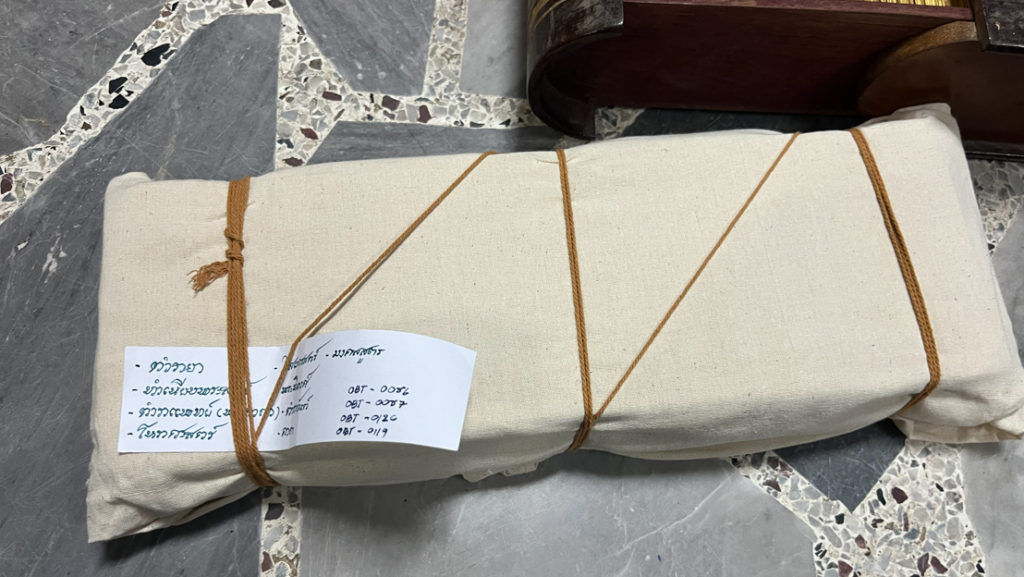
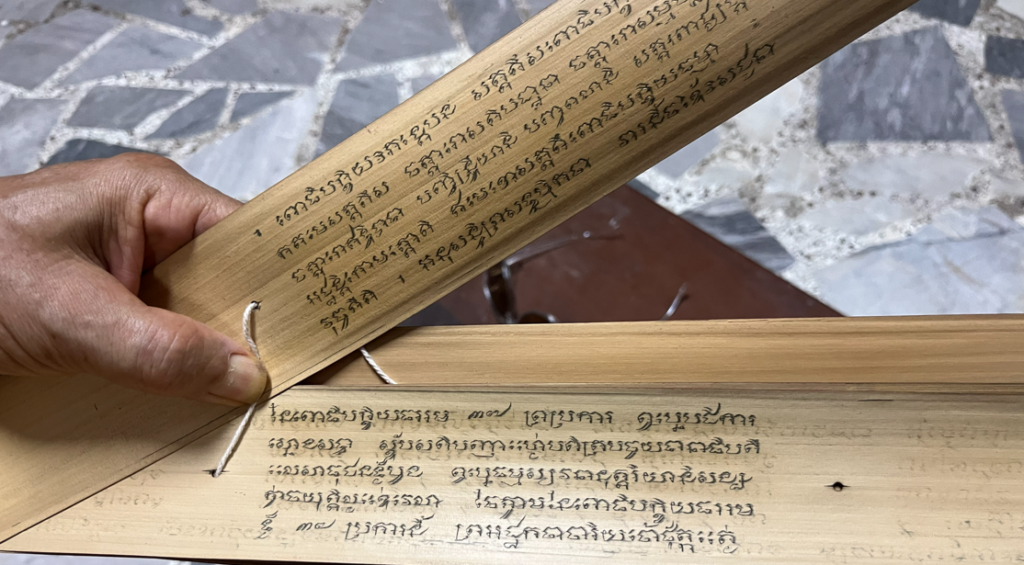
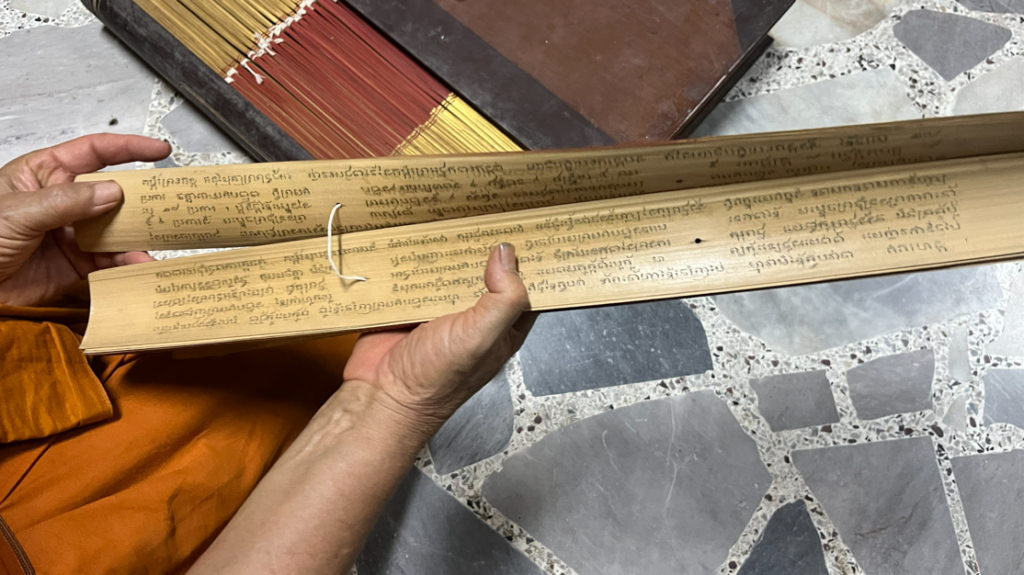
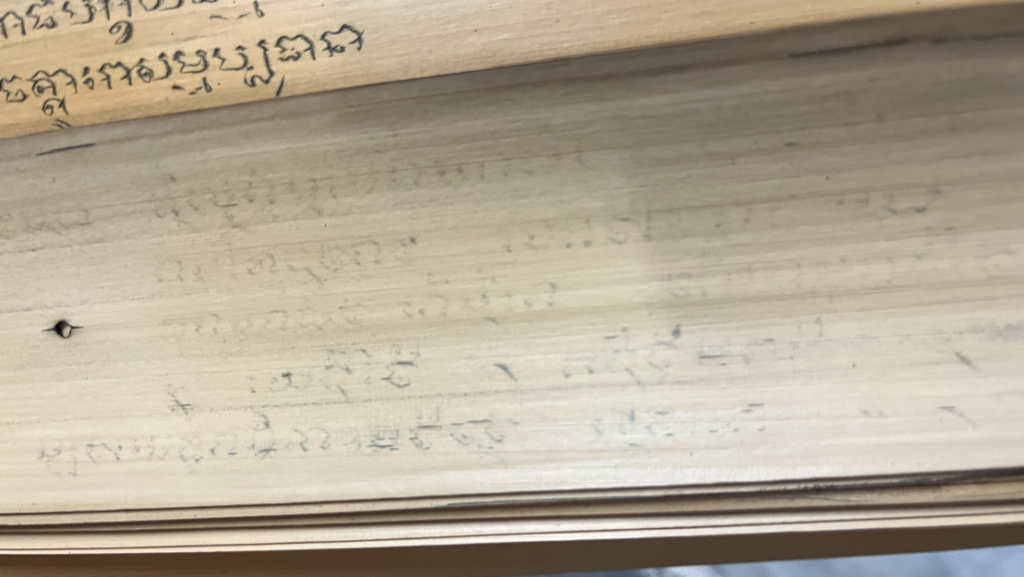
From a wrapped manuscript bundle to individual inscribed leaves: details of the materials used to preserve and organise the texts.
Leaving Wat Ban Laeng with More Than Photographs
Before leaving, I watched the monk examine the manuscript once more. Around us were cabinets, bundles, and the ordinary furnishings of a temple room. It was a quiet setting for an encounter that had become the highlight of my day.
I had come to Wat Ban Laeng to explore its old ubosot, prang, and scripture library. Through the monks’ generosity, I also saw the leaves on which teachings were recorded and the cloths used to wrap them.
The earlier stop at Wat Taphong Nai and this visit belonged together in my memory. Both brought me closer to a tradition I had previously known mainly through descriptions. Riding away, I carried photographs and footage, but also gratitude for the people who had taken time to show me what they kept.
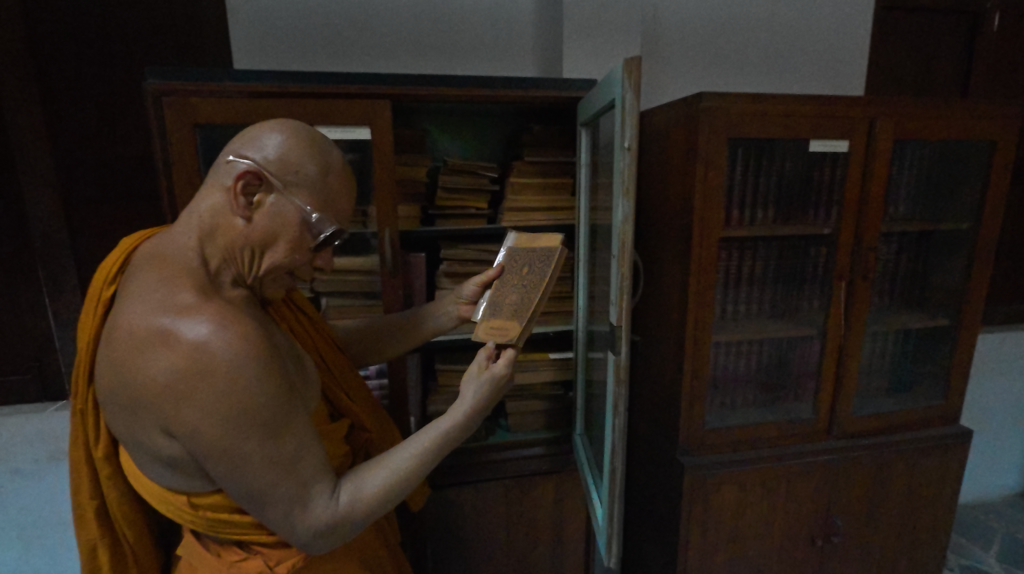
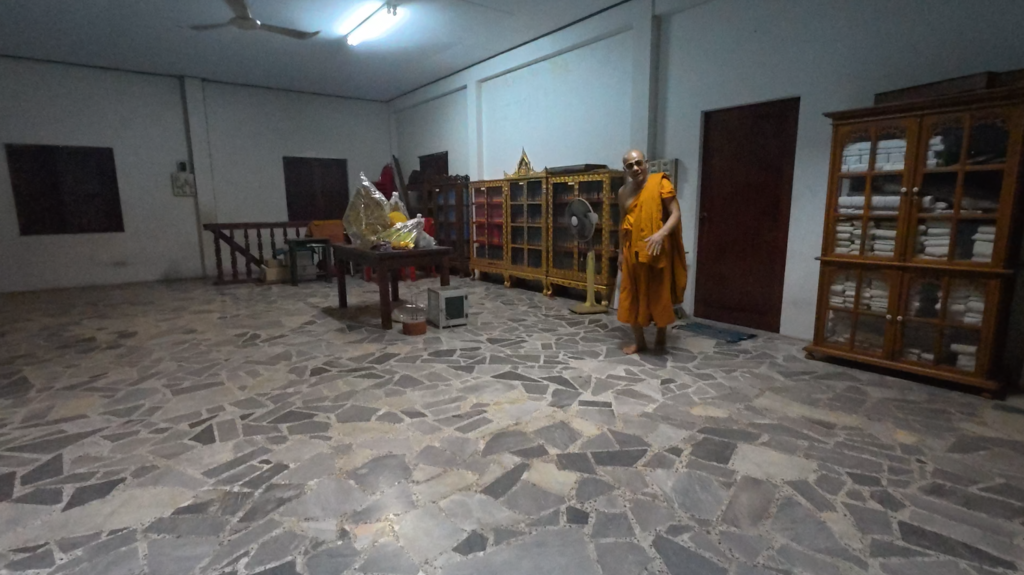
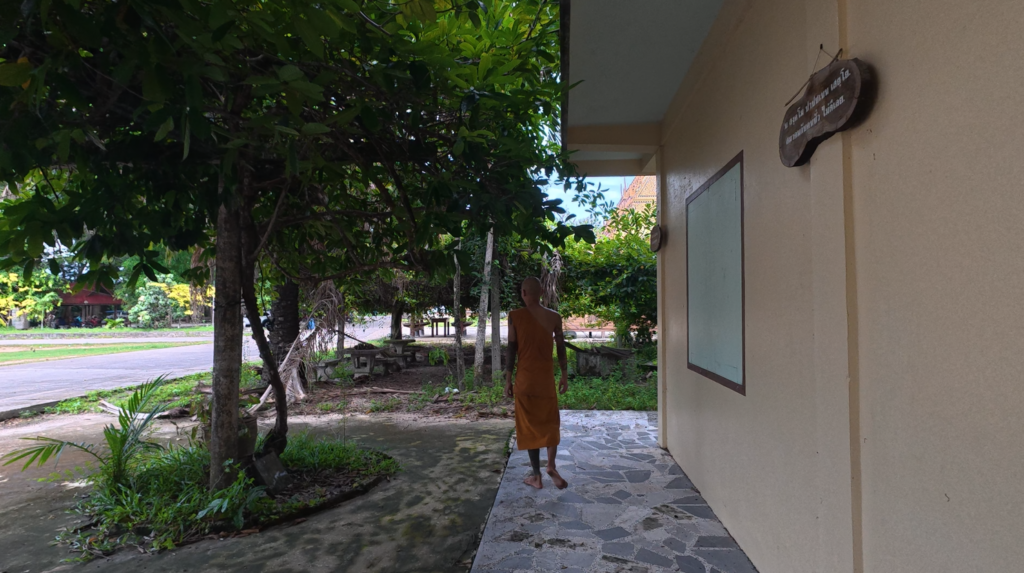
A final look at the manuscripts and the room where the monks shared them with me, before returning outside.
Watch the Visit to Wat Ban Laeng
Join me at Wat Ban Laeng in Rayong, from the old ubosot and prang to the historic scripture library, followed by an opportunity to see palm-leaf manuscripts and their wrapping cloths with the monks.
A visit to Wat Ban Laeng: historic temple buildings, palm-leaf manuscripts, and the monks who shared them.
Visitor Information
- Location: Wat Ban Laeng (วัดบ้านแลง), Ban Laeng Subdistrict, Mueang Rayong District, Rayong 21000, Thailand.
- Admission: Check with the temple for any fees or access arrangements.
- Opening hours: Confirm locally, especially if you wish to enter the historic buildings.
- Best time: Visit in daylight to appreciate the buildings and their details.
- Dress: Wear modest clothing covering shoulders and knees.
- Footwear: Remove shoes before entering worship halls and wherever requested.
- Photography: Ask permission before photographing monks, opening cabinets, or handling manuscripts.
- Visit duration: Allow about one hour for the grounds, with additional time if an opportunity arises to speak with the monks.
The manuscript viewing described here was a personal encounter during my visit, rather than a scheduled public activity. Please ask the monks whether viewing is possible and respect their availability.
📍 Find Wat Ban Laeng on Google Maps
Continue the Journey
Earlier that day, I stopped at Wat Taphong Nai, where my first encounter with palm-leaf manuscripts made the visit to Wat Ban Laeng even more meaningful.
Read the earlier story: An Unexpected Encounter with Old Manuscripts at Wat Taphong Nai – Rayong, Thailand.