Arriving at Wat Phlu Yang


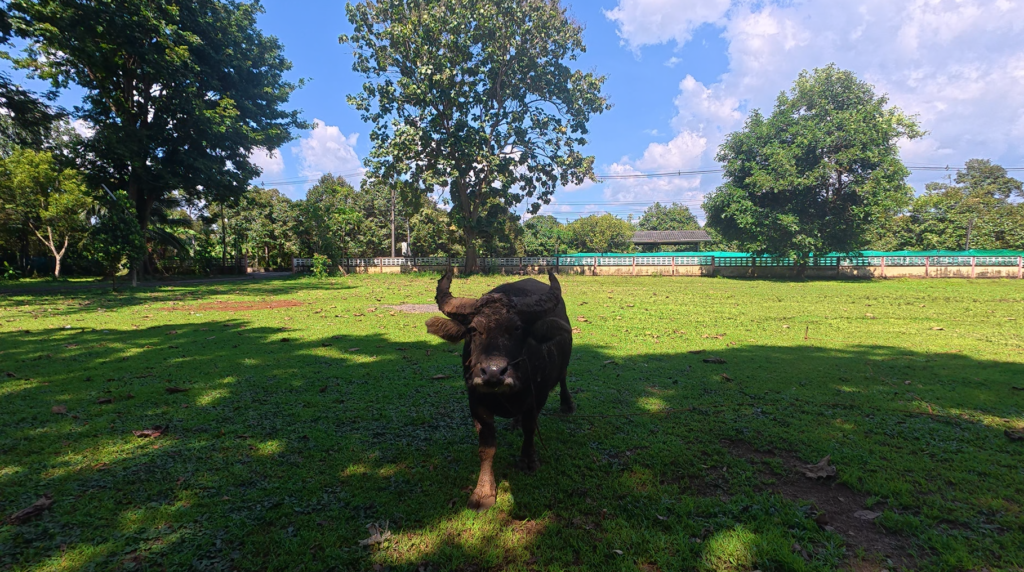
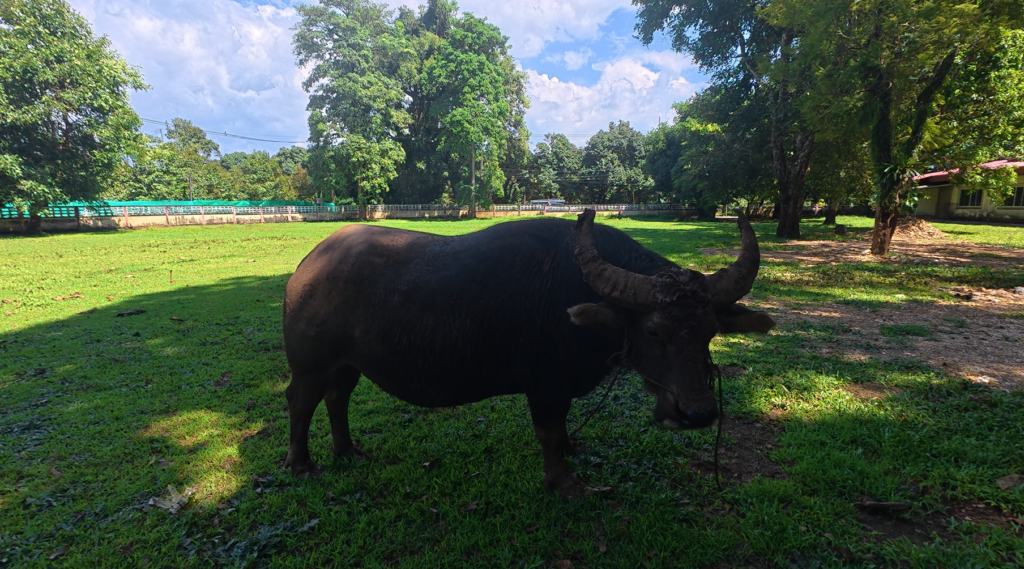

A quiet arrival, with buffalo grazing on the temple grounds.
Wat Phlu Yang in Chanthaburi began as a quiet temple visit. Beyond the entrance gate, open lawns and large trees created a relaxed setting, while buffalo grazed nearby.
Officially known as Wat Phutthakhayaram, the temple offered little indication at first of how much time I would spend examining its older buildings. I began with the newer ordination hall, taking my time before looking farther into the grounds.
A Walk Around the Newer Ubosot


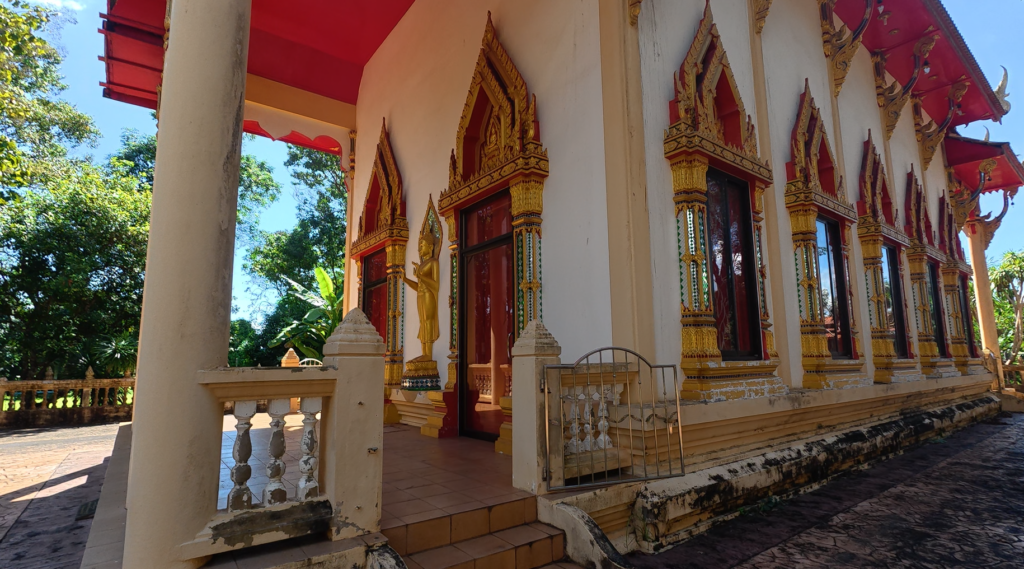
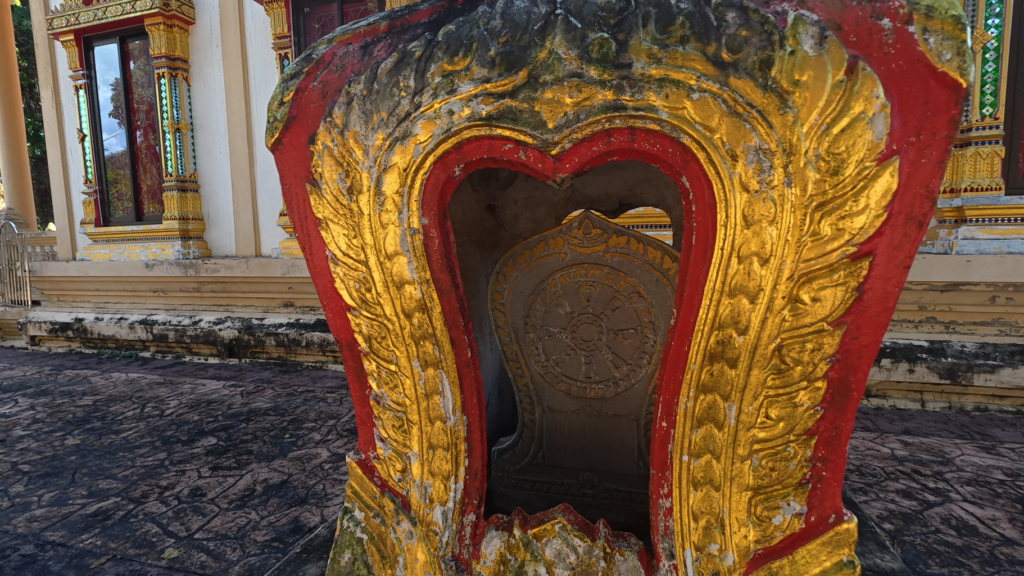
The newer ubosot, its decorated exterior, and a sheltered sema boundary stone.
The newer ubosot drew my attention with its colourful gable and relief decoration. Walking around the building, I stopped to examine the ornamental surfaces and the small structures sheltering its boundary stones.
These sema stones mark the sacred boundary associated with monastic ceremonies. Their presence also provided a useful introduction to what I would find later: another ordination hall, much quieter in appearance, with weathered boundary stones of its own.
At this stage, however, I had not yet reached the building that would become the heart of my visit.
The Old Ubosot I Almost Missed at Wat Phlu Yang
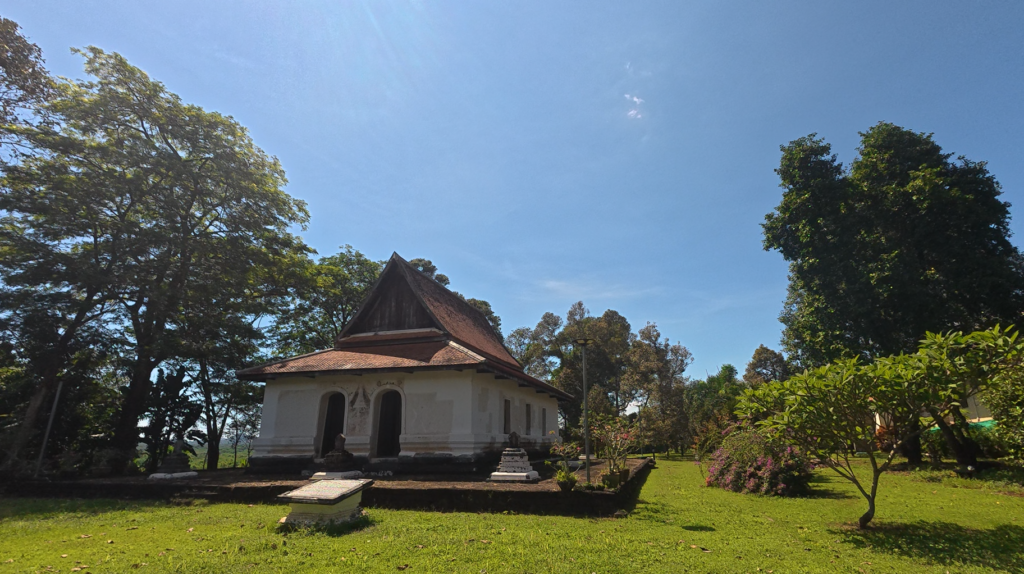
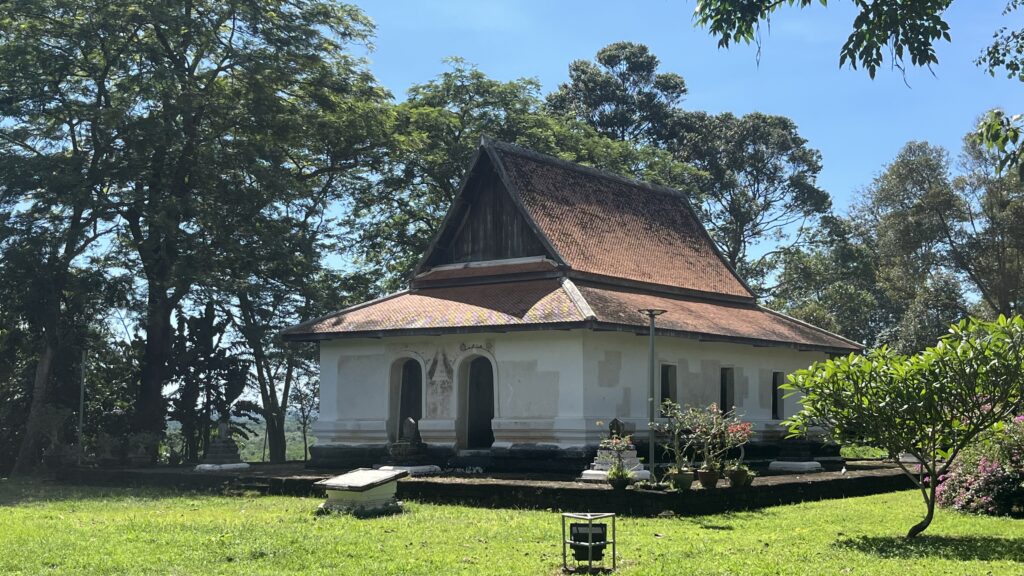

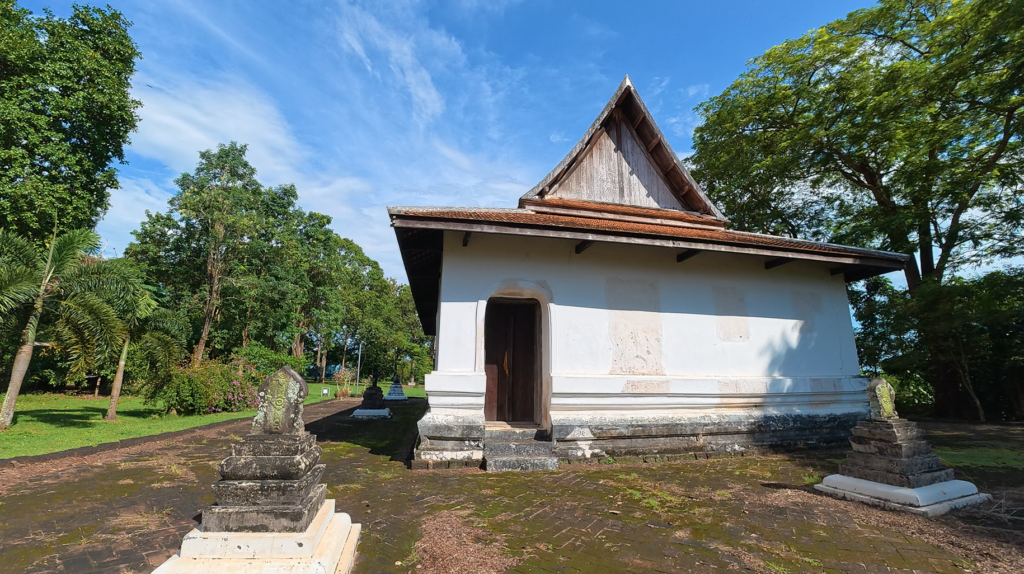
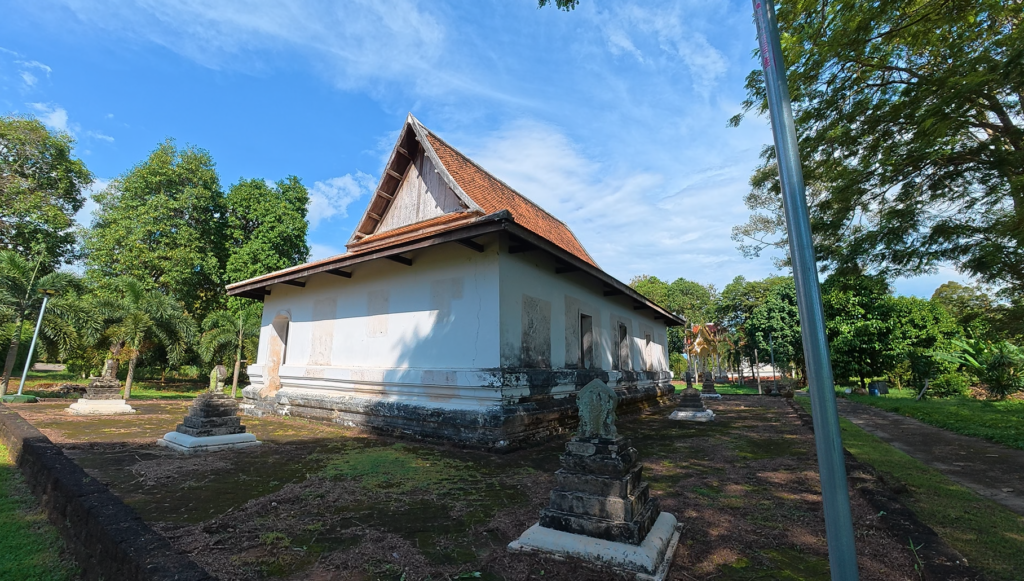
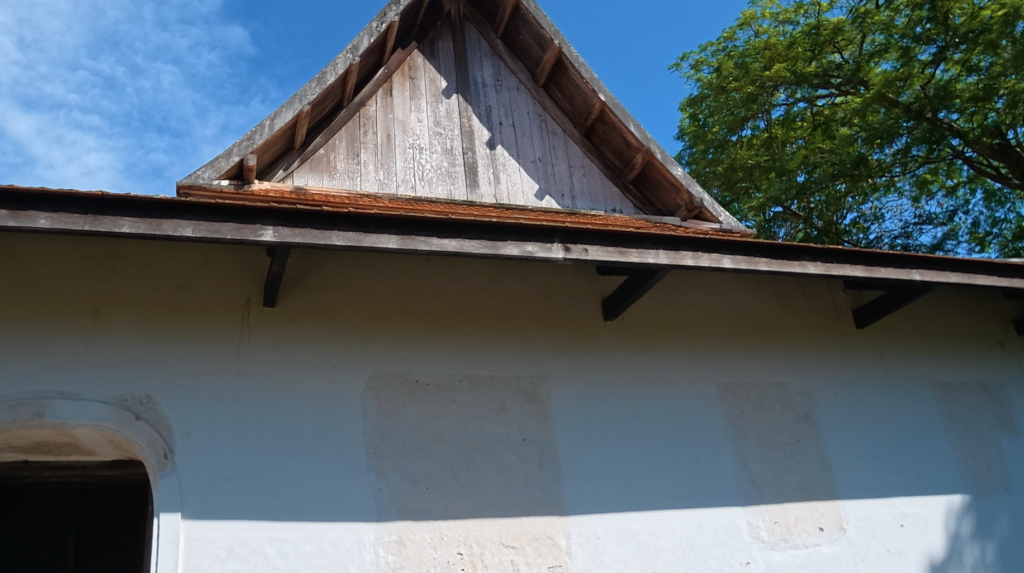

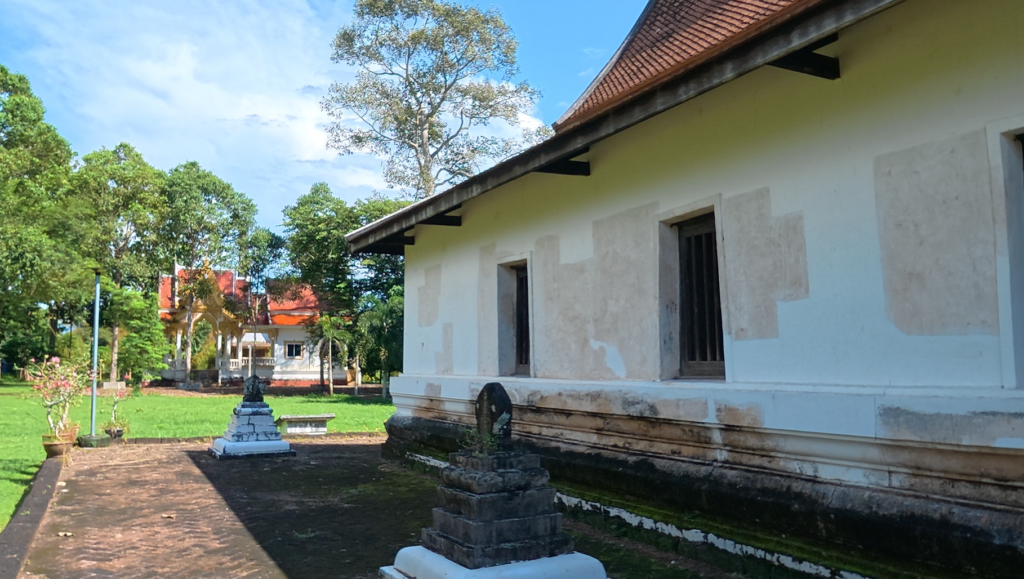
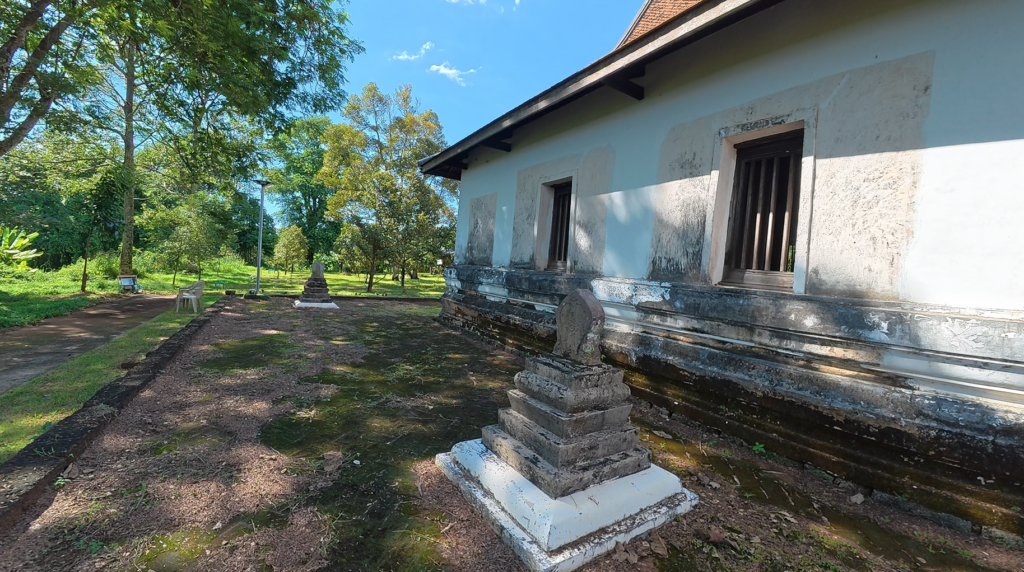
Walking around the old ordination hall and examining its restrained architecture.
I almost missed it.
Farther inside the grounds, the old ubosot stood among the trees. Its pale walls and subdued roof looked very different from the more colourful building I had just visited.
A friendly monk helped me explore, giving me the opportunity to look closely and spend time with the details. That welcome changed the visit completely.
The temple’s historical sign records its foundation in 1829, Buddhist Era 2372, during the reign of Rama III. This is the recorded foundation date of the temple; it does not establish that every surviving painting or image was made in the same year.
The building rewarded a slow walk. Its wooden gables, broad roof, modest openings, and worn base made its age tangible without requiring elaborate decoration.

Weathered Boundary Stones and a Painted Heavenly Chedi
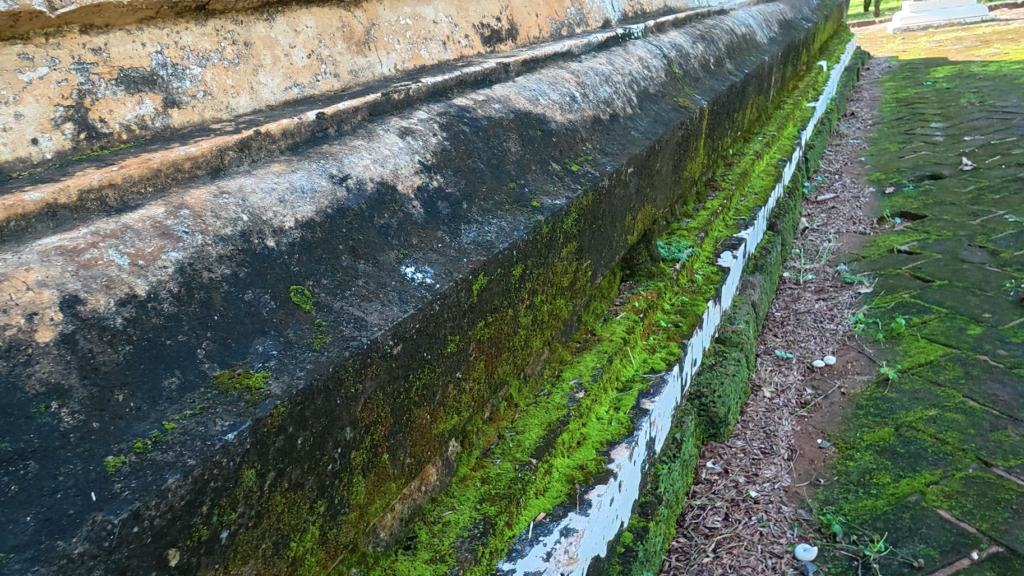
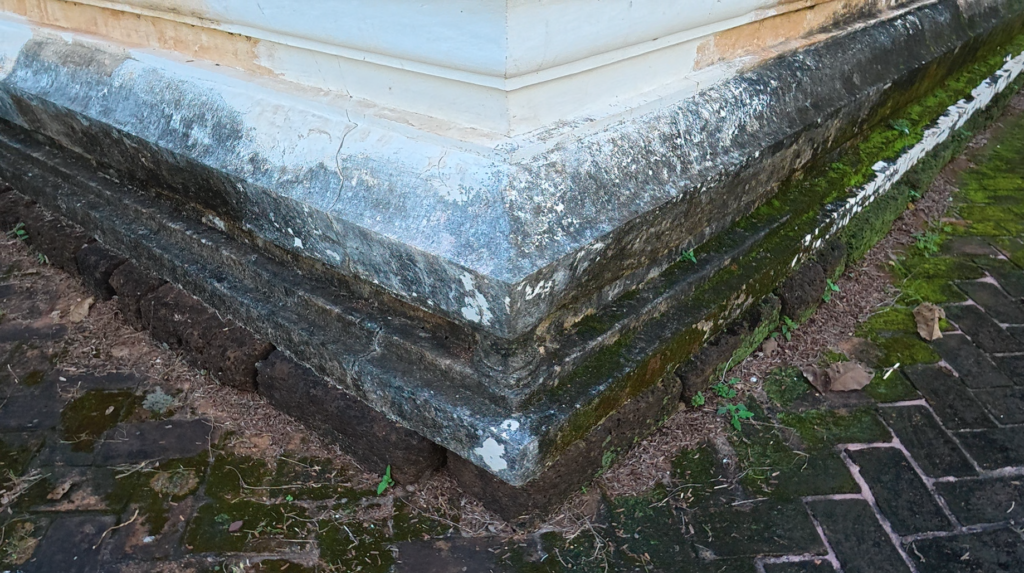
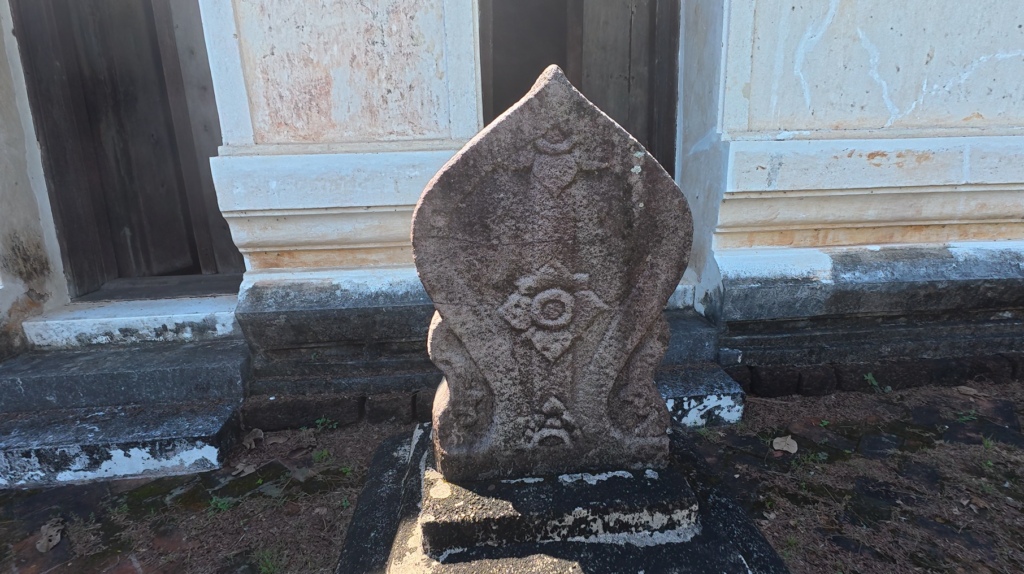

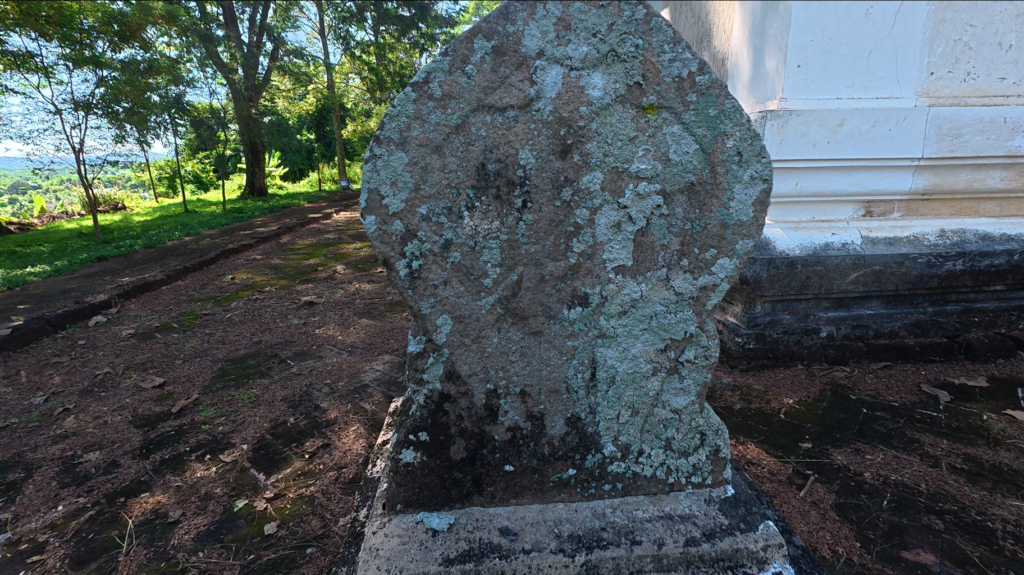
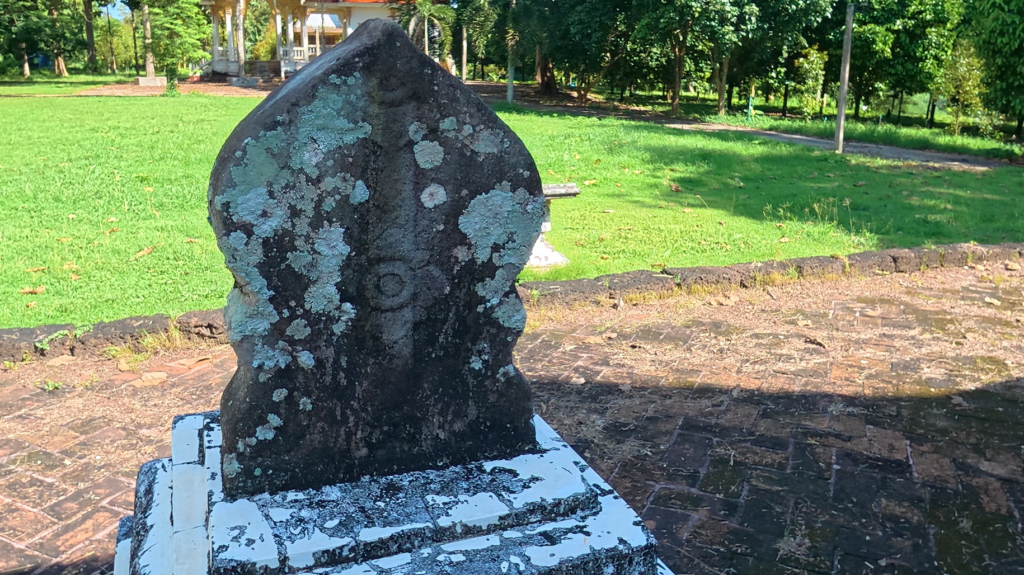
The worn building base and carved sema stones surrounding the old ubosot.
Around the hall, moss gathered along the base, while carved sema stones stood on small pedestals. Their weathered surfaces invited closer examination. Some details remained visible; others had softened with exposure.
They helped define the building as a ceremonial space, connecting its exterior to the religious life once conducted within its boundary.
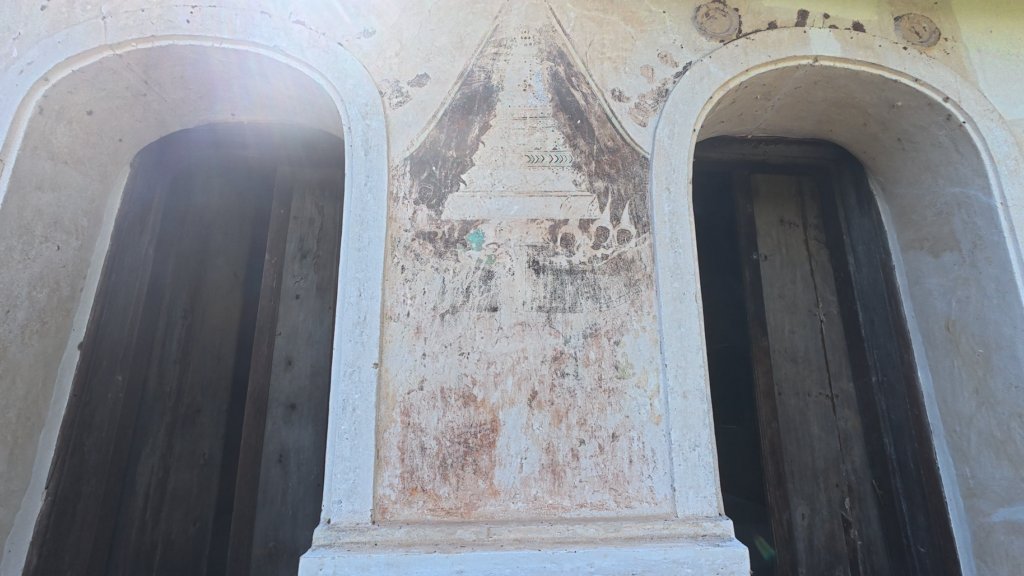
At the front, two arched doorways framed a fading mural of a chedi. Local historical teaching material identifies this as Chulamani Chedi. www.thaieducation.net
In Buddhist tradition, Chulamani is a heavenly shrine in Tavatimsa, associated with relics of the Buddha, including the hair cut at his renunciation. The painting therefore introduces a sacred landscape before the visitor enters the hall. finearts.go.th
Through the Doorway into a Darkened Hall
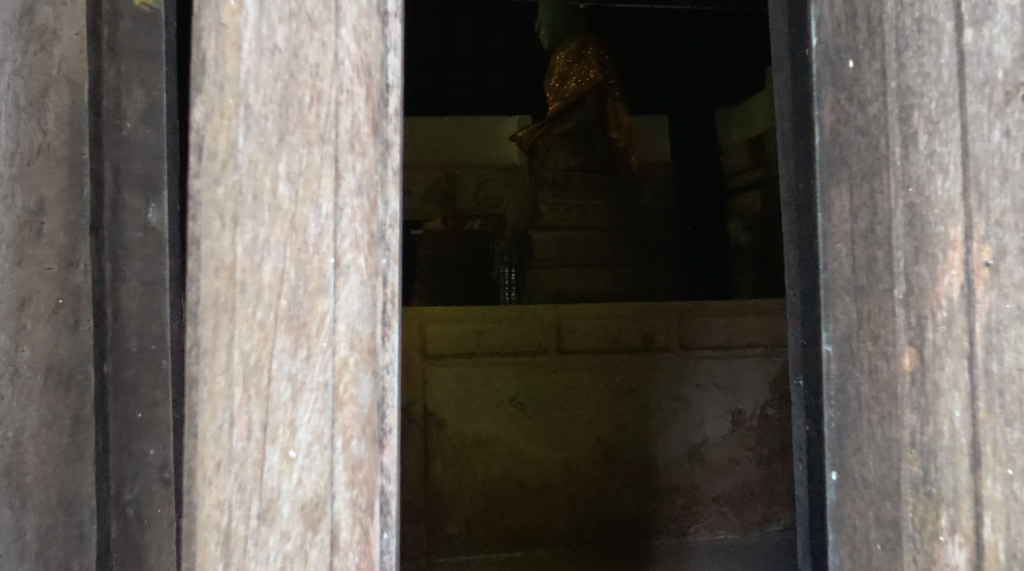
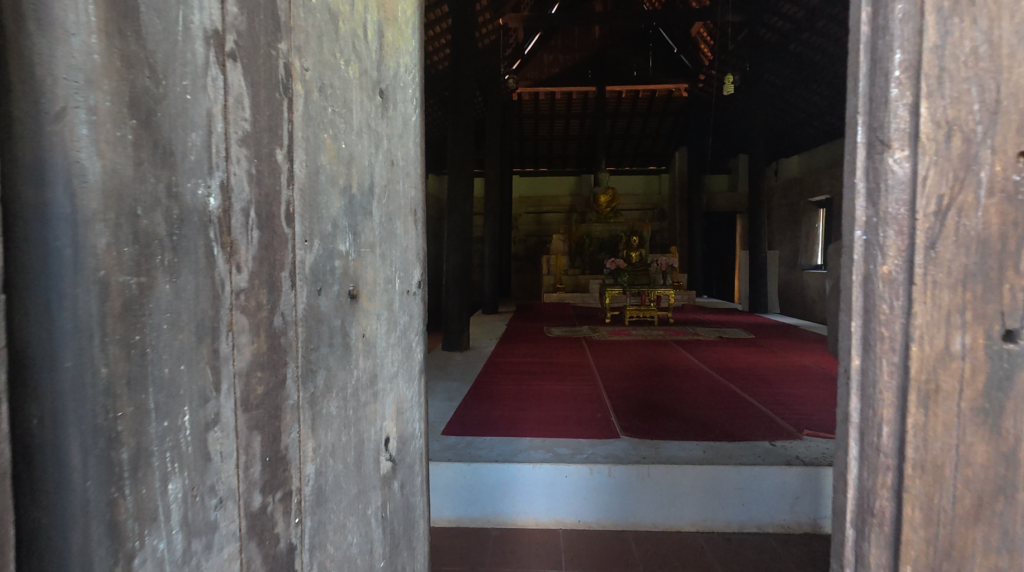
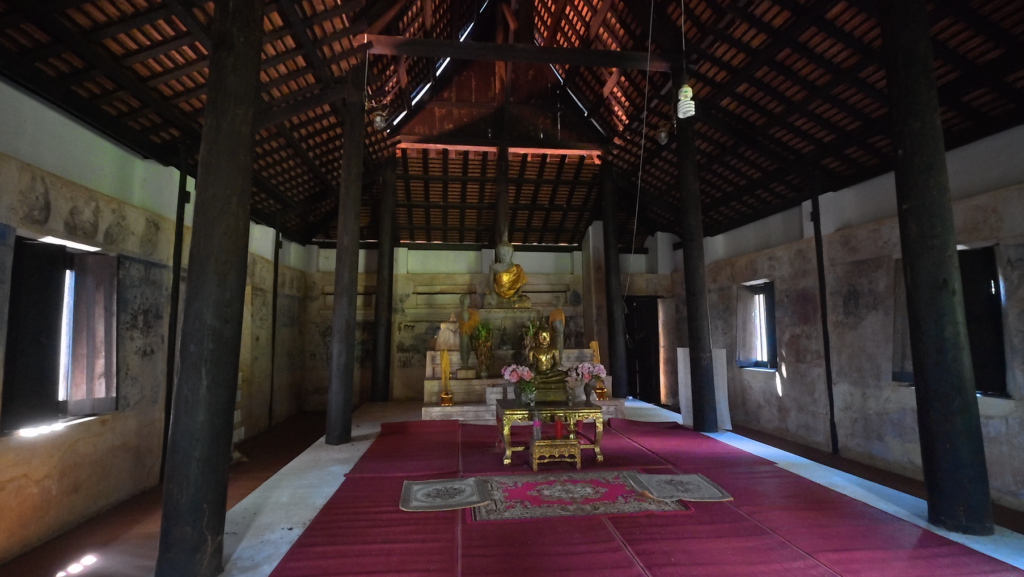

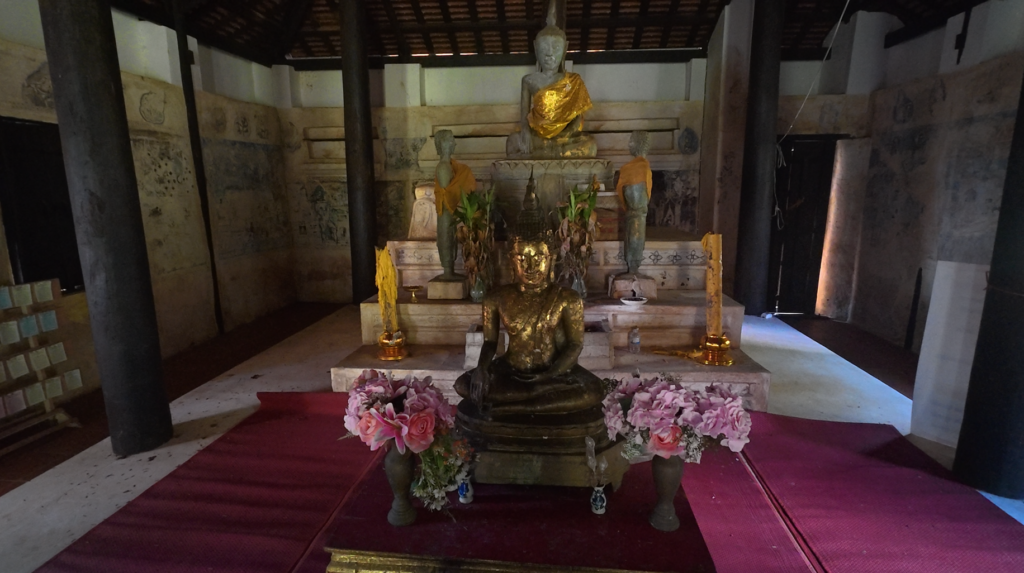
Entering the dim interior, where wooden pillars lead the eye toward the principal Buddha.
Through the doorway, the interior initially appeared dark. As my eyes adjusted, the Buddha image at the far end gradually emerged.
Tall wooden pillars supported an exposed roof structure. Daylight entered through the doors and windows, revealing fragments of colour on the walls.
I paused before approaching the altar. The room felt solemn, but it also felt cared for. Offerings, cloth, and the arrangement of the images gave the old hall the presence of a place still held in affection.
The Wooden Buddha and Disciples at Wat Phlu Yang

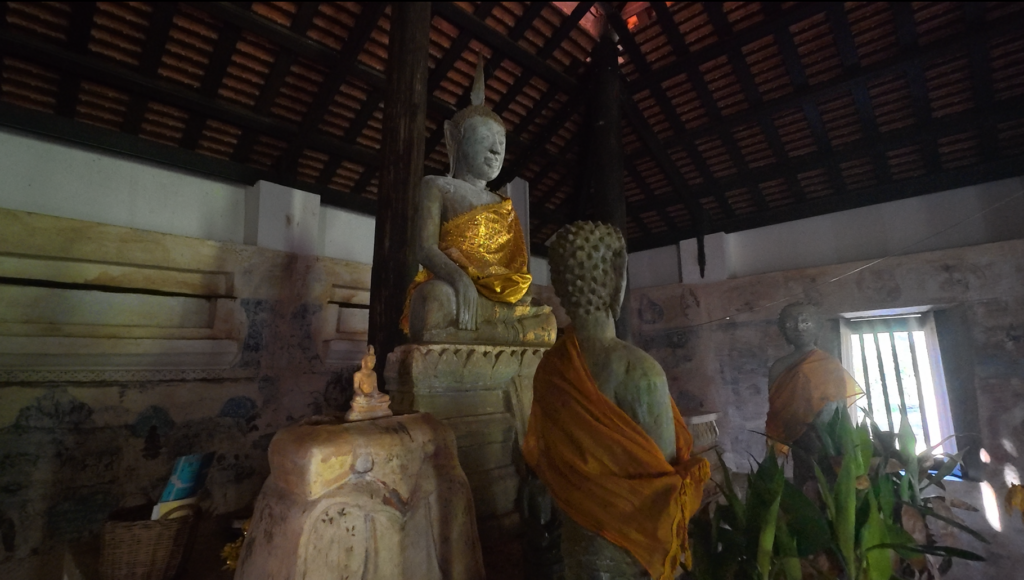


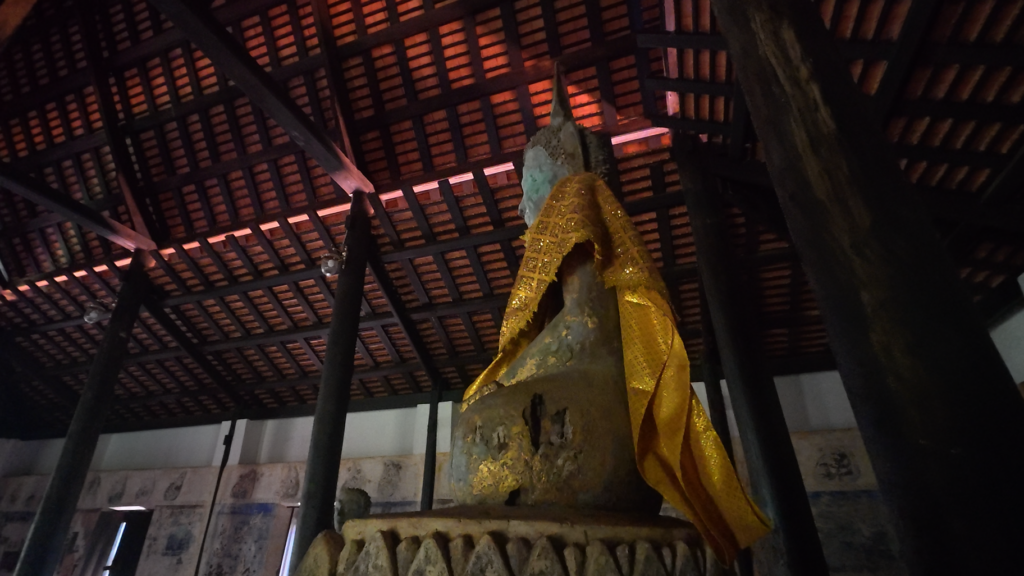
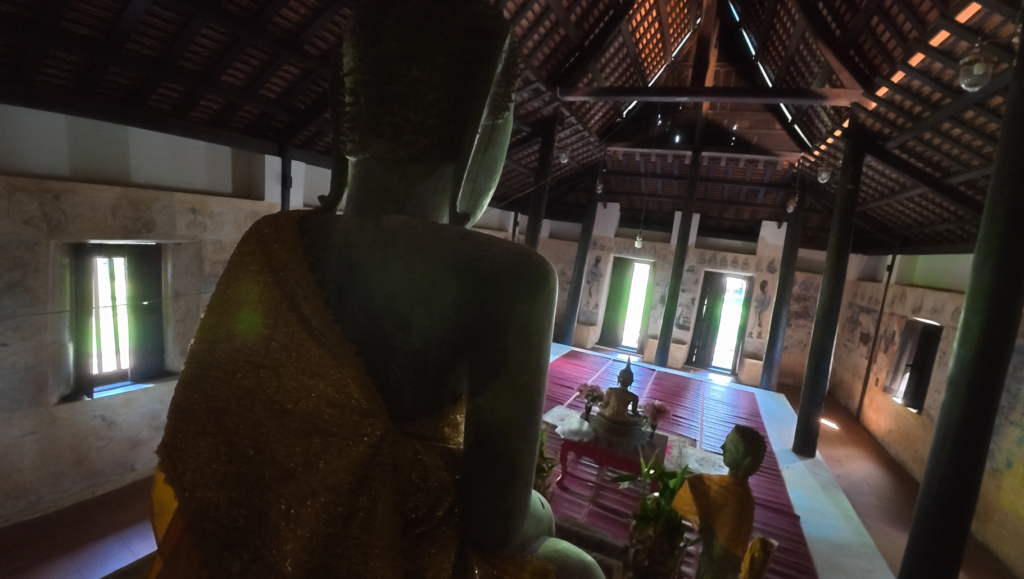
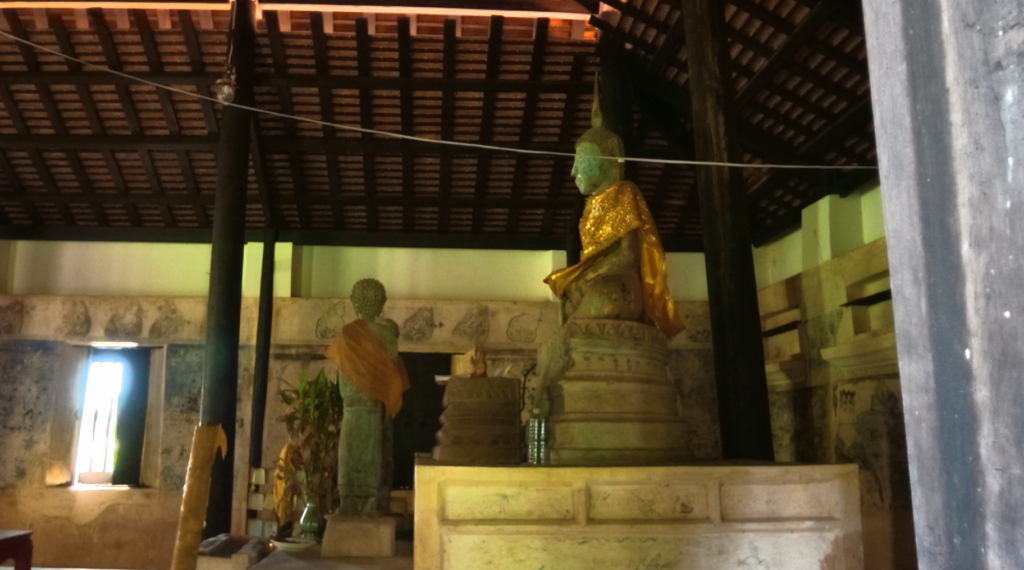
The principal wooden Buddha and its attendants, viewed from different positions around the altar.
The large principal Buddha on the raised rear pedestal is wooden. A separate bronze Buddha stands farther forward. Seeing them together makes it important to distinguish the two.
I studied the principal image’s expression, proportions, and surface. Its prominent features gave it a distinctive character, while worn coatings and surviving traces of gold recorded changes across time.
The lowered right hand forms the earth-touching gesture associated with the Buddha’s victory over Mara. Yet it was the face that held my attention: individual, direct, and unlike the polished uniformity of many newer images.
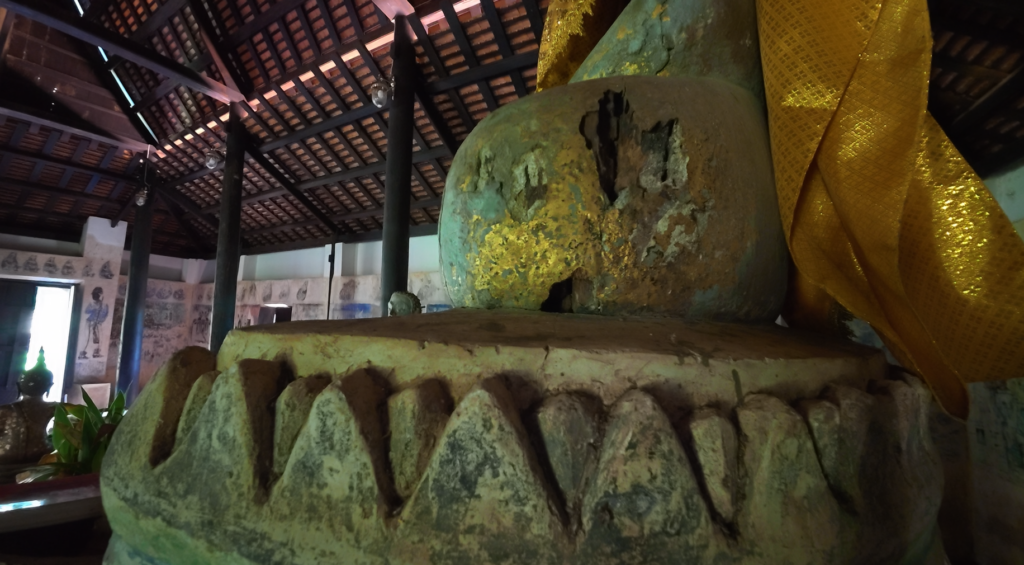
The damaged areas made the material especially apparent. Rather than seeing only deterioration, I found myself thinking about the generations who had continued to honour and care for the image.

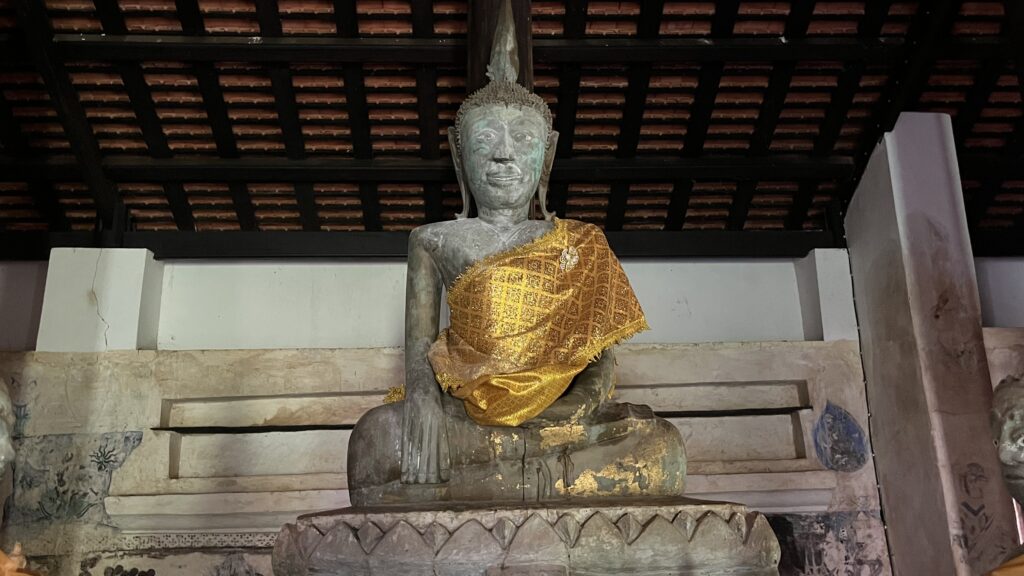
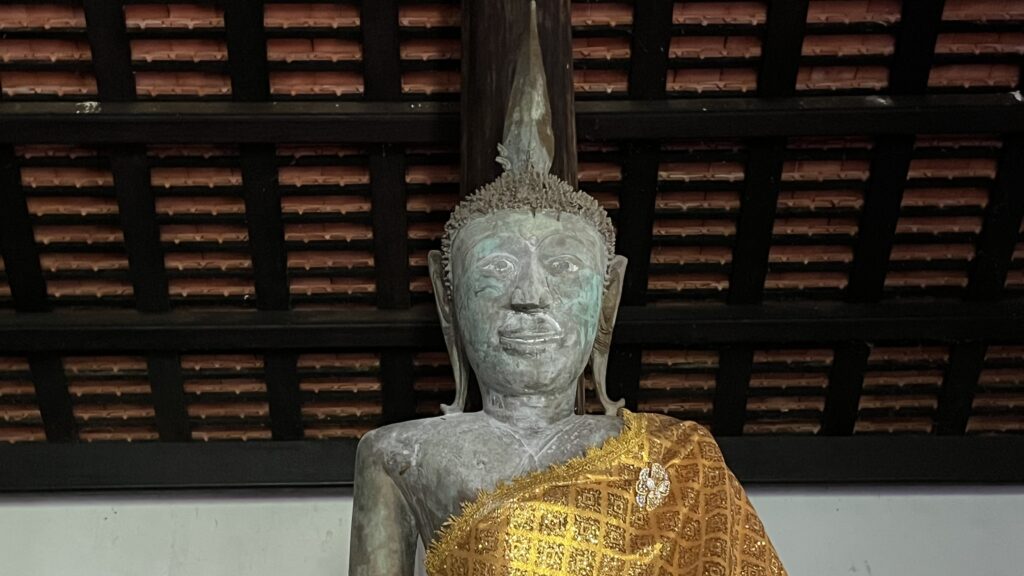

The principal Buddha’s distinctive face and the surviving texture of its surface.
Two wooden disciple figures stand before the principal Buddha with their hands joined in reverence. Their bright eyes are particularly striking.
Their faces differ subtly. One appears longer and more pronounced around the mouth; the other has a rounder, firmer expression. Both seem alert, as though still listening to the Buddha’s teaching.
Their individual names and dates of manufacture remain unconfirmed.

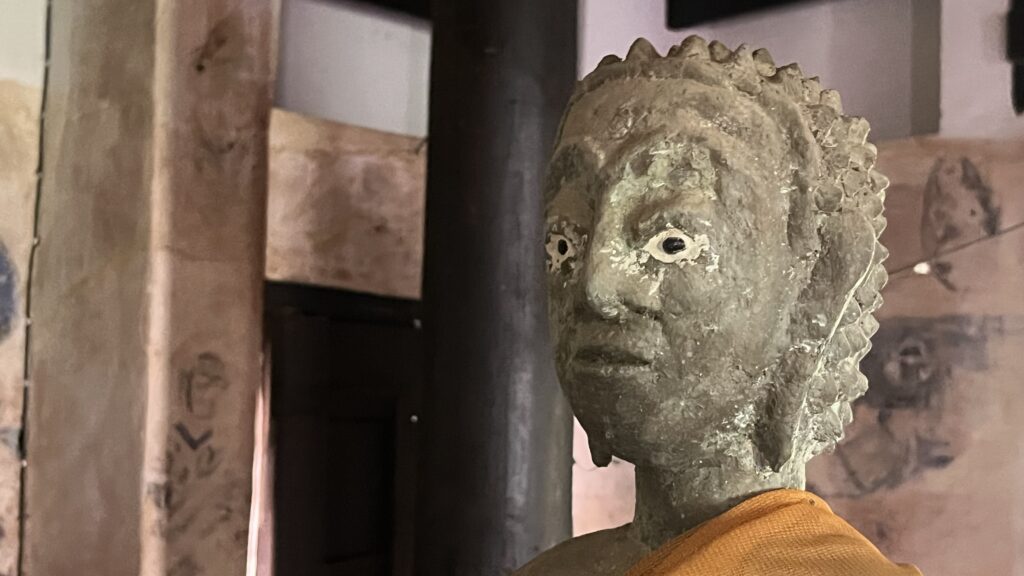
The two wooden disciples, their clearly defined eyes giving them an attentive presence.
Inside Wat Phlu Yang’s Old Ubosot
A quiet look inside the old ordination hall, with its wooden Buddha images, fading murals, and mysterious painted guardians.
Exploring the Murals of Wat Phlu Yang
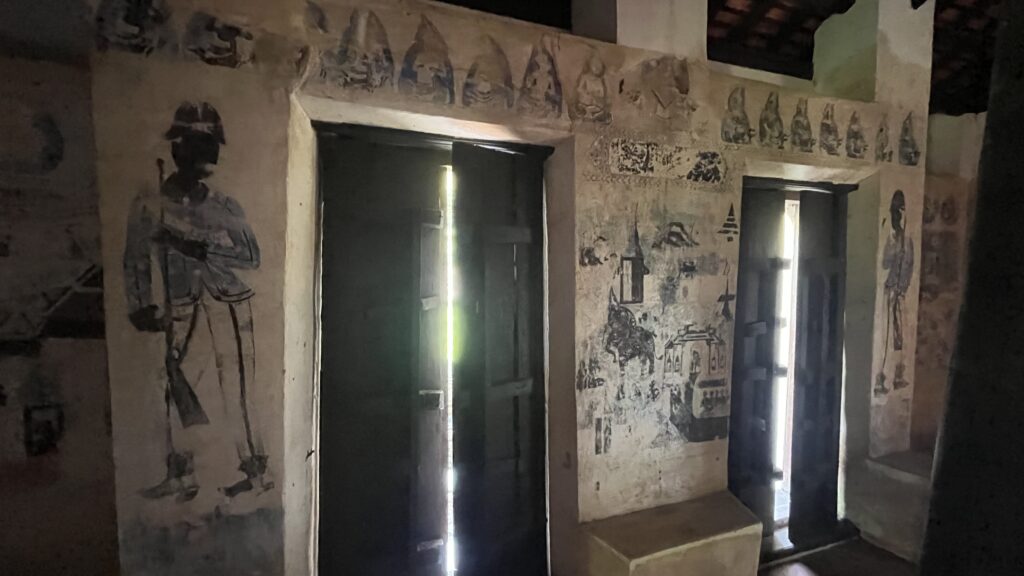


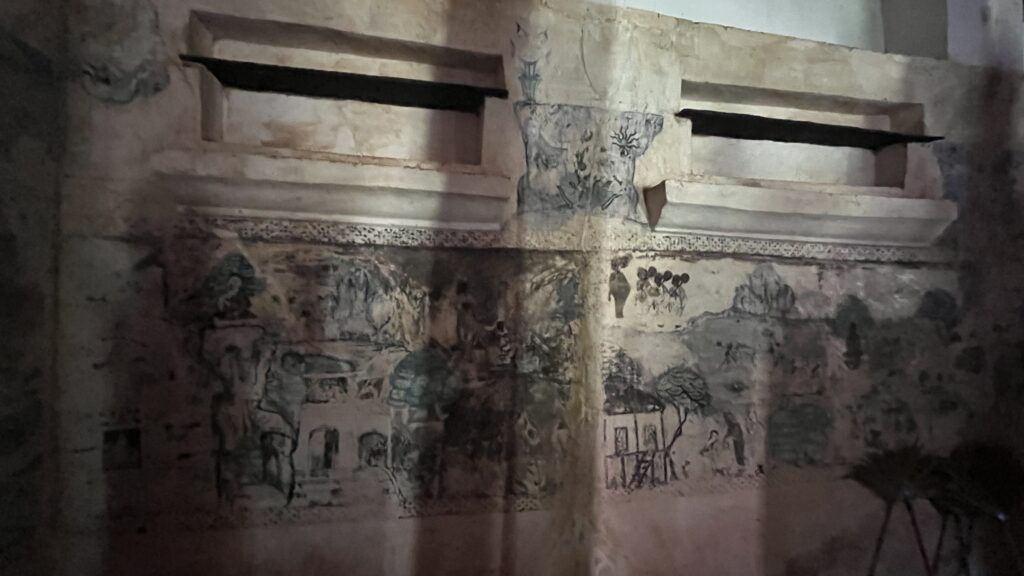


Surviving murals surround the hall, combining sacred narratives with architectural and landscape details.
Only after spending time with the images did I turn fully toward the walls.
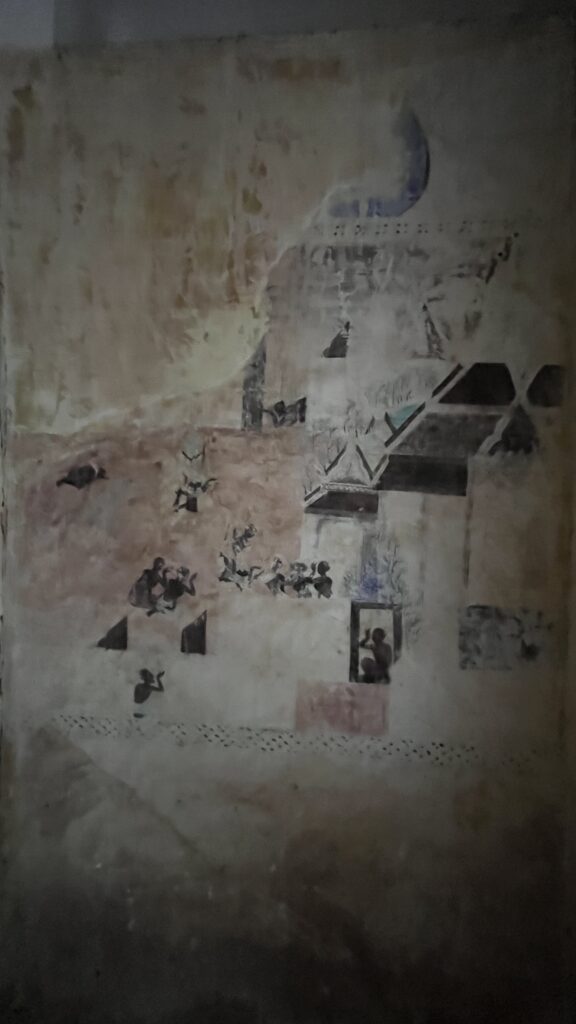
Paintings filled the room. Some passages retained recognisable figures and buildings; others had faded into scattered lines and patches of colour.
The historical sign identifies three principal subjects: the assembly of celestial beings, the Buddha’s life, and the Ten Great Birth Tales.
These subjects offer different ways of understanding the same religious space. The celestial assembly expresses reverence, the Buddha’s biography describes his final life, and the birth tales explore the long cultivation of virtues before Buddhahood.
The photographs below record surviving details. Where a scene is too worn to identify securely, I have left its precise subject open.
The Celestial Assembly

Known in Thai as Thep Chumnum, the celestial assembly depicts heavenly beings gathered in respect for the Buddha and his teaching.
Their repeated forms create a rhythm above the narrative paintings. Looking upward, I felt that the people standing in the hall were sharing the space with another, painted congregation.
Local educational material records seventy celestial figures in the upper register. Their arrangement is easier to appreciate in the wider views than in an isolated close-up. www.thaieducation.net
The Life of the Buddha


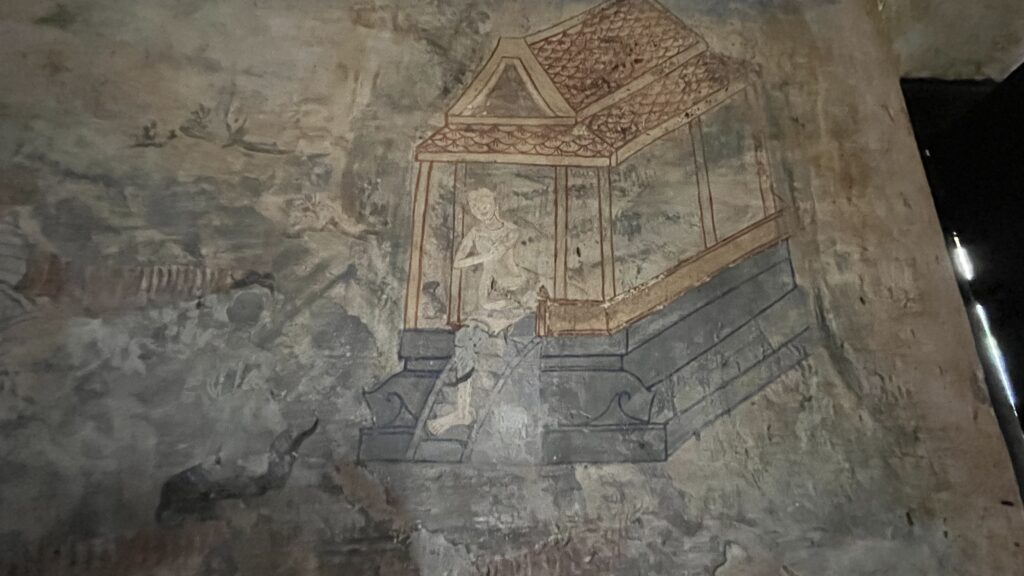
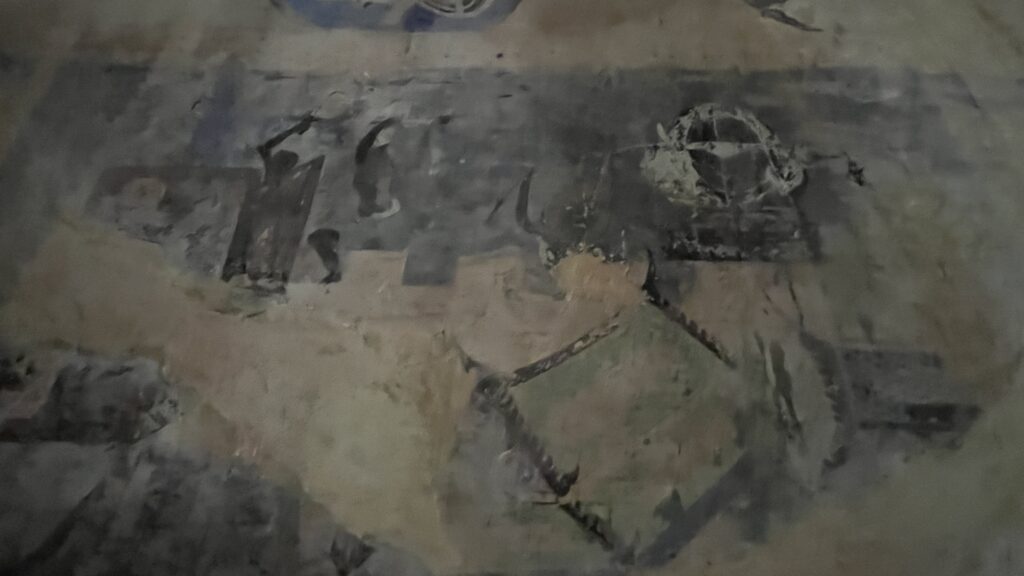

Narrative details from the surviving murals, photographed for closer study.
The Buddha’s life provides the framework for understanding many Thai temple paintings.
The story begins with Prince Siddhartha’s birth and privileged upbringing. His encounters with ageing, sickness, death, and a religious seeker lead him to question a life protected by palace walls.
He leaves that life, undertakes severe austerities, and eventually recognises that extreme self-denial does not bring liberation. Sujata’s offering of milk-rice belongs to the transition toward the Middle Way.
The confrontation with Mara culminates in awakening beneath the Bodhi tree. In Thai representations, the Earth Goddess may appear wringing water from her hair, bearing witness to the accumulated merit of the Bodhisatta.
Later episodes include the first teaching, the gathering of disciples, and the final passing into parinibbana.
These are useful stories to know when examining a mural, but a familiar building, animal, or seated figure alone is not enough to identify a damaged scene. Here, the pleasure was often in looking carefully without forcing an answer.
The Ten Great Birth Tales
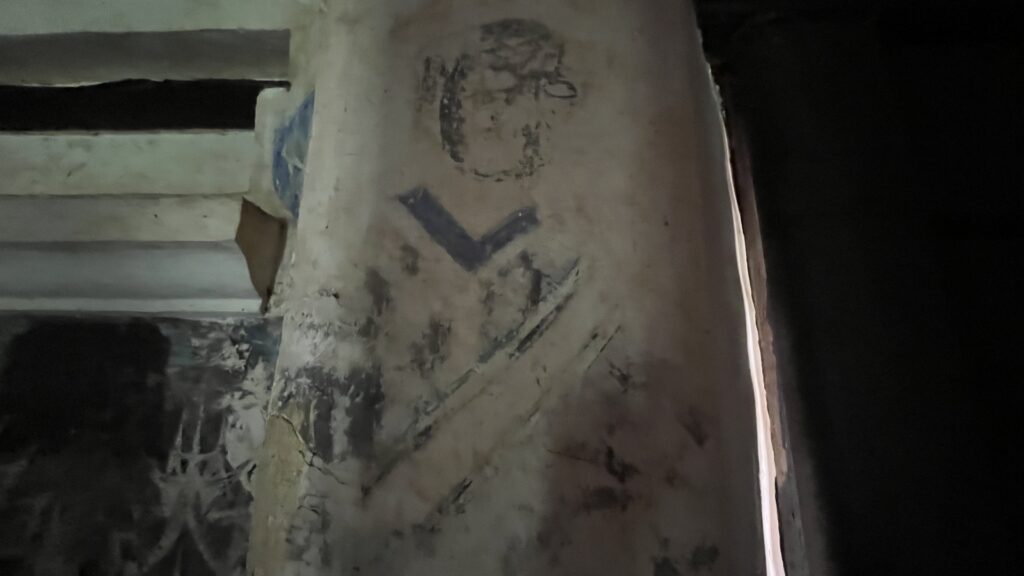
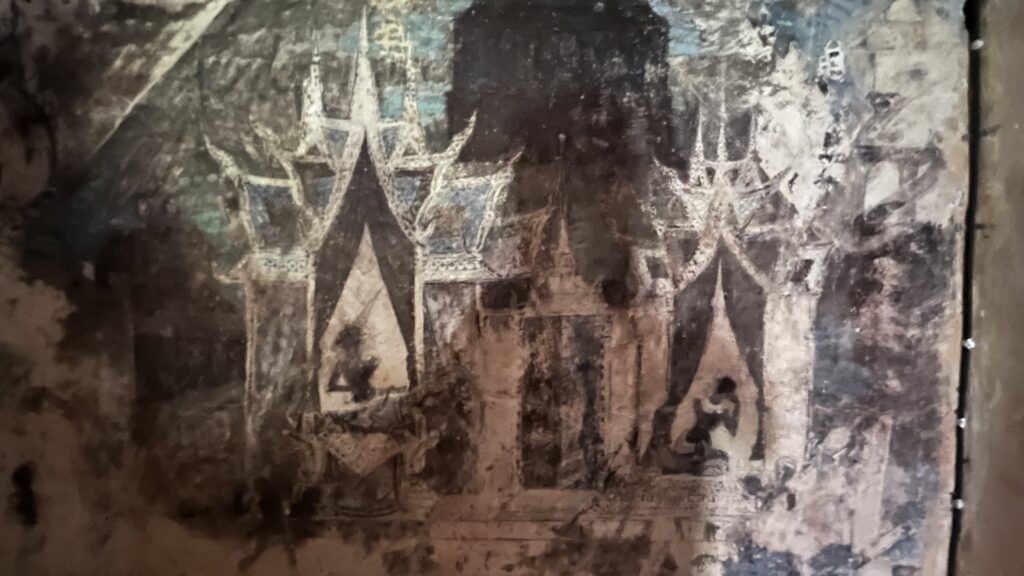
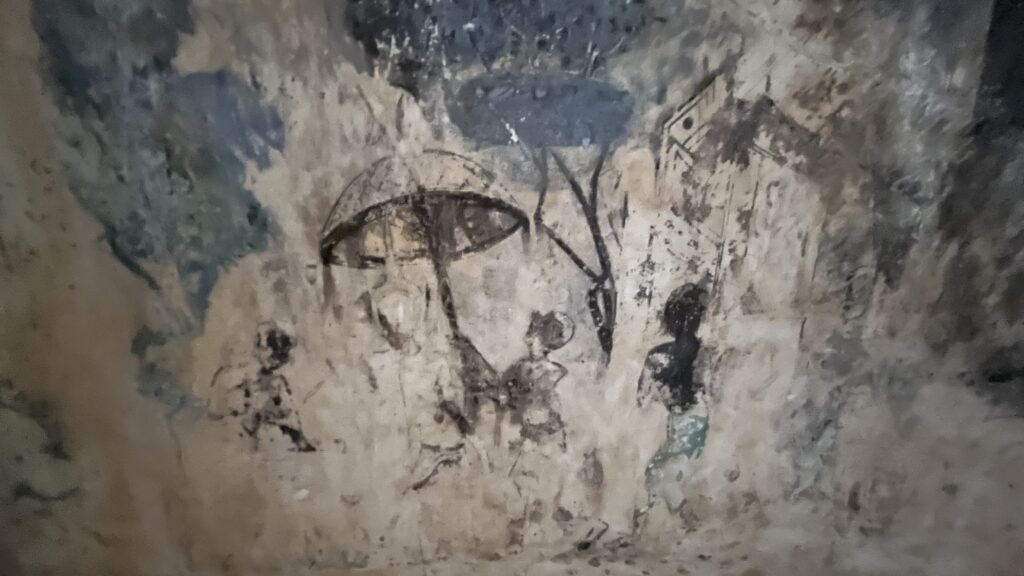
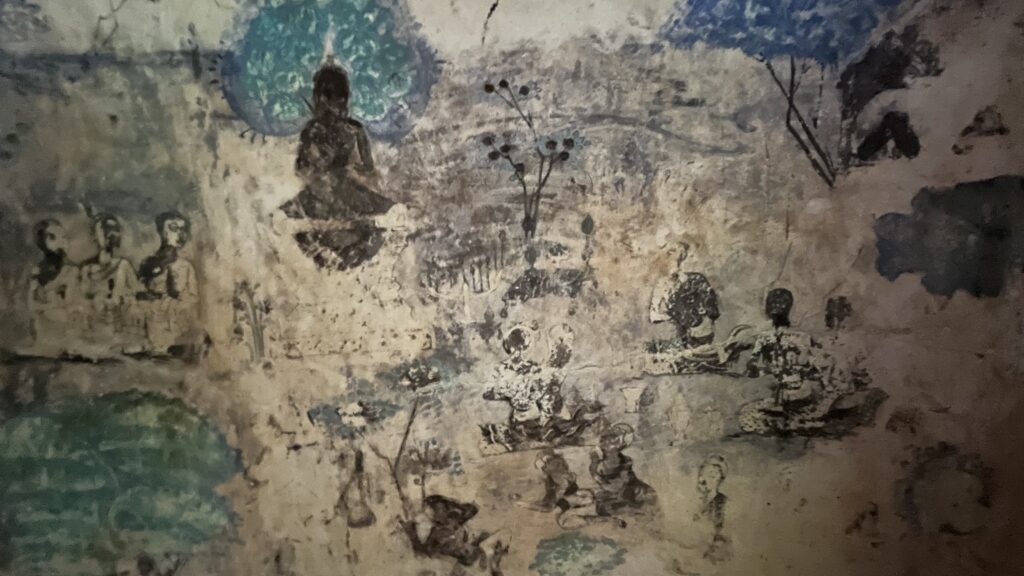


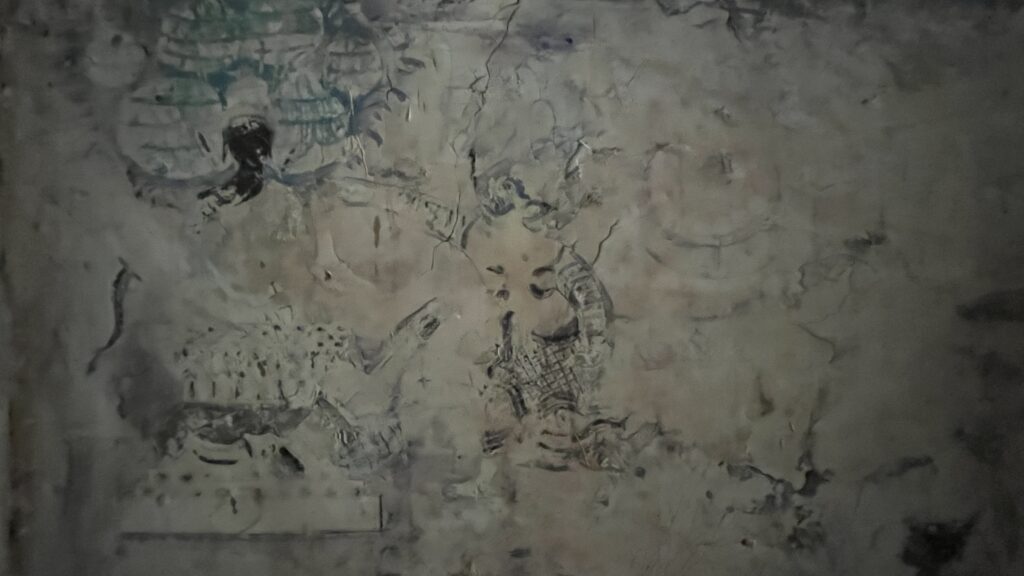
Figures, animals, buildings, and landscapes survive within the hall’s extensive narrative paintings.
The Thotsachat, or Ten Great Birth Tales, concern earlier lives of the Bodhisatta. In Thai tradition, each is associated with a particular perfection, or virtue cultivated toward Buddhahood. searcharchives.bl.uk
Temiya — Renunciation
A prince refuses to speak or move because he fears the wrongdoing that royal power may require. Eventually, he reveals his strength and chooses a religious life. A prince lifting a chariot is a useful identifying scene.
Mahajanaka — Perseverance
After a shipwreck, Mahajanaka continues swimming despite the apparent hopelessness of his situation. His determination, and the intervention of a goddess, make the sea a setting for spiritual perseverance.
Suvannasama — Loving-kindness
A young man cares for his blind parents in the forest. When a king wounds him with an arrow, the story tests compassion and devotion. Deer, a water vessel, and a hunter-king can help identify it.
Nemi — Resolution
King Nemi journeys by celestial chariot through hell and heaven. The contrasting destinations reveal the consequences of conduct and reinforce his determination to follow a virtuous path.
Mahosadha — Wisdom
A wise child grows into an adviser who resolves disputes and protects his people through intelligence. Court scenes, judgments, and an elaborate tunnel feature in the story.
Bhuridatta — Moral Discipline
A naga prince observes religious vows and endures capture by a snake charmer. His refusal to abandon his discipline is central to the tale.
Candakumara — Patience
A prince and other intended victims face a misguided royal sacrifice. The narrative exposes the danger of false counsel and celebrates endurance under injustice.
Narada — Equanimity
The Brahma Narada descends to correct a king’s mistaken beliefs about actions and their consequences. Teaching and moral persuasion drive the story.
Vidhura — Truthfulness
A respected counsellor becomes entangled in the wishes of beings from different worlds. Even under threat, his truthful teaching remains his strength.
Vessantara — Generosity
A prince gives away his auspicious elephant and, later, his children and wife. This demanding religious narrative explores generosity taken to its furthest extent; it should be understood within its devotional setting.
Together, these stories make virtue visible through difficult choices. Knowing them gives a visitor something to look for, even when the painted surface has become fragmentary.
The Soldiers Whose Identity Remains a Mystery
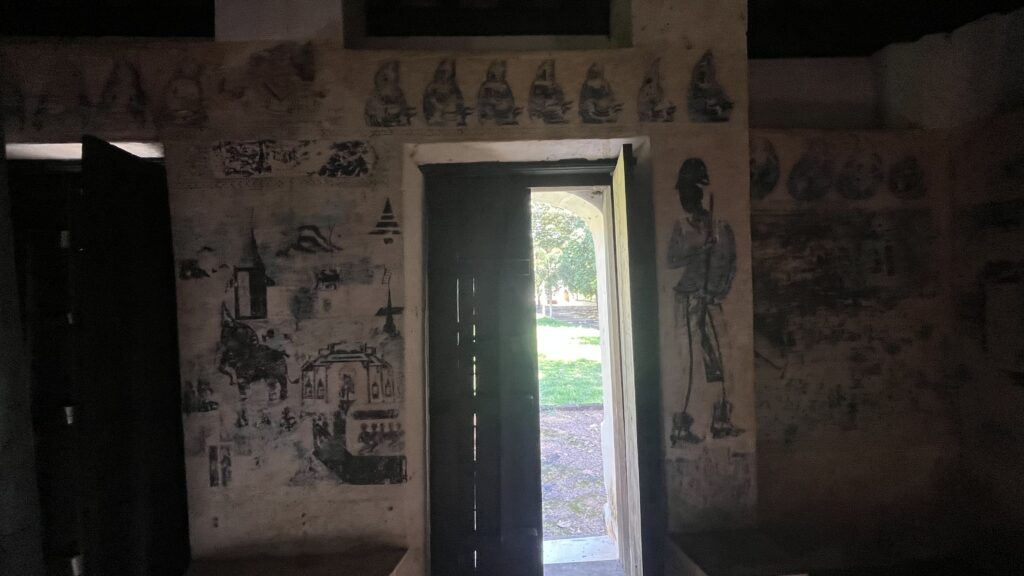


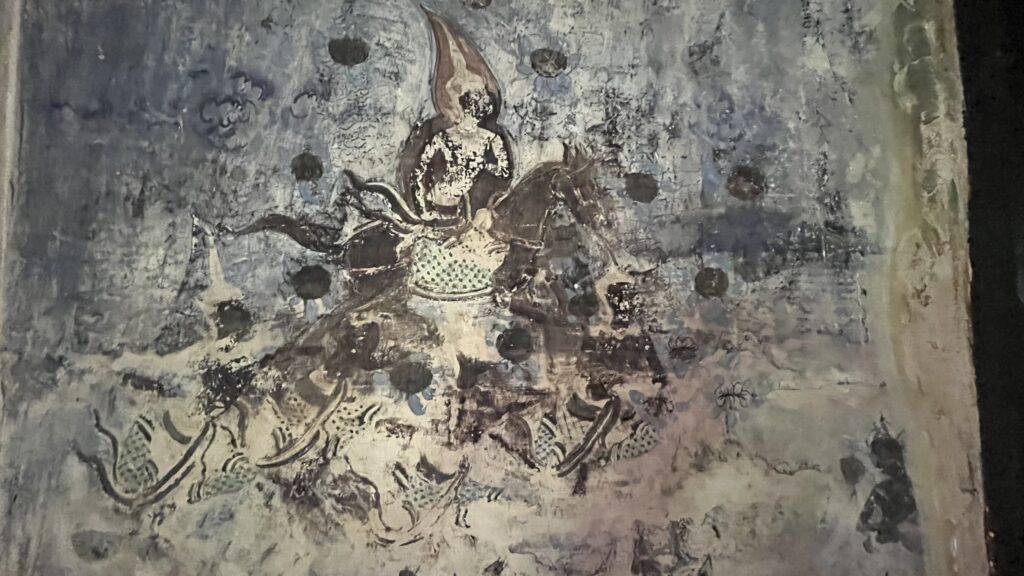
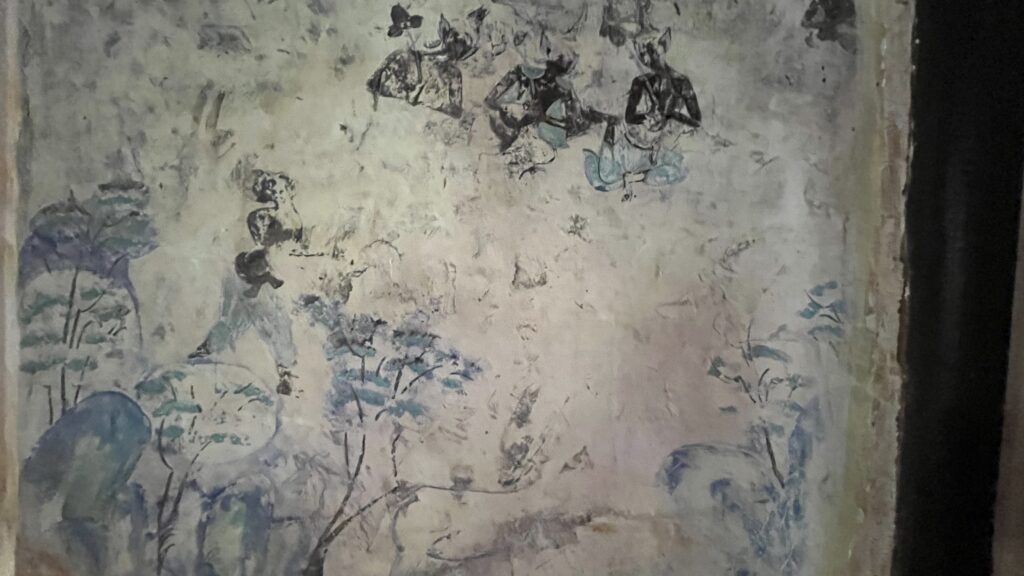

Wider views and closer details show how narrative paintings occupy the spaces around the doors and windows.

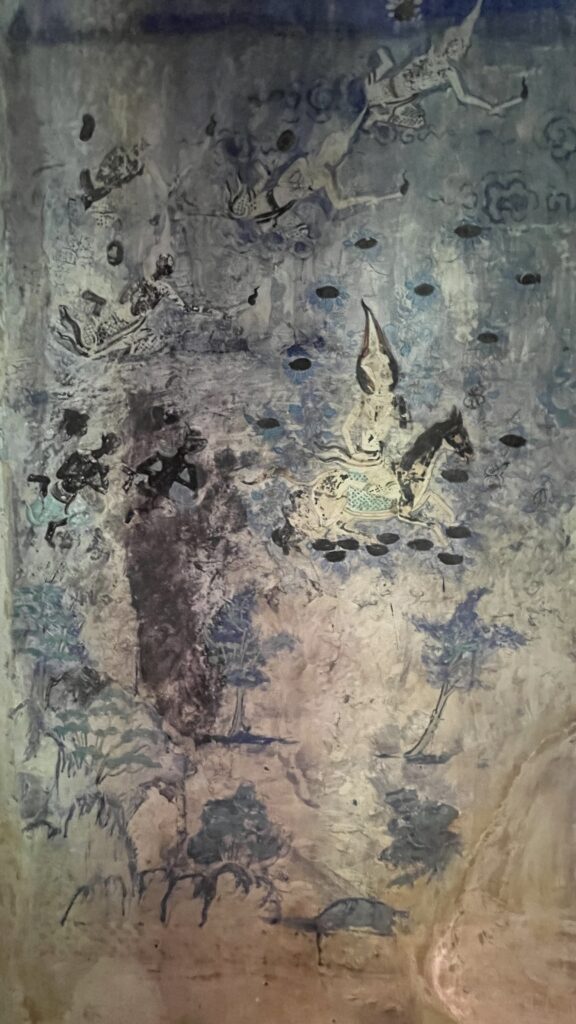


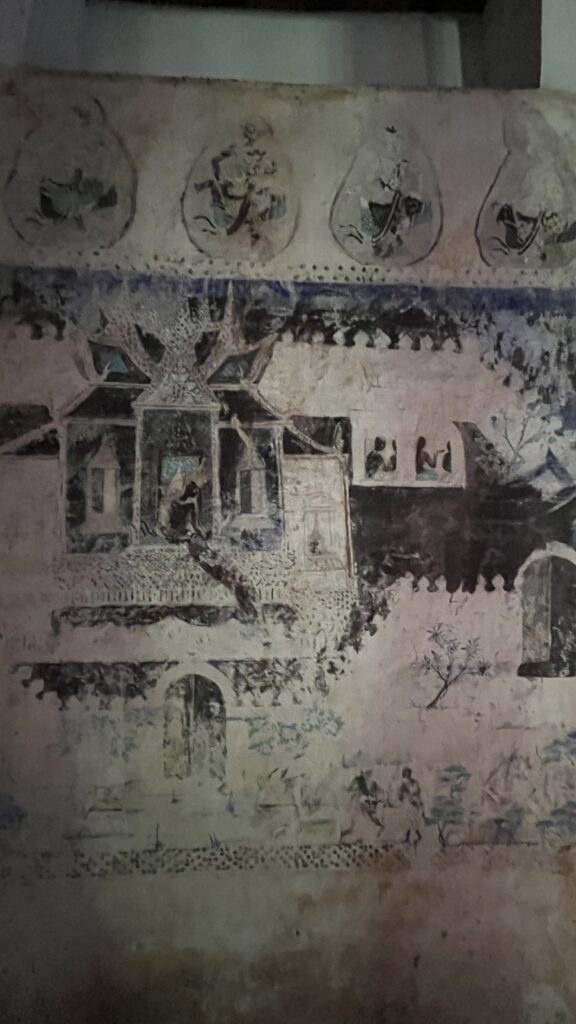


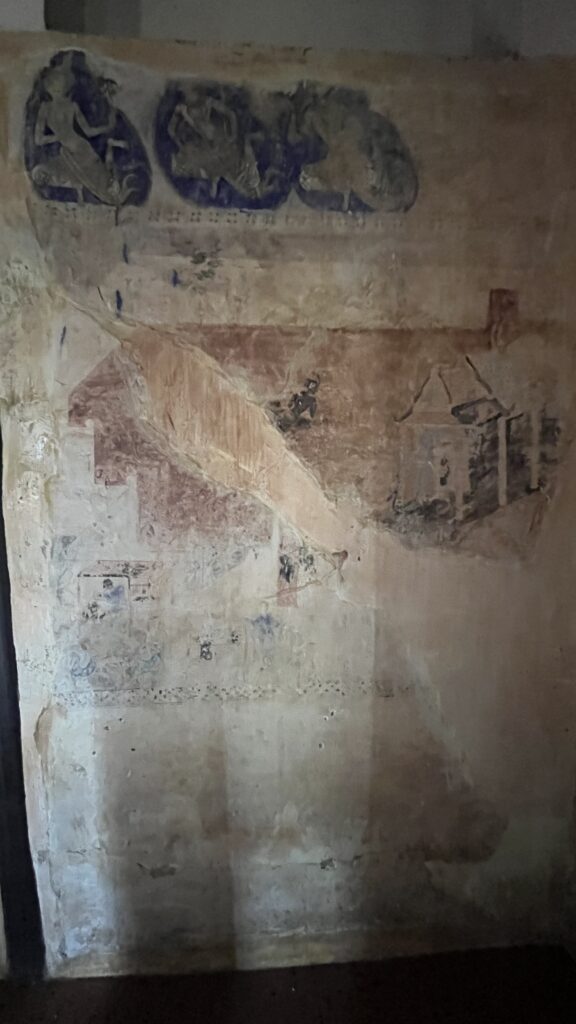
Vertical mural panels and the rifle-bearing figures beside the entrances.
Among the religious paintings, two standing soldiers were especially unexpected.
They occupy the outer sides of the two entrance doorways. With their hats, uniforms, cross-belts, and long firearms, they appear to serve as painted guardians.
Their precise identity remains a mystery. I could not establish their nationality, regiment, or the model used by the painter. The suggestion that they represent French soldiers requires firmer evidence before it can become part of the temple’s established history.
For now, their unanswered story is compelling enough.
Above them, celestial beings gather in reverence. Below, two unnamed soldiers continue to stand beside the doors.
Leaving with the Earth Goddess

Outside, the brightness of the grounds felt different after the dim interior.
Beneath a large tree stood Phra Mae Thorani, the Earth Goddess. After studying the wooden faces and faded stories inside, I took her presence as a gentle farewell.
I had almost passed through Wat Phlu Yang without finding its old ubosot. Instead, a monk’s kindness allowed me to spend time in a room filled with traces of earlier hands, continuing devotion, and questions still unanswered.
Then it was time to return to the road.
For another historic temple in Chanthaburi, explore Wat Phlap Bang Kacha and its sacred well, old scripture library, and distinctive Buddha image.
Location and Visitor Information
- Temple: Wat Phlu Yang, also known as Wat Phutthakhayaram
- Thai name: วัดพลูยาง / วัดพุทธคยาราม
- Location: Si Phaya, Tha Mai District, Chanthaburi, Thailand
- Map: Find Wat Phlu Yang on Google Maps
- Old ubosot access: Ask a resident monk; access may depend on availability.
- Photography: Request permission, avoid flash around the murals, and leave painted surfaces and sculptures untouched.