Introduction
After eighteen years of living in Thailand, I finally made my way to the Sanctuary of Truth in Pattaya. I had heard about this famous wooden monument many times, but I had never felt strongly drawn to it. I assumed it was mainly a commercial attraction created for tourists, and that prejudice kept it outside my riding plans for years.
This time, however, I decided to set those assumptions aside and see the place with my own eyes. Riding through the busy streets of Pattaya, I still did not know that this visit would become more than an encounter with an extraordinary building. It would introduce me to the life of a remarkable man, the woman who stood beside him, and a cultural legacy designed to outlive its creators.
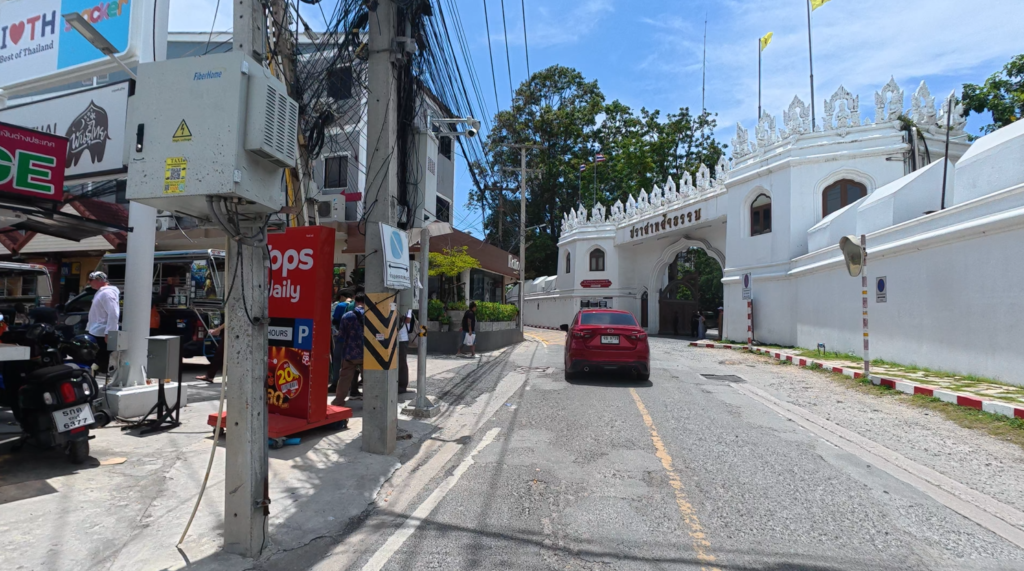
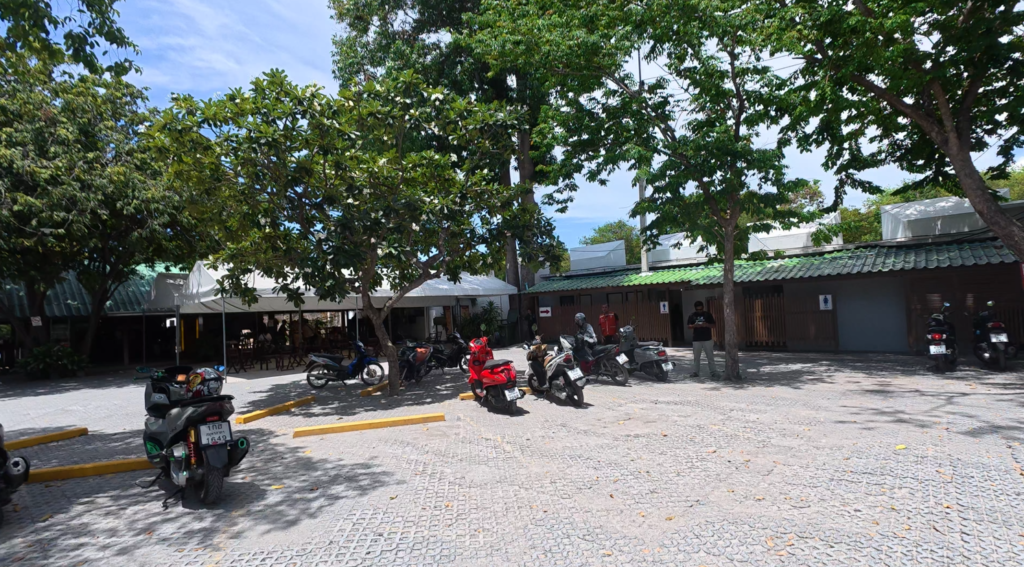
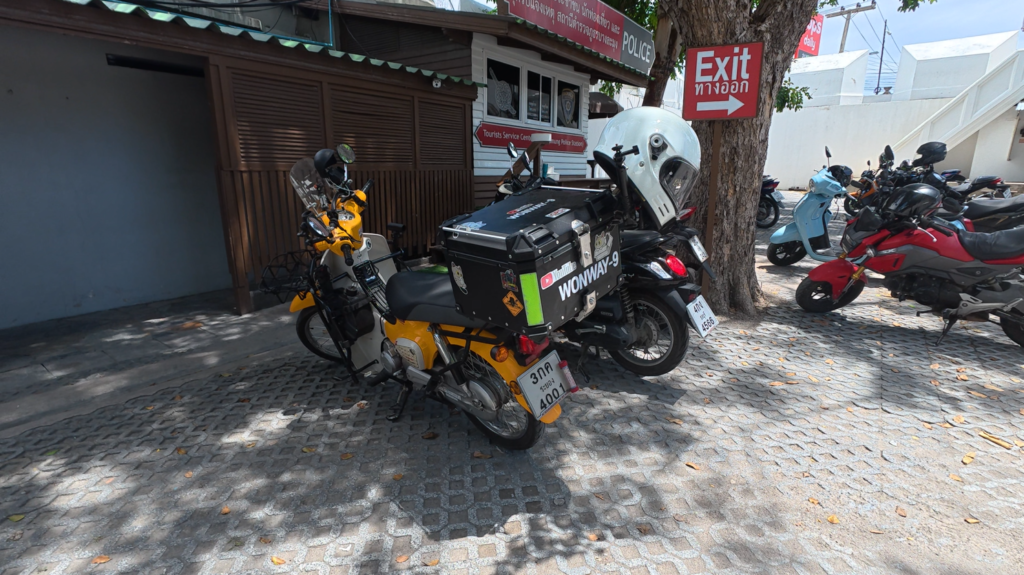
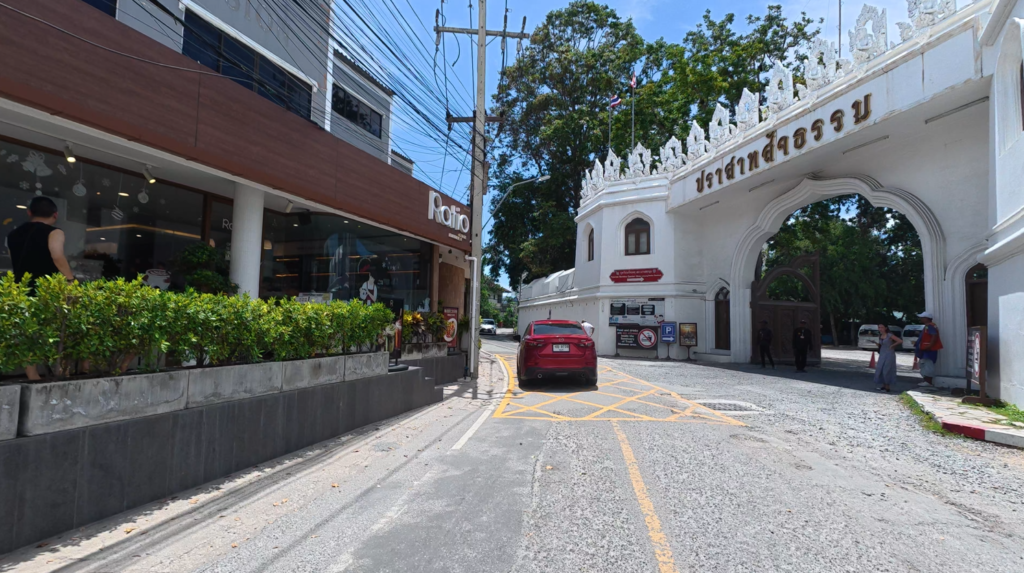
Riding through Pattaya and arriving at the entrance—after eighteen years in Thailand, I was finally ready to discover the Sanctuary of Truth for myself.
Leaving My Prejudice at the Gate
The Sanctuary of Truth is not entered like an ordinary temple. After arriving, visitors pass through the admission and orientation area before following the path toward the wooden structure. The organized entrance, visitor facilities, and tour groups initially reinforced my old impression that this might simply be another polished Pattaya attraction.
But beyond the entrance, the atmosphere began to change. The city noise slowly disappeared beneath the trees, and the path opened toward the sea. Then, through the dense tropical greenery, the dark wooden spires of the sanctuary appeared for the first time. Surrounded by forest and standing against the blue water, it looked less like a tourist attraction and more like a mysterious wooden mountain rising from the coast.
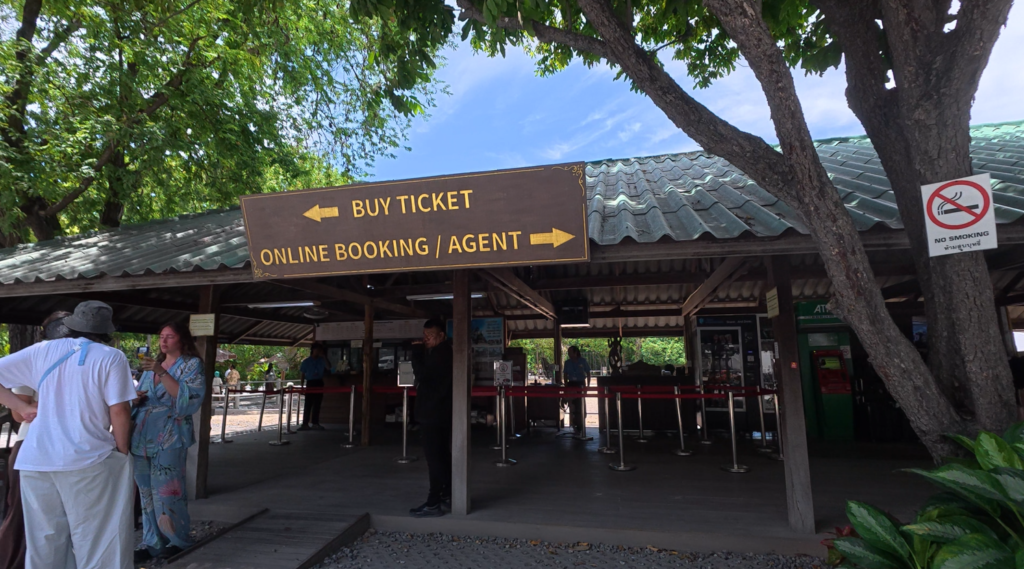
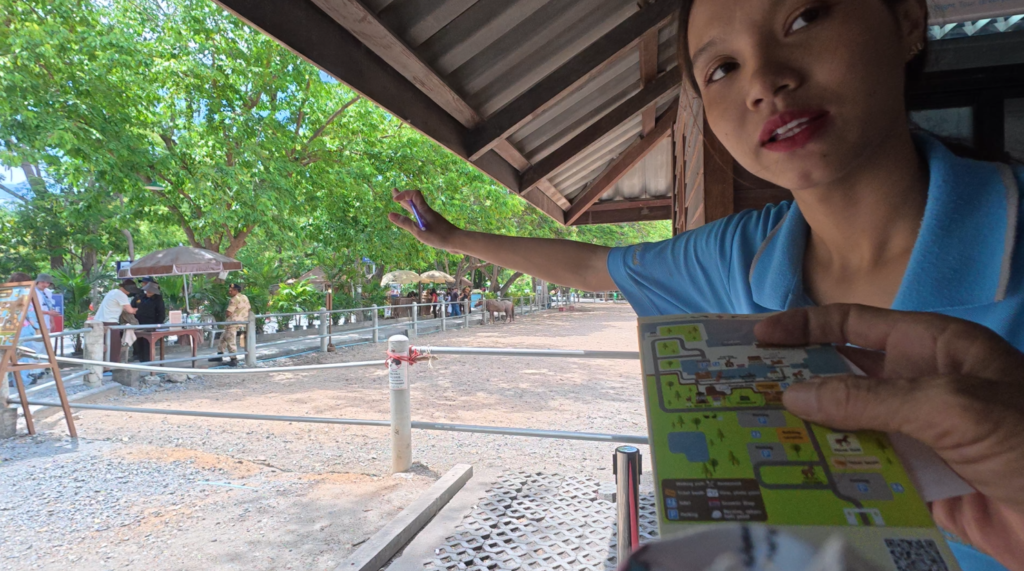
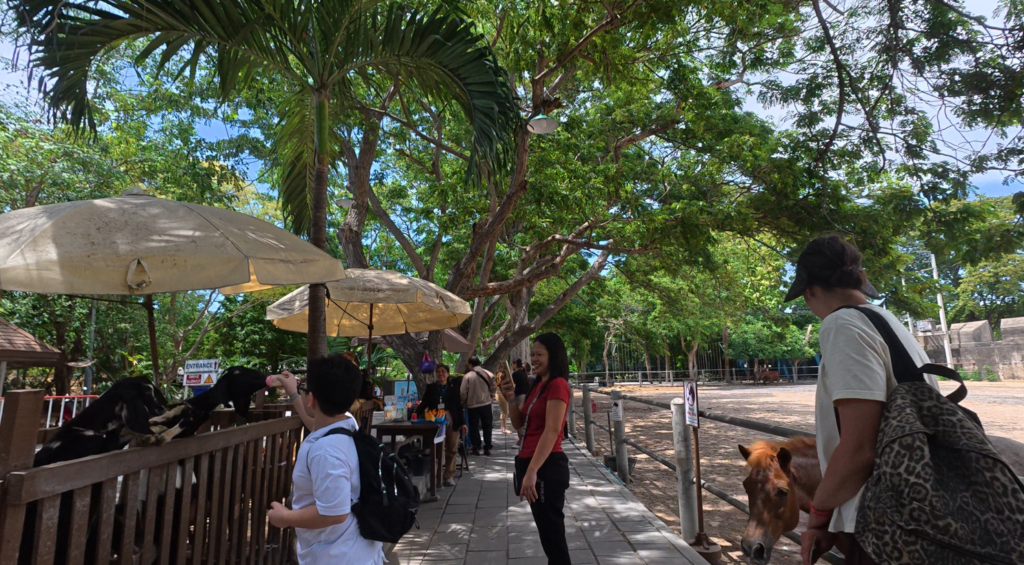
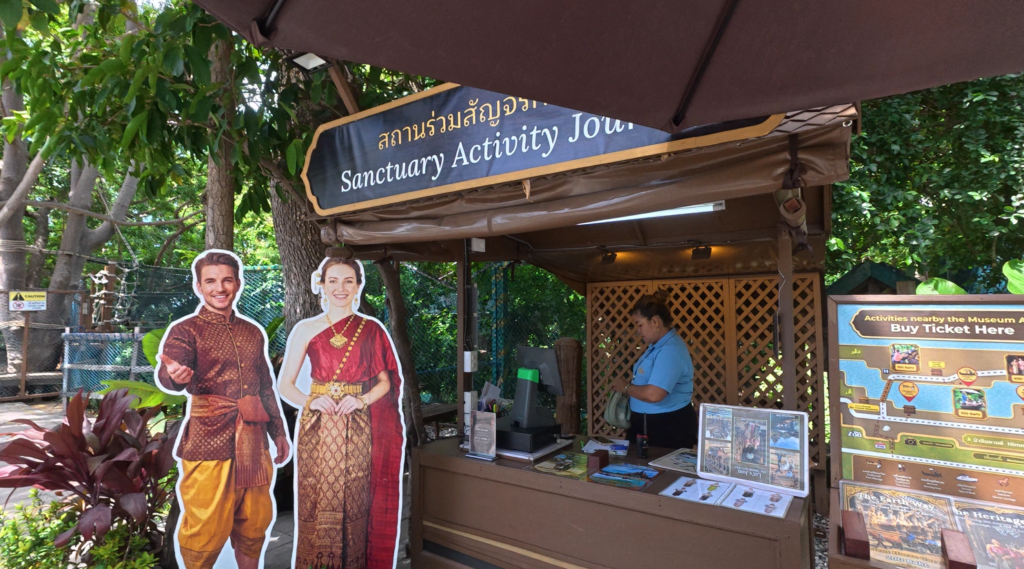
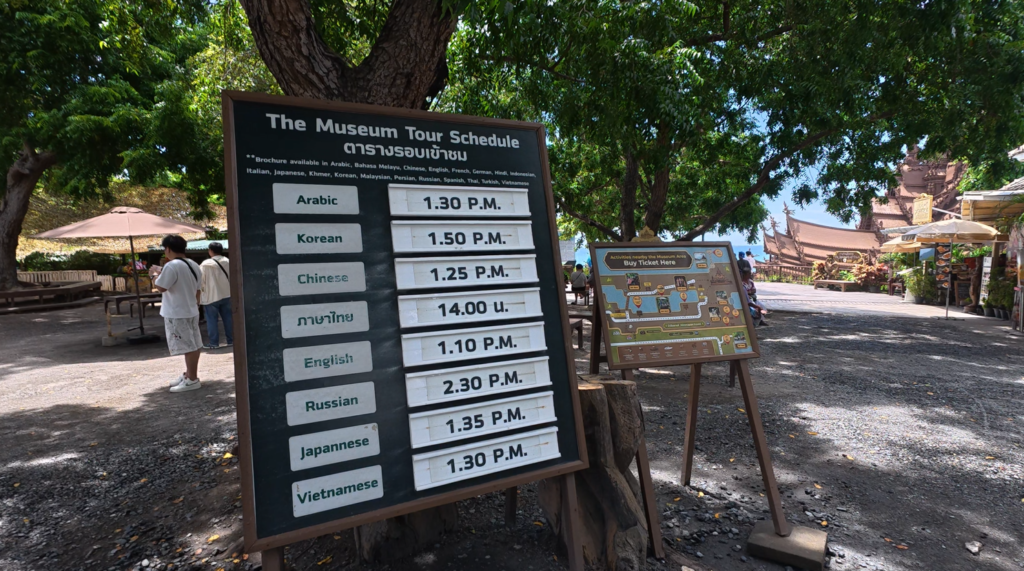
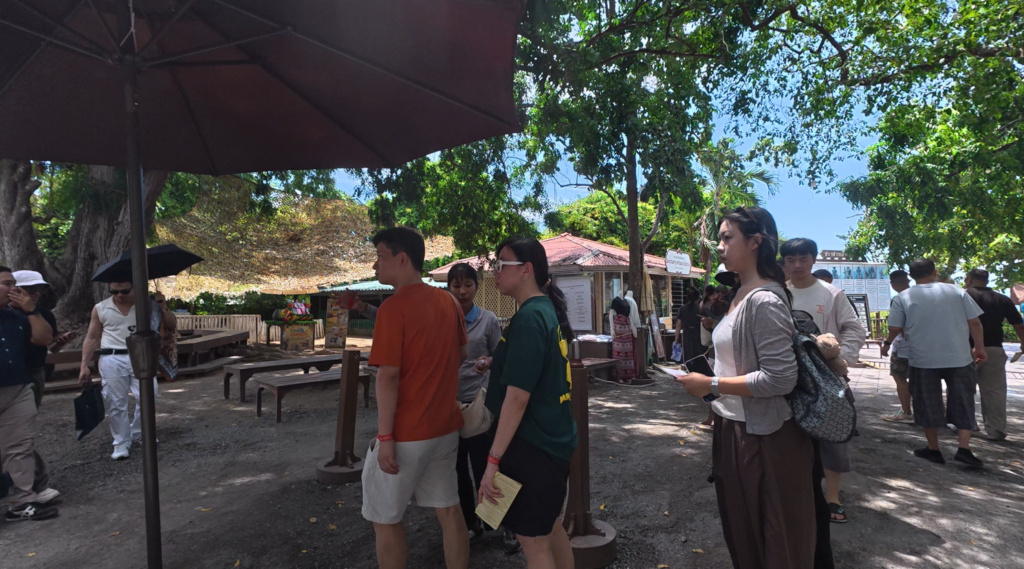
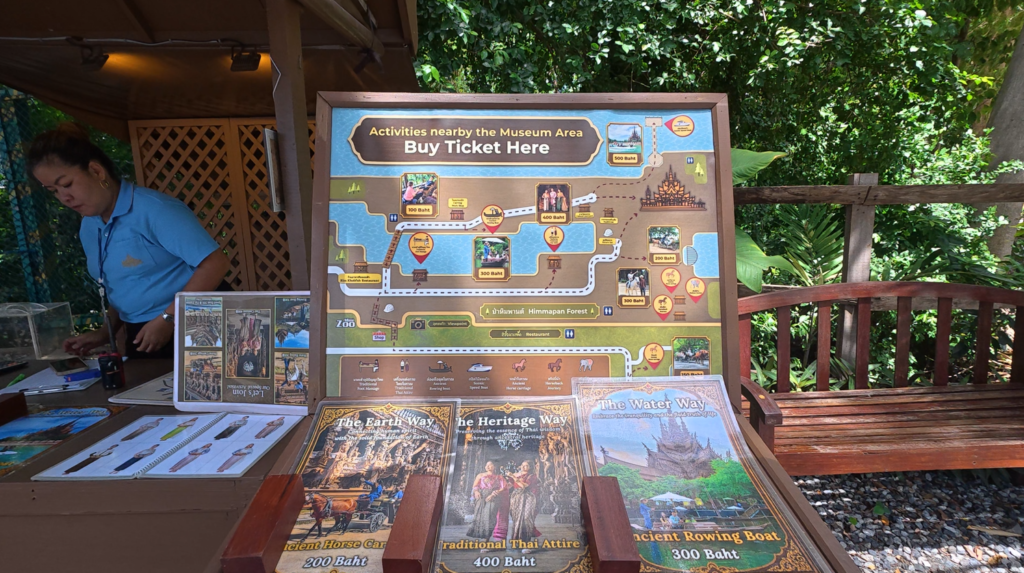
Passing through the entrance and orientation area before following the shaded path toward the sanctuary.
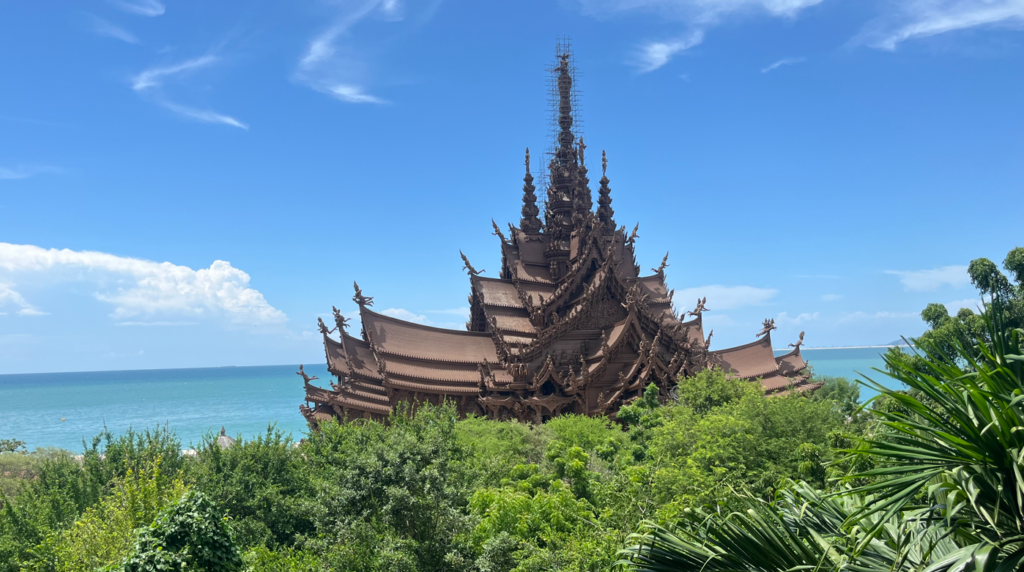
Follow my first journey into the Sanctuary of Truth—a visit that began with skepticism and ended with a deep respect for the vision and legacy behind this extraordinary wooden monument.
Won Cub Life enters Pattaya’s Sanctuary of Truth after eighteen years in Thailand, exploring its continuing craftsmanship, sacred relics, Eastern philosophy, and the remarkable lives of Lek and Prapai Viriyaphant.
A Sanctuary That Is Still Being Created
Construction of the Sanctuary of Truth began in 1981, yet the work continues more than four decades later. This is not simply because the building was never completed. New carvings are still being produced while older sections, constantly exposed to coastal heat, rain, humidity, and salt-laden air, must be inspected, repaired, or replaced.
Massive hardwood logs wait near the sanctuary before being transformed by the craftsmen. The building uses several durable species, including mai daeng, mai takian, mai pan chat, kiam khanong, and golden teak. Official descriptions state that some of the timber was obtained through concessions in Thailand’s neighboring countries, although the exact origin of the individual logs displayed here is not clearly identified.
Inside the workshop, craftsmen continue to carve figures and architectural components by hand. Traditional mortise-and-tenon joints, wooden pegs, wedges, and dovetail connections allow the structure to be assembled according to methods inherited from earlier generations. What I was seeing was not a completed monument preserved behind glass, but a living construction site where architecture, sculpture, and craftsmanship continue together.
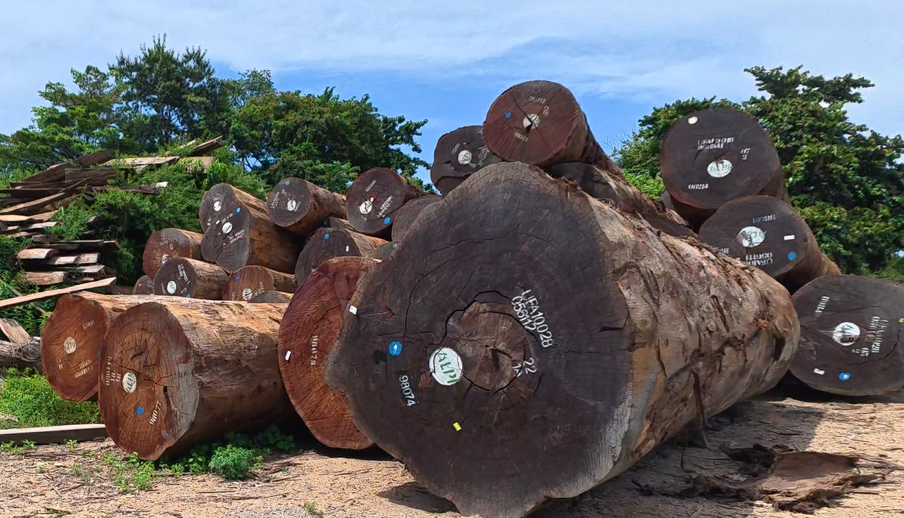
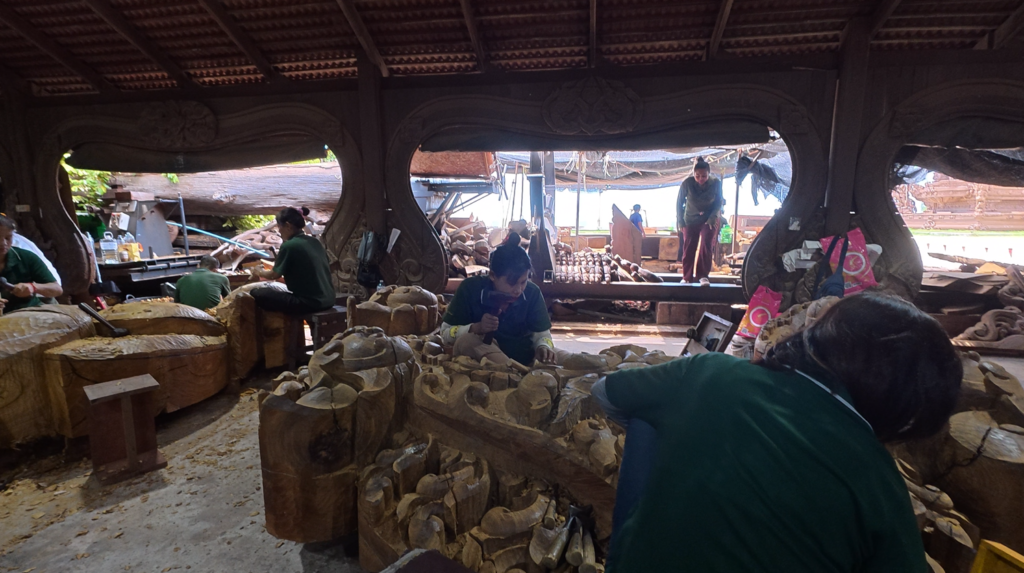
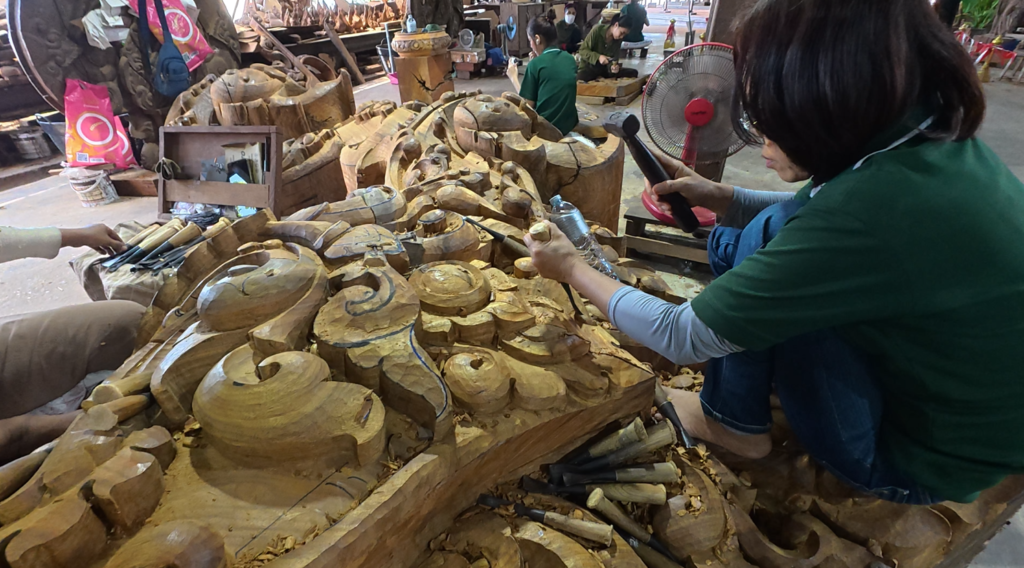
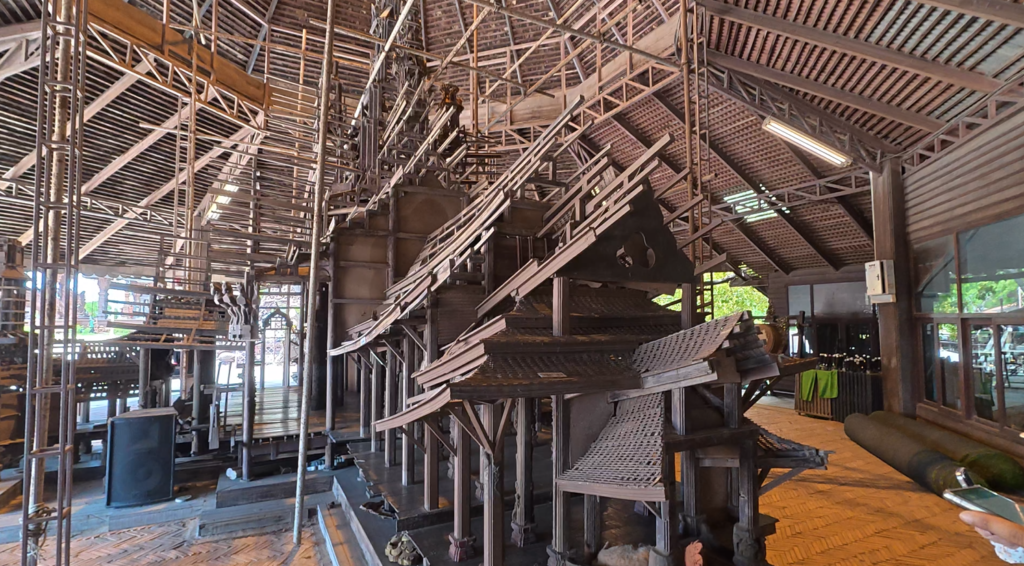
Inside the working area, new carvings and structural components are still being shaped by hand using knowledge passed down through generations.
A Wooden Universe of Eastern Thought
As I approached the sanctuary, its scale became difficult to comprehend. Rising approximately 105 meters above the coast, the building resembles a traditional Thai castle with four great wings extending toward the cardinal directions. Every roofline, column, doorway, and exterior surface is covered with carved figures, leaving almost no part of the structure without meaning.
The overall form draws strongly from Thai architecture, particularly traditions associated with the Ayutthaya and Rattanakosin periods. Yet the carvings reach far beyond a single country or religion. Figures inspired by Hindu mythology stand beside Buddhist teachings, while artistic elements associated with Khmer, Chinese, and other Eastern traditions become part of the same wooden universe.
These figures should not be viewed simply as decoration. Some appear to represent deities, celestial beings, guardians, sages, families, animals, and scenes from religious mythology. Together, they introduce the sanctuary’s central idea: civilizations may give different names and forms to the sacred, but they continue to ask the same questions about creation, morality, suffering, and the purpose of human life.
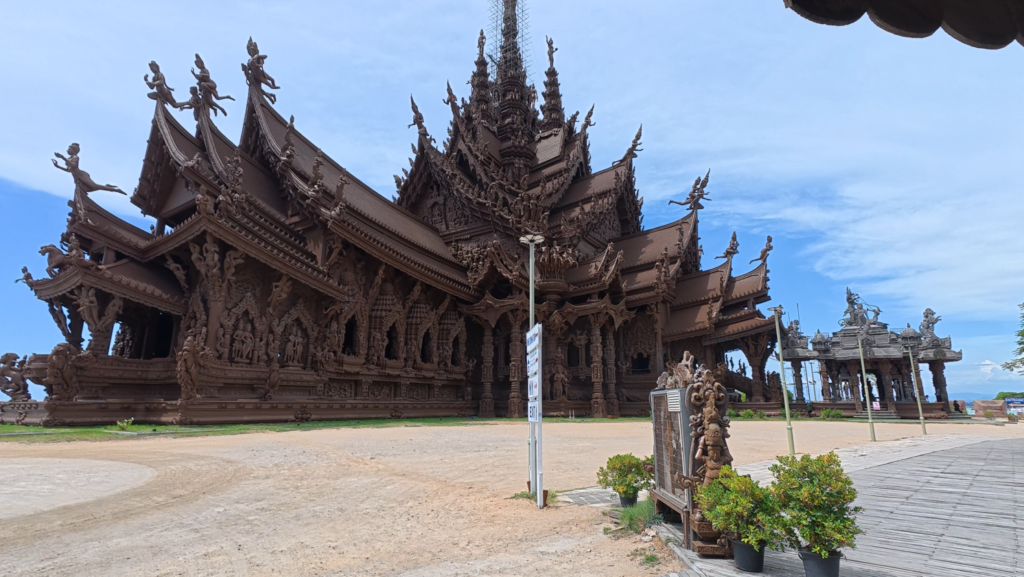
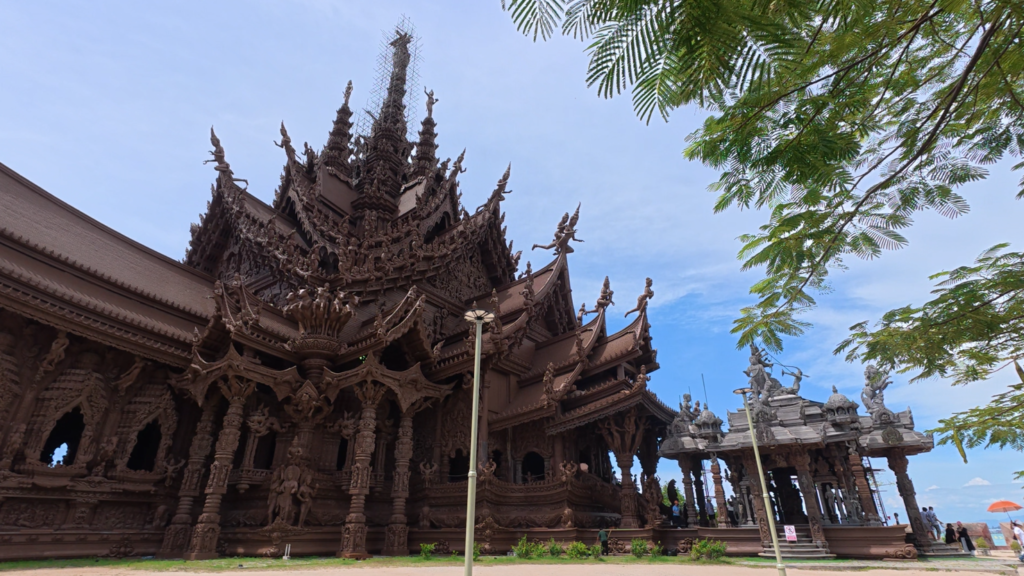
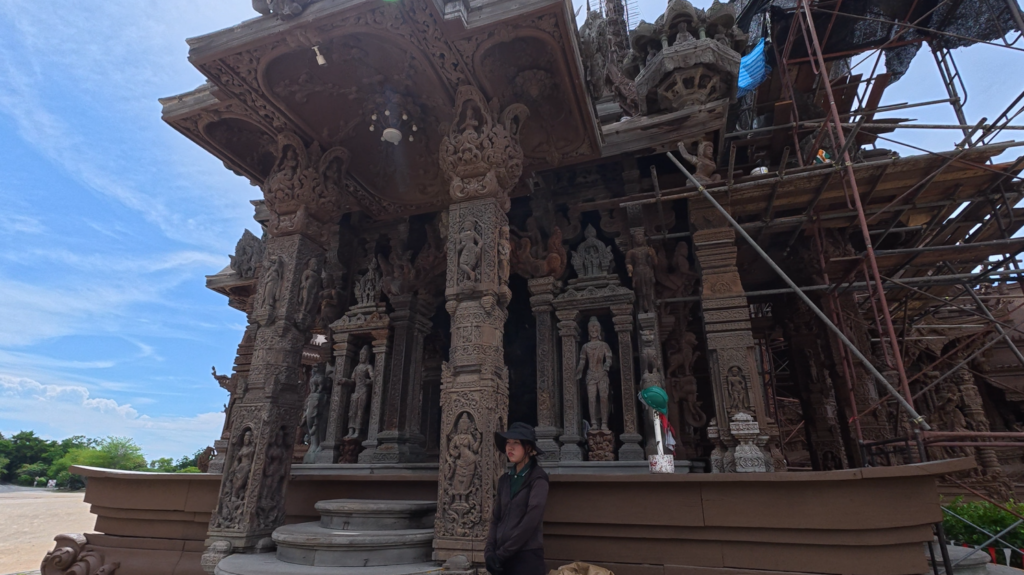
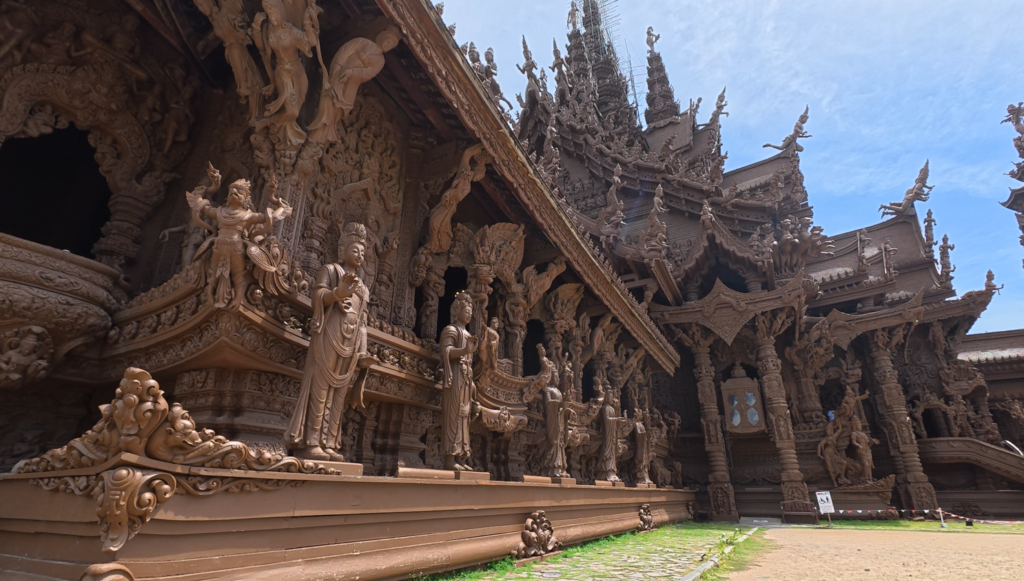
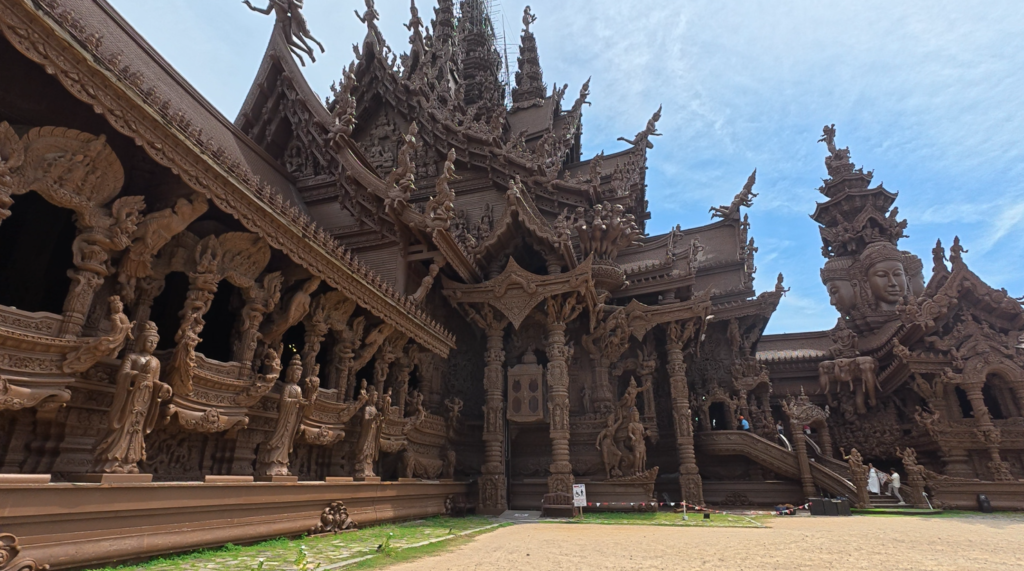
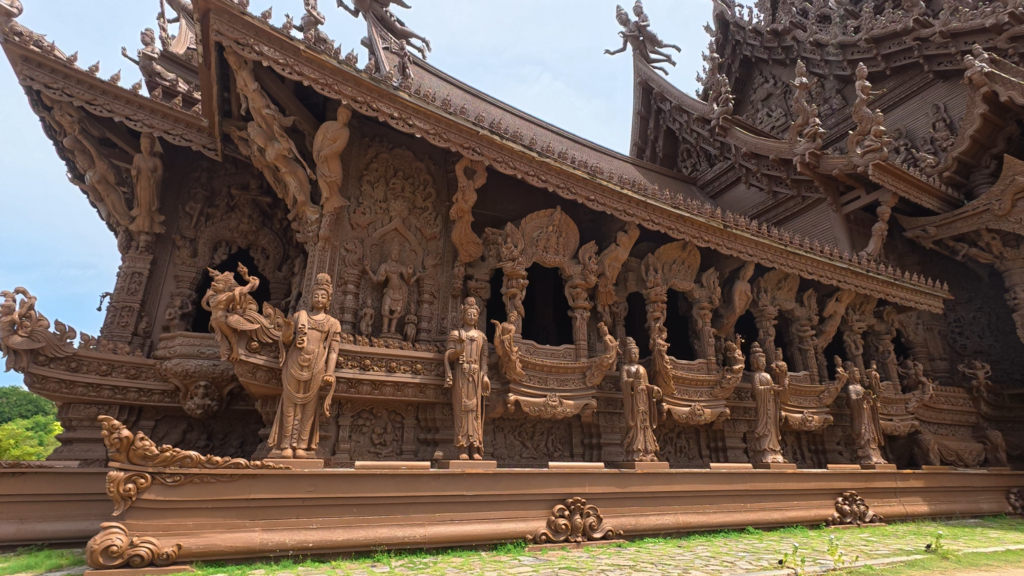
The sanctuary’s four wings and layered rooflines combine monumental Thai wooden architecture with an extraordinary density of hand-carved detail.
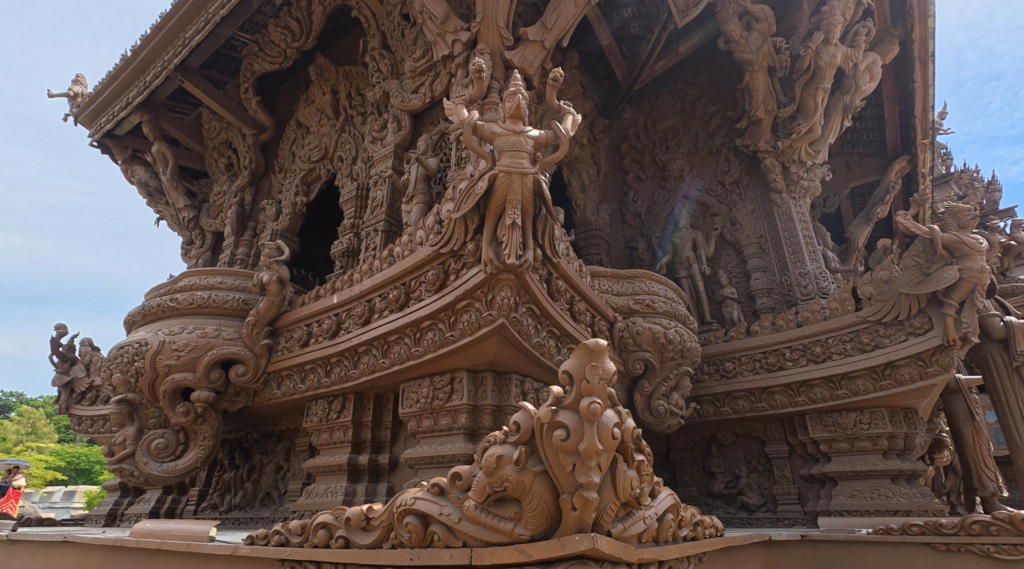
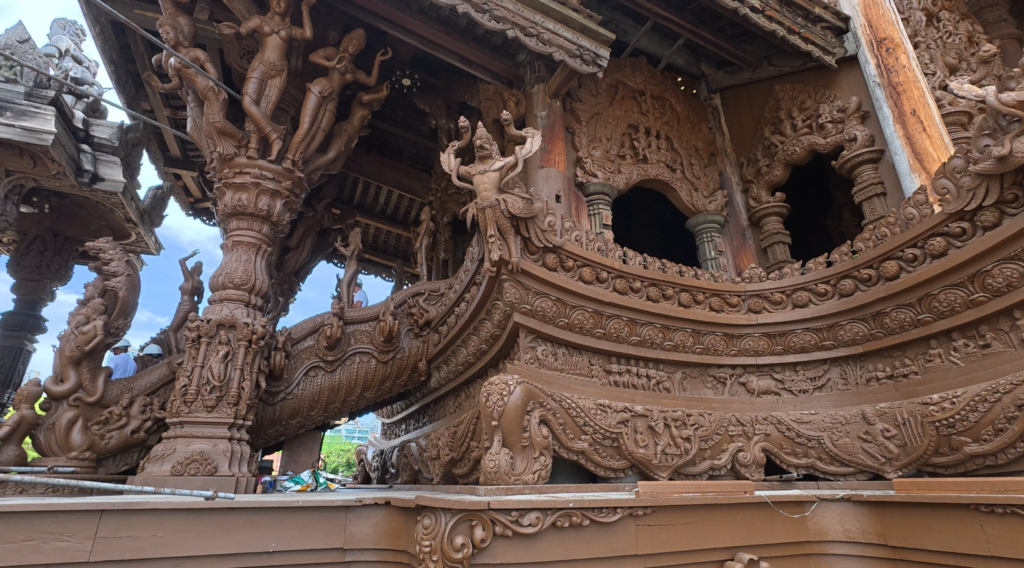
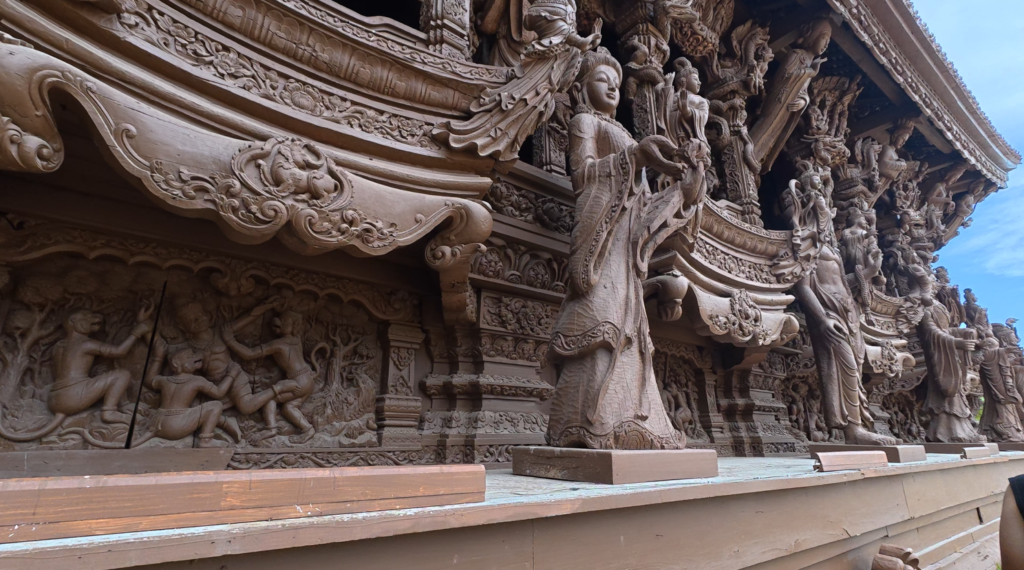
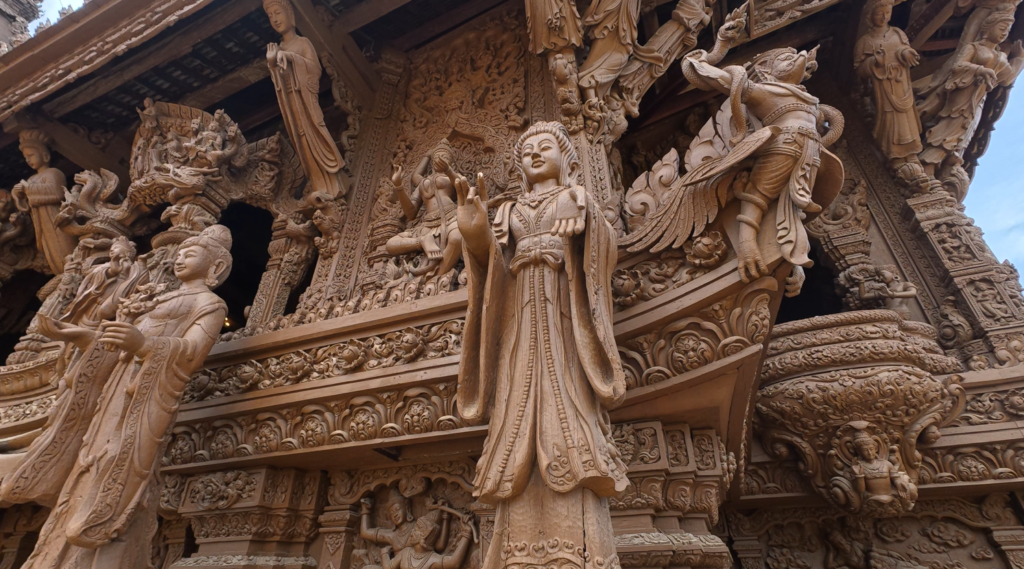
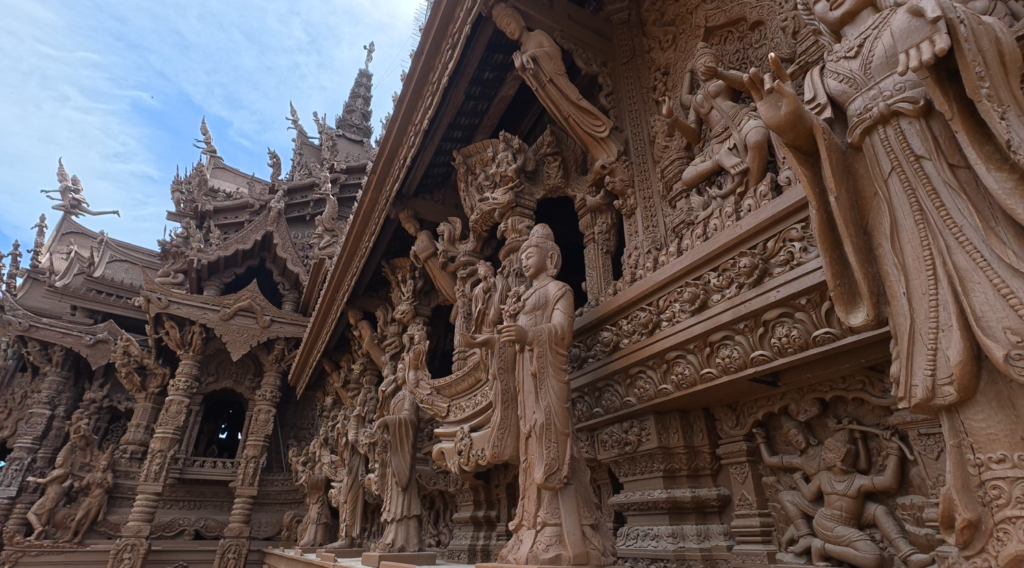
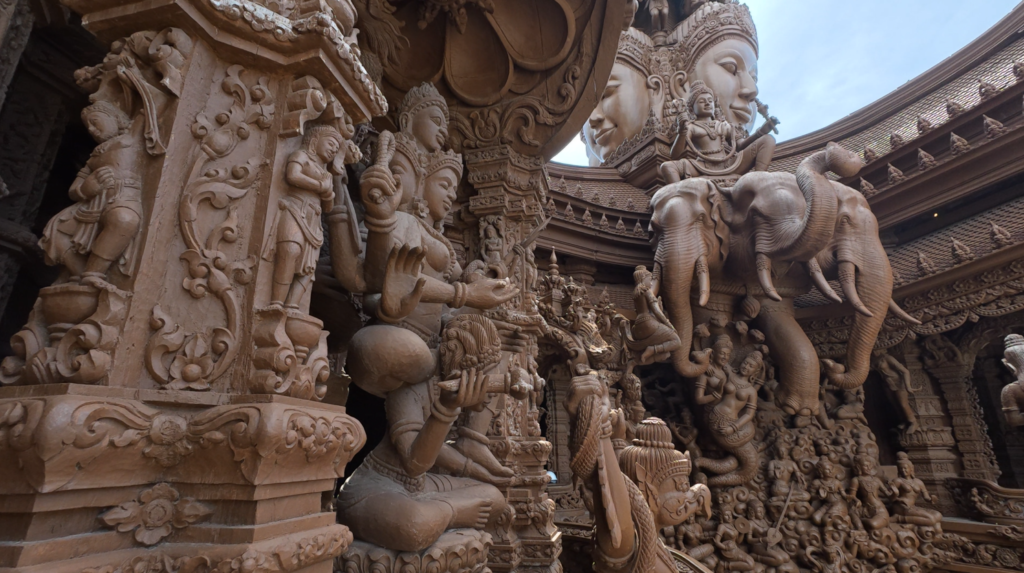
Deities, guardians, celestial beings, and mythological figures form a continuous narrative around the exterior of the wooden sanctuary.
Many Faiths Beneath One Roof
Crossing the threshold changed the experience completely. Outside, the sanctuary had appeared immense and dramatic; inside, it became a forest of carved pillars, arches, ceilings, and human forms. Sunlight entered through the open sides and moved across the dark wood, revealing one story before allowing another to disappear into shadow.
The interior brings together several religious and cultural traditions. Hindu deities and stories of cosmic creation appear alongside Buddhist teachings. Some figures and architectural details reflect Khmer and Angkorian influences, while other sections draw upon Chinese Buddhism, Taoist thought, and traditional Thai Buddhist imagery. Rather than separating these traditions, the sanctuary places them within a single philosophical journey.
This does not mean that all religions are presented as identical. Each retains its own symbols, characters, and artistic language. Yet together they explore shared human concerns: the relationship between heaven and Earth, the duty between parents and children, the consequences of human desire, the importance of compassion, and the possibility of spiritual liberation.
Standing among these carvings, I began to understand that the sanctuary was not attempting to create another religion. It was using the wisdom of many traditions to remind visitors that material progress alone cannot sustain human society. Knowledge must be accompanied by morality, and civilization must remain connected to nature, family, and the spiritual life.
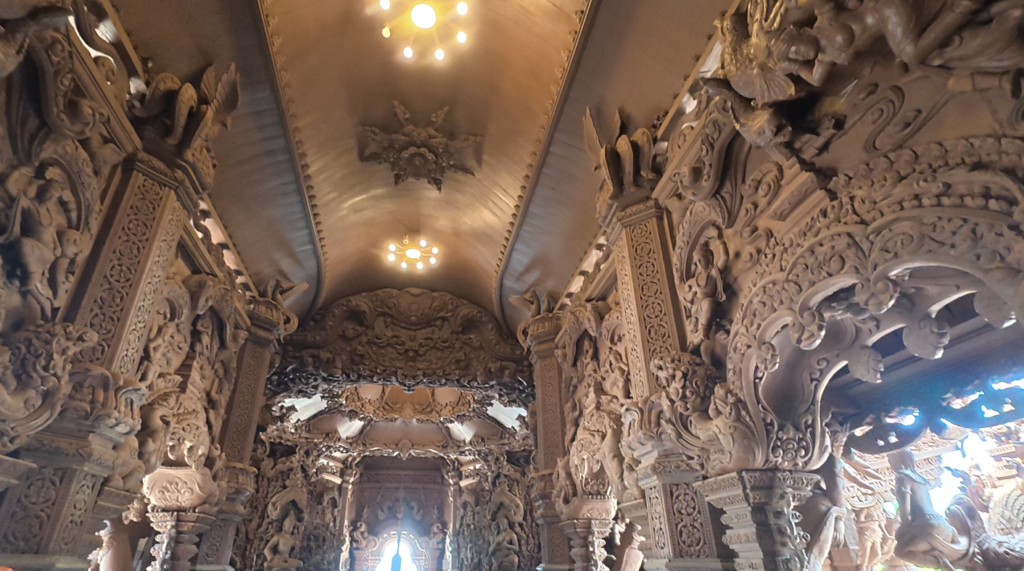
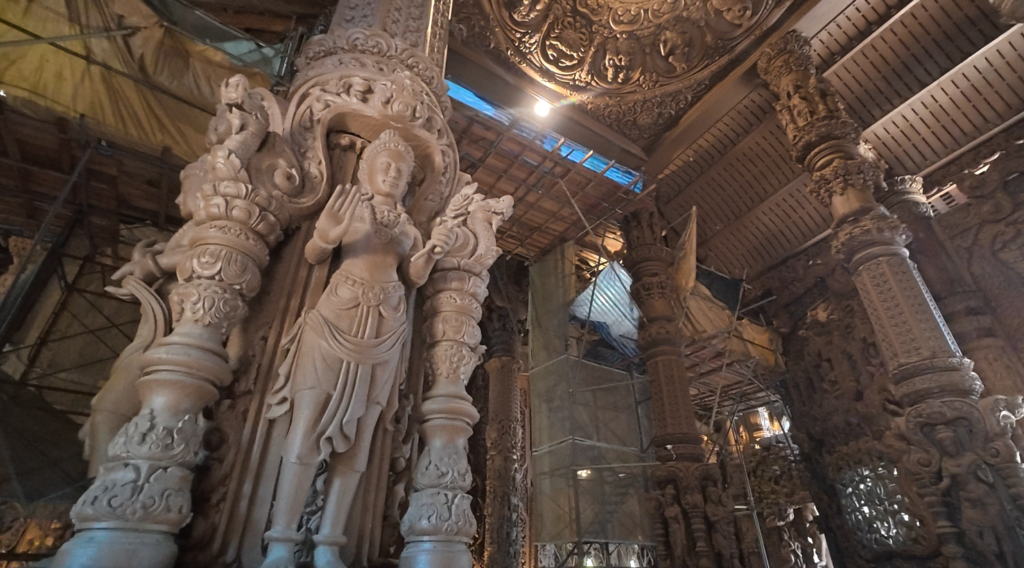
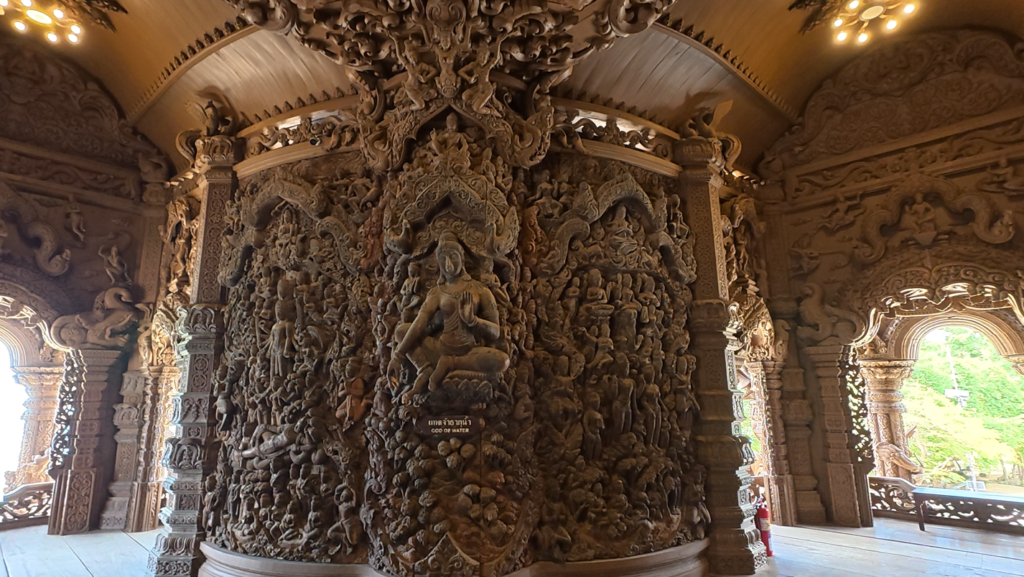
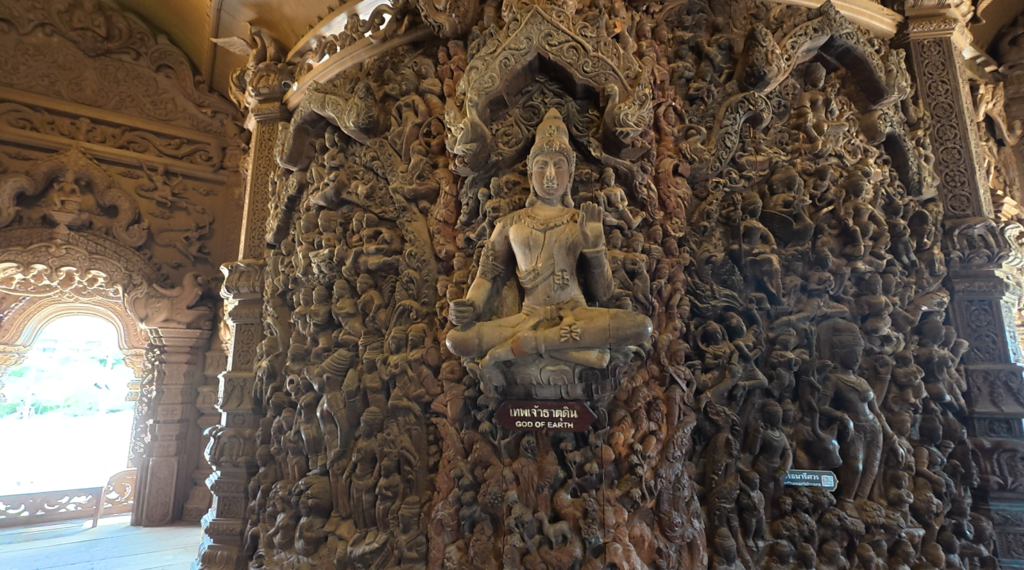
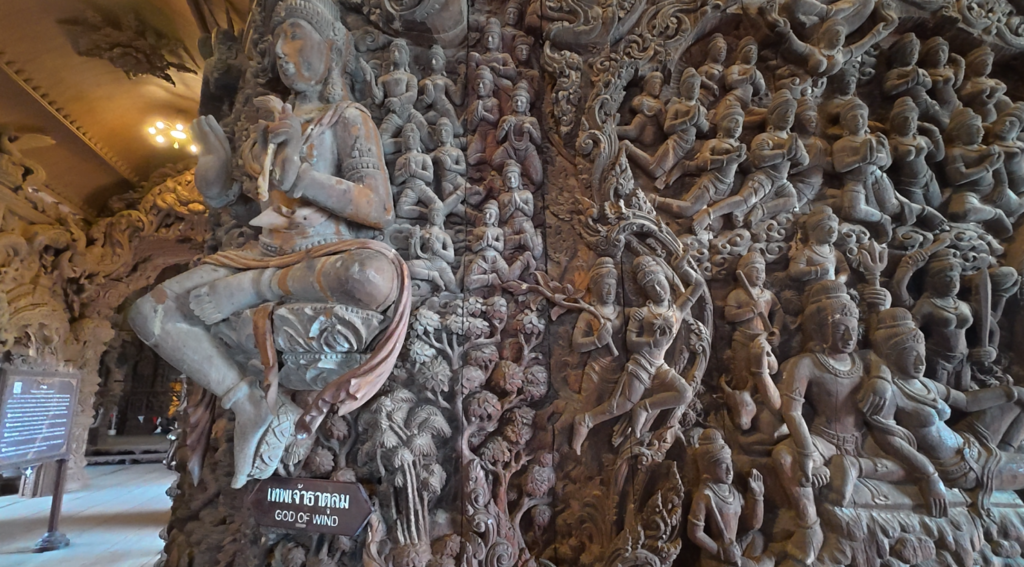
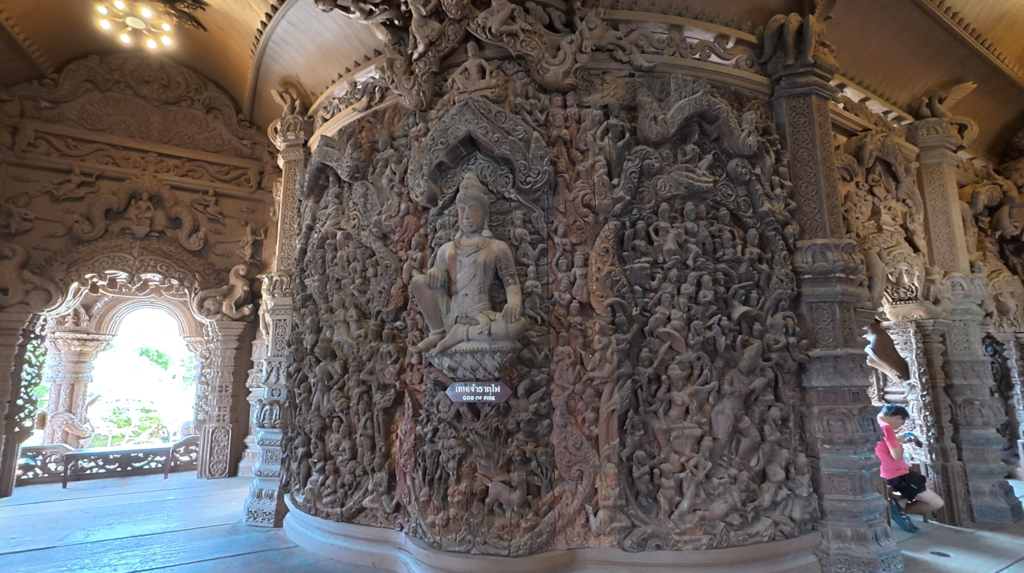
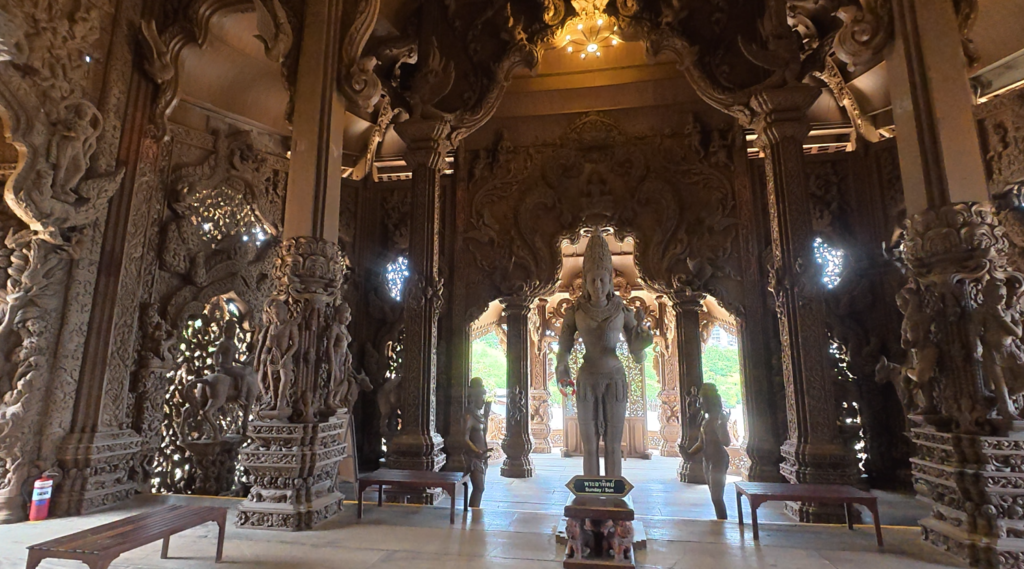
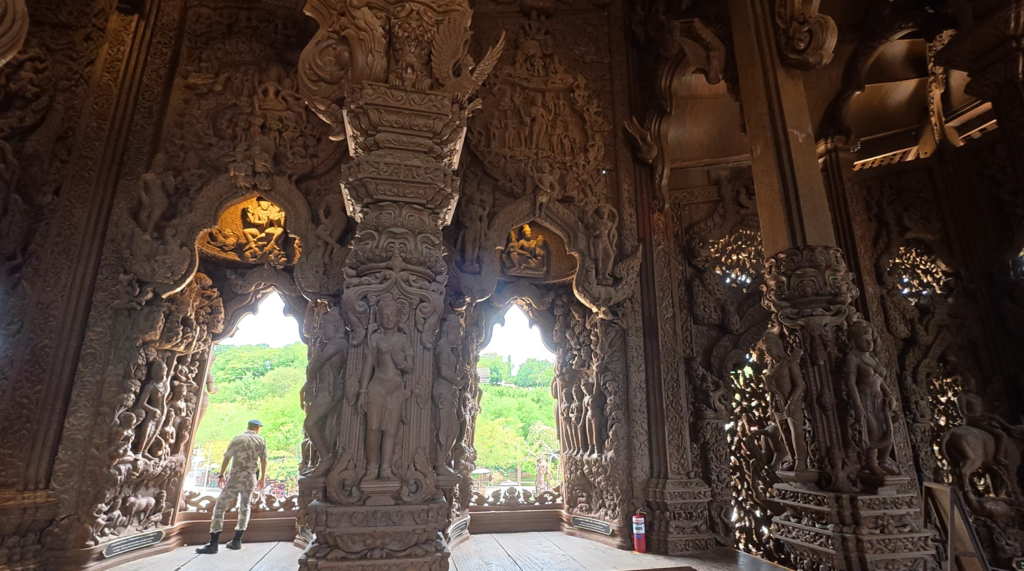
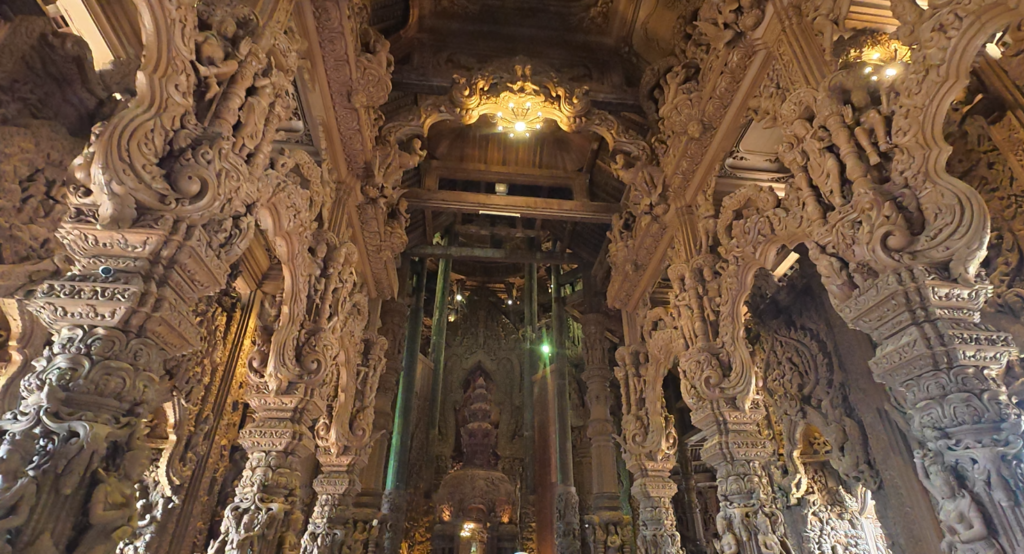
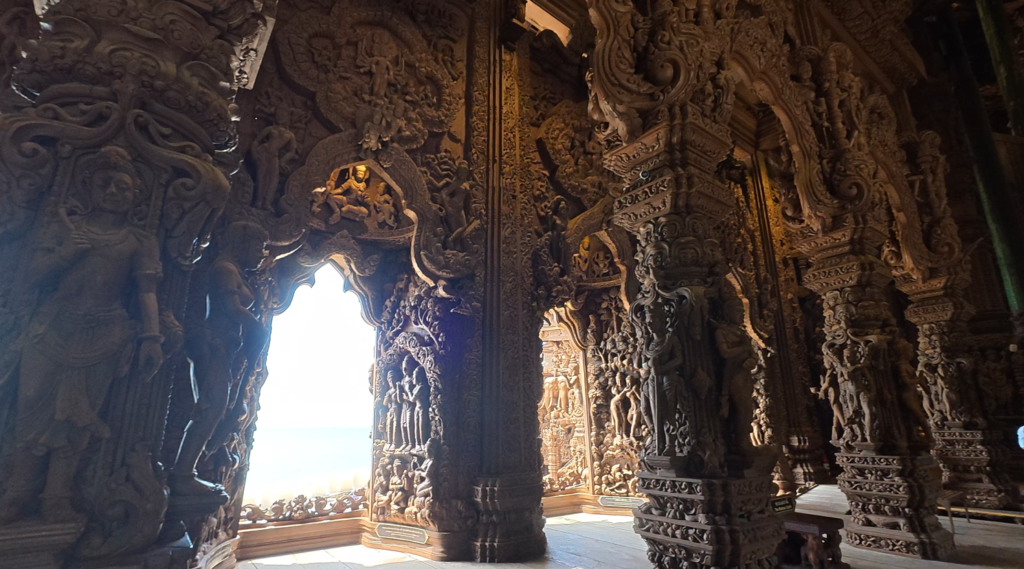
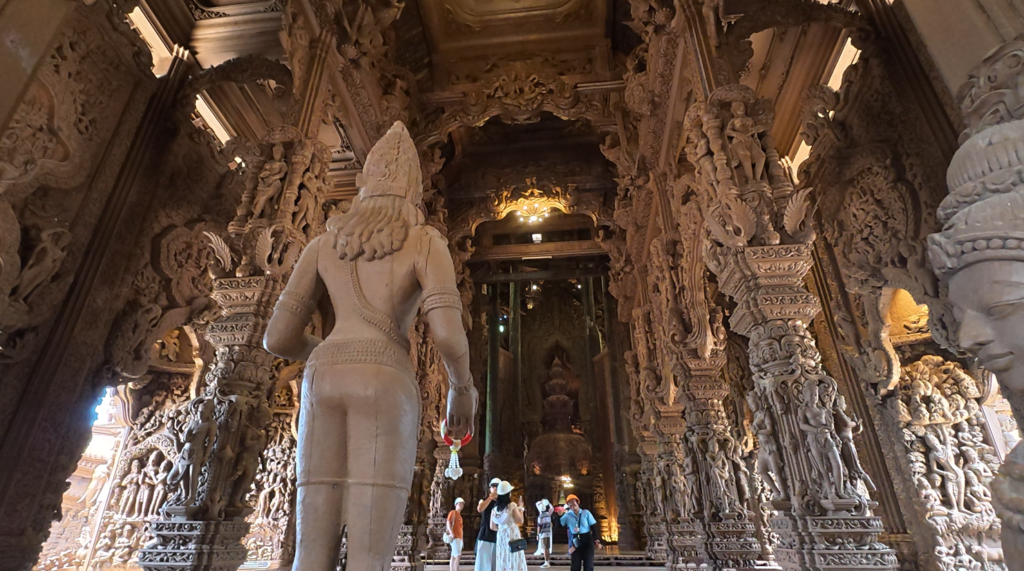
Hindu, Buddhist, Khmer, Chinese, Taoist, and Thai artistic traditions meet within one continuous story about humanity, morality, and the universe.
Sacred Relics at the Heart of the Sanctuary
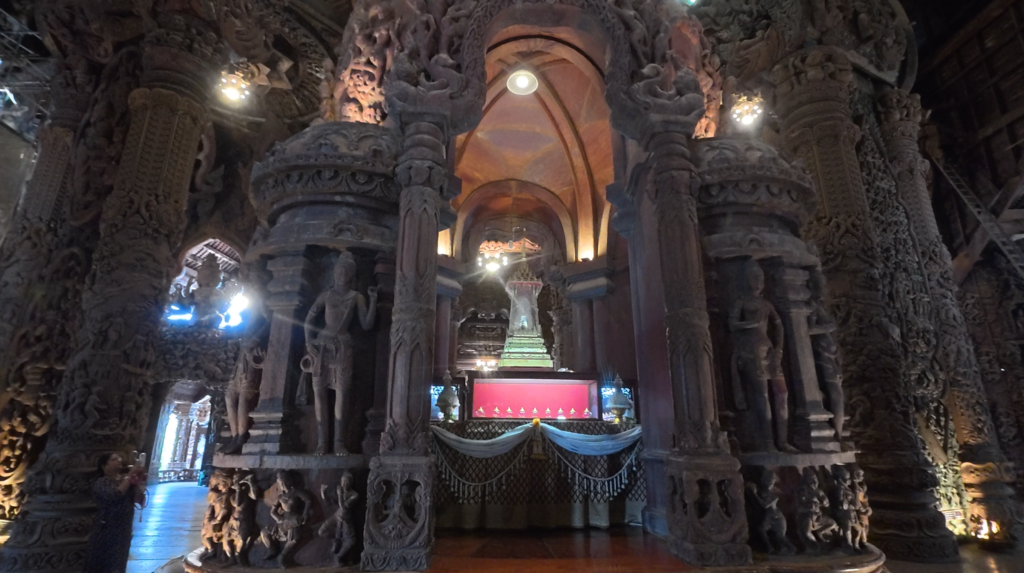
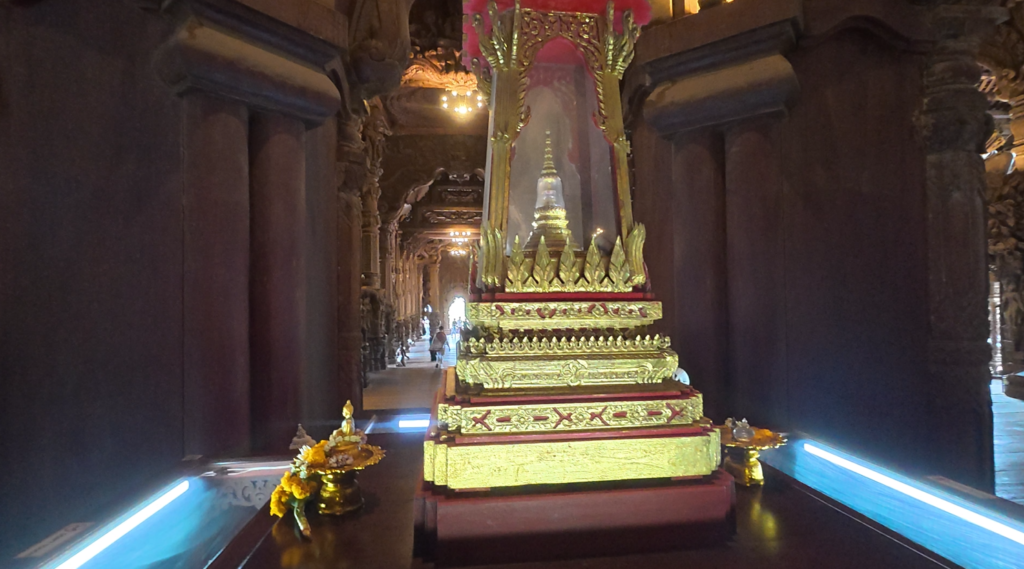
The spiritual and visual journey reaches its quietest point at the center of the sanctuary. Here, within the great central hall, stands an intricately carved wooden pavilion representing release from the material world and the Buddhist ideal of liberation.
Sacred relics presented as those of the Buddha and revered Indian monks are enshrined within this central space. For me, this was the true highlight of the visit. After passing countless deities, celestial beings, guardians, and mythological scenes, I arrived at a place where the scale and complexity of the building suddenly gave way to silence.
At the center of this enormous structure, there is no celebration of wealth, military power, or political authority. Instead, the most honored space preserves the sacred traces of people remembered for wisdom, discipline, and the search for enlightenment. The message felt clear: however impressive human creation may become, its highest purpose should lead us back toward humility and truth.
The sanctuary contains the visual languages of many civilizations, but here their different paths seem to meet. The carvings surrounding the relics no longer felt like separate religious stories. They became parts of a single human question—whether we can overcome greed, ignorance, and conflict, and live with greater compassion.
A Living Work Passed Between Generations
The Sanctuary of Truth has remained under construction since 1981, but “unfinished” does not fully explain what is happening here. New carvings are still being created according to Lek Viriyaphant’s original vision, while older sections must also be repaired or replaced. Standing beside the sea, the wood is constantly exposed to sunlight, humidity, salt, wind, and tropical rain.
No single successor is publicly identified as the sanctuary’s new designer. Lek’s philosophy, drawings, architectural concepts, and system of symbolic narratives remain the guiding plan. His descendants and the organization that inherited the project continue to support it, while researchers, engineers, designers, and generations of Thai woodcarvers interpret and preserve the original vision.
This makes the sanctuary more than a building waiting for completion. It is a living school of craftsmanship. Experienced artisans pass traditional knowledge to younger workers, and ancient methods of wooden joinery continue to be practiced on a monumental scale. One generation begins a carving, another protects it, and a future generation may eventually replace it.
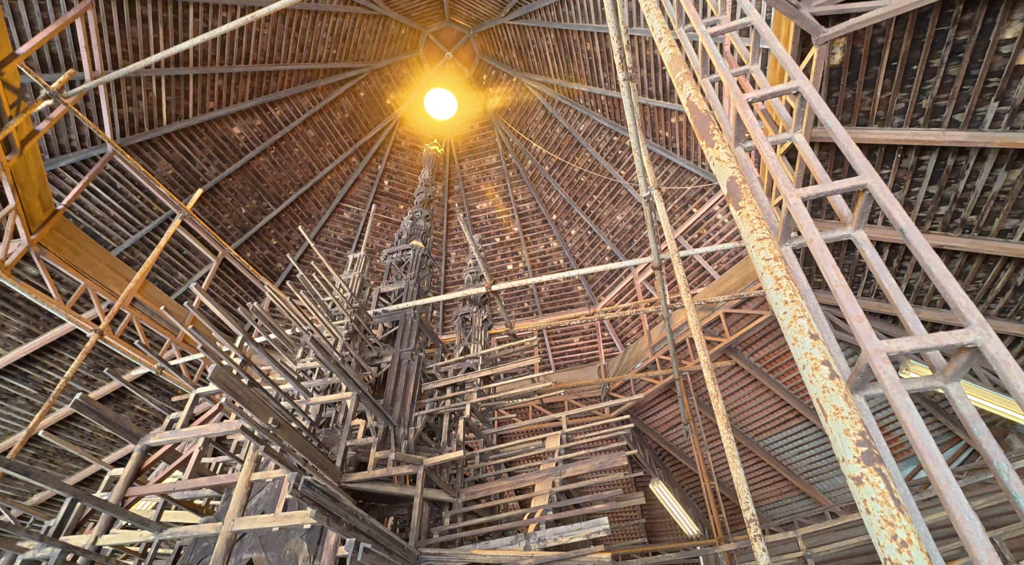
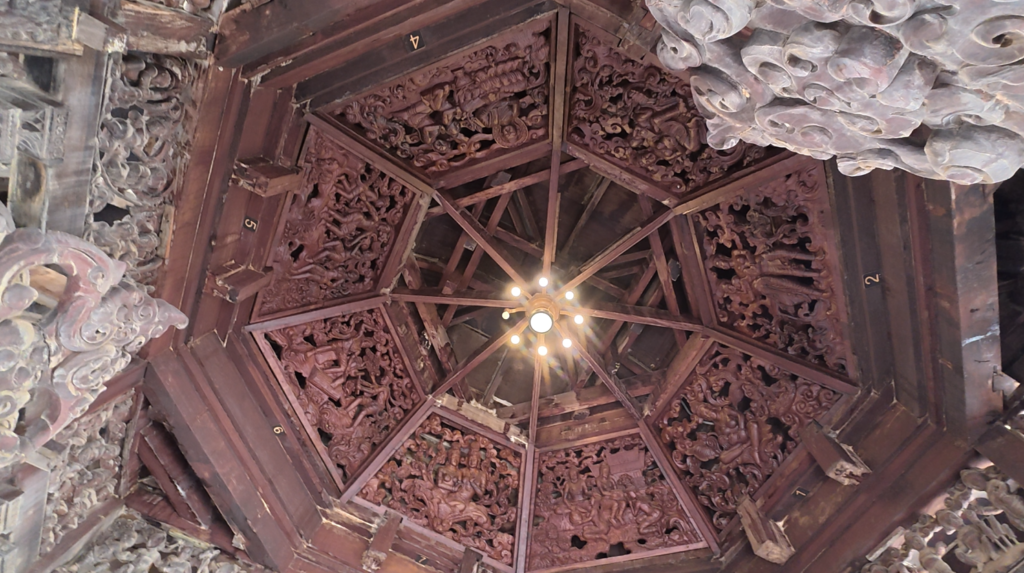
Looking upward at the carved ceilings and towering interior structure, I realized that continuing construction is part of the sanctuary’s meaning. Like human life itself, it is never completely finished. It is created, damaged by time, repaired, and entrusted to those who come next.
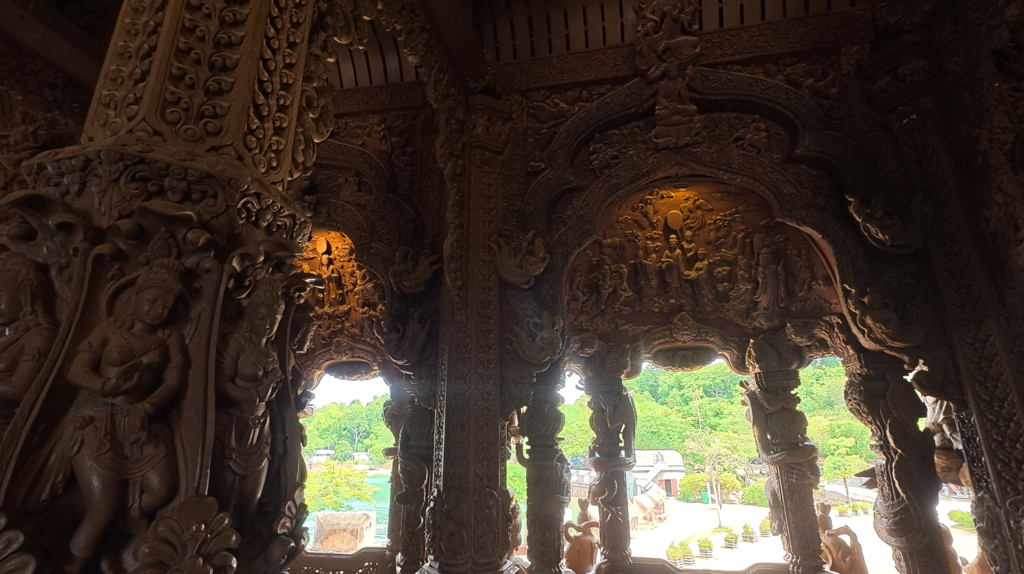
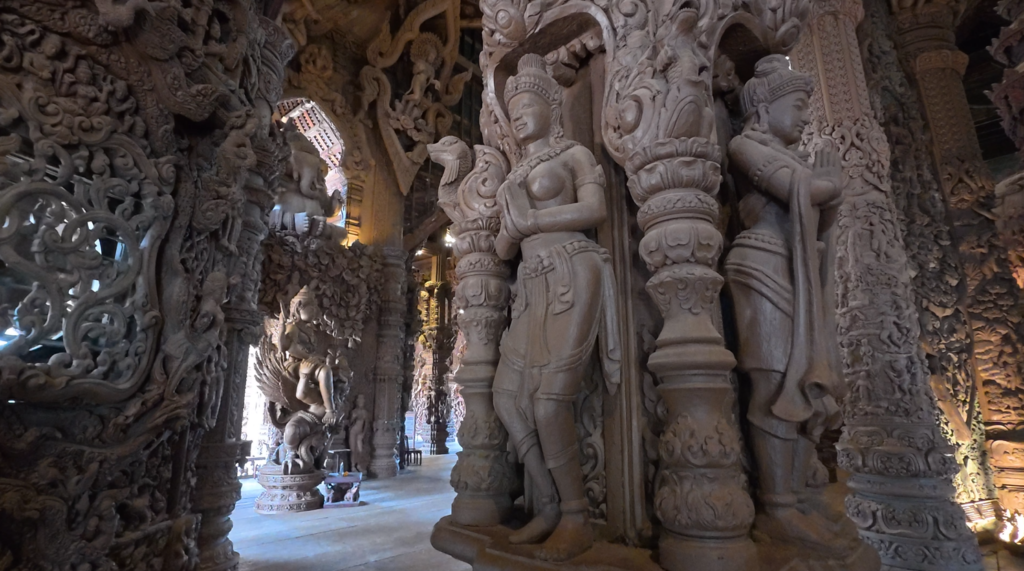
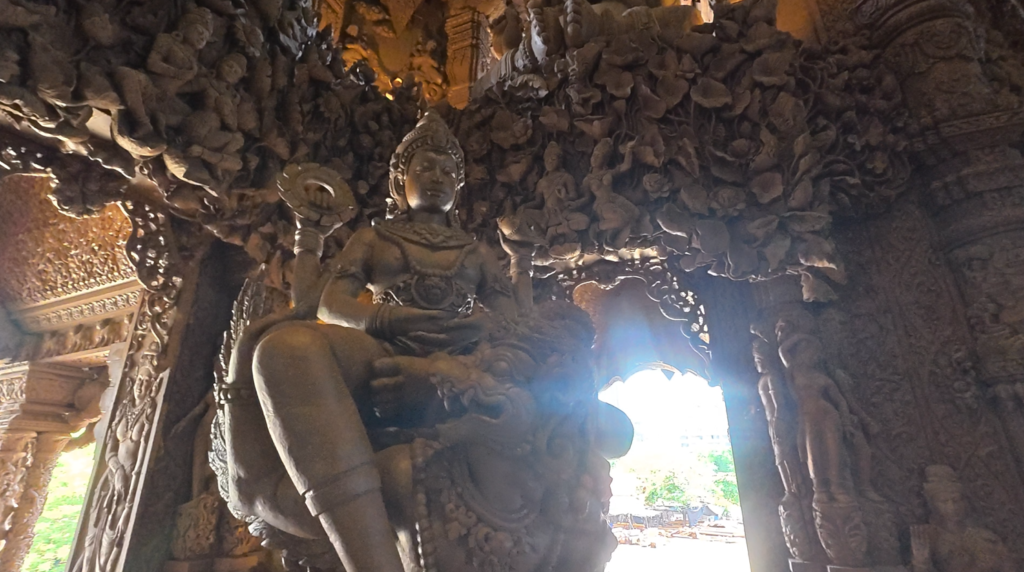
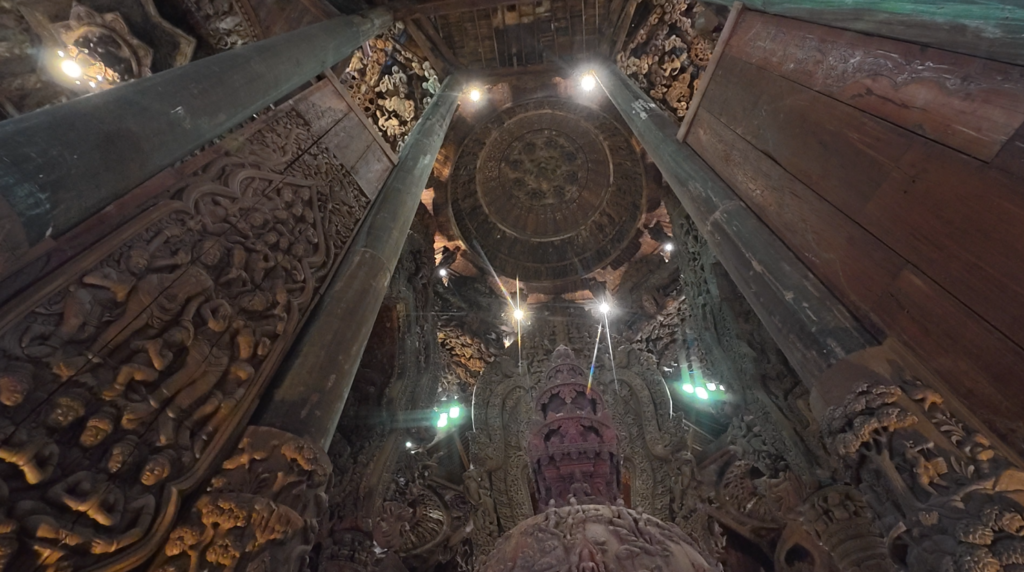
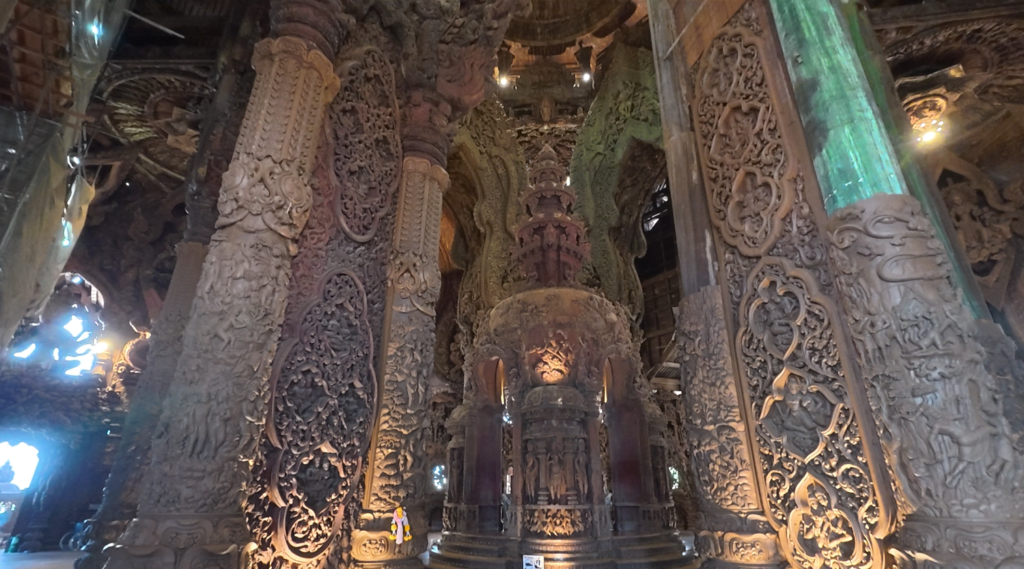
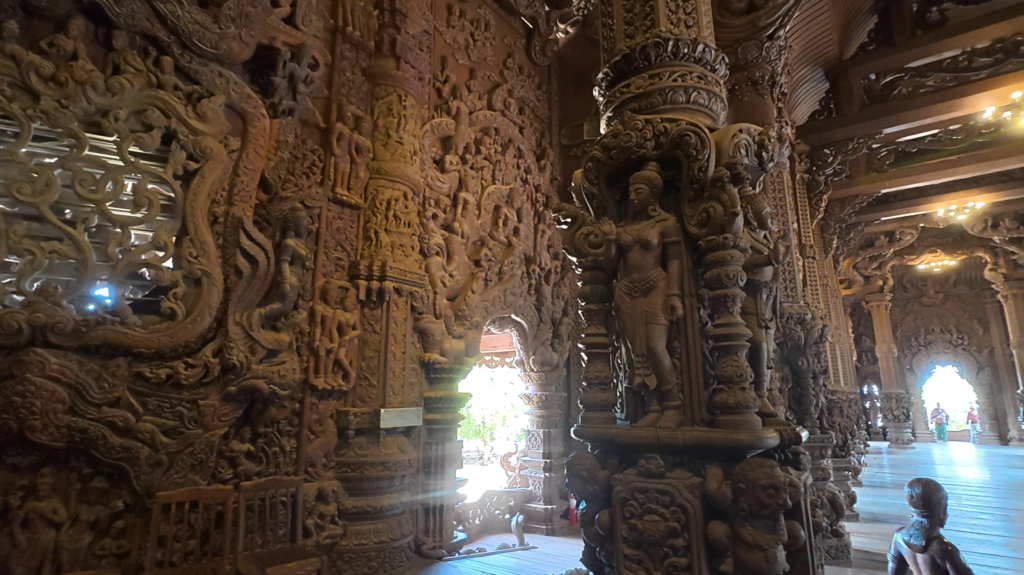
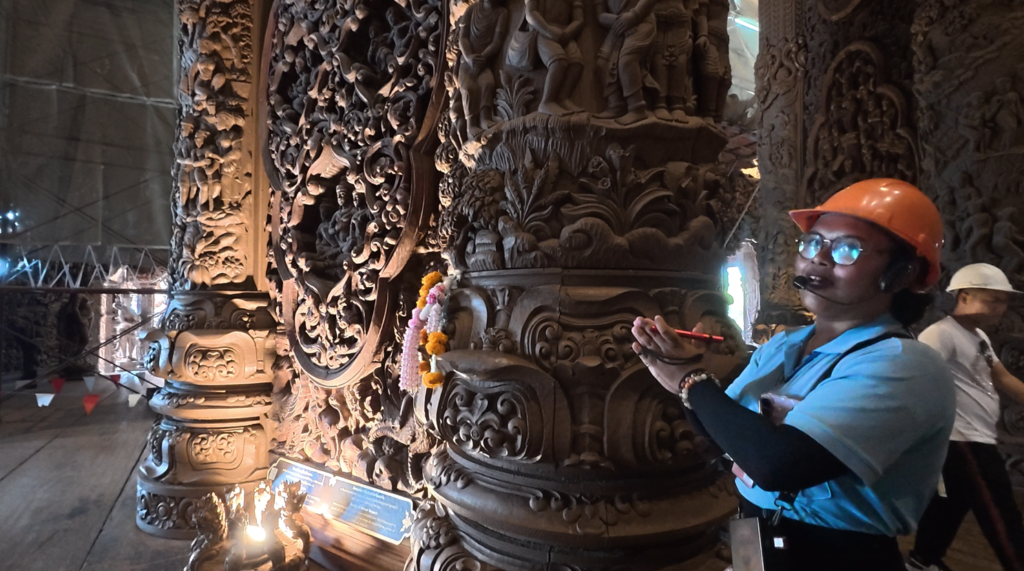
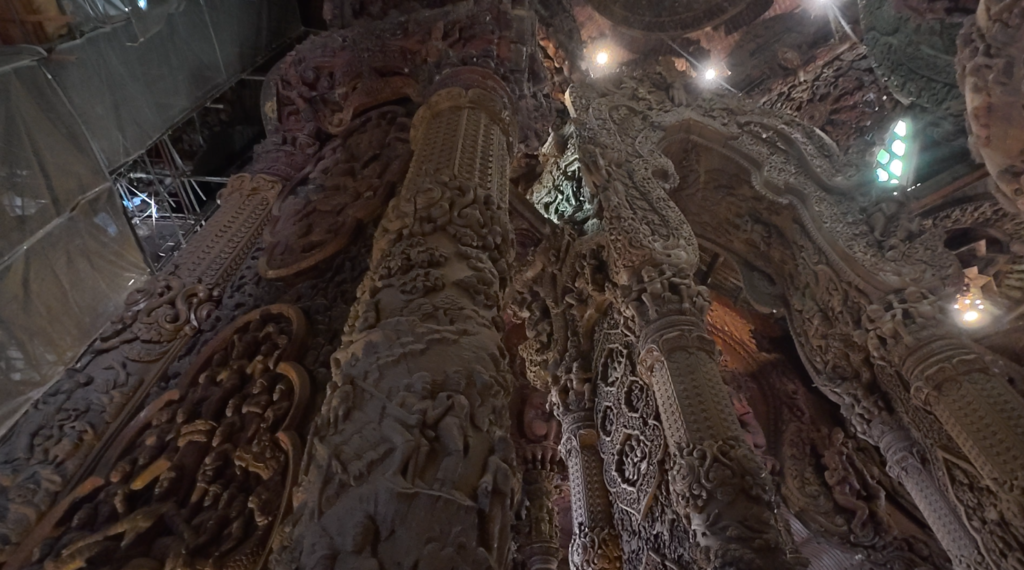
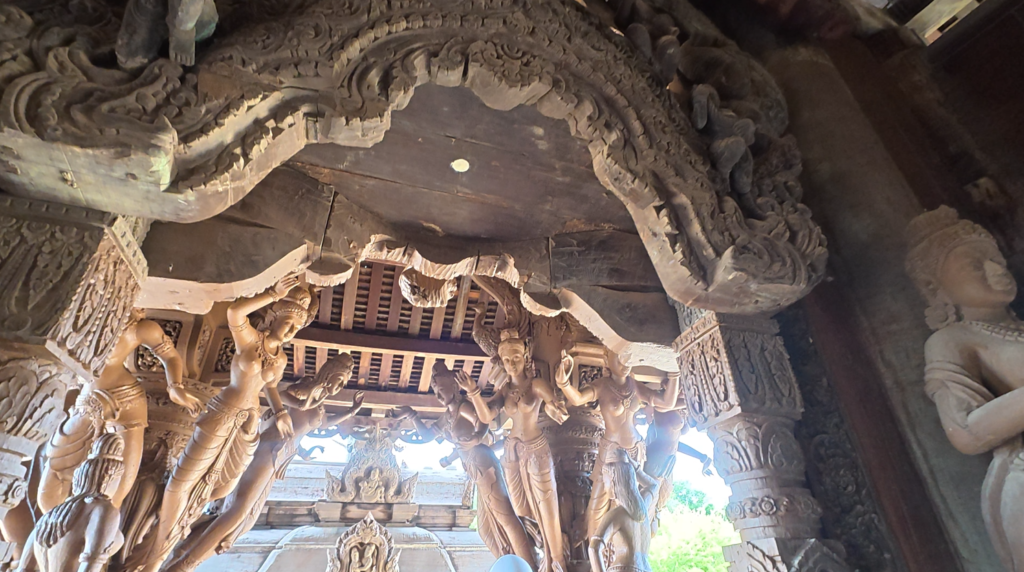
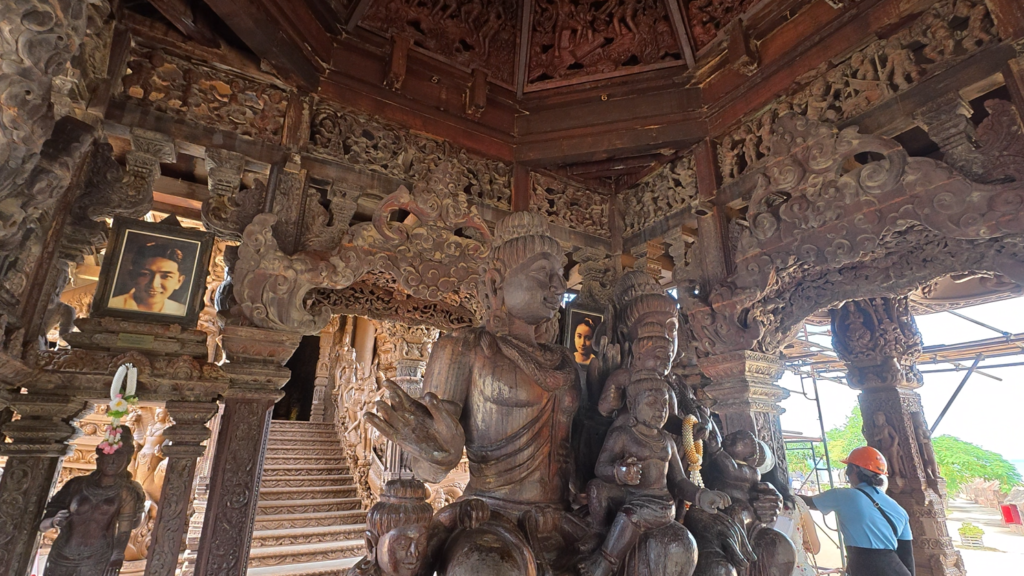
Looking upward through the carved halls, every column and ceiling reveals work created, maintained, and passed between generations of Thai craftsmen.
The Couple Behind the Vision
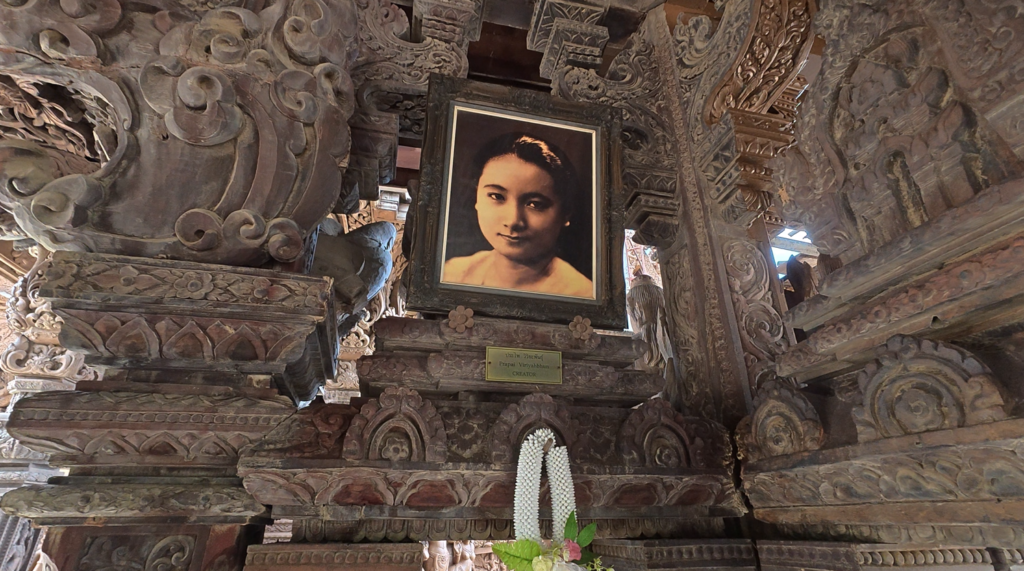
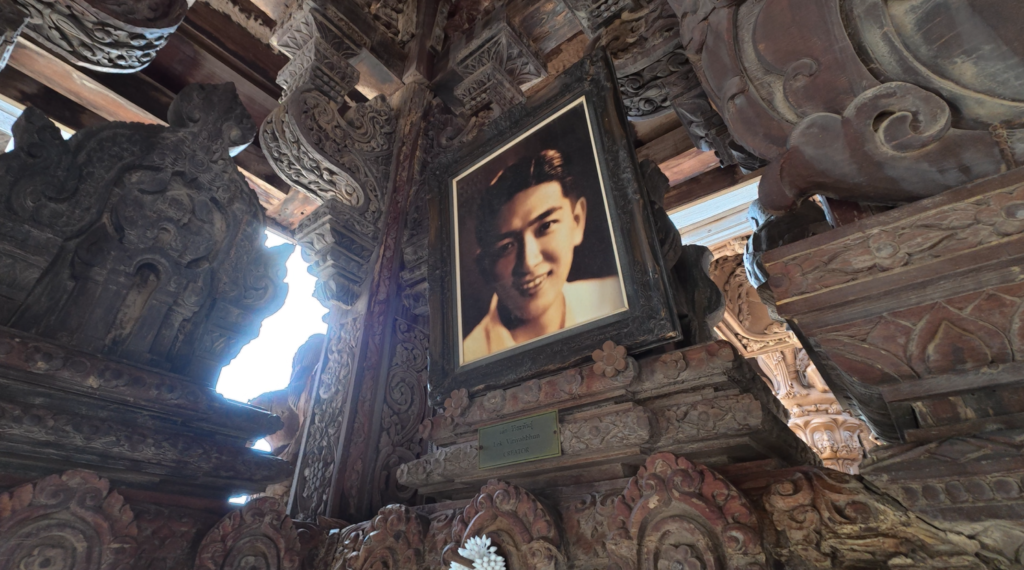
Near the end of my visit, I encountered portraits of the two people responsible for this extraordinary place: Lek and Prapai Viriyaphant. Their images changed the direction of my story. Until then, I had been looking mainly at architecture and sculpture. Now I wanted to understand the human lives behind them.
Lek Viriyaphant was born in Bangkok in 1914 to a Chinese business family that operated a traditional pharmacy in the Sampeng district. As a young man, he studied politics and administration in Shanghai, where encounters with Chinese tradition, Western modernity, religion, philosophy, and art broadened his view of civilization. He returned to Thailand when his father became ill and continued the family business.
In 1938, he married Prapai Viriyaphanich, the daughter of another established Thai-Chinese business family. Prapai became far more than the wife of a successful entrepreneur. Official accounts describe her as Lek’s lifelong companion, adviser, inspiration, and essential supporter in both business and cultural work.
Lek later helped establish Monthon Bank and developed the Thonburi automotive businesses, including automobile assembly and the Mercedes-Benz trade in Thailand. His commercial success made him one of the country’s leading businessmen, but accumulating wealth was not the final purpose of his life. He gradually redirected his time, energy, and fortune toward the preservation of Thai history and Eastern spiritual culture.
Together, Lek and Prapai began creating the Ancient City in Samut Prakan in 1963. Rather than constructing a simple theme park, they worked with scholars and traveled throughout Thailand for years, recording historic buildings, local landscapes, traditional communities, and endangered architectural knowledge. The result became a living museum where structures damaged or lost elsewhere could be studied and remembered.
Construction of the Sanctuary of Truth began in 1981. Lek conceived it during the Cold War, when ideological conflict and material competition seemed to dominate the world. He wanted architecture and sculpture to remind humanity that technological progress without morality could never create lasting peace.
Prapai died in 1992 after suffering from diabetes. Lek preserved her memory at the Ancient City and established a cultural foundation in her name. Two years later, construction of the Erawan Museum began as a home for the art and sacred objects he had collected. Lek continued working on all three cultural projects until his death in 2000 at the age of 86.
Their children and grandchildren inherited more than property. Their eldest son continued and completed the unfinished Erawan Museum, while later generations have maintained the Ancient City, the Sanctuary of Truth, and the cultural foundation bearing the couple’s names. The family inherited prosperity, but also the responsibility of protecting a legacy intended for people they would never meet.
The Meaning of the Five Spires
The information boards near the end of the route helped bring the sanctuary’s many ideas together. They explain that Lek and Prapai Viriyaphant created three major cultural places: the Ancient City, the Sanctuary of Truth, and the Erawan Museum. Although different in appearance, all three were intended to preserve cultural memory and encourage people to examine the values guiding human society.
The five principal spires of the Sanctuary of Truth express that purpose through symbolic figures. The first, an angel holding a lotus, represents a firm determination to work for peace between heaven and Earth. The second holds a sacred book and points toward knowledge inherited wisdom—the need to study where we came from, who we are, and what purpose should guide our lives.
The third spire shows an angel guiding a child and supporting an elderly person. It represents morality, compassion, and responsibility toward others within society. The fourth depicts an angel with a bird and a sheaf of rice, suggesting that a good life can illuminate the way for others and help create a peaceful community.
The fifth spire brings these virtues together through an angel riding a horse and carrying symbols of peace and sacred goodness. It represents the hope that the finest qualities found throughout humanity can become one force for peace in society and across the world.
After walking through the building, these symbols no longer seemed like distant philosophical statements. The carvings inside had already shown how knowledge, family, morality, nature, compassion, and spiritual discipline depend upon one another. The five spires simply lift that message into the sky.
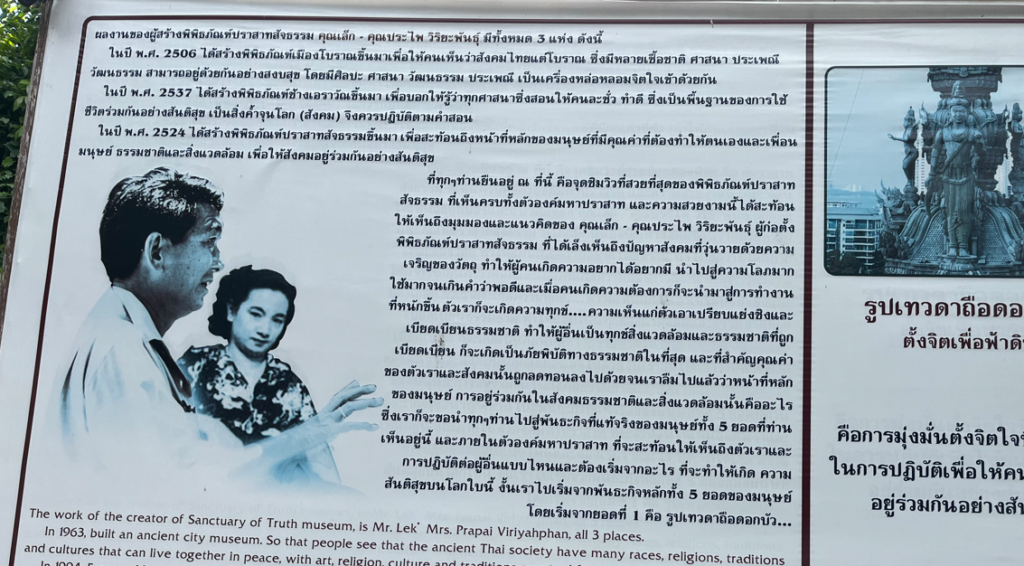
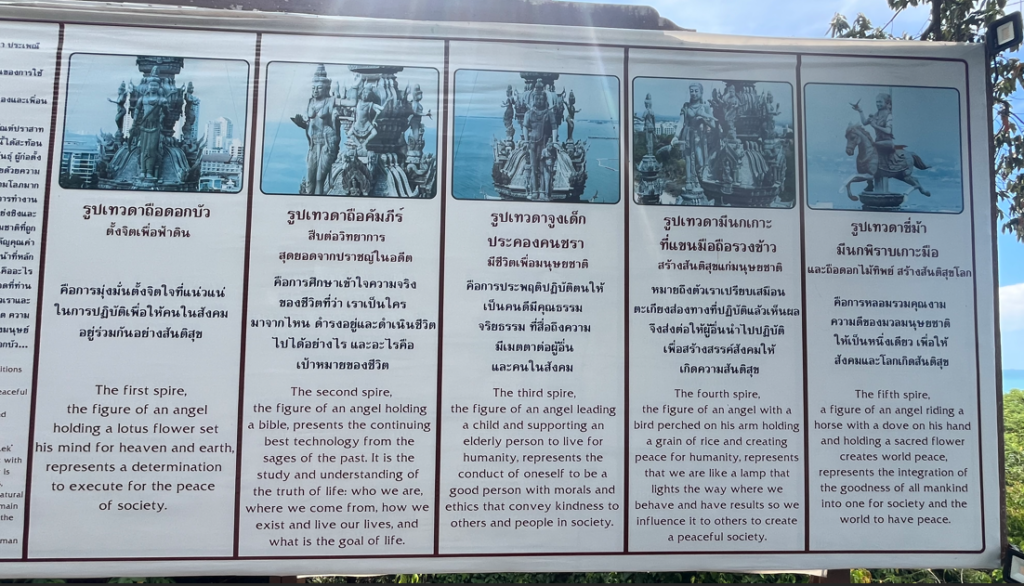
The founders’ philosophy and the meaning of the five spires reveal that the sanctuary was conceived not simply as a monument, but as a lesson about human responsibility and peace.
What I Found After Eighteen Years
I entered the Sanctuary of Truth carrying an old prejudice. For eighteen years, I had regarded it as a place designed mainly to impress tourists. I left with a very different understanding. The building was magnificent, but the life behind it affected me more deeply than its size or decoration.
Lek Viriyaphant inherited his family business and transformed it into remarkable commercial success. What makes his life exceptional, however, is not the fortune he accumulated. He used that fortune to preserve Thailand’s history, cultural memory, traditional craftsmanship, and the spiritual wisdom of the East.
Many wealthy people leave property and money to their descendants. Lek and Prapai left something more demanding: a purpose, a responsibility, and a cultural legacy. Their children and grandchildren inherited prosperity, but they also inherited the task of preserving works that may never be considered completely finished.
A human life eventually ends, and wealth cannot remain with its owner forever. But when wealth is transformed into knowledge, beauty, and a gift for future generations, its meaning can continue long after its creator is gone.
Lek Viriyaphant died in 2000, but his vision remains alive in every wooden carving, every craftsman continuing the work, and every visitor who pauses here to think about life. He is gone, yet the work he began may endure for centuries.
Today, Won Cub Life discovered something much greater than a famous building in Pattaya. I discovered how one person’s success can become a legacy for humanity. I arrived as a skeptical visitor, but I rode away with profound respect for the path he chose.
Won Cub Life continues, carrying one more important story from the road.
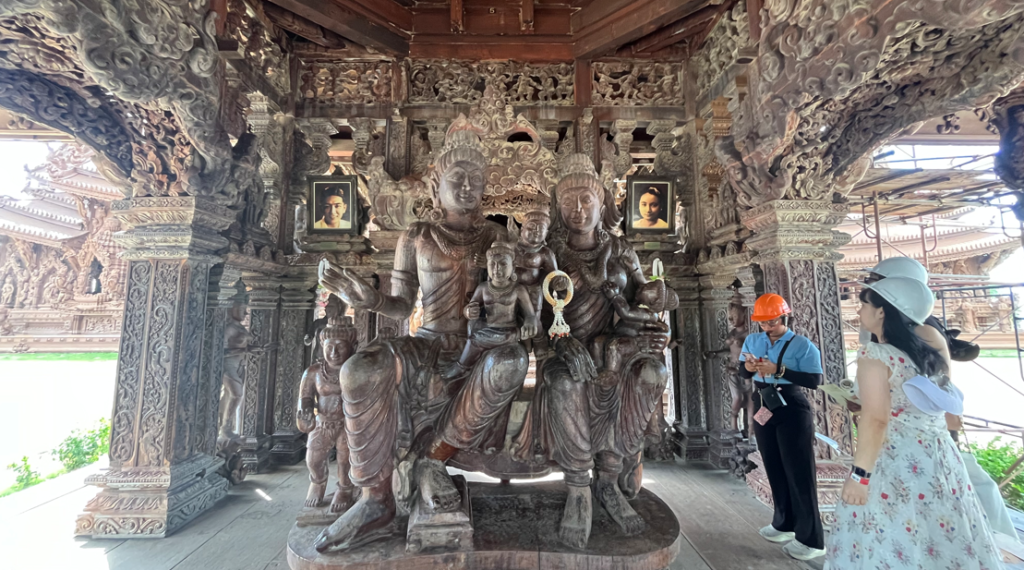
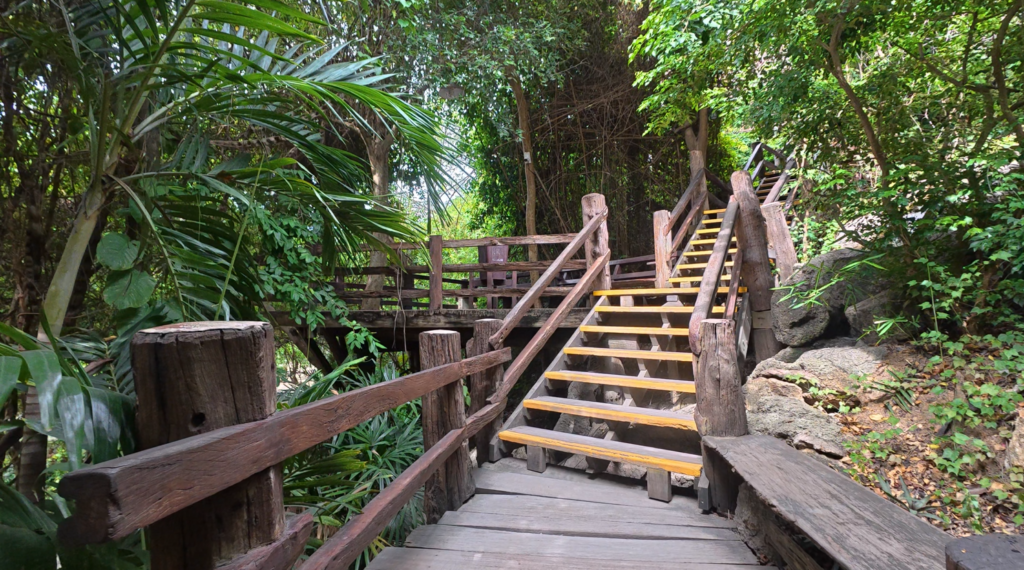
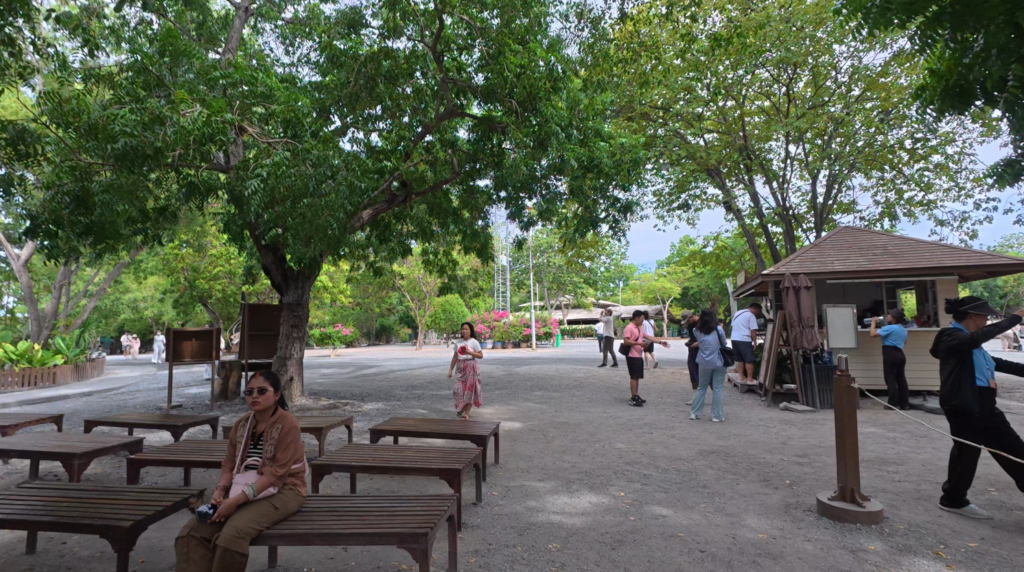
Leaving the sanctuary with a different perspective—the building was unforgettable, but the lives and purpose behind it became the most important discovery of the day.
Location and Visitor Information
Location: 206/2 Moo 5, Pattaya–Naklua Road, Naklua, Bang Lamung District, Chonburi 20150, Thailand
Opening Hours: Open daily. Day tours operate from approximately 8:20 AM to 6:00 PM, with daytime tickets available until 5:00 PM. Night tours operate from approximately 6:20 PM to 8:30 PM.
Admission: Adult day ticket: 500 THB; adult night ticket: 700 THB. Children measuring 110–140 cm: 250 THB for the day tour and 350 THB for the night tour. Children under 110 cm enter free. Free parking is available. Prices and schedules may change, so check the official website before traveling.
Best Time to Visit: Early morning offers cooler temperatures, while late afternoon gives the wooden exterior a warmer color. Allow extra time if you want to study the carvings rather than simply walk through the building.
Dress: Wear respectful clothing covering the shoulders and knees. This is officially a museum, but its religious imagery, sacred relics, and spiritual purpose deserve the same consideration given to a place of worship.
Photography: General photography is permitted in much of the complex. Follow staff instructions around sacred objects, restricted areas, active construction, and guided groups. Avoid touching the carvings or using equipment that obstructs other visitors.
Visit Time: Allow at least two hours. A visit of around three hours is better for examining the exterior, watching the craftsmen, exploring the interior halls, and reading the philosophical displays.
Footwear and Safety: Wear comfortable shoes suitable for slopes, stairs, wooden walkways, and uneven surfaces. Because construction and restoration remain active, visitors may be required to wear a safety helmet in designated areas.
Google Maps: Open the Sanctuary of Truth in Google Maps
Official Information: Current admission prices, opening hours, and guided-tour schedules are available from the Sanctuary of Truth Museum official website.
Continue Exploring the Vision
The Sanctuary of Truth becomes even more meaningful when viewed alongside the other cultural works created by Lek and Prapai Viriyaphant. The official resources below provide further information about the couple’s philosophy, their museums, and the cultural research continued in their names.
External Links
- Sanctuary of Truth Museum
Anchor: Explore the philosophy and continuing construction of the Sanctuary of Truth - Muang Boran – The Ancient City
Anchor: Discover Lek and Prapai Viriyaphant’s vision at the Ancient City - Erawan Museum
Anchor: Learn how the Viriyaphant family continued the Erawan Museum - Lek–Prapai Viriyaphant Foundation
Anchor: Explore the cultural research continued by the Lek–Prapai Viriyaphant Foundation
Related Won Cub Life Story
Another remarkable cultural sanctuary near Pattaya also began with one person’s determination to preserve a spiritual and artistic heritage. Continue the journey at Viharn Sien, where Thai and Chinese history meet through religion, sculpture, and cultural exchange.