Ayutthaya Royal Chronicles Part 2 Korean translation continues the chronicle through the later reigns and the fall of the capital in 1767.
Phra Phutthabat in Saraburi, home to the sacred Buddha’s Footprint revered by Thai Buddhists.
This second part continues the Korean translation of the Ayutthaya Royal Chronicles, following the kingdom through royal successions, court conflicts, religious patronage, diplomatic missions, and military campaigns. The chronicle’s final pages describe the Burmese siege and the fall of Ayutthaya in 1767.
Use the contents and subject index below to jump to a page in the PDF. Page numbers refer to the PDF viewer. For historical context, see the Korean translation of Part 1.
Ayutthaya Royal Chronicles Part 2 Korean translation: This volume continues the chronicle through the final centuries of the Ayutthaya kingdom and the capital’s fall in 1767.
The volume follows royal succession and state affairs across the final centuries of the Ayutthaya kingdom. Its entries move from ceremonies at court to events in distant provinces, showing how the capital’s rulers managed religious life, diplomacy, and warfare. Rather than presenting these subjects as separate modern chapters, the source records them within the reigns and events of the time.
Readers can follow accounts of royal ceremonies and sacred images, including the royal journey associated with the Buddha’s Footprint in Saraburi. Other passages refer to the Japanese community and Japanese fighters in Ayutthaya, as well as diplomatic contact with European envoys. The chronicle also describes campaigns and conflicts involving Ava, Burma, Chiang Mai, Cambodia, Nakhon Ratchasima, and Nakhon Si Thammarat.
The final part turns to the political crisis that preceded the fall of Ayutthaya. It records the Burmese advance, the siege and destruction of the capital in 1767, and the fate of members of the royal family after the city fell. These closing entries connect the end of the old capital with the emergence of new centers of power in the following period.
The linked contents list the principal reigns covered in this volume. The subject index provides another route through the text by grouping people, temples, wars, and events. Select a page link to open the corresponding page in the embedded PDF. Page references use the PDF viewer’s numbering, which differs from the printed pagination inside the chronicle. These links are intended for quick reference while reading. The translation keeps the source’s chronological arrangement, allowing readers to follow how court decisions, religious patronage, and regional conflicts appear in the royal record.
This Ayutthaya Royal Chronicles Part 2 Korean translation also links the subject index directly to the relevant PDF pages.
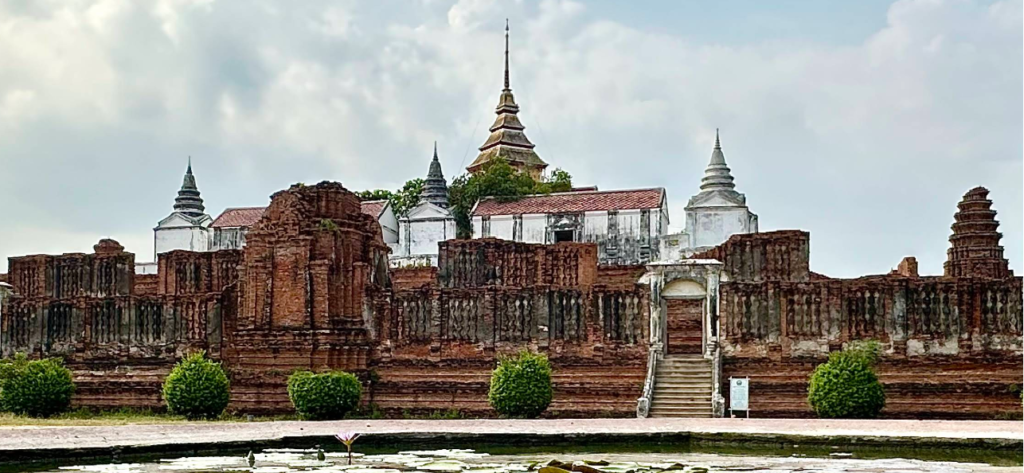
A royal retreat on the eastern bank of the Pasak River in Nakhon Luang District, Ayutthaya Province, where King Prasat Thong rested in 1631 (B.E. 2174) while traveling to pay homage to the Buddha’s Footprint in Saraburi.
About the Ayutthaya Royal Chronicles Part 2 Korean Translation
Contents
- Continuation from Part 1
- The Reign of King Si Sawat Phak
- The Reign of King Songtham
- The Reign of King Chetthathirat
- The Reign of King Si Suthammarat
- The Reign of King Phetracha
- The Reign of King Sue (Luang Sorasak)
- The Reign of King Thai Sa
- The Reign of King Borommakot
- The Final Reigns
- The Burmese Invasion and the Fall of Ayutthaya
- The Royal Family After the Fall
Subject Index
Kings and Royal Figures
- King Songtham — PDF 3–5
- King Chetthathirat — PDF 6–15
- King Si Suthammarat — PDF 16–67
- King Phetracha — PDF 68–102
- King Sue (Luang Sorasak) — PDF 103–120
- King Thai Sa — PDF 121–129
- King Borommakot — PDF 130–148
- Ekathat and the final royal period — PDF 149–162
- Uthumphon, Taksin, and the surviving royal family — PDF 163
Wars, Diplomacy, and Major Events
- Japanese residents and Japanese fighters in Ayutthaya — PDF 3–4, PDF 18
- The Buddha’s Footprint and the royal pilgrimage to Saraburi — PDF 5–14
- Campaigns involving Ava, Burma, and Chiang Mai — PDF 29–57
- European envoys and foreign relations — PDF 35–41, PDF 52, PDF 59–67
- Conflicts involving Nakhon Ratchasima and Nakhon Si Thammarat — PDF 78–89
- Relations and campaigns involving Cambodia — PDF 92–93, PDF 122–124, PDF 139, PDF 144
- The Burmese siege and fall of Ayutthaya in 1767 — PDF 152–162
- What happened to the royal family after the fall — PDF 163
Temples and Sacred Sites
- Wat Chaiwatthanaram — PDF 9, PDF 13, PDF 16, PDF 115, PDF 147, PDF 161
- Wat Phra Si Sanphet — PDF 10, PDF 20, PDF 73, PDF 140, PDF 161
- Wat Mahathat — PDF 12
- Wat Phra Non Chaksi and Wat Khun Inthapramun — PDF 146
- Wat Nang Pluem and Wat Si Pho during the siege — PDF 160
- The reclining Buddha and its new sanctuary — PDF 128–130, PDF 146
External Links
- Historic City of Ayutthaya — UNESCO World Heritage Centre
- Ayutthaya Royal Chronicles, Part 1 | Korean Translation


The revered Buddha’s Footprint is enshrined in the ornate mondop at Wat Phra Phutthabat, Saraburi.