By Won Cub Life / October 5, 2026
Wat Tao Pun in Chonburi stands quietly in Samet, not far from the old coastal town of Bang Pla Soi. At first glance, it appears to be another local temple where old buildings and newer halls share the same grounds. Yet behind its ordinary neighborhood setting lies a story reaching back to the final days of Ayutthaya.
Local tradition says that part of Phraya Tak’s army camped at Ban Samet while moving east toward Chanthaburi. A great kradon tree is said to have served as their landmark, and local people associate that gathering place with the present grounds of Wat Tao Pun. The royal chronicles confirm that Phraya Tak’s forces moved through the wider Bang Pla Soi area, although they do not name this temple or the tree. The story should therefore be understood as a local memory connected to a larger historical march—not as proof that King Taksin founded the temple.
My visit, however, did not begin with an army or a king. It began quietly, inside a shrine dedicated to a monk who served this community for much of his life. I carried a single flower toward Luang Pho Ploy, bowed before him, and began walking through the many layers of faith that still live within Wat Tao Pun.
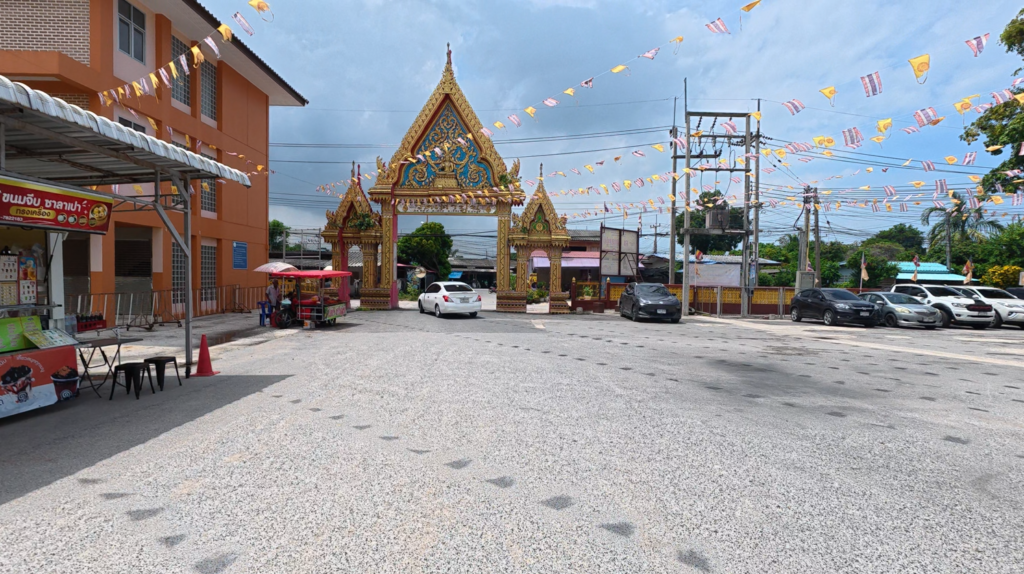
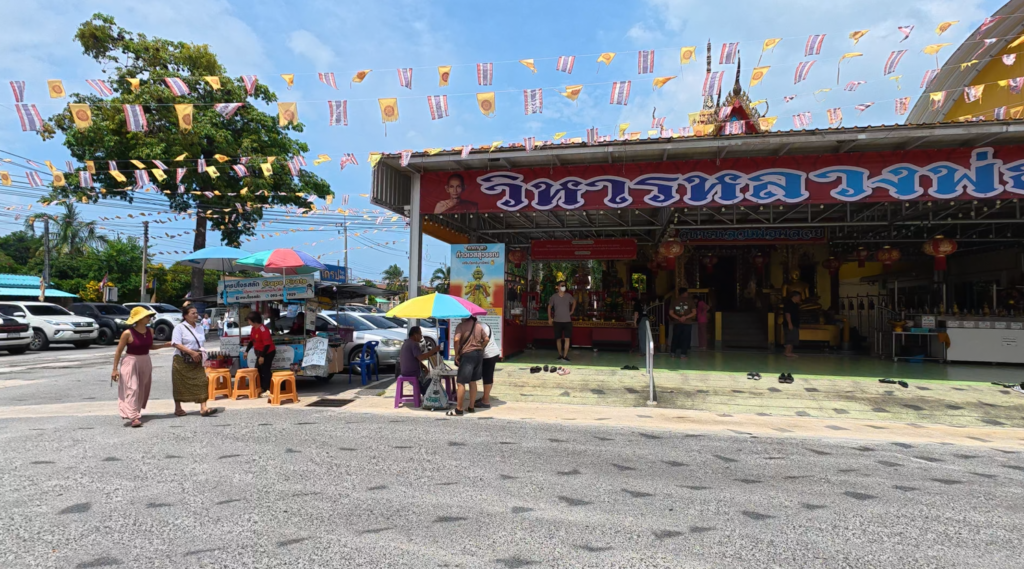
Arriving at Wat Tao Pun in Samet, Chonburi—a neighborhood temple where the memory of Taksin’s eastern march meets the living faith of the present community.
A Single Flower for Luang Pho Ploy
Before exploring the old ubosot, I stopped at the shrine of Luang Pho Ploy, the former abbot whose long service helped shape the Wat Tao Pun seen today. I entered quietly with a single yellow flower in my hand. There was no elaborate offering—only a flower, a bow, and a moment of respect for a monk whose work continued far beyond his own lifetime.
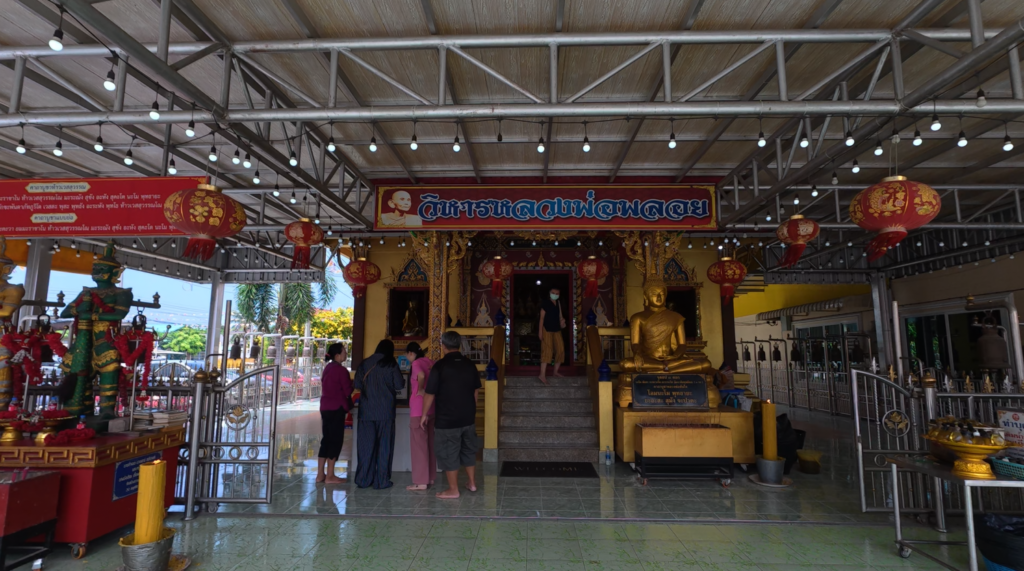
My visit began at the shrine of Luang Pho Ploy, the former abbot remembered for developing both the temple and its local community.
Local accounts describe Luang Pho Ploy, formally known as Phra Khru Silawutthikhun, as a modest and disciplined monk. He is said to have led Wat Tao Pun from 1931 until his death in 1990. During those decades, he repaired or developed the old ubosot, monks’ residences, preaching hall, crematorium and temple walls.
His most enduring contribution, however, was education. In 1940, he initiated the construction of Wat Tao Pun School, giving children in the Samet community access to formal schooling at a time when temples often served as the educational centres of rural Thailand. The school later became part of the public education system and remains a visible continuation of his work.
Inside the shrine, his preserved remains rest in a glass coffin and are treated with deep respect by local worshippers. Some devotees regard the condition of his body as a sign of spiritual attainment. That belief belongs to the faith of the community, but his historically documented legacy is already remarkable: he transformed an old neighborhood temple into a centre for worship, education, funerals and community life.
I placed the flower before him and bowed. It felt like an appropriate beginning—not by asking for good fortune, but by acknowledging a life spent building something that others could continue to use.
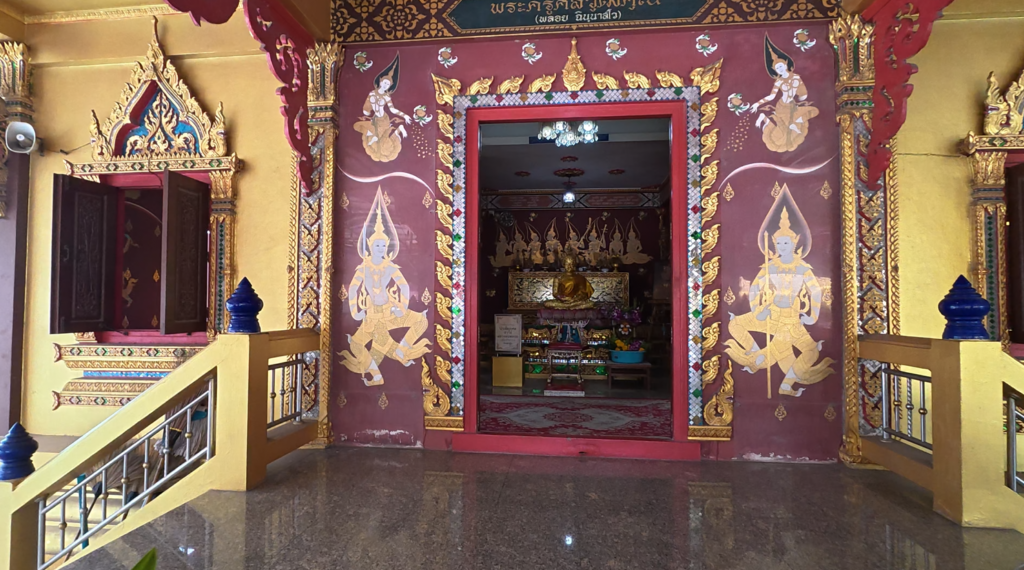
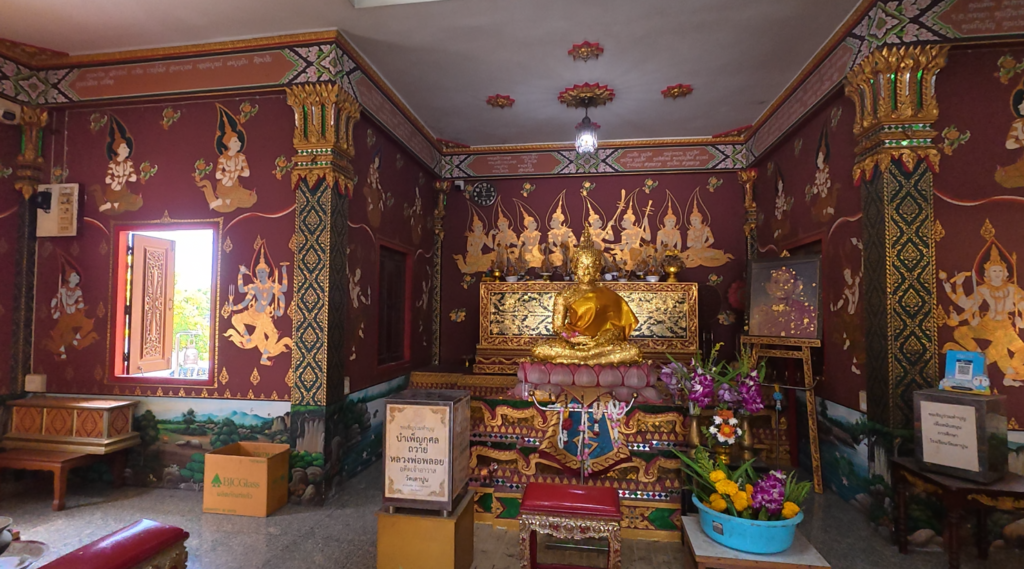
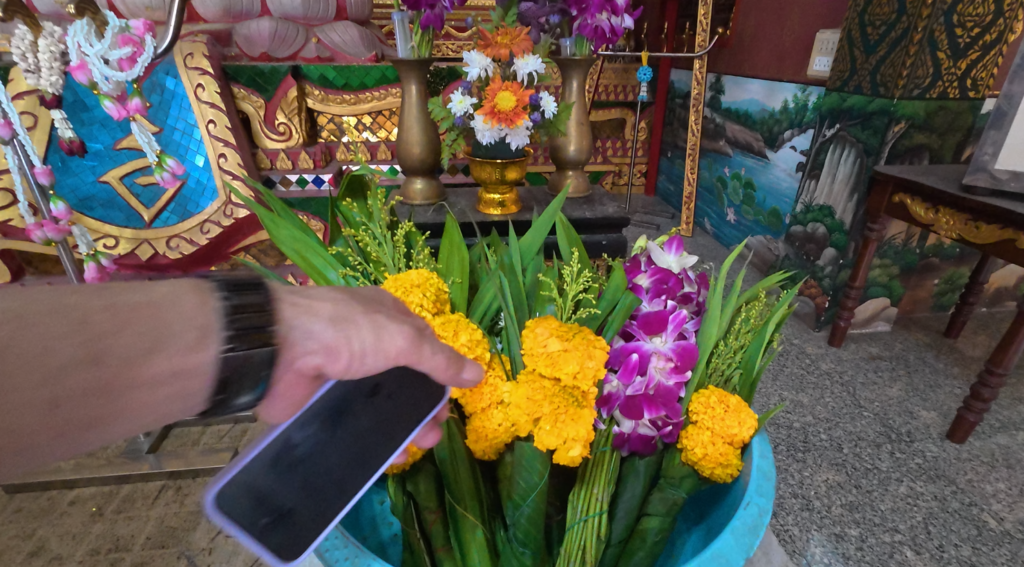
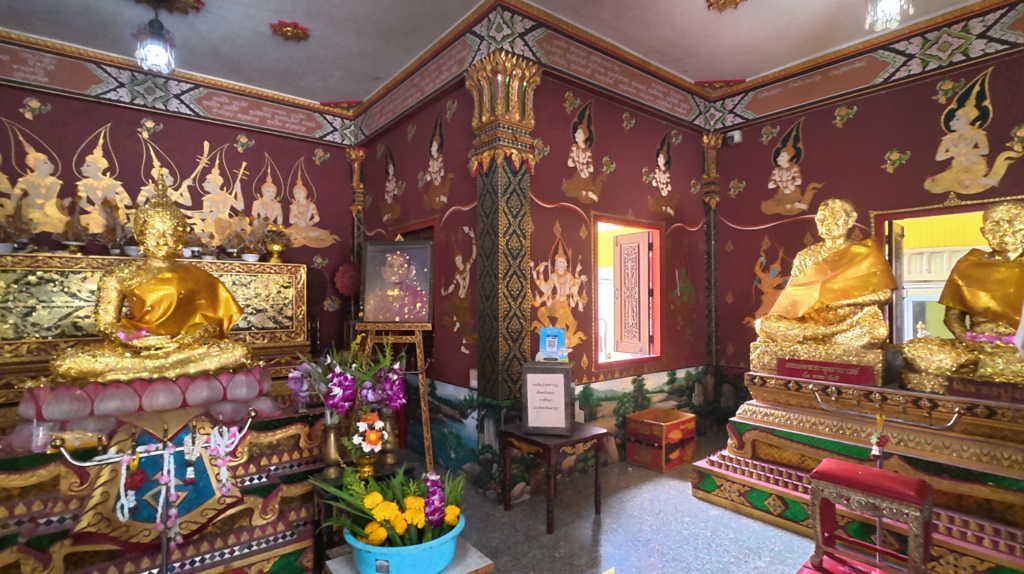
Inside the memorial shrine of Luang Pho Ploy, I offered a single yellow flower and paid respect to the former abbot whose work helped develop Wat Tao Pun, establish its school and strengthen its role within the Samet community.
A War Elephant and the Memory of Taksin’s Eastern March
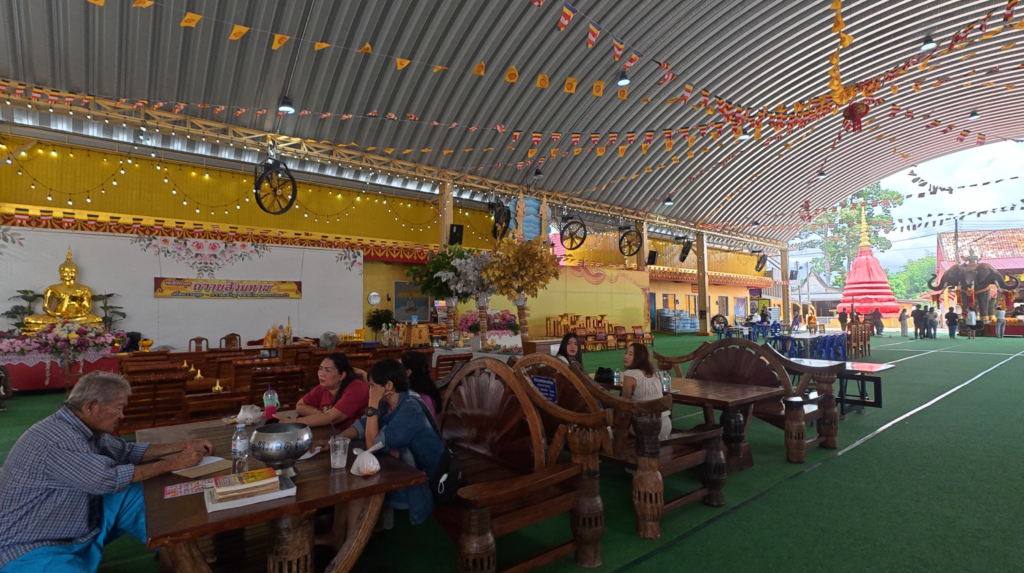
Leaving the shrine, I came upon a large black elephant standing beneath the covered courtyard. It immediately brought the temple’s oldest local story to mind—the march of Phraya Tak, the military leader who would later become King Taksin the Great.
In early 1767, while Ayutthaya remained surrounded by the Burmese, Phraya Tak broke through the siege and led his forces eastward. He intended to gather men, food and weapons in the eastern provinces before returning to restore Siamese independence. The royal chronicles record his army moving through the wider Bang Pla Soi area of present-day Chonburi on its way toward Rayong and Chanthaburi.
Wat Tao Pun preserves a more local version of that journey. According to community tradition, a group from Taksin’s army camped at Ban Samet, using a great kradon tree as a landmark and gathering point. Local people believe that the tree once stood around the present temple grounds.
The chronicles do not mention Wat Tao Pun, Ban Samet or the kradon tree by name. The story should therefore be treated as inherited local memory rather than a fully documented military event. The temple itself was formally established later, in 1802, so it would also be inaccurate to say that King Taksin founded it.
The elephant displayed here is not presented as a surviving object from Taksin’s army. Instead, it serves as a powerful visual reminder of an age when elephants carried commanders, supplies and weapons through forests and uncertain roads. Standing beneath it, I could imagine the exhausted soldiers pausing somewhere in this landscape before continuing east.
Individual Photo — No. 9
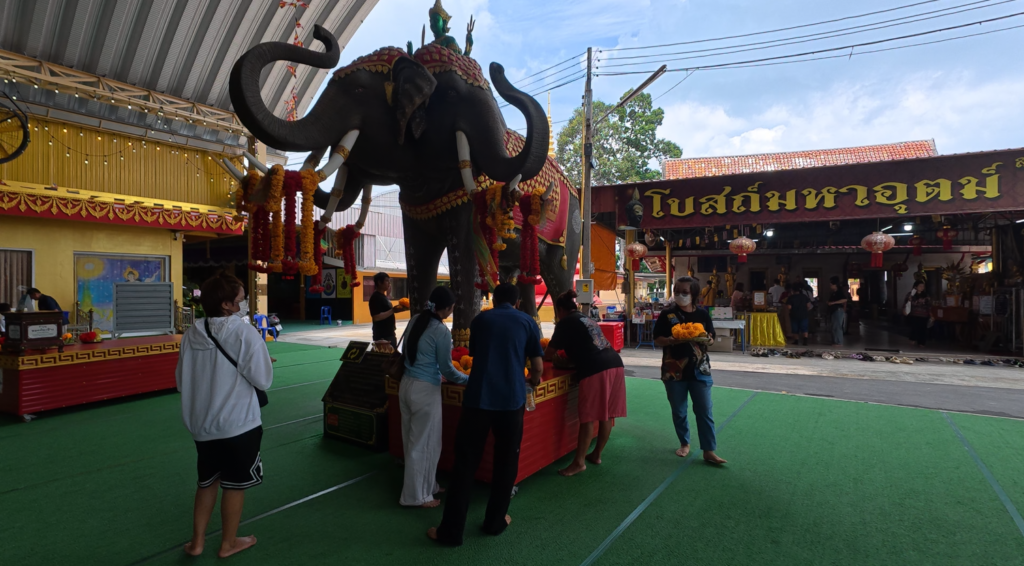
A black elephant recalls the era of Phraya Tak’s eastern campaign, while local tradition remembers part of his army camping at Ban Samet.
The historical memory of an army sits alongside a very different kind of belief. Nearby are offering stations, sacred figures and a shrine dedicated to Ai Khai, the spirit of a young boy widely venerated in modern Thai folk religion. Visitors light incense, make wishes and leave offerings, often asking for protection, opportunity or success.
These practices are not the same as the Buddha’s teachings preserved in the old ubosot. Yet Thai temples have long served as places where formal Theravada Buddhism and local beliefs coexist. The Buddha remains the highest religious focus, while guardian spirits and popular sacred figures respond to the immediate hopes and anxieties of everyday life.
Rather than hiding this mixture, Wat Tao Pun displays it openly. The memory of a king, the image of a war elephant, the devotion surrounding Ai Khai and the Buddhist rituals of repentance all occupy the same living temple compound.
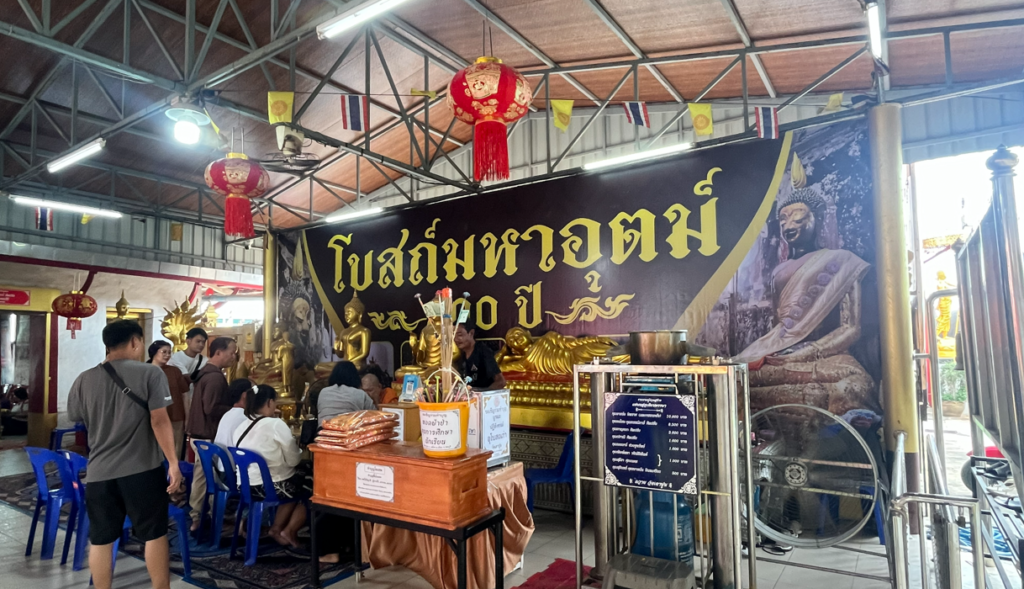
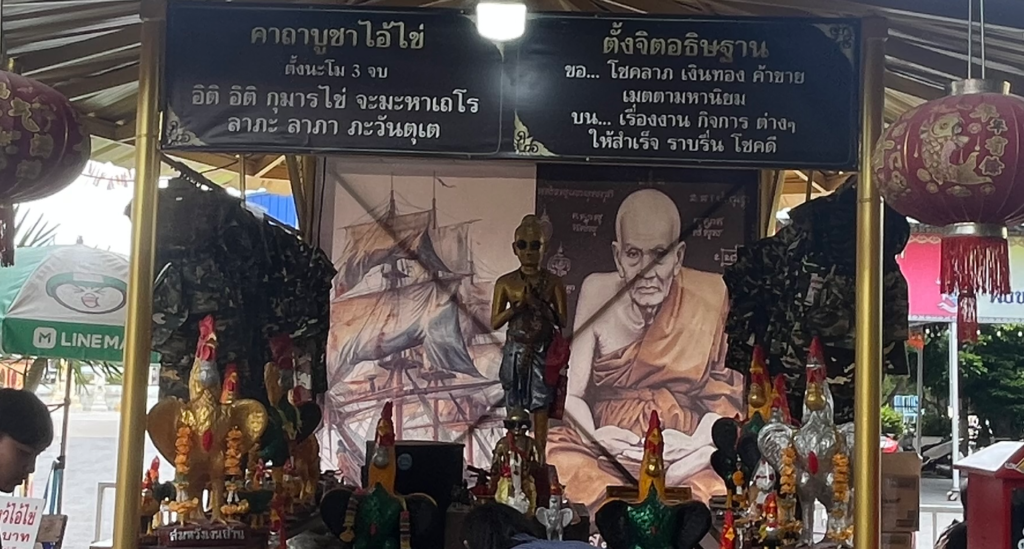
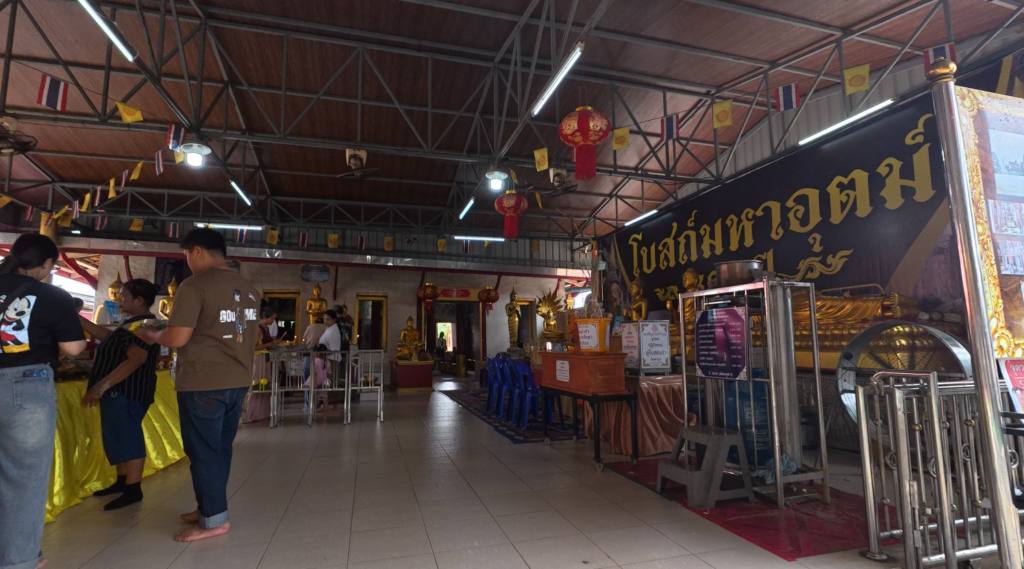
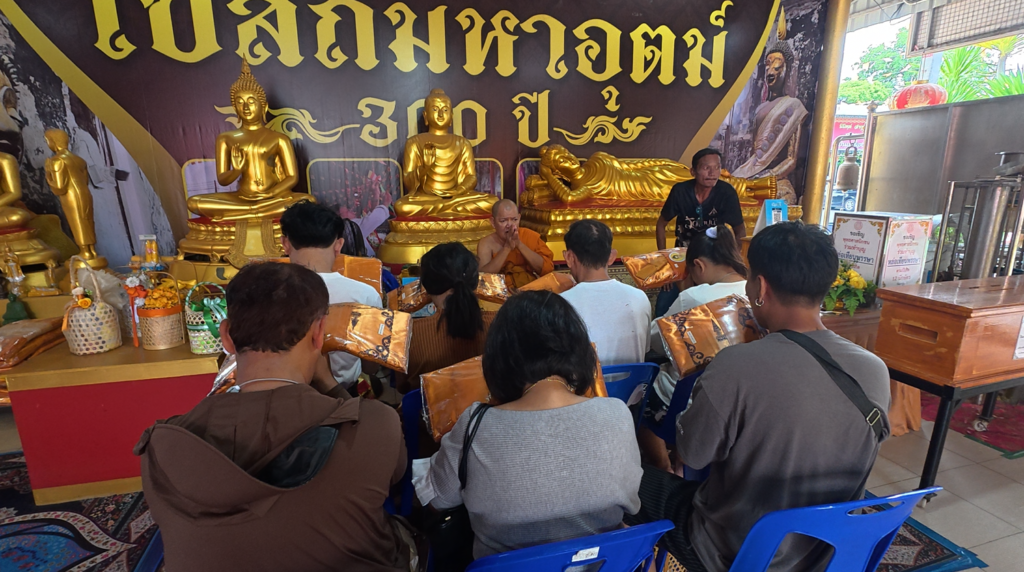
Around the covered courtyard, the memory of Taksin’s era meets contemporary popular faith—from the Maha Ut ubosot ritual area to the shrine of Ai Khai and worshippers seeking blessings in their own way.
Entering the Old Maha Ut Ubosot
Beyond the busy courtyard, several aged Buddha images stood quietly beside the old building. Their gilding was uneven, their surfaces worn and their expressions softened by time. They were not displayed like museum objects. Flowers, cloth and traces of repeated offerings showed that they remained part of the temple’s living religious world.
Individual Photo — No. 14
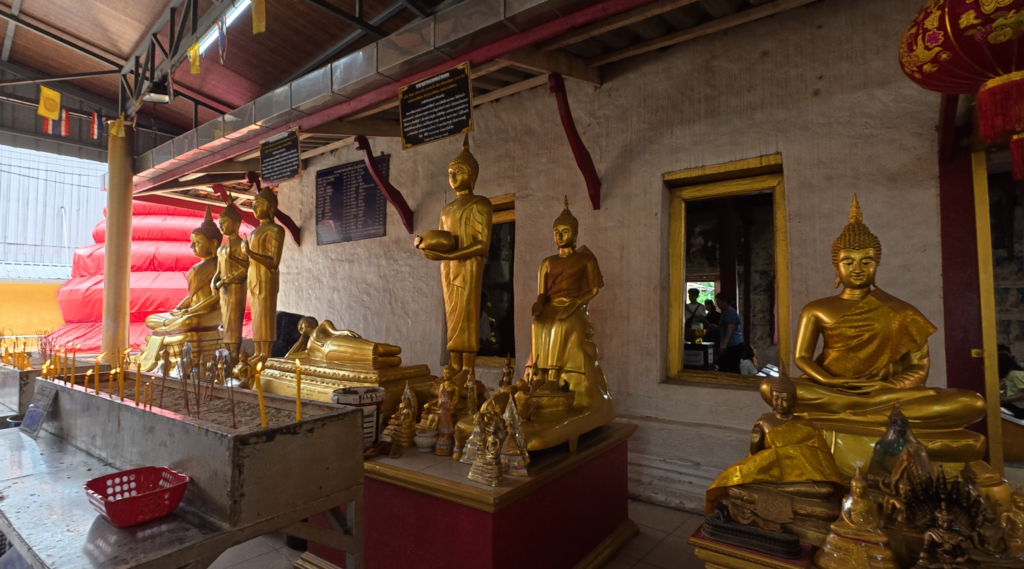
Time has worn their surfaces, but these old Buddha images continue to receive offerings from worshippers at Wat Tao Pun.
The old ubosot is a modest brick-and-plaster building with a timber roof structure. Temple information describes it as five bays long, approximately 8.75 metres wide and 11.15 metres long. Compared with the newer and more elaborate temple buildings outside, its low walls, red wooden columns and narrow openings preserve the feeling of an earlier period.
It is locally known as the Maha Ut Ubosot. Traditionally, a Maha Ut structure was designed as an enclosed sacred chamber, often with a single principal entrance, and was associated in popular belief with concentrated spiritual power. Wat Tao Pun’s building now has side openings and windows, possibly reflecting alterations made during its long history. It is therefore best introduced by its local name without claiming that every part of the present structure follows the strict original Maha Ut form.
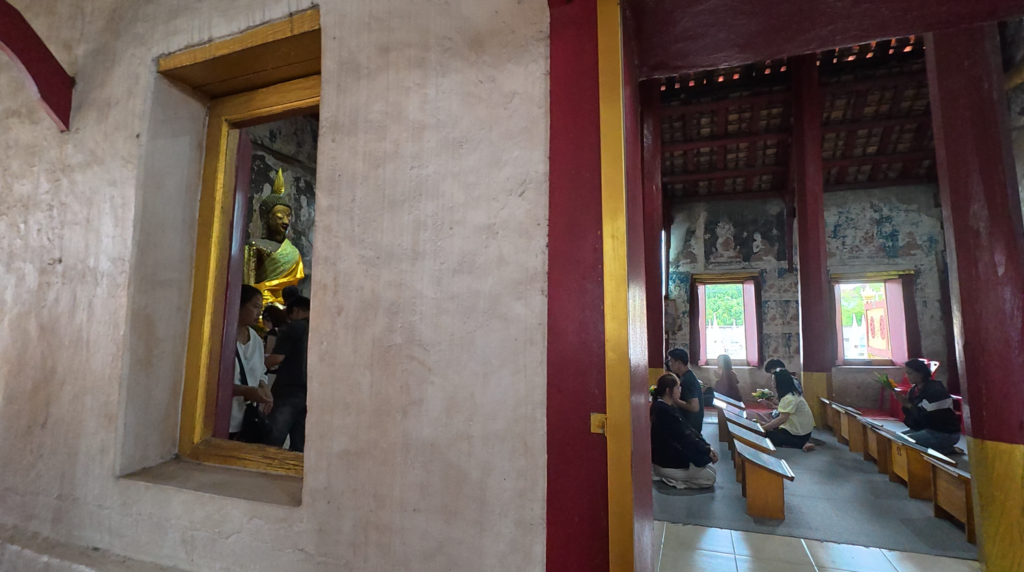
Through a small side opening, the dark interior of the old ubosot slowly revealed its Buddha images and fading murals.
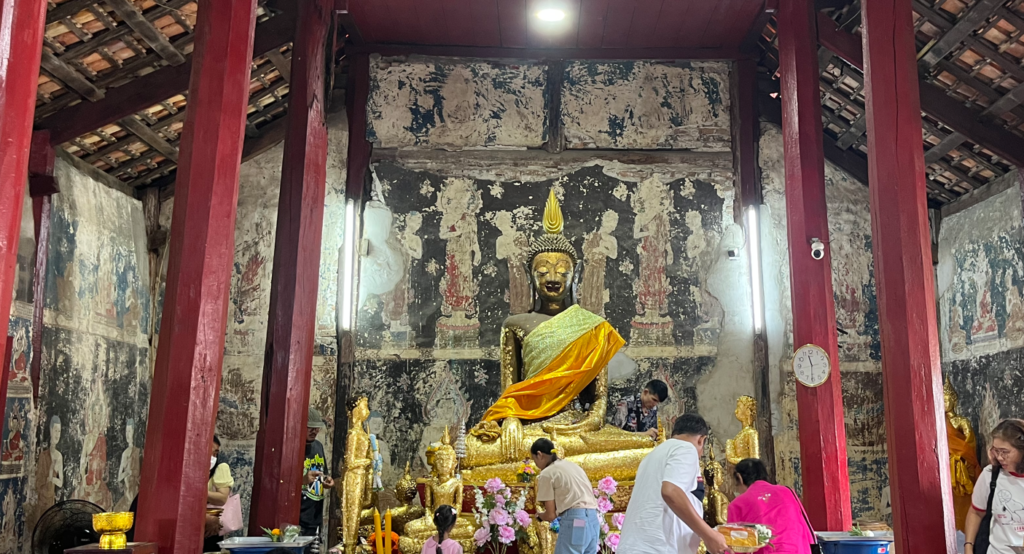
Inside, the contrast was immediate. Bright daylight disappeared behind the thick walls, and the golden central Buddha emerged from the dim interior. This principal image is known locally as Luang Pho Pak Daeng, or “the Red-Mouthed Buddha,” a name drawn from the distinctive colour of his lips.
The Buddha sits in the Mara-Vijaya posture, with the right hand reaching toward the earth. It represents the moment before enlightenment when the Buddha called the earth to witness his accumulated merit and overcame Mara’s army—not through physical force, but through spiritual truth.
His eyes appear almost closed, yet they are more accurately described as lowered. This is a traditional feature of Thai Buddhist art, expressing meditation, composure and inward awareness. On either side stand the two chief disciples: Sariputta, remembered for wisdom, and Moggallana, remembered for spiritual power. Together, the three figures represent the enlightened teacher and the monastic community that carried his teaching forward.
The room was not silent or abandoned. People knelt before the Buddha, recited prayers, offered flowers and applied gold leaf. Some had come for the modern practice of asking forgiveness and releasing old vows or resentments. Whatever brought them inside, their presence gave continuing life to this worn and fragile building.
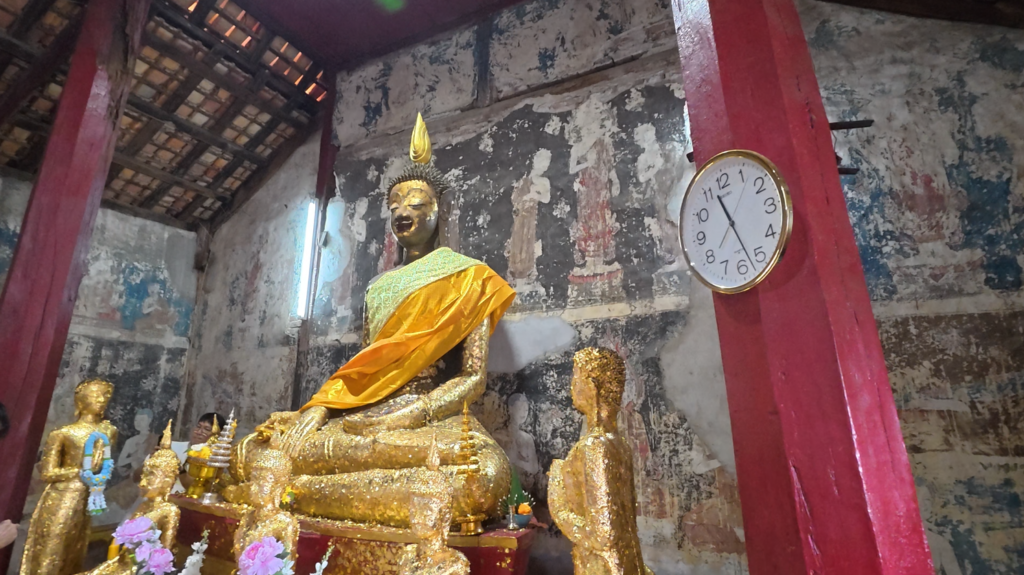
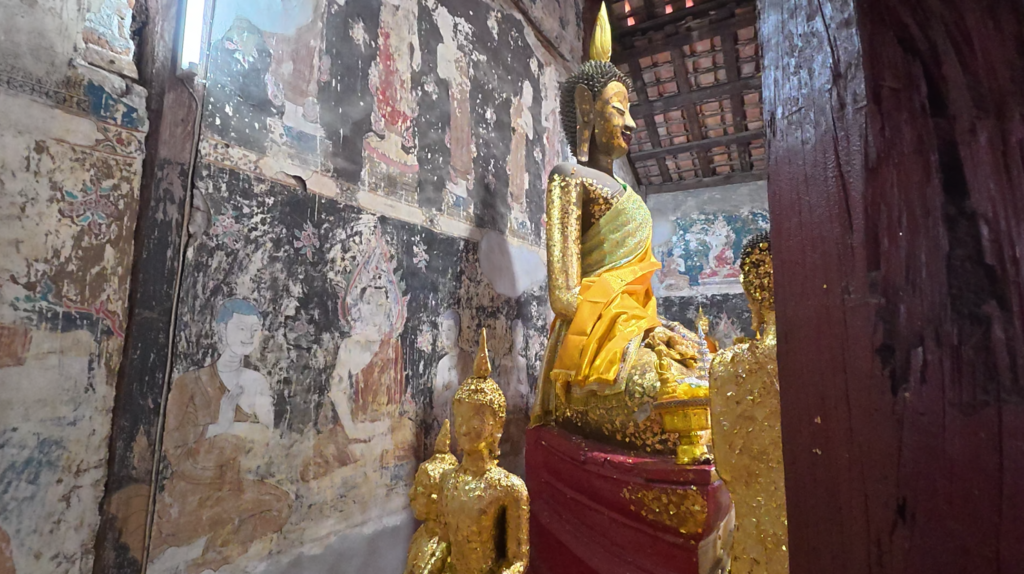
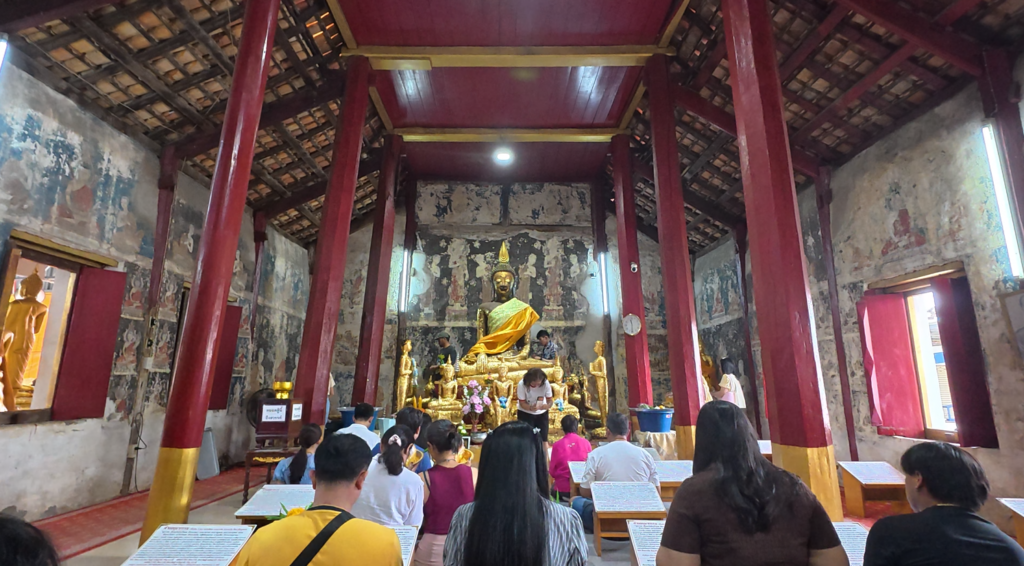
Luang Pho Pak Daeng sits beneath a flame-shaped radiance, accompanied by the two chief disciples, while worshippers pray within the dim interior of Wat Tao Pun’s old Maha Ut ubosot.
Fading Murals of the Buddhas Before Our Time
Once my eyes adjusted to the dim light, the walls became as important as the principal Buddha. Almost every available surface had once been covered with paintings, but age, moisture and repeated repairs had removed much of their original colour. Dark blue, brown, red and white still remained in broken layers.
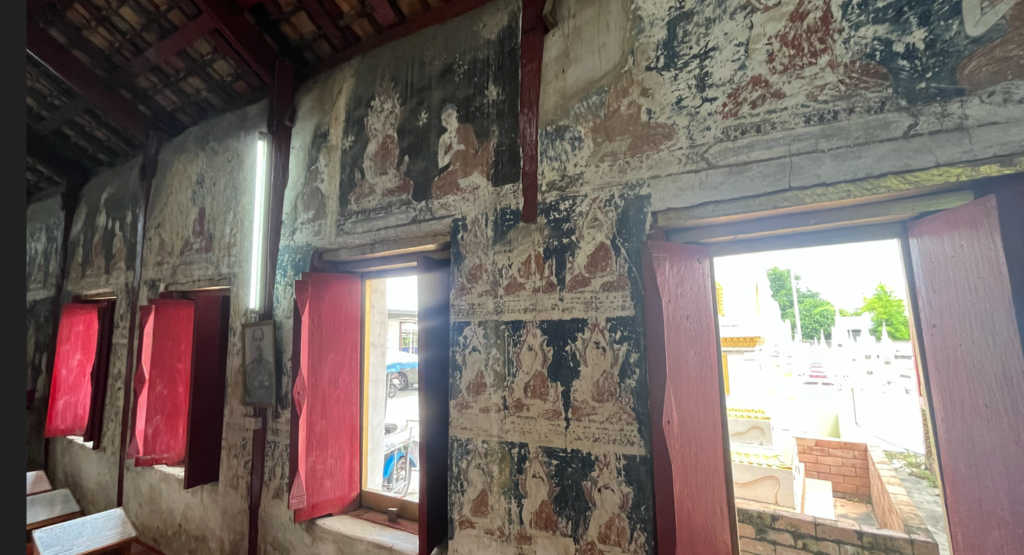
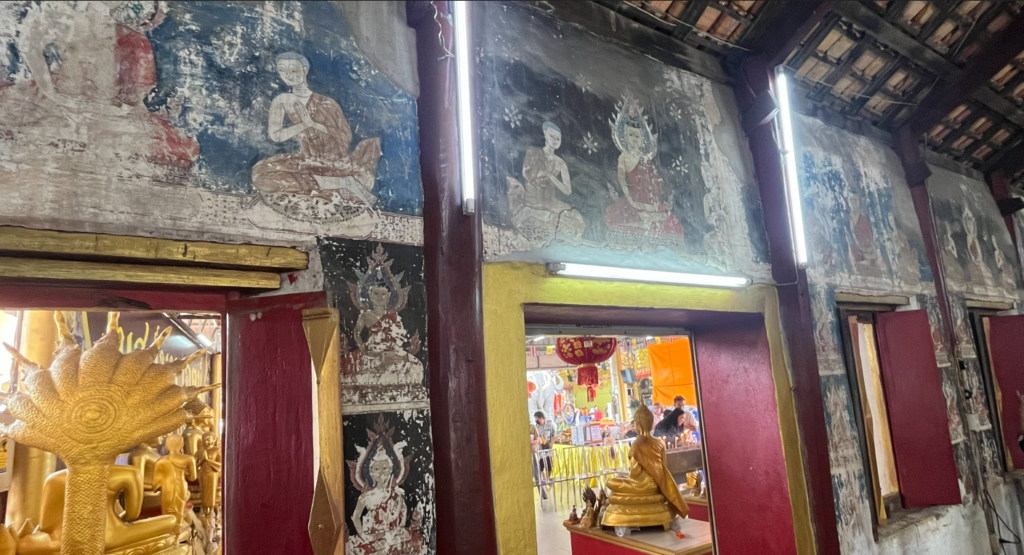
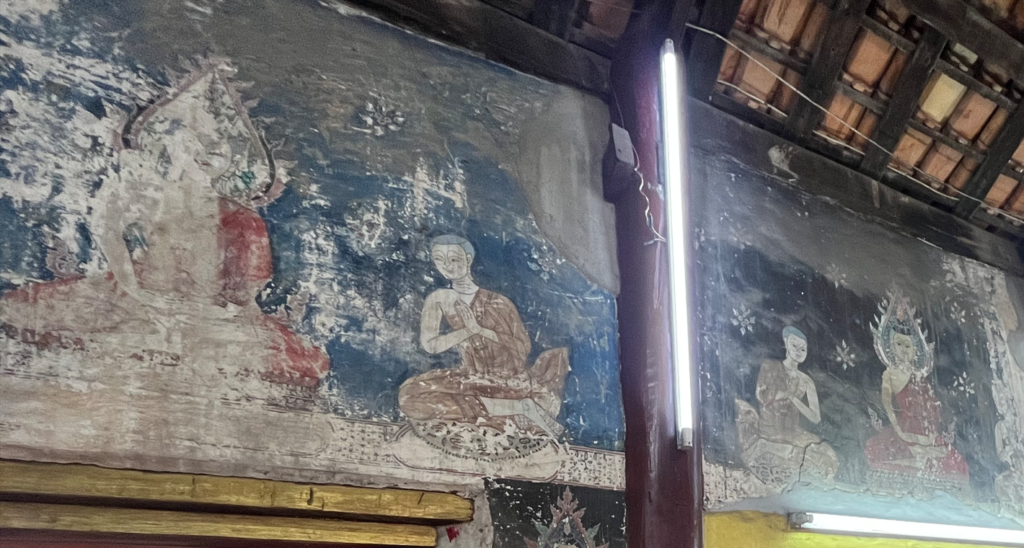
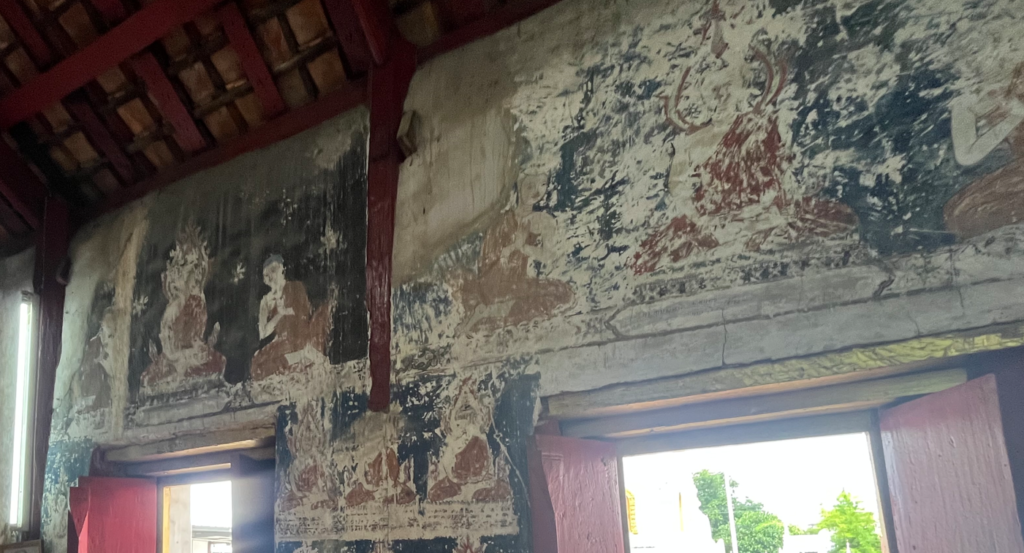
Faded paintings cover the walls between the old red shutters, preserving rows of sacred figures despite extensive loss of colour and plaster.
These are not simply repeated decorations. Temple records identify the figures as past Buddhas, shown in seated, standing and reclining postures. They are arranged in horizontal rows and rectangular compartments, creating the impression of countless enlightened beings extending beyond the life of the historical Buddha Gautama.
In Theravada Buddhist tradition, Gautama Buddha was not the first and will not be the last Buddha. Other Buddhas attained enlightenment in earlier ages, while a future Buddha will appear when the present teaching has disappeared. By surrounding the main image with past Buddhas, the painters placed the worshipper inside a much larger Buddhist understanding of time.
Many figures can now be recognized only by an outline, a flame-shaped radiance or the remains of a red robe. Some faces have disappeared almost completely. Yet the repetition itself still carries meaning: individuals and buildings pass away, while the possibility of awakening continues from one age to another.
The paintings also offer clues to the age and artistic background of the building. Their compartmental arrangement, restrained colours and close relationship with the red timber structure connect them broadly with central Thai religious art inherited from the late Ayutthaya and early Rattanakosin periods. However, without a dated inscription or a detailed conservation study, the exact year and individual painters should not be claimed.
Individual Photo — No. 25
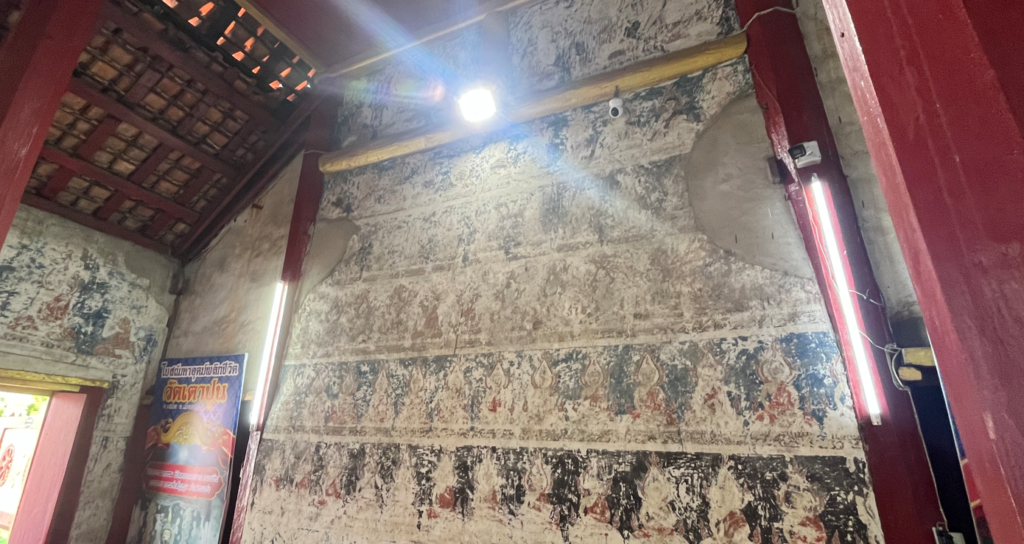
Seated Buddhas once filled the wall in repeated rows, expressing a Buddhist vision of enlightenment continuing across immeasurable ages.
The murals are damaged, but their condition also reveals their long history. They have survived smoke, tropical humidity, leaking roofs, insects and generations of human use. Their faded surfaces should therefore be seen not simply as neglected decoration, but as fragile historical evidence still sharing space with daily worship.
A Living Place of Worship, Not a Museum
Looking upward, I could see the old timber roof resting above red columns and walls covered with fragile paintings. Electric lights, fans and security cameras had been added for present-day use, but the basic form of the old hall remained visible. The building had not been preserved as an empty historical exhibit—it was still performing its original religious purpose.
Individual Photo — No. 26
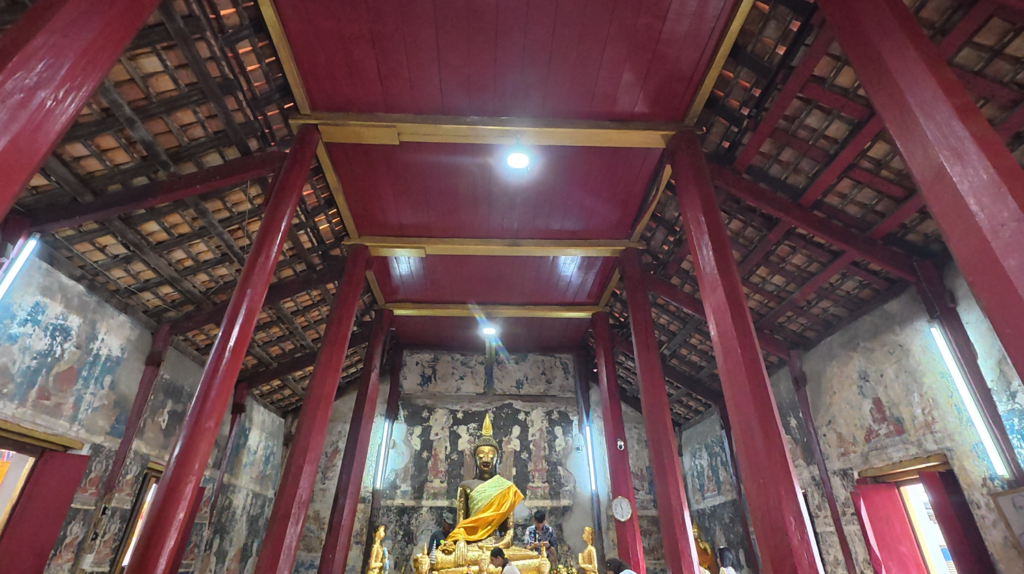
Old timber beams, red columns and fading murals surround the principal Buddha inside a hall that remains in daily use.
More worshippers gradually entered and sat together on the floor. Some followed printed prayer texts, while others bowed silently before Luang Pho Pak Daeng. Their presence changed the atmosphere of the room. The worn murals were no longer merely objects from the past; they became the background to prayers being spoken in the present.
Wat Tao Pun is now especially known for prayers of kho khama kam, asking forgiveness for harm caused to others, and for releasing old promises, oaths or words spoken in anger. Popular signs sometimes describe this practice as “changing one’s life.” It should not be understood as a ritual that automatically erases karma. Its deeper value lies in recognizing past actions, asking forgiveness and making a sincere decision not to repeat them.
This combination of old art and contemporary devotion is what gives the ubosot its strongest character. The paintings may be fading and the wooden structure may be aging, but people still kneel in the same room, lower their heads and search for a way to begin again.
I remained behind them for a while. There was no need to explain every figure on the wall. The bowed bodies, quiet prayers and worn floor already showed that faith here had never become a thing of the past.
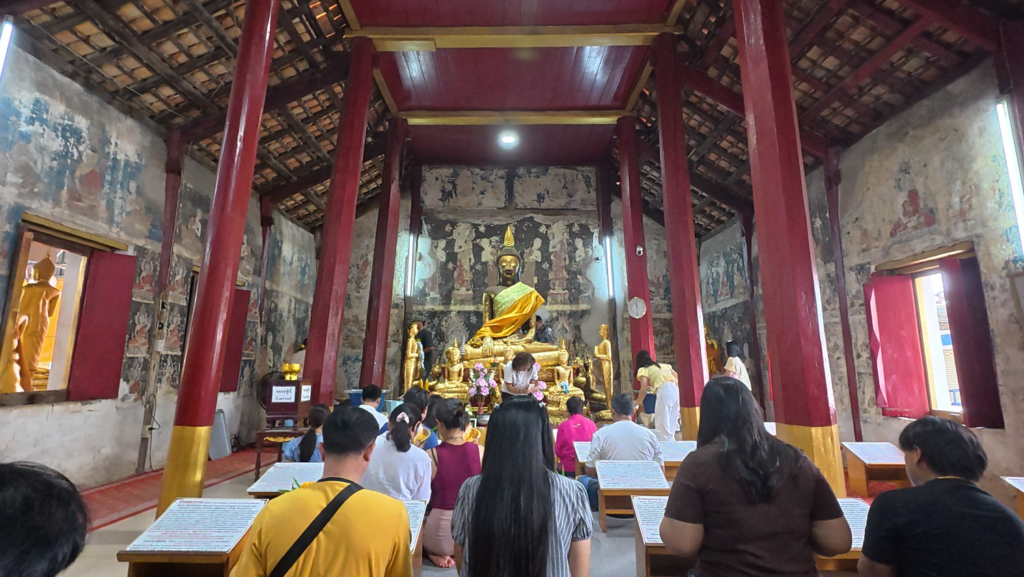
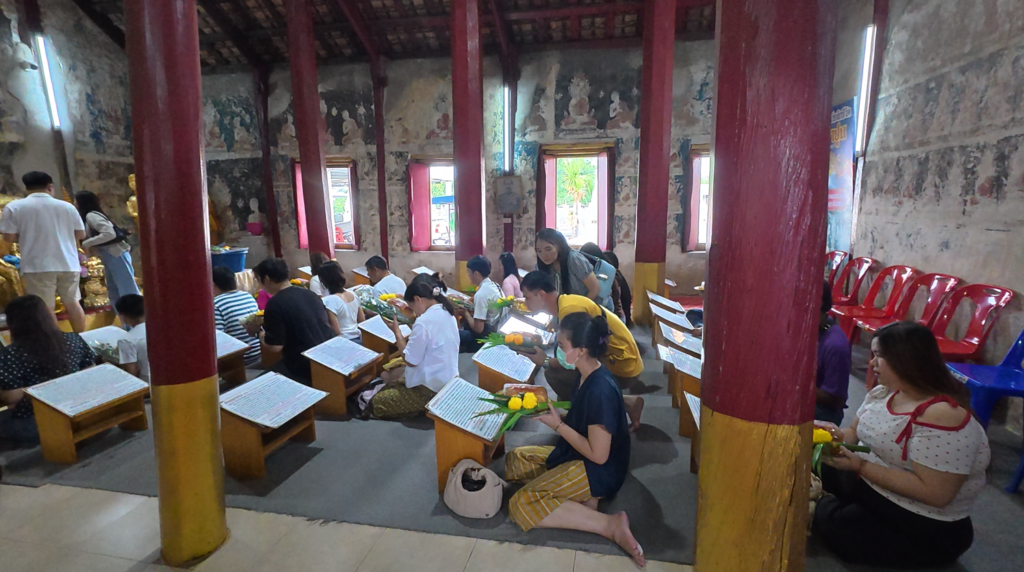
Worshippers bow and recite prayers before Luang Pho Pak Daeng, continuing the religious life of the old ubosot beneath its fading murals and timber roof.
Old Walls, New Faith
Stepping back into the daylight, I walked around the exterior of the old ubosot. A red chedi stood close to the building, while low roofs, whitewashed walls and worn foundations revealed how the temple had expanded gradually rather than according to a single grand plan.
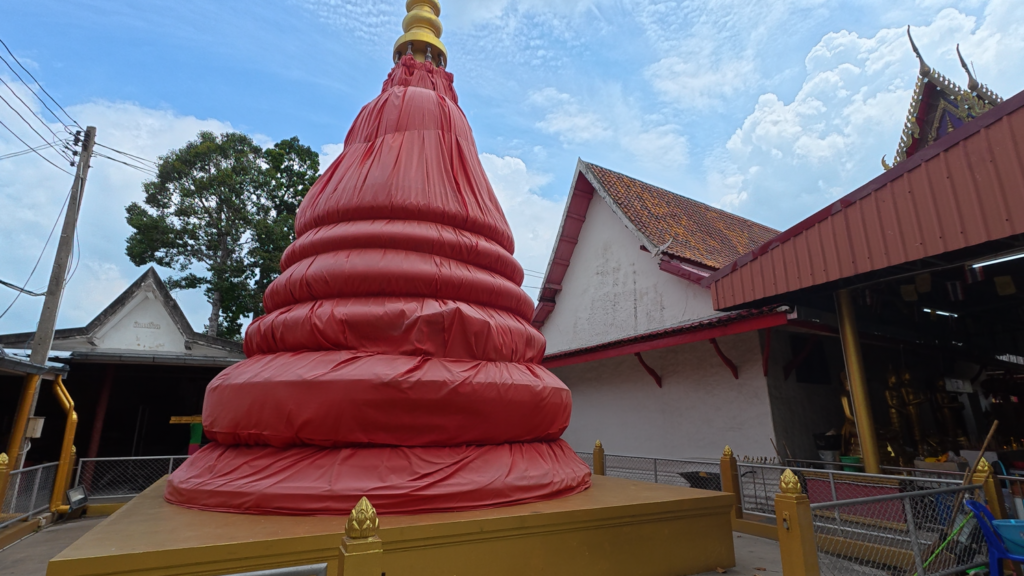
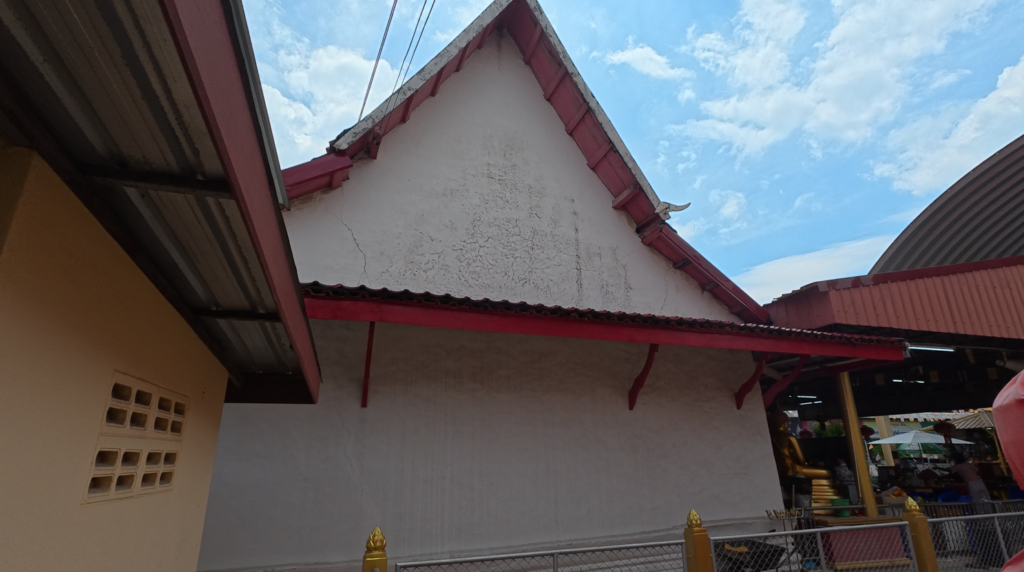
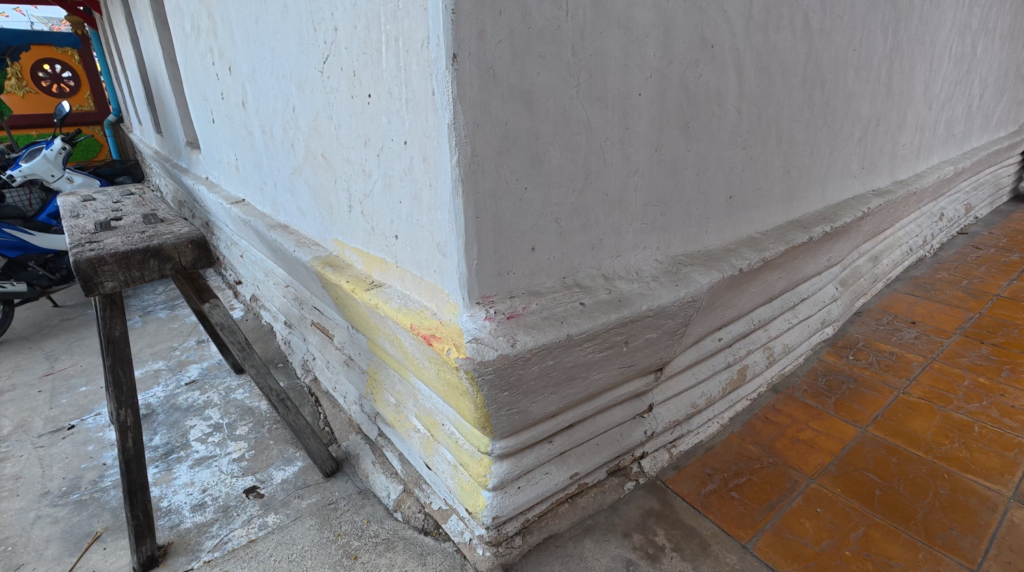
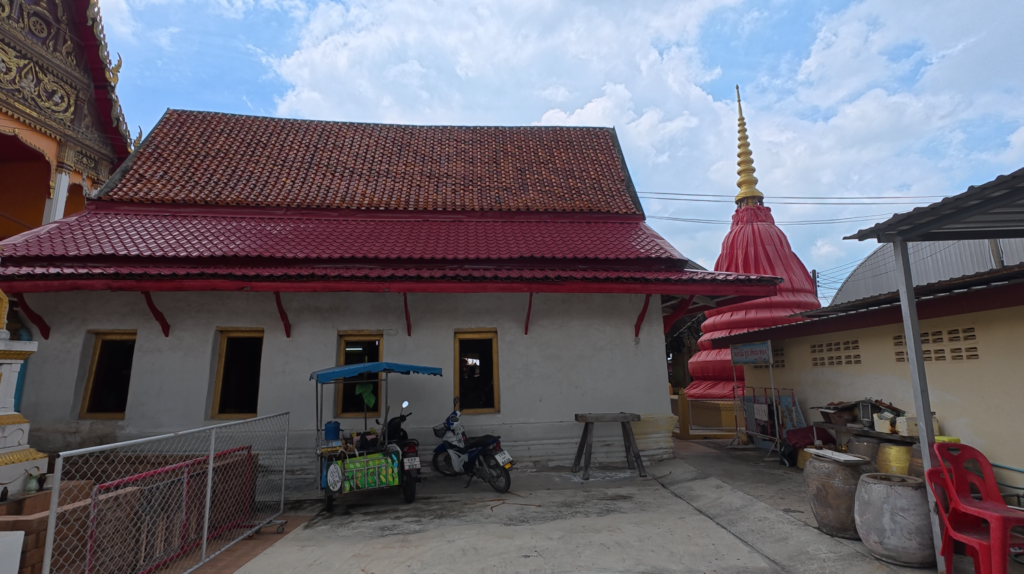
A red chedi, aging walls and the exterior of the historic ubosot reveal the older architectural layer of Wat Tao Pun before the view opens toward its newer buildings.
The temple is officially recorded as having been established in 1802, during the early Rattanakosin period. This was about 35 years after Phraya Tak’s eastward march, confirming that the military encampment and the founding of the temple belong to two separate layers of local history.
Its name preserves another construction story. In Thai, tao means a kiln, while pun refers to lime or plaster. Local tradition says that a military commander travelling through the Bang Pla Soi area ordered kilns to be built here to fire bricks and prepare lime. Those materials were then used for the ubosot, chedi, principal Buddha and the two standing disciples. The place consequently became known as Wat Tao Pun—the Temple of the Lime Kiln.
Some sections of the old building show cracks, repaired plaster and moisture damage around the base. These details remind us that survival is not guaranteed simply because a place is sacred. The murals, timber roof and early structures require continuing care if they are to remain part of the community rather than becoming only photographs of something lost.
Nearby, newer temple buildings rise with brighter colours, stronger materials and more elaborate decoration. They reflect the continuing support of worshippers and the practical needs of a growing community. The contrast is striking, but the new and old temples should not be treated as rivals. One preserves memory; the other provides space for religious life to continue.
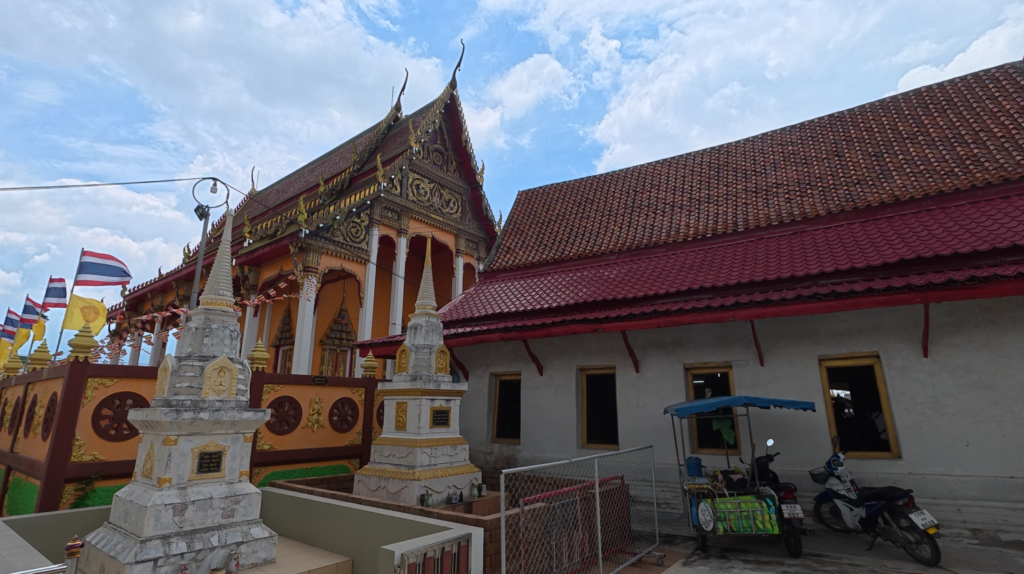
Old and new structures share the grounds of Wat Tao Pun, connecting inherited memory with the continuing life of the temple.
As I prepared to leave, the different stories of Wat Tao Pun seemed to gather in one place: soldiers remembered beneath a vanished kradon tree, an elephant recalling Taksin’s eastern campaign, local spirits receiving everyday prayers, past Buddhas fading across old walls and worshippers still bowing before Luang Pho Pak Daeng.
Among them remains the legacy of Luang Pho Ploy. His buildings have aged, but the school he helped establish, the temple he developed and the community he served continue beyond him. That may be the most meaningful form of survival—not a monument untouched by time, but work that remains useful after the person who began it has gone.
Wat Tao Pun does not preserve history in a single perfect form. It carries history through worn paintings, local memories, repeated prayers and new buildings rising beside old ones. Here, the past has not disappeared. It has simply learned to live alongside the present.
Walking Through Wat Tao Pun
Follow my visit through Wat Tao Pun—from paying respect to Luang Pho Ploy and encountering the memory of Taksin’s eastern march to entering the old ubosot, where fading murals still surround people in prayer.
Walking through the history, murals and living faith of Wat Tao Pun in Chonburi.
Visitor Information
| Information | Details |
|---|---|
| Temple | Wat Tao Pun |
| Thai name | วัดเตาปูน |
| Address | 39 Moo 5, Samet, Mueang Chonburi, Chonburi 20000, Thailand |
| Coordinates | 13.317257, 100.938767 |
| Main highlights | Luang Pho Ploy Shrine, old Maha Ut ubosot, Luang Pho Pak Daeng, past Buddha murals, red chedi and local Taksin tradition |
| Religious character | Theravada Buddhist temple with local popular-belief shrines |
| Recommended time | Allow approximately 60–90 minutes to explore slowly |
| Dress and conduct | Wear respectful clothing, remove shoes before entering sacred halls and avoid blocking worshippers |
| Photography | Photograph quietly and avoid flash near old murals or people praying |
| Admission | No formal entrance ticket; voluntary temple donations may be made on site |
Google Maps
Open Wat Tao Pun in Google Maps
Wat Tao Pun is located in Tambon Samet, close to Chonburi city and Ang Sila. The temple can easily be combined with a visit to Wat Yai Intharam or the Na Jasa Tai Chue Shrine, but it deserves enough time to enter the old ubosot quietly and examine its murals rather than treating it as a brief roadside stop.
Continue Following Taksin’s Eastern Journey
Wat Tao Pun preserves one local memory from the desperate journey east in 1767. To follow the wider story—from Rayong to the military base that helped rebuild Siam—continue with these journeys:
Before Chanthaburi: King Taksin’s Legacy at Wat Ratchabanlang
A ride through an old Rayong temple where local memory, a historic ubosot and objects associated with King Taksin recall the army’s movement toward Chanthaburi.
King Taksin in Chanthaburi – The Land That Helped Rebuild Siam
The larger story of how Chanthaburi supplied soldiers, food, boats and resources for Taksin’s campaign to recover Siam.
Historical References
Wat Tao Pun – Burapha University Eastern Information Centre
Temple history, the Ban Samet military-camp tradition, the origin of the name Wat Tao Pun, old-ubosot architecture and mural descriptions.
Wat Tao Pun – Thailand Cultural Environment Conservation Database
Information about the temple, Luang Pho Ploy, Wat Tao Pun School and the site’s cultural significance.
Thonburi Royal Chronicle – Fine Arts Department of Thailand
Historical chronicle material concerning Phraya Tak’s movement through the eastern provinces.