A Hidden Sanctuary on the Road to Pattaya
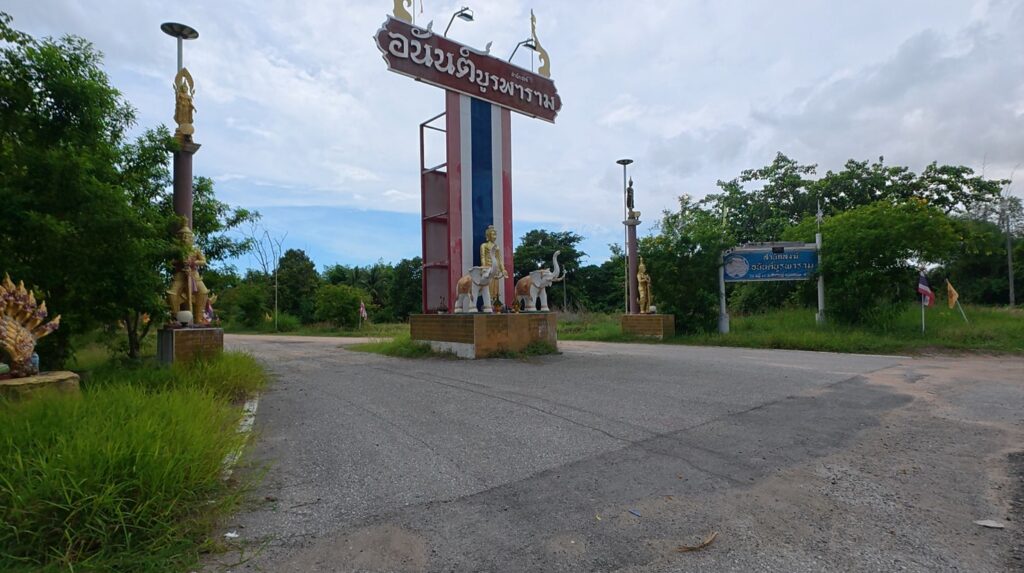
Anan Burapharam sanctuary is a hidden religious retreat discovered along a quiet road toward Pattaya.
The road toward Pattaya was unusually quiet that day. There were few vehicles, and the countryside seemed to stretch peacefully beneath the open sky.
What makes Anan Burapharam sanctuary especially fascinating is the way Buddhism, Hindu mythology, royal memory and local spirit beliefs coexist within the same grounds.
While riding along this little-known route, I noticed an entrance decorated with tall statues inspired by Hindu mythology. It did not look like a famous tourist temple, nor was there anything outside inviting travellers to stop. Yet the unusual gateway immediately caught my attention.
I slowed down, turned the Honda Cub toward the entrance, and passed beneath the statues.
Beyond the gate, a narrow road continued through open land and trees. A few cows were grazing peacefully beside the path. One of them stood directly in front of me, looking at the motorcycle as though it were checking an unexpected visitor.
For a moment, neither of us moved.
Then the cow quietly stepped aside and allowed me to continue.
It was a simple and amusing welcome to a place that would soon reveal an extraordinary collection of Buddhist, Hindu and local spiritual traditions.
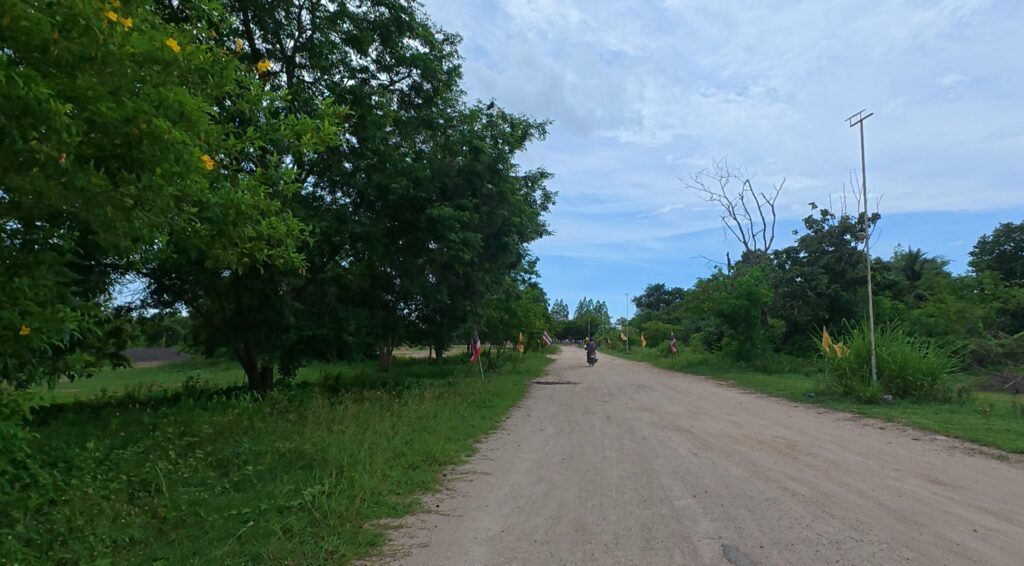
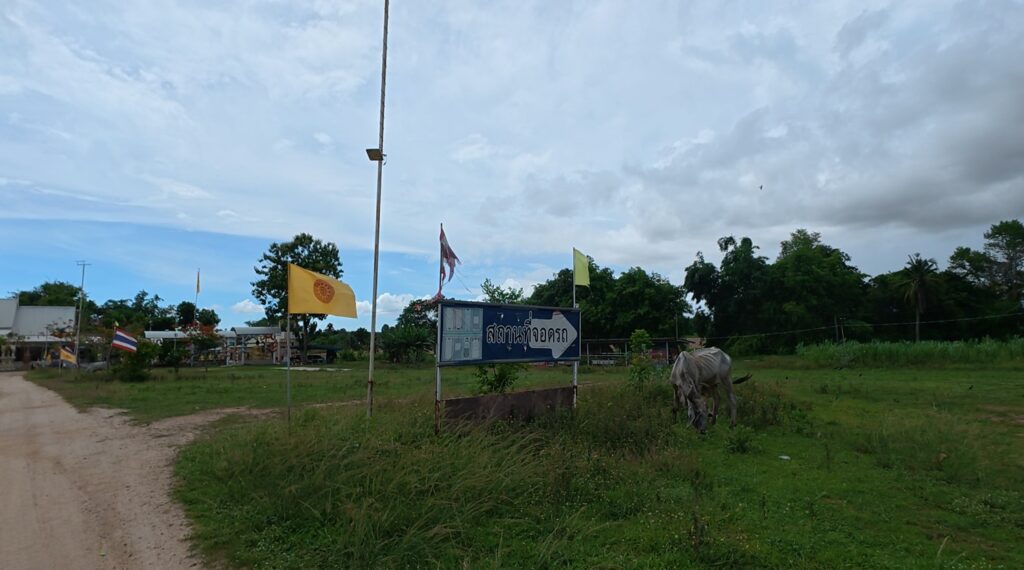
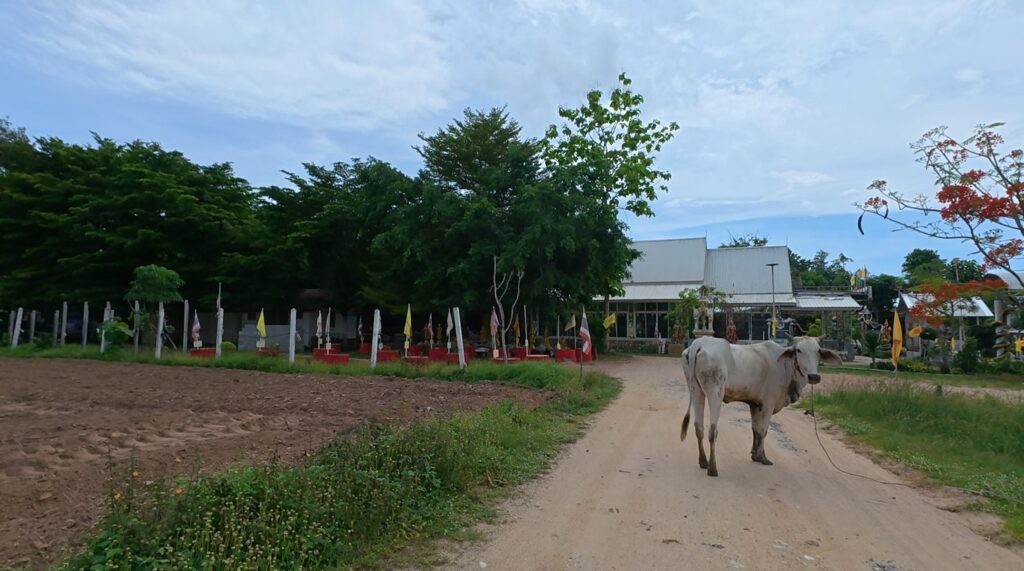
A peaceful country road leads into the sanctuary, where grazing cows quietly welcome an unexpected visitor.
A journey through Anan Burapharam, a hidden sanctuary filled with Buddha images, mythical guardians and symbols of Thai faith.
A Sanctuary Filled with Sacred Images
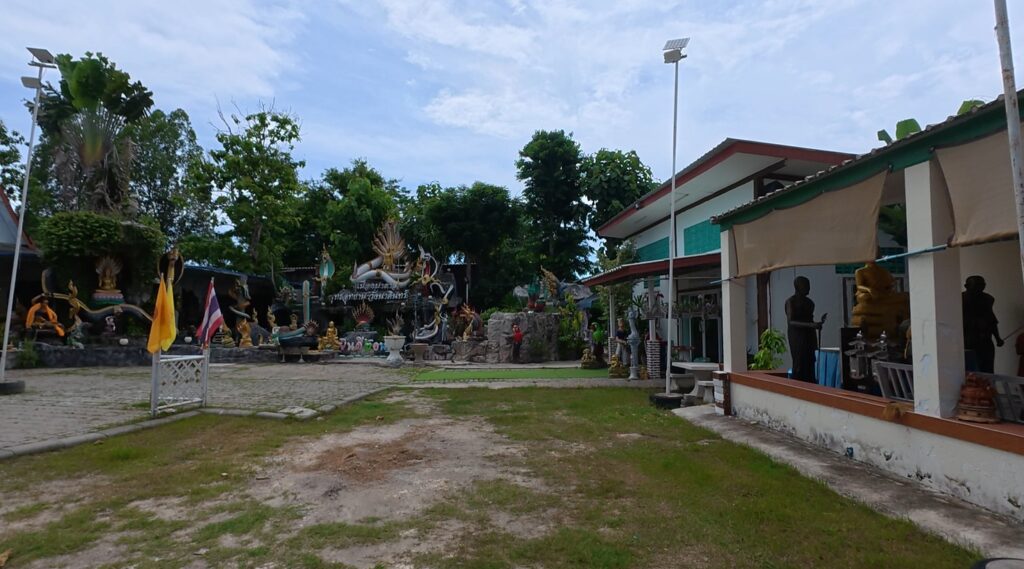
At the end of the entrance road, many Buddha images and religious sculptures appeared among the buildings and trees.
I parked my yellow Honda Cub beside the statues and began walking through the sanctuary.
This was not a temple arranged around one grand building. Instead, sacred figures were scattered throughout the grounds—under trees, beside ponds, inside small halls and along quiet garden paths.
The deeper I walked, the more it seemed that nearly every layer of Thai religious culture had found a place here.
Buddha images stood beside Hindu guardians. Naga serpents surrounded monks and sacred teachers. Ancient queens and kings appeared near elephants, while hermit sages, Guanyin and local guardian spirits occupied other corners of the sanctuary.
It felt less like a conventional temple and more like a living museum of Thai faith.
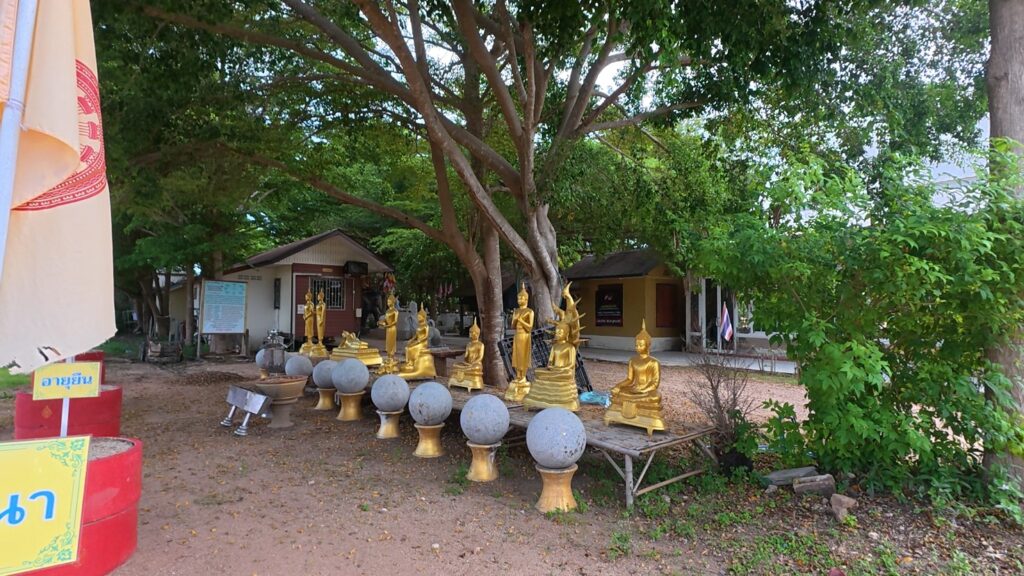
Hanuman, the Loyal Guardian
One of the first scenes I encountered was a standing Buddha protected by monkey-like figures.
These figures appear to represent Hanuman, the powerful monkey warrior from the Hindu epic Ramayana. In Thailand, Hanuman is also one of the best-known characters in the Ramakien, the Thai adaptation of the ancient Indian story.
Hanuman is admired for his courage, intelligence, strength and absolute loyalty to Prince Rama. In Thai religious art, he is not always presented merely as a mythological character. He may also appear as a guardian who protects sacred places and drives away harmful forces.
Standing before the Buddha, I placed my hands together in respect.
The scene revealed one of the most distinctive qualities of Thai religious culture. Hindu mythology and Buddhist devotion do not always exist as separate traditions. They often appear together, each adding another layer of meaning to the same sacred space.
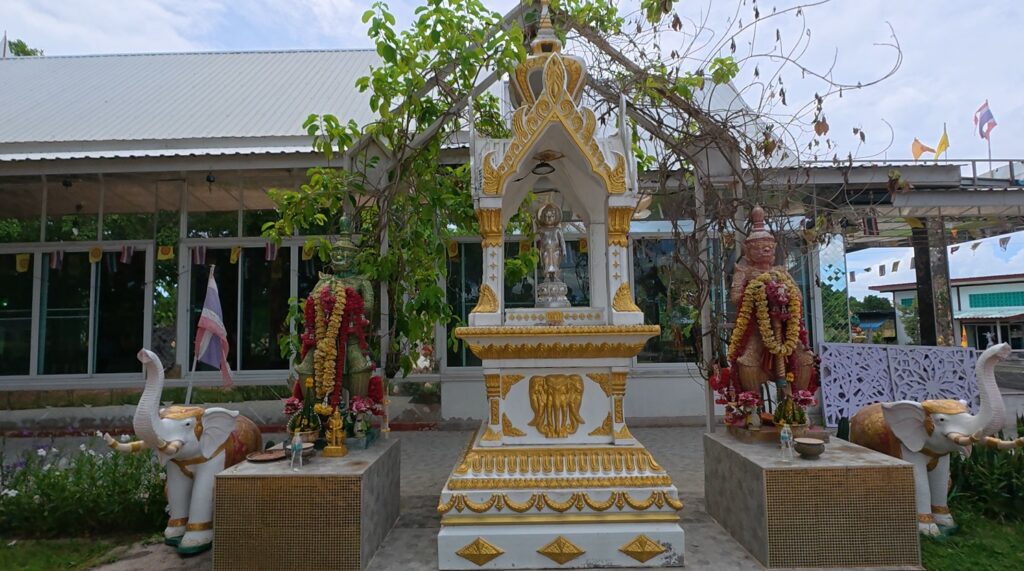
A Quiet Tribute to a Departed Royal Figure
Nearby, a memorial photograph of a deceased royal woman had been carefully placed among the sacred objects.
I stopped briefly and paid my respects.
Thai temples often maintain a close relationship with the monarchy. Portraits and memorial displays may honour members of the royal family who supported Buddhism, charitable work or national development.
Even in this small and little-known sanctuary, the memorial suggested that royal remembrance remained part of the spiritual landscape.
It was a quiet reminder that religion in Thailand is connected not only to monks and sacred images, but also to history, kingship and national memory.
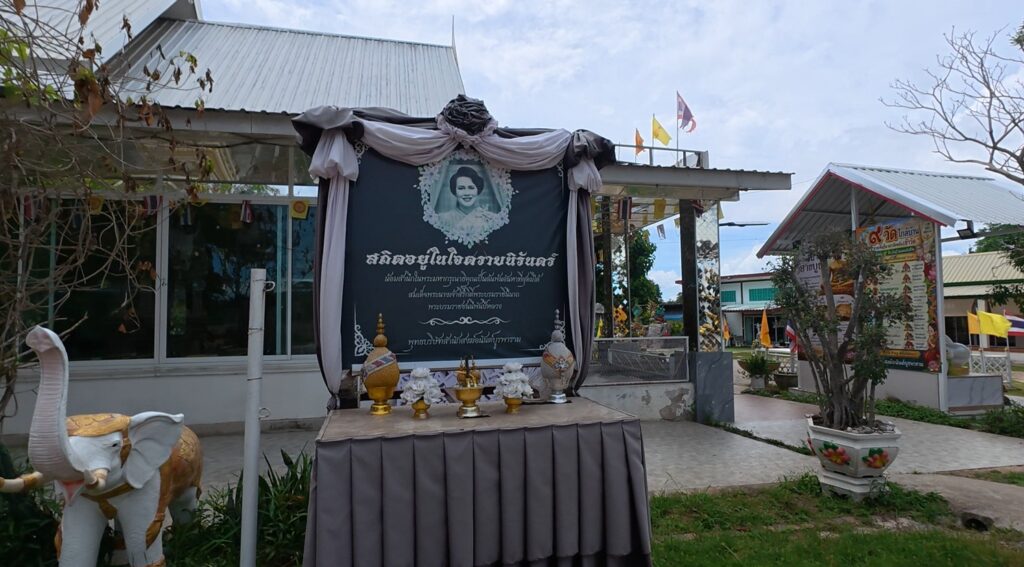
Naga, the Protector of Buddhist Teachings
Moving toward the right side of the sanctuary, I found seated statues of respected monks surrounded by serpent-like forms.
These sacred serpents are known as Naga, or Phaya Naga in Thailand.
Naga figures are among the most familiar symbols in Thai temples. They frequently appear beside stairways, ponds, caves and entrances to sacred buildings.
In Buddhist tradition, the Naga is closely associated with protection. One of the best-known stories tells how the Naga king Mucalinda sheltered the meditating Buddha from a violent storm by spreading his hood above him.
For this reason, the Naga represents more than a mythical snake. It can symbolise protection, water, fertility and the boundary between the ordinary world and sacred space.
Here, the serpents seemed to protect the seated teachers and the Buddhist teachings they represented.
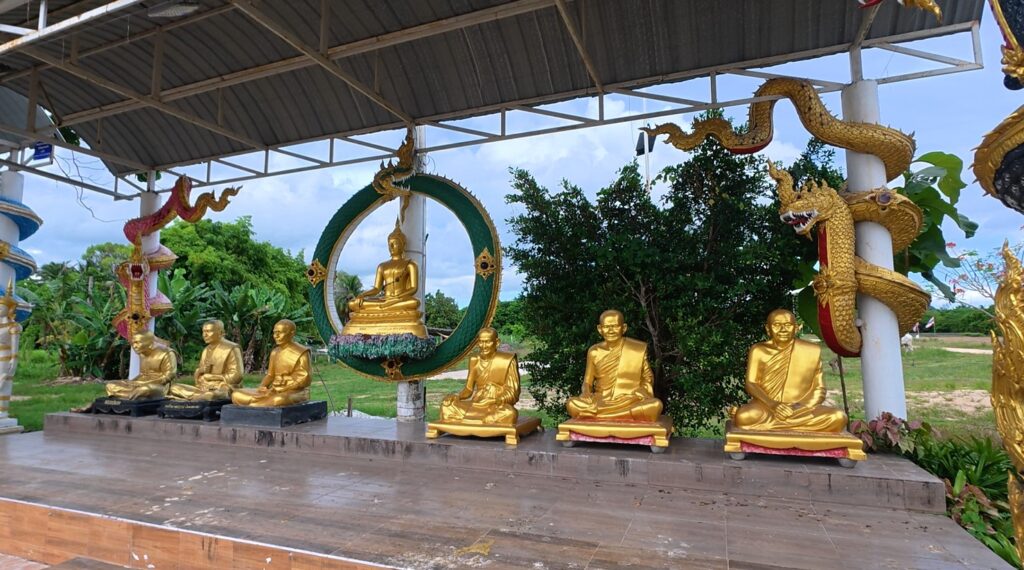
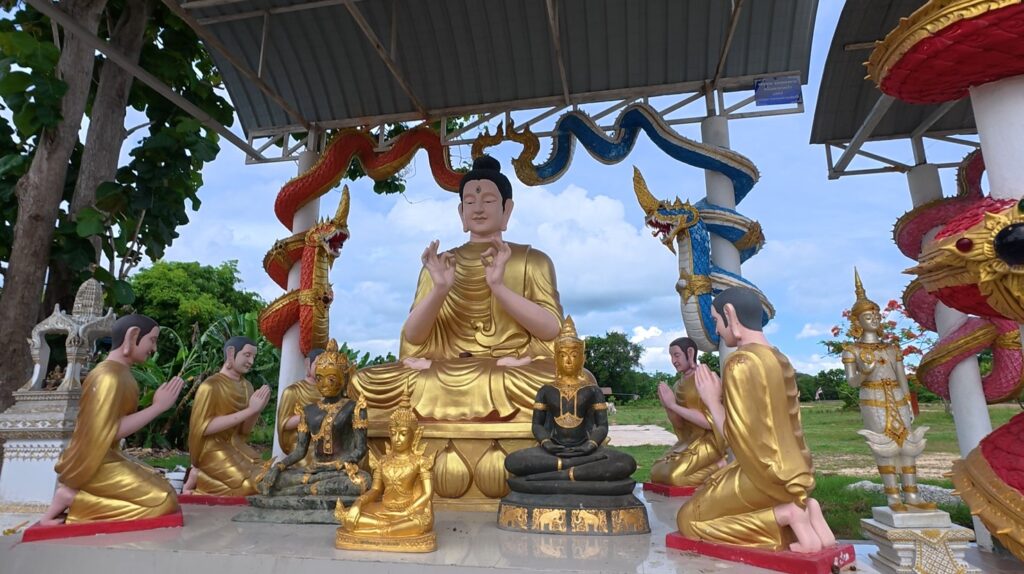
The Buddha Teaching His Disciples
Another group of sculptures showed the Buddha seated among his followers.
The arrangement appeared to depict a moment of teaching, with the disciples gathered respectfully around their teacher.
Such scenes represent the transmission of the Dharma—the teachings that explain suffering, its causes and the path toward liberation.
The image also reminded me that Buddhism was not preserved through statues alone. It survived because teachings were passed from the Buddha to his disciples, from teachers to monks and from one generation to the next.
The nearby seated figures of respected monks seemed to continue that same chain of knowledge.
Together, the sculptures formed a visual story of Buddhist learning: the Buddha teaches, the disciples listen and later teachers preserve and pass on the wisdom.
Popeye, Angels and Parrots
After viewing the solemn religious statues, I turned toward a small building on the left.
There I encountered something completely unexpected.
Figures resembling Popeye, angels and colourful parrots stood outside the building. Their playful appearance seemed almost out of place among the Buddhas, Nagas and revered monks.
Perhaps the building had once been used as a classroom or children’s activity area. The cheerful statues may have been intended to make younger visitors feel comfortable and welcome.
Whatever their original purpose, they revealed another side of the sanctuary.
This was not only a place of formal worship. It was also a community space where religion, education and ordinary life could meet.
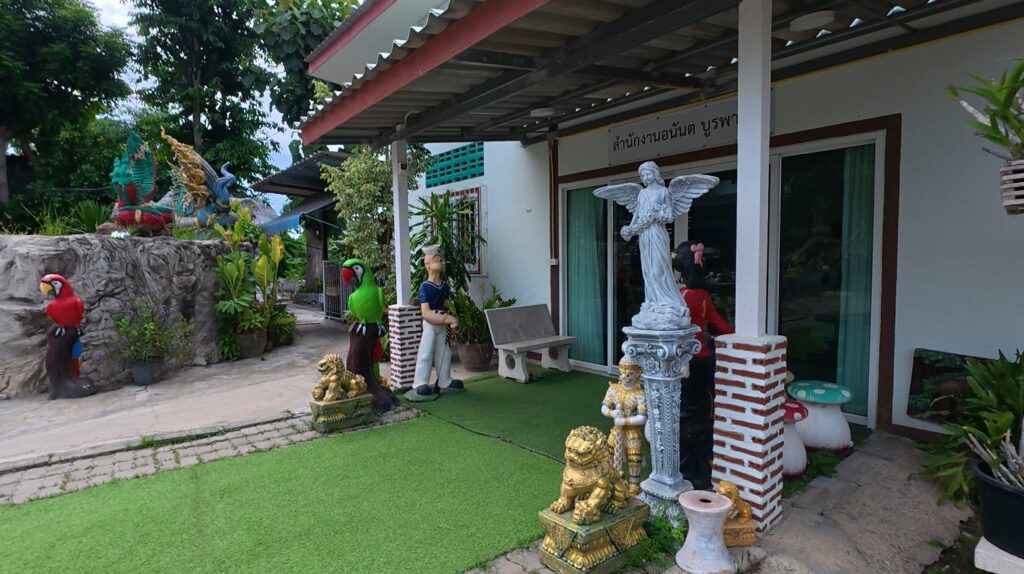
Playful figures beside a small building suggest a classroom or welcoming space created for children.
A Pond Filled with Sacred Symbols
Soon, a remarkable pond garden opened before me.
Its edges were crowded with colourful sculptures—golden serpents, birds, deities, small guardians and fantastic animals. Trees and plants grew among them, while the reflections in the water gave the entire scene a dreamlike quality.
At first, the collection appeared almost chaotic. But each figure carried its own symbolic meaning.
The Naga figures linked the pond with water, fertility and spiritual protection. Their twisting bodies seemed to mark the pond as a sacred boundary.
Brightly coloured bird statues, some resembling peacocks, represented beauty, dignity and the splendour of the natural world. In Buddhist and Hindu art, magnificent birds may also suggest spiritual elevation and the movement between earthly and heavenly realms.
Other animal figures appeared to guard the water or accompany the sacred beings. Some belonged to recognised religious traditions, while others may have reflected local imagination and folk belief.
The pond was not merely decorative.
It was a small symbolic universe in which nature, mythology and religion had been brought together.
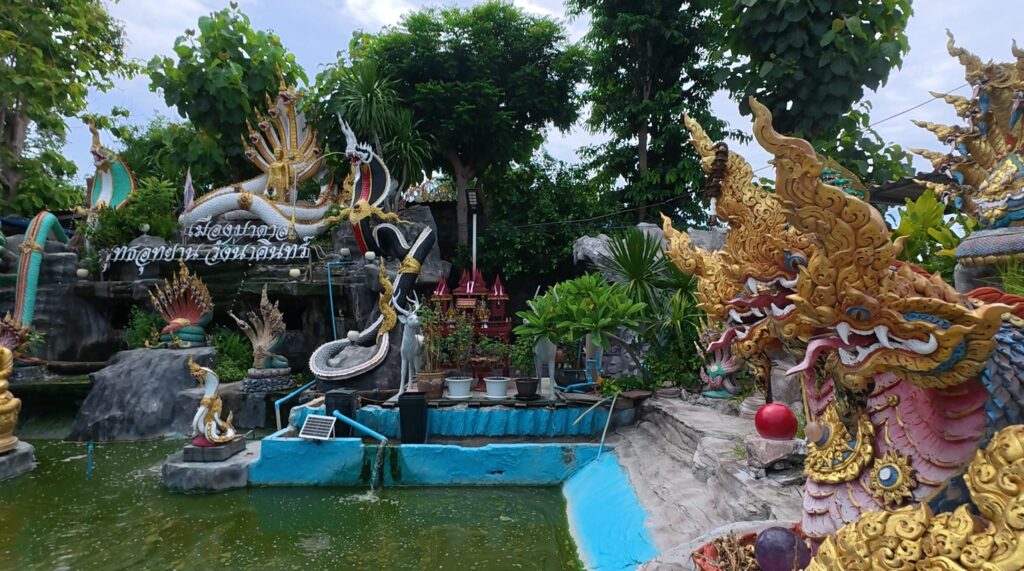
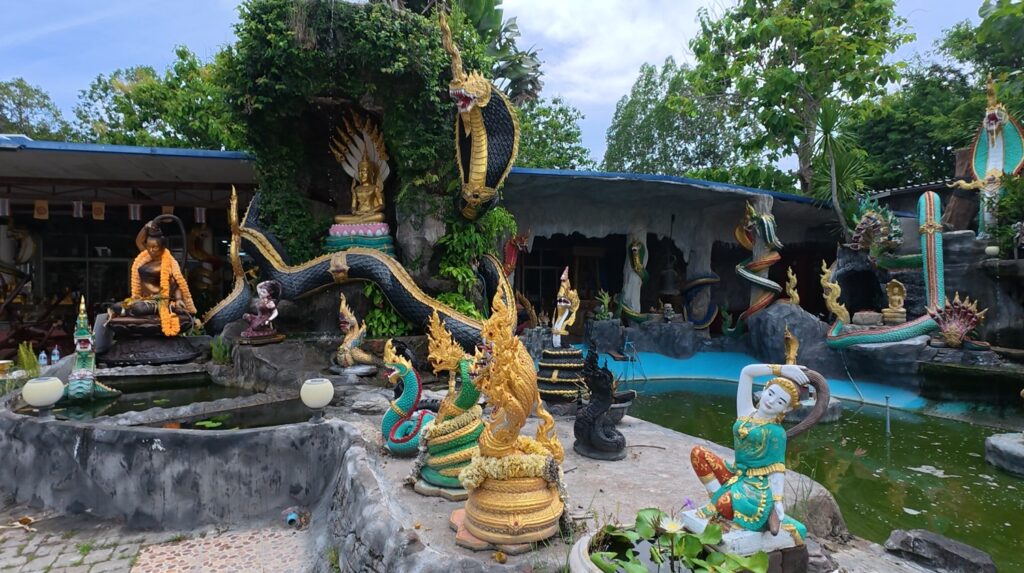
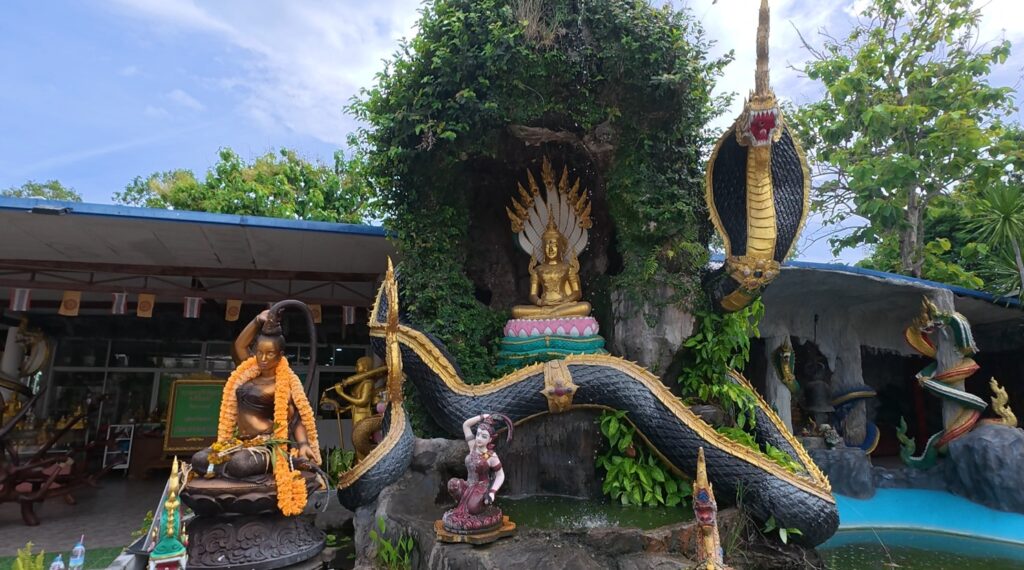
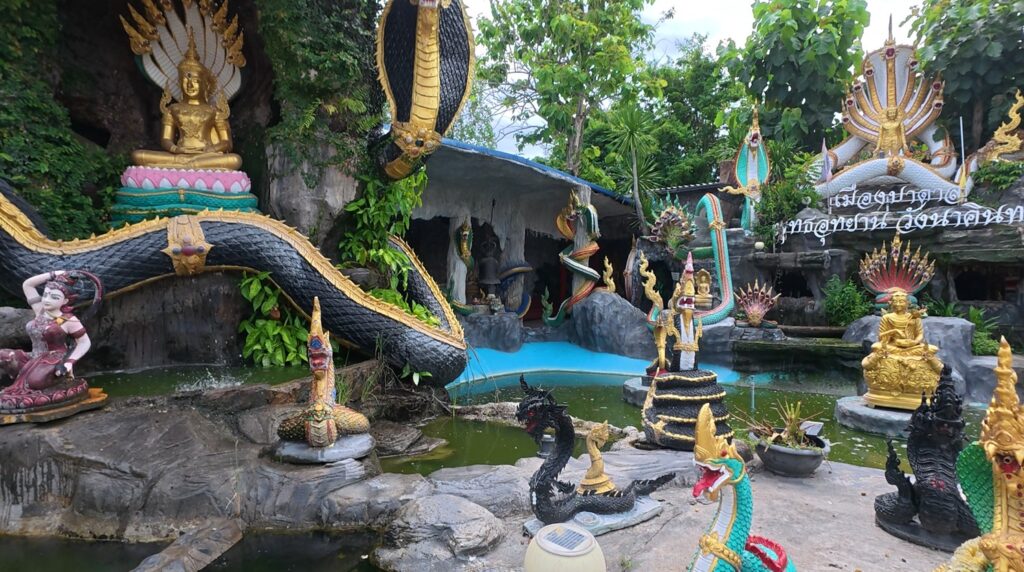
Naga serpents, mythical animals and colourful birds transform the pond into a symbolic garden of protection, nature and sacred imagination.
Where Buddhism and Hindu Mythology Meet
The variety of images around the pond demonstrated how Thai religious culture has developed through centuries of exchange.
Buddhism remains the central faith of most Thai temples, but its visual world has long included elements drawn from Hindu mythology, Brahmanical ritual and local spirit beliefs.
Hanuman may guard a Buddha image. Naga serpents may protect monks. Hindu gods may appear near Buddhist halls. Local spirits may stand beside national kings and historical rulers.
To an outsider, these combinations may seem contradictory.
In Thailand, however, they often coexist naturally.
Rather than replacing one another, the traditions have accumulated over time. Each generation has added another story, another image and another object of respect.
This sanctuary seemed to preserve that layered history in one compact space.
The Main Buddha Hall
After exploring the crowded garden, I entered the main shrine hall.
Inside, the Buddha sat calmly with a gentle and compassionate expression.
The atmosphere was very different from the colourful world outside. There were no dramatic guardians or mythical animals demanding attention. The seated Buddha alone created a feeling of stillness.
I paused before the image.
After seeing so many religious symbols, the quiet figure of the Buddha seemed to bring everything back to the central purpose of the sanctuary: awareness, compassion and inner peace.
The sculptures outside told many stories, but the Buddha’s silence carried its own teaching.
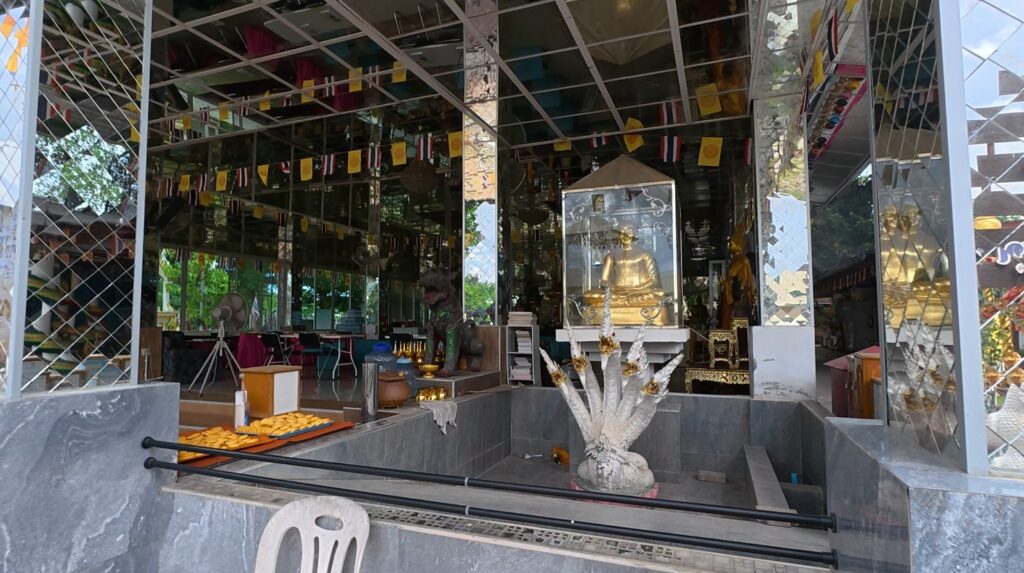
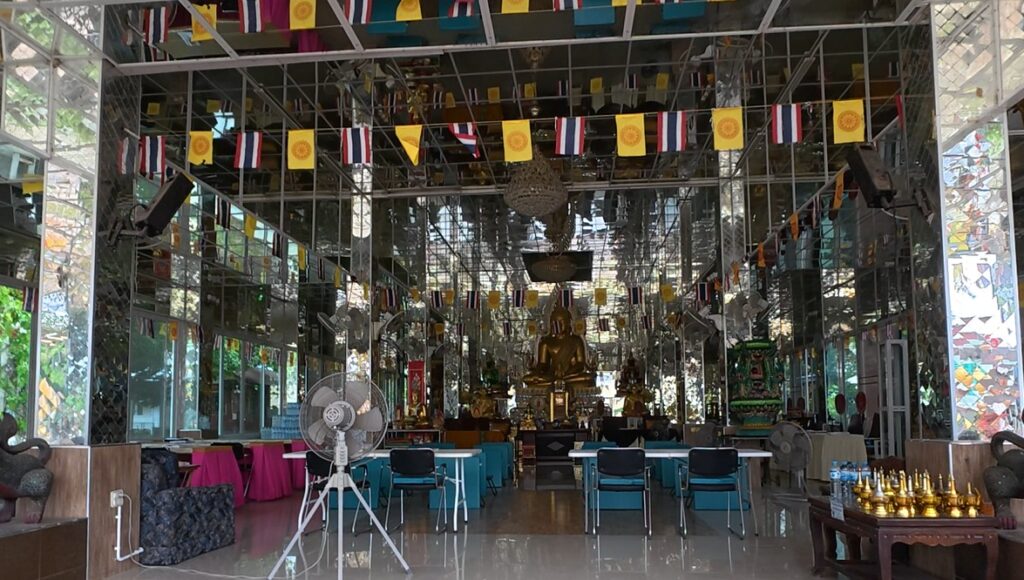
Beyond the colourful outdoor sculptures, the main Buddha hall offers a quieter space for reflection and prayer.
The People Who Keep the Sanctuary Alive
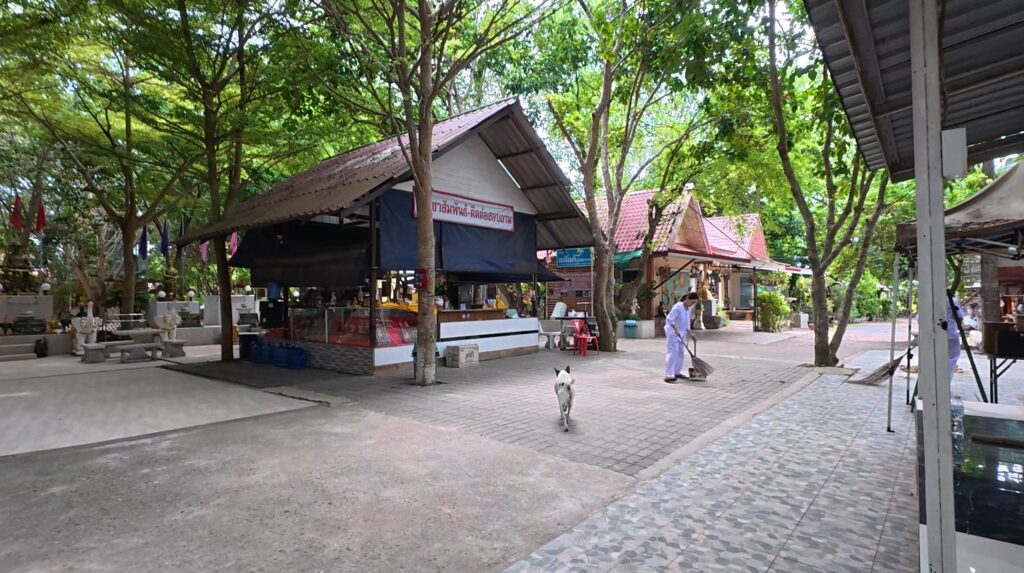
Behind the main area, I saw people cleaning and maintaining the grounds.
They swept the paths, collected leaves and quietly cared for the buildings.
It was an ordinary scene, but an important one.
Sacred places do not survive through statues and donations alone. They remain alive because people continue to clean them, repair them and treat them as part of daily life.
The workers did not appear to be performing for visitors. They were simply continuing their normal responsibilities.
Their presence made the sanctuary feel less like a forgotten collection of religious objects and more like a living community.
Queen Chamadevi and the Mon Buddhist Legacy
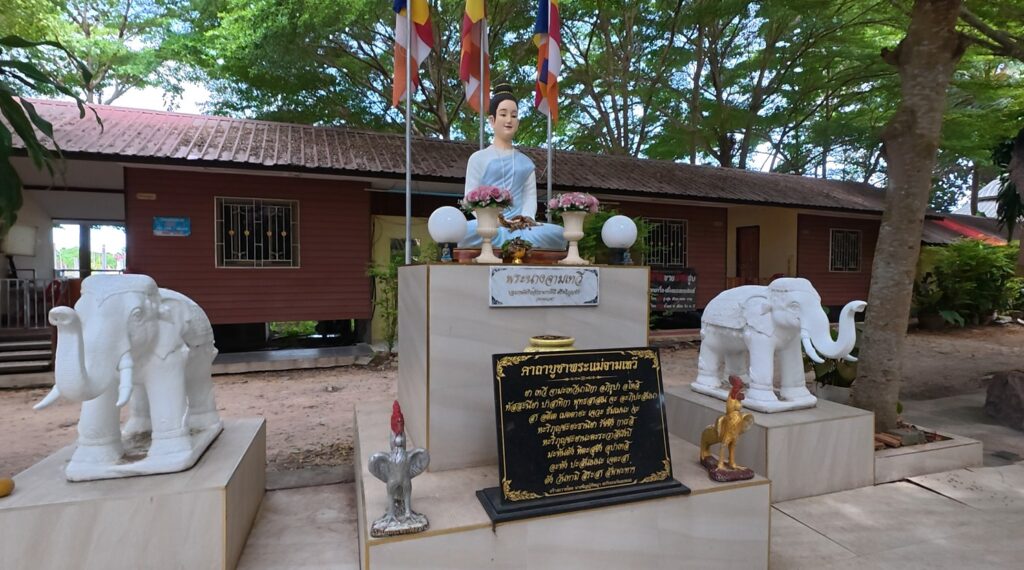
Near a white elephant statue stood a figure associated with Queen Chamadevi, also known in Thailand as Phra Nang Chamathewi.
According to traditional chronicles, Queen Chamadevi became the founding ruler of the ancient kingdom of Hariphunchai, centred around present-day Lamphun in northern Thailand.
Hariphunchai was strongly connected with Mon culture and became one of the important early Buddhist centres in the region.
Queen Chamadevi is remembered not only as a ruler but also as a patron of Buddhism. Tradition credits her with supporting temples, monastic communities and the spread of Buddhist culture.
Her story belongs partly to history and partly to later legend, yet her importance in Thai cultural memory remains strong.
The elephant beside her added another layer of meaning.
In Southeast Asian royal culture, elephants symbolise power, dignity and legitimate kingship. A white elephant in particular has long been associated with royal merit and good fortune.
Here, the image of the queen and the elephant connected Buddhism with political authority and the memory of an ancient Mon kingdom.
To learn more about Queen Chamadevi and the ancient Hariphunchai kingdom, visit the official Tourism Authority of Thailand guide to Lamphun.
Kings, Elephants and the Protection of Buddhism
Other royal figures appeared nearby, some accompanied by large elephant statues.
Thai temples frequently honour kings who supported Buddhism, defended the kingdom or helped restore religious institutions.
This does not necessarily mean that the kings are worshipped in the same way as the Buddha. Rather, they are remembered as protectors and patrons of the faith.
Throughout Thai history, kingship and Buddhism have been closely connected. A righteous ruler was expected to govern according to moral principles, support the monastic community and protect the religion.
The elephant statues reinforced this royal symbolism.
Elephants once carried kings and warriors into battle, transported heavy materials and represented the strength of the kingdom. Their presence beside historical rulers expresses courage, authority and national memory.
In this quiet sanctuary, the statues created a bridge between religious devotion and the history of the Thai state.
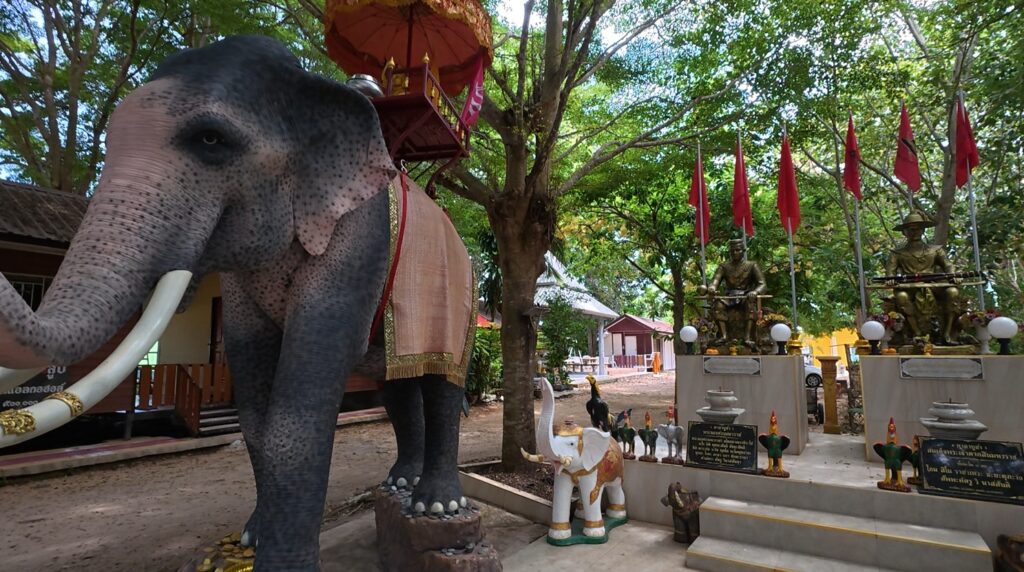
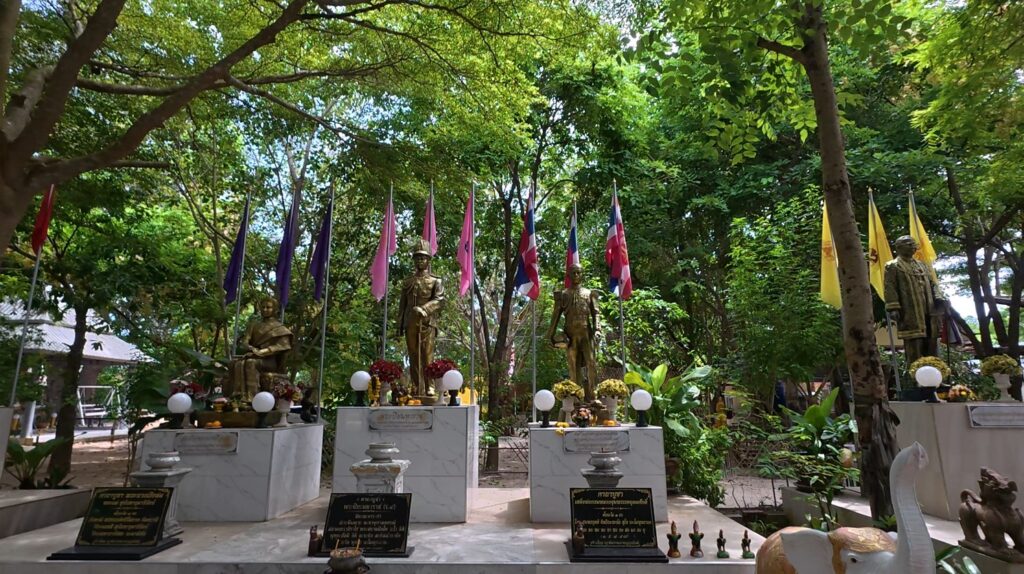
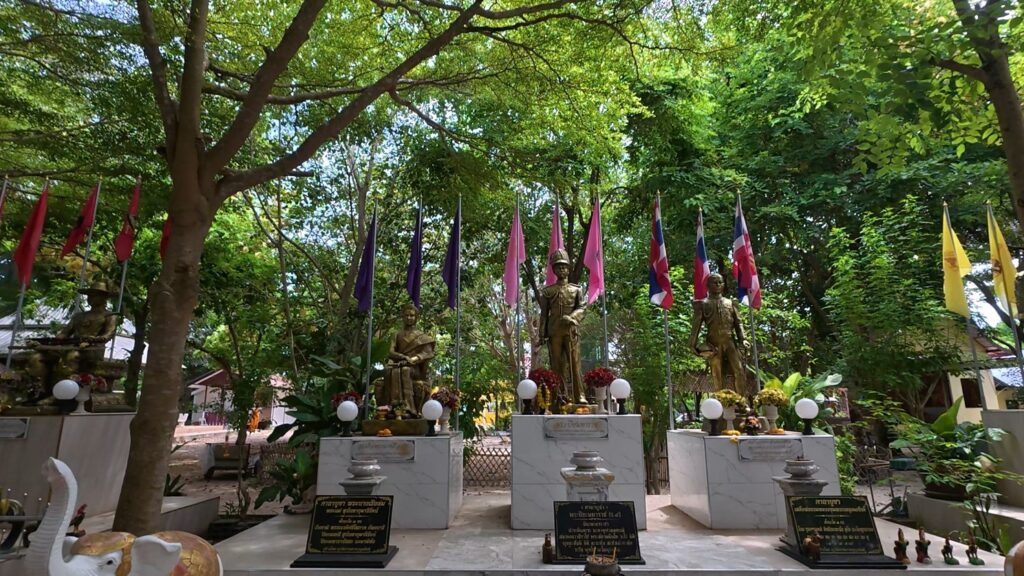
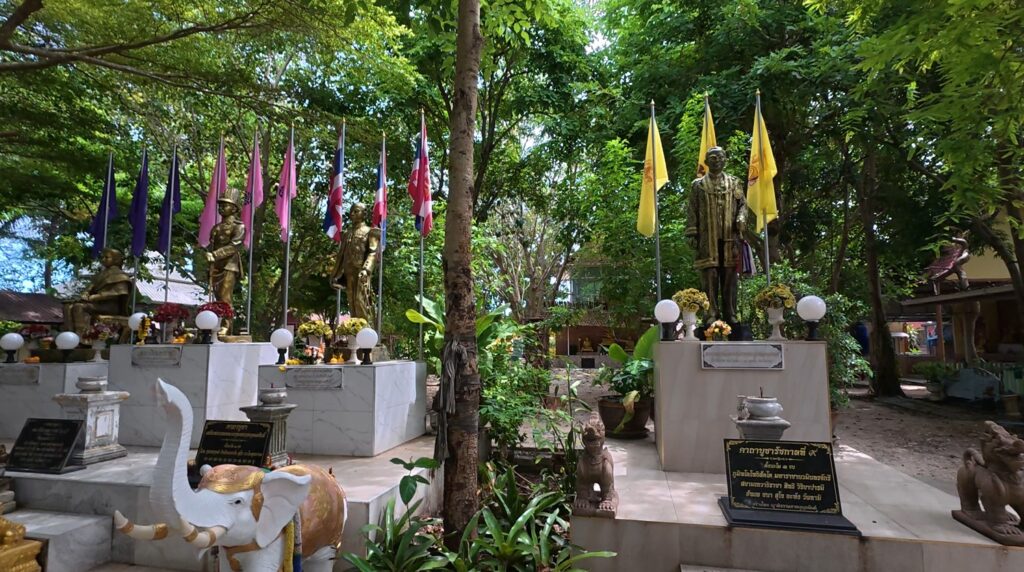
Elephants and royal figures recall the long relationship between Thai kingship, national history and the protection of Buddhism.
A Buddha in the Open Teaching Hall
Toward the rear of the sanctuary, I found a structure resembling an open lecture or teaching hall.
A Buddha image sat inside, watching over the empty space.
The hall may have been used for sermons, community gatherings or meditation instruction.
Unlike the main shrine, it felt informal and open to the surrounding trees. The design suggested that Buddhist teaching did not have to remain enclosed within a grand temple building.
It could take place beneath a simple roof, among ordinary people and within the sounds of daily life.
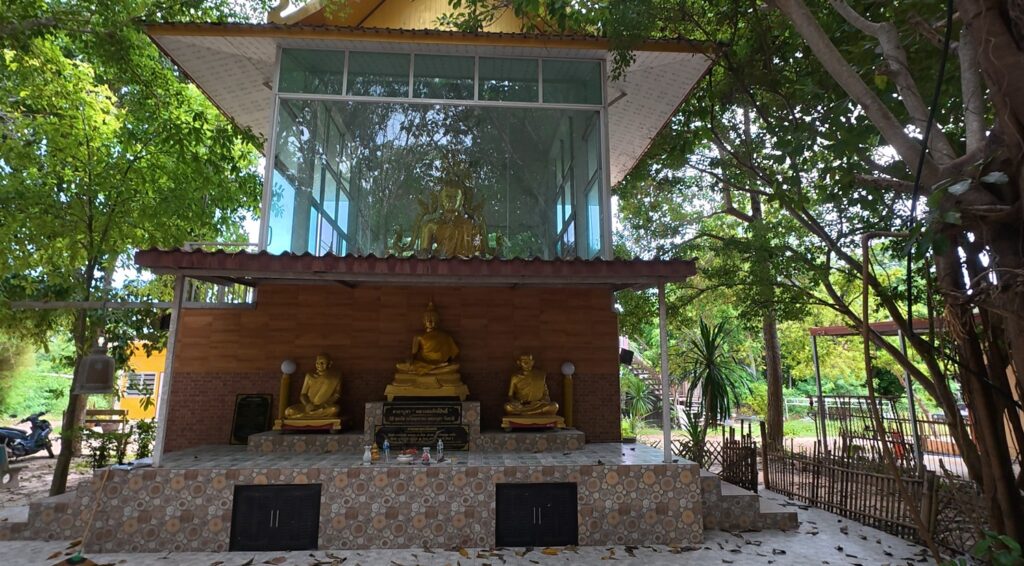
The Mysterious Hermit Sage
One of the most unusual statues in the sanctuary was a large seated figure with a long beard and the appearance of an ancient ascetic.
This figure was most likely a Ruesi, the Thai form of the Indian Rishi, or hermit sage.
A Ruesi is not the same as a Buddhist monk.
The tradition originated in ancient India, where sages withdrew from society to practise meditation, study spiritual knowledge and seek wisdom in forests or remote places.
In Thailand, Ruesi figures became associated with meditation, traditional medicine, astrology, sacred knowledge and the transmission of learning from teacher to student.
They are often shown with long hair or beards, seated in a meditative posture and dressed as forest ascetics.
Their presence in Thai sanctuaries reflects the influence of older Indian religious traditions that continued alongside Buddhism.
The Ruesi statue seemed to watch silently over the grounds, representing the ancient search for wisdom beyond ordinary life.
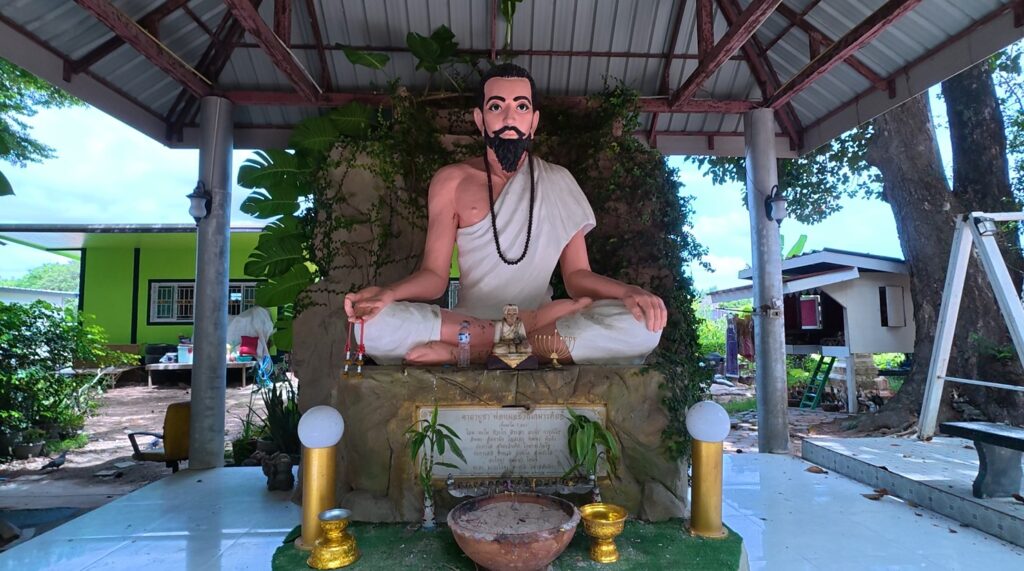
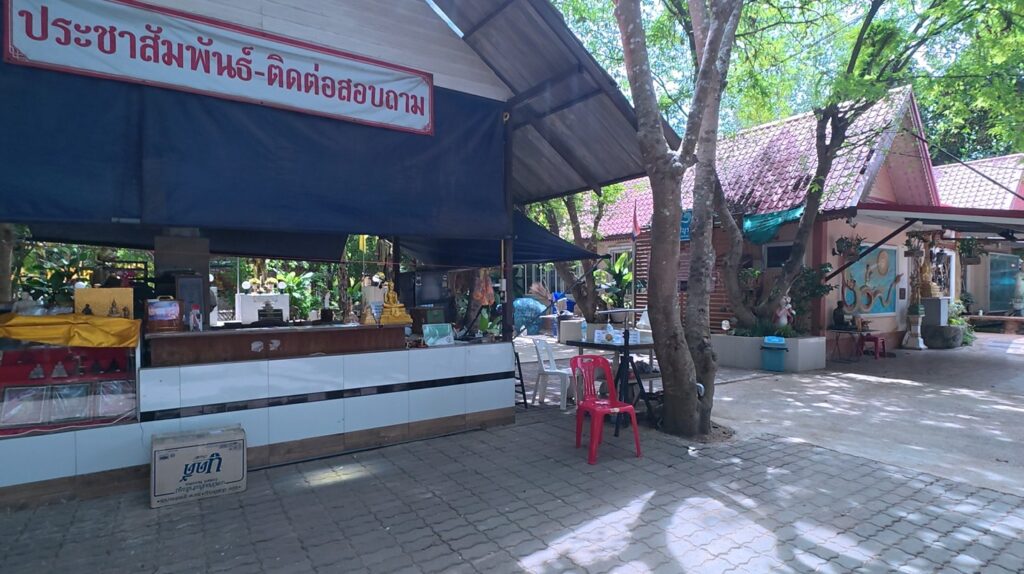
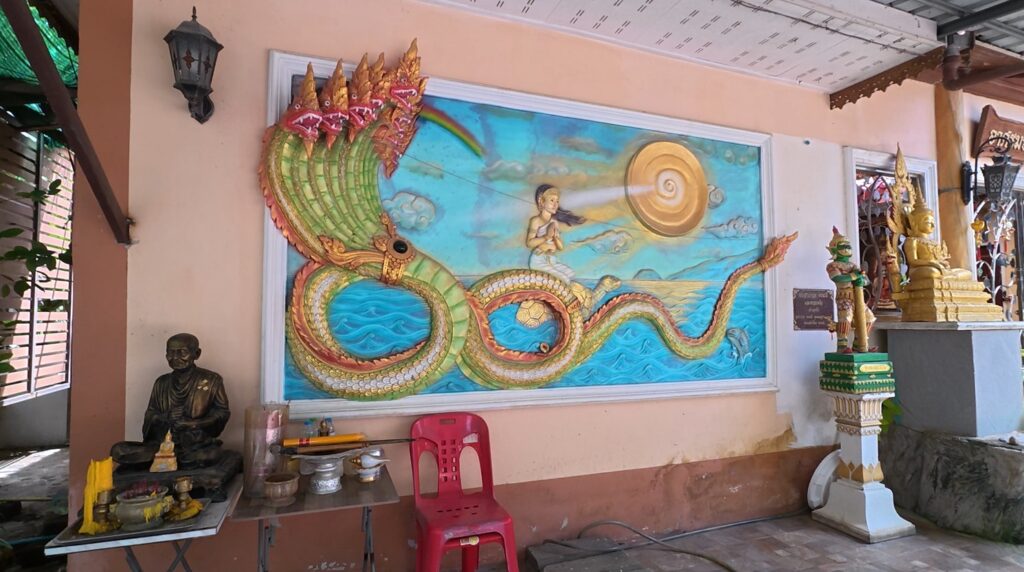
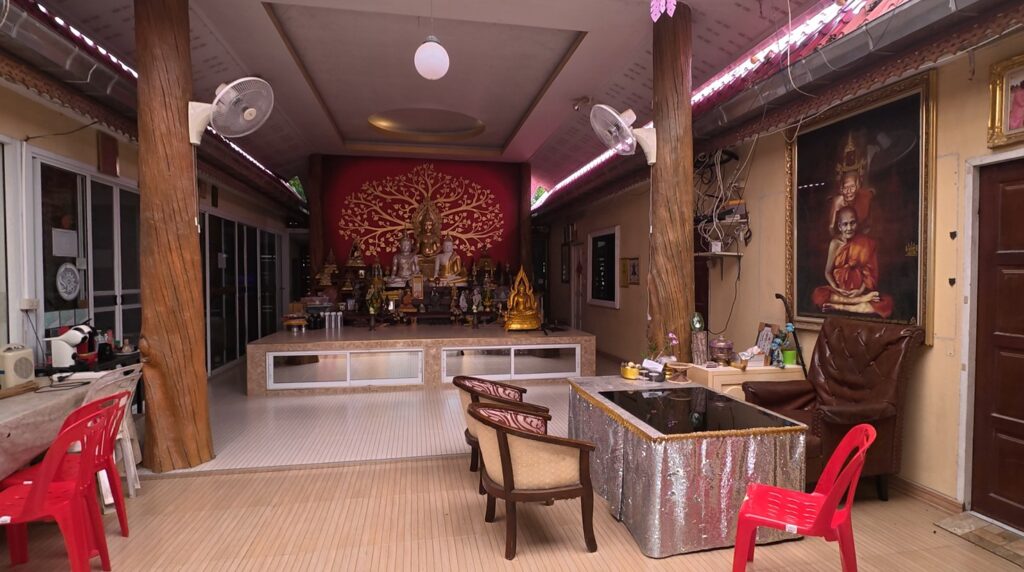
Images of sacred serpents, teaching spaces and devotional objects reflect the sanctuary’s mixture of Buddhist and older spiritual traditions
A Sacred Woman Beneath the Trees
Elsewhere in the garden, a female figure stood among the trees and smaller shrines.
Her exact identity was difficult to confirm from the available view.
She may represent a local female guardian, a revered spiritual woman or another figure connected with the sanctuary’s history.
Female sacred figures in Thailand can come from many different traditions. Some are Buddhist, some are Hindu and others belong to local stories known only within a particular community.
Rather than forcing a definite name upon her, it is more respectful to understand the statue as part of the sanctuary’s wider world of protection, fertility and spiritual care.
Her quiet position beneath the trees gave the impression of someone watching over the surrounding space.
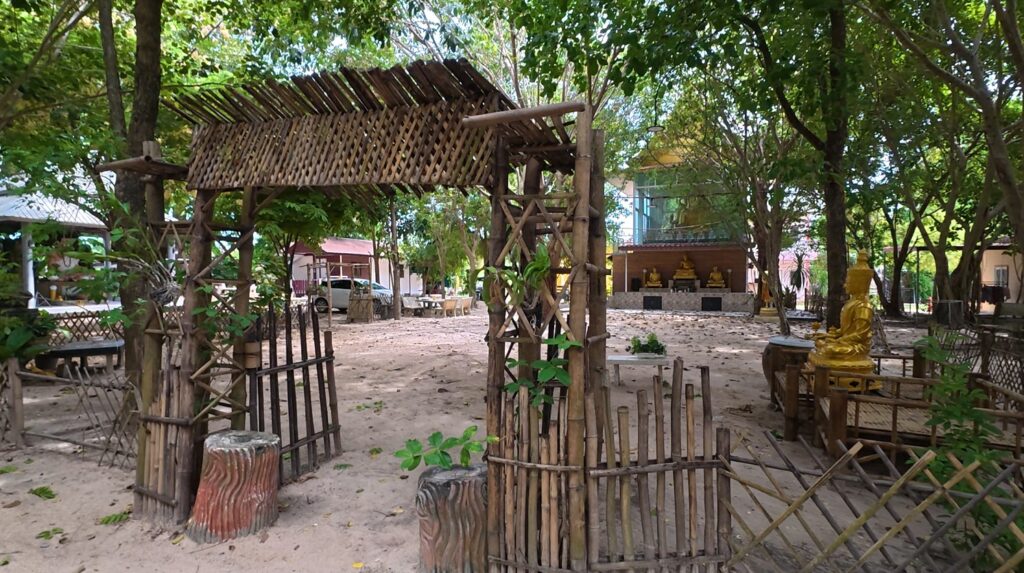
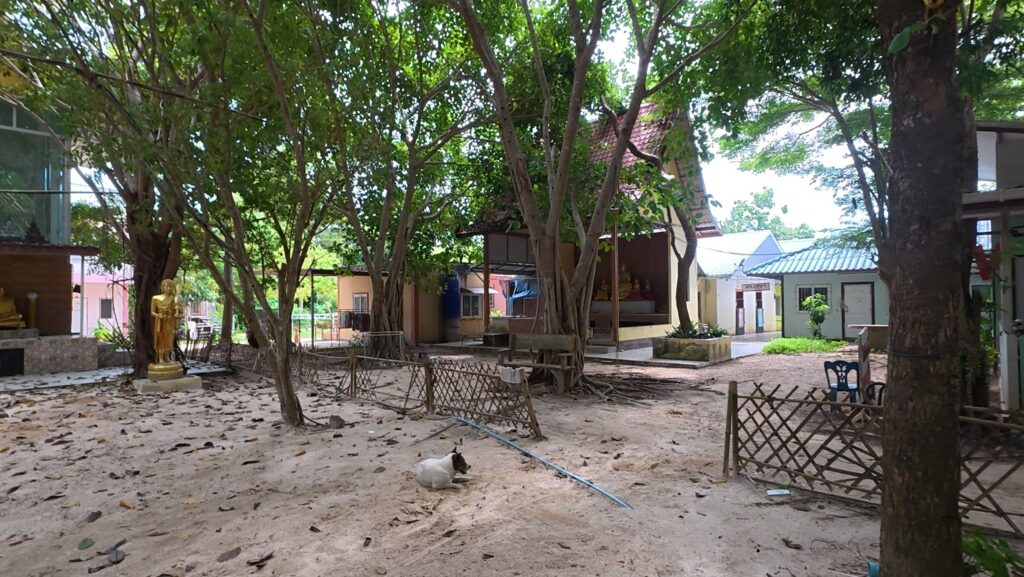
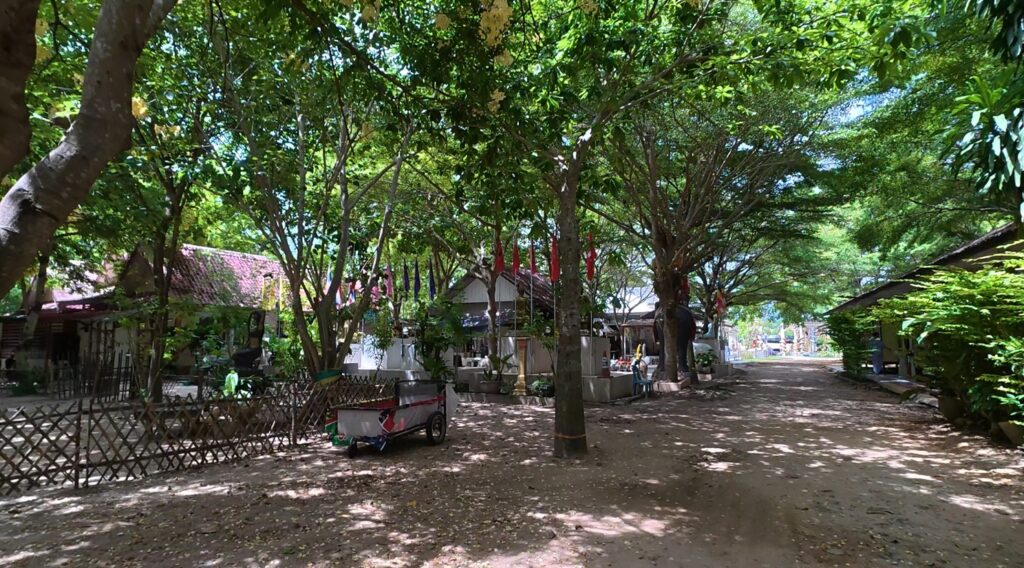
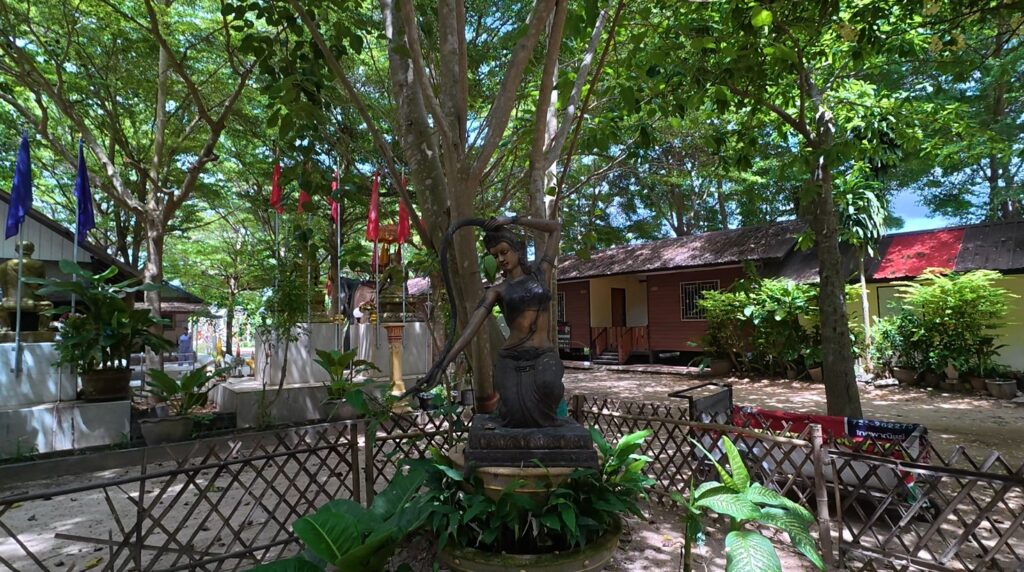
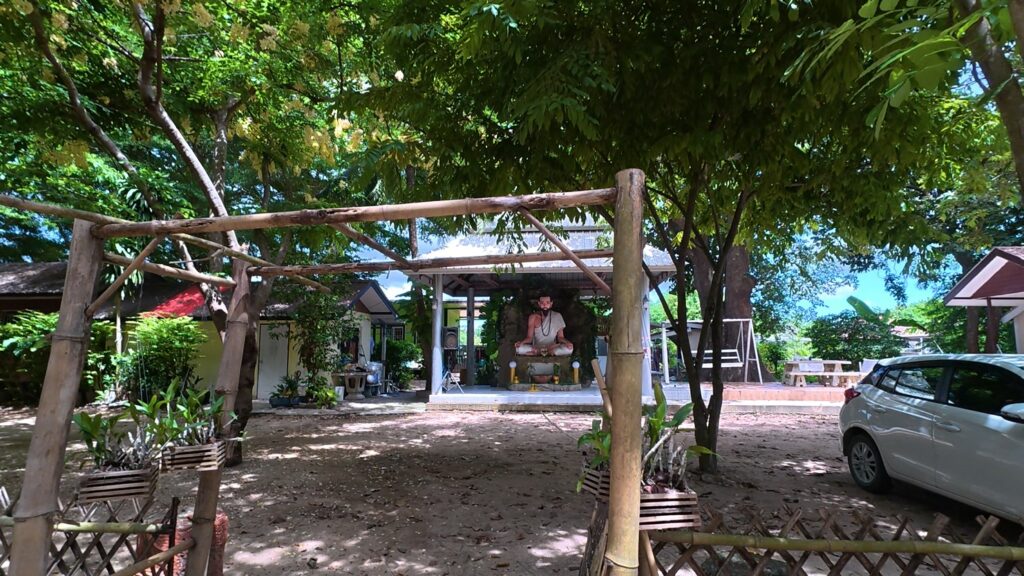
Shaded paths, small shrines and quiet corners reveal the sanctuary as a place of both spiritual practice and everyday life.
Guanyin, the Bodhisattva of Compassion
At another building, I encountered a graceful female figure dressed in flowing robes.
She appeared to represent Guanyin, known in Thailand as Chao Mae Kuan Im.
Guanyin developed from the Buddhist bodhisattva Avalokiteshvara, the embodiment of compassion. As the tradition moved through China and other parts of East Asia, the bodhisattva was increasingly represented in a gentle female form.
Guanyin is believed to hear the cries of those who suffer and to offer mercy without discrimination.
In Thailand, devotion to Guanyin is especially visible in Chinese-Thai communities, but her image can also be found in temples and sanctuaries where several traditions meet.
Her flowing robes, calm expression and connection with water symbolise mercy, healing and purity.
The presence of Guanyin added yet another layer to the sanctuary—Chinese Mahayana Buddhist influence within a predominantly Theravada Buddhist country.
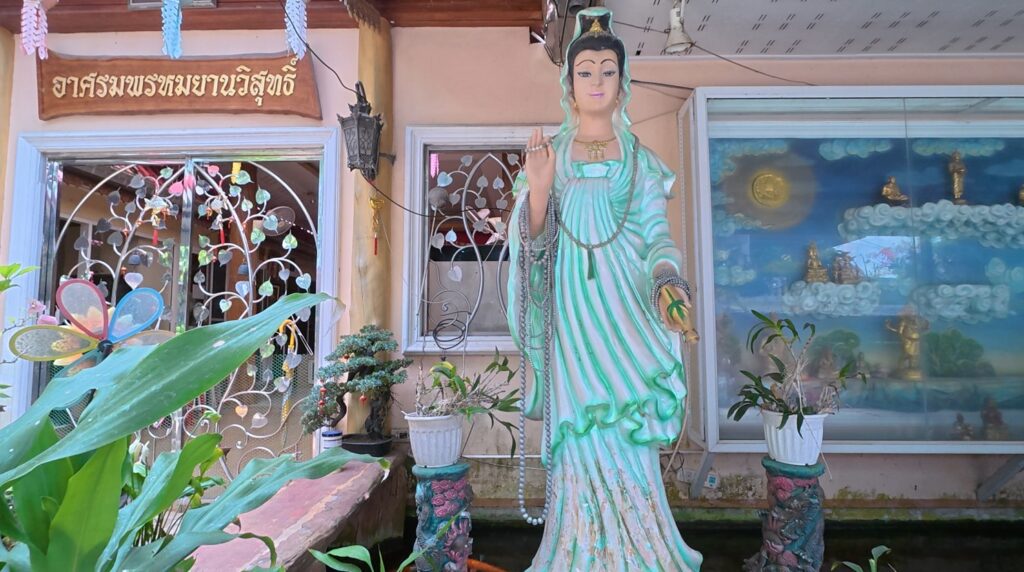
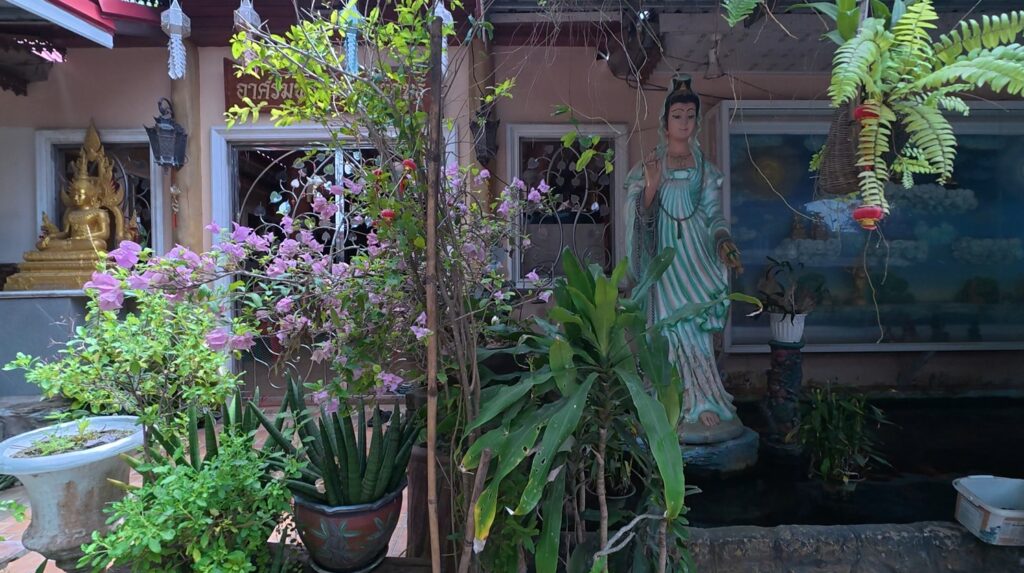
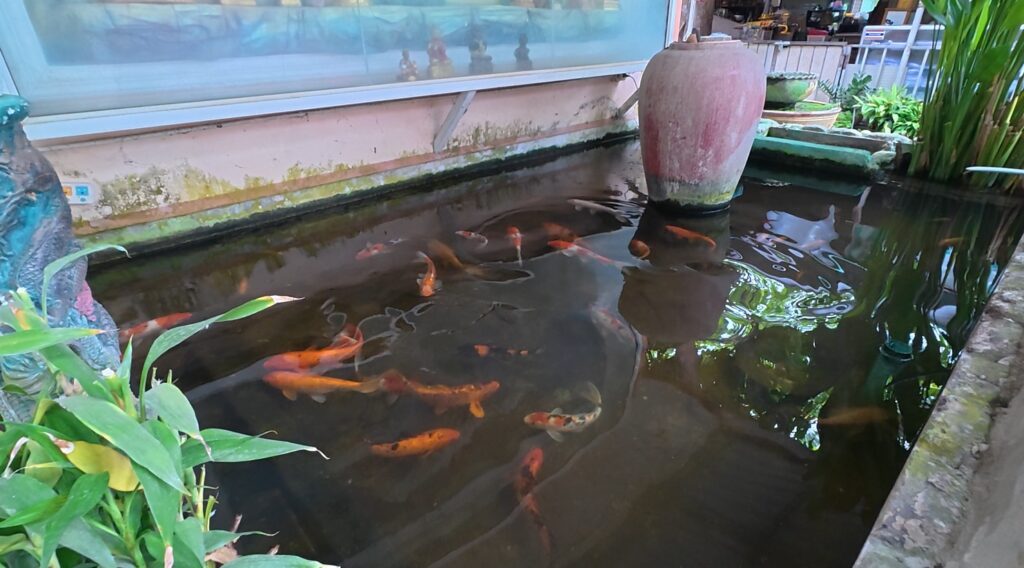
Flowers, water and koi create a peaceful setting around the image of Guanyin, the Bodhisattva of Compassion.
A Guardian at the Village Boundary
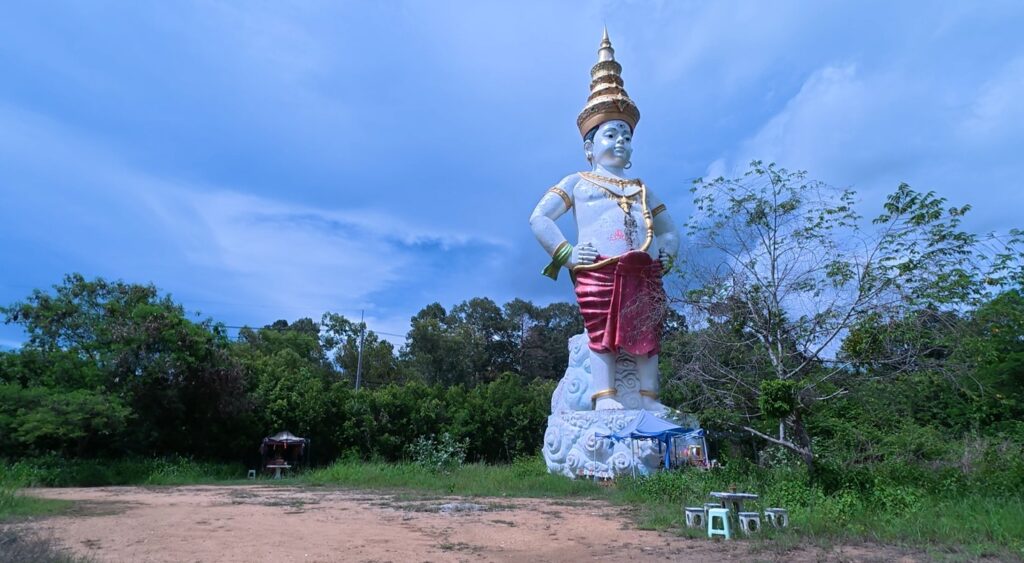
After leaving the sanctuary and continuing to another area, I discovered a towering figure beside the road.
It did not resemble a conventional Buddha image or a well-known Hindu deity.
The statue appeared to be a local guardian spirit, placed near the boundary of the village or surrounding land.
Across Thailand, communities often honour guardian spirits believed to protect the soil, homes and people living within a particular area.
These beings may be associated with a spirit house, a shrine, an ancient ancestor or a local legend. Their names and stories are sometimes known only to villagers.
Such guardians belong to a spiritual tradition older than Buddhism itself.
When Buddhism became established in the region, local spirit beliefs did not disappear. Instead, they often continued beside Buddhist practice.
People may visit a temple, make merit, respect monks and also leave offerings for the guardian spirit of their home or village.
The tall roadside statue represented this enduring connection between religion and the land.
A Living Collection of Thai Faith
By the time I finished exploring, I realised that this small sanctuary contained an extraordinary variety of religious traditions.
There was the Buddha and his disciples.
There were respected monks and teachers.
There was Hanuman from the Hindu epic tradition, Naga from Buddhist and pre-Buddhist mythology, a Ruesi from the world of ancient sages and Guanyin from Chinese Mahayana Buddhism.
There were kings, queens, elephants and royal memories.
There were also local guardians, playful children’s figures and people quietly cleaning the grounds.
None of these elements appeared entirely separate.
Together, they revealed how Thai religion is experienced in everyday life—not as one perfectly organised system, but as a collection of beliefs, memories and symbols that have grown together over many centuries.
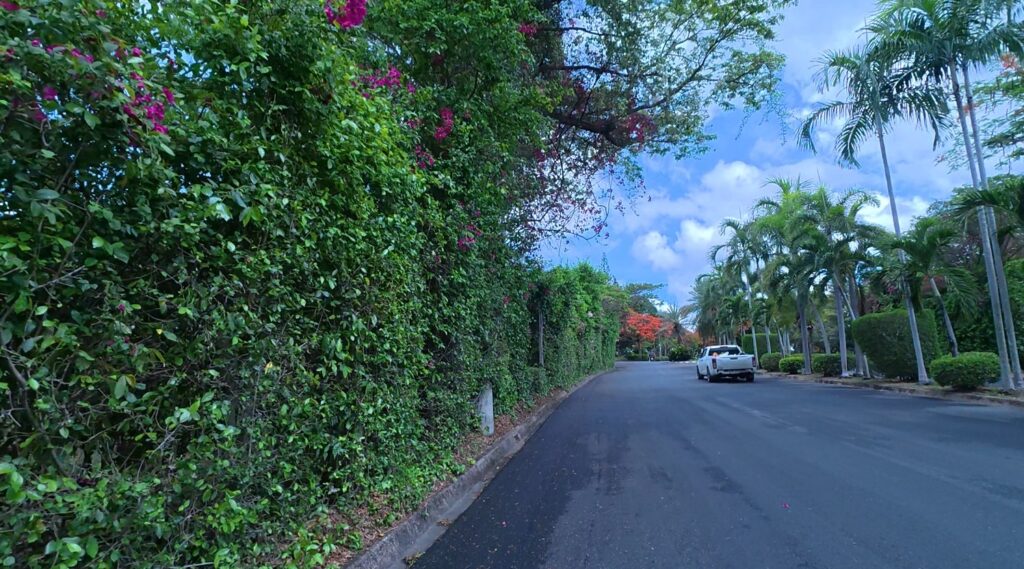
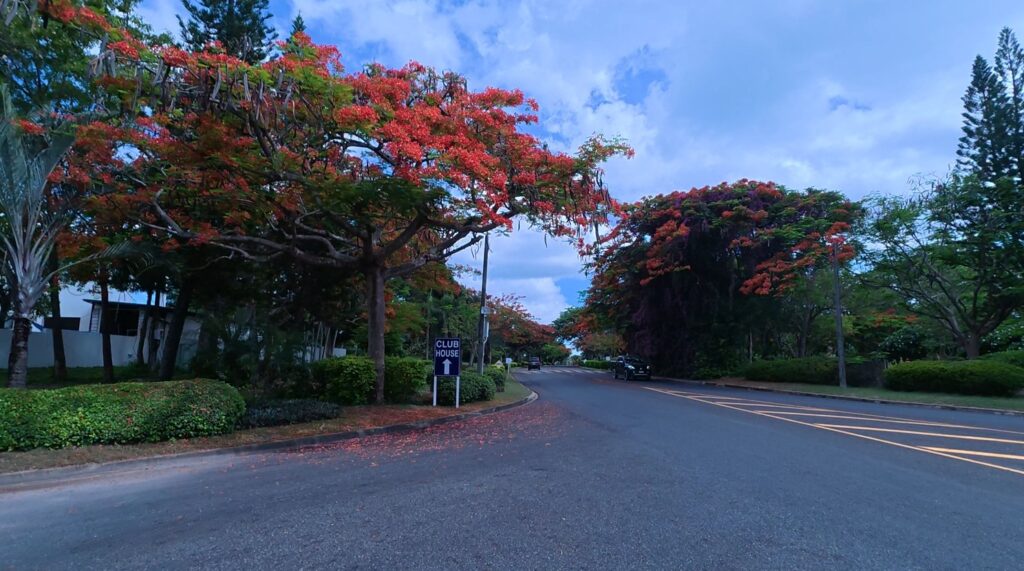
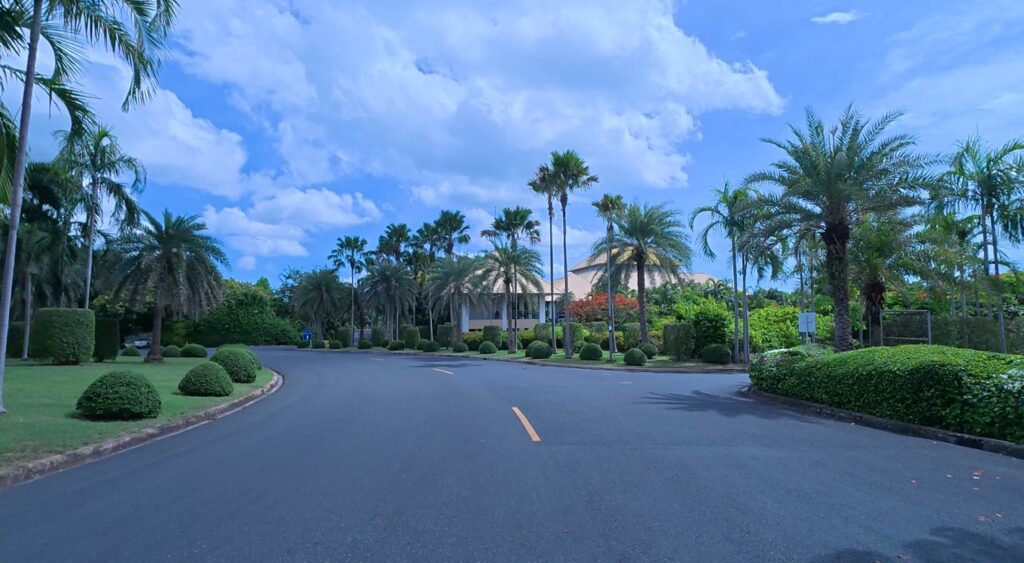
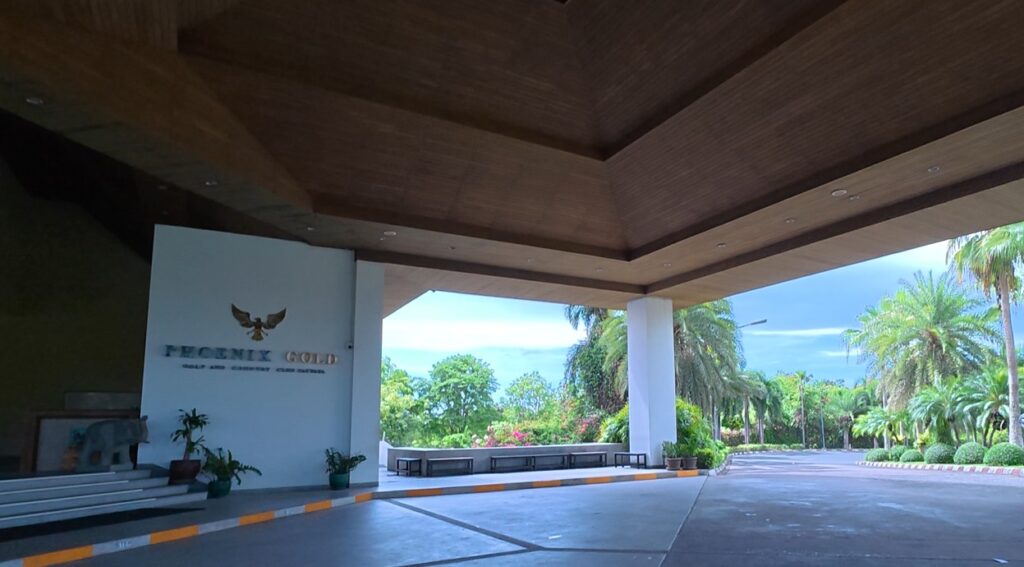
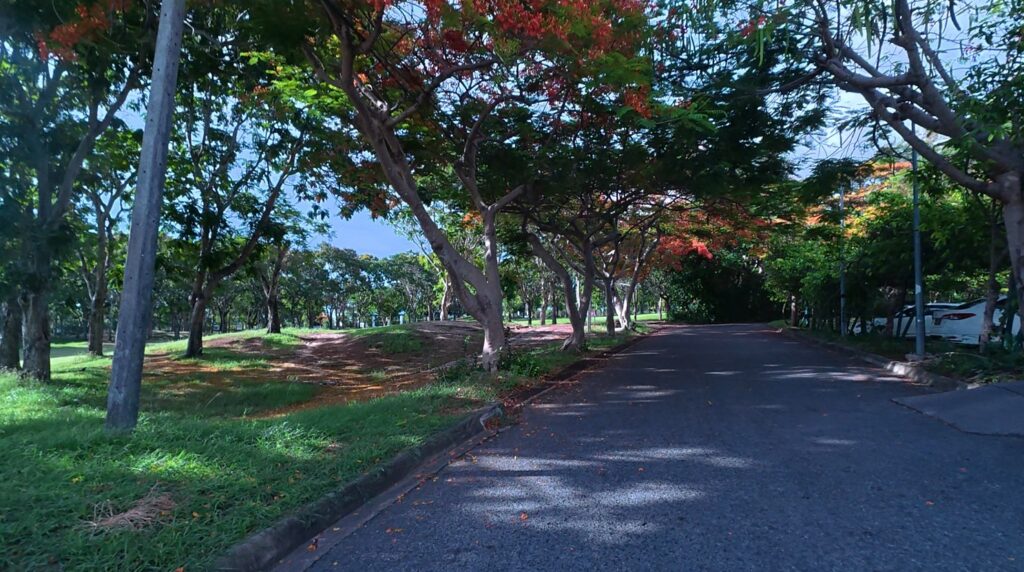
The journey ends along the peaceful, garden-like roads surrounding Phoenix Gold Golf and Country Club.
Leaving Through the Garden Roads
I eventually returned to the Honda Cub and left the sanctuary behind.
The road carried me toward the landscaped surroundings of Phoenix Gold Golf and Country Club. Wide, peaceful lanes passed through trimmed gardens, trees and open green spaces.
After the crowded statues and mysterious sacred figures, the final ride felt calm and refreshing.
The sanctuary had been discovered by chance, yet it became one of those places that stayed in my memory.
It was not famous, polished or designed for tourists.
But within its quiet grounds, I had found something remarkable: a small world containing many of the beliefs that shaped Thailand.
As the Honda Cub moved gently along the garden-like road, the images remained with me—the Buddha beneath the trees, the protective Naga, the loyal Hanuman, the ancient queen, the silent hermit and the guardian watching over the village.
Sometimes the most meaningful places are not found in guidebooks.
They simply appear beside a quiet road, waiting for a traveller to slow down and enter.